
Quick summary: There is no EUDR certification. Learn what EUDR really requires, whether FSC or PEFC are enough, who validates compliance, what happens if a DDS is rejected, and how long EUDR data must be retained.

If you’re searching for EUDR certification, you’re not alone, and that’s exactly the problem. Many companies assume EUDR works like FSC or Rainforest Alliance, with a certificate you can obtain and move on. It doesn’t. There is no formal EUDR certification, and treating it like one is one of the fastest ways to fall out of compliance.
EUDR is a regulatory obligation, not a label. Compliance is proven through data, geolocation, risk assessment, and a Due Diligence Statement (DDS), not through a certificate issued by a third party. Companies that focus only on “getting certified” often miss the real requirements: plot-level geolocation, deforestation-free verification, traceability, and ongoing risk mitigation.
The pain point is clear: searching for EUDR certification can distract teams from building the systems regulators will actually audit. This guide cuts through that confusion. It explains what EUDR really requires, how compliance is assessed, and what data, processes, and proof you need to stay legally on the EU market.
Key Takeaways
EUDR certification is a commonly used term, but it does not exist as an official certificate or label issued by the European Union. When companies refer to “EUDR certification,” they usually mean being compliant with the EU Deforestation Regulation (EUDR) and able to legally place products on the EU market.
Unlike voluntary sustainability schemes, EUDR is a binding regulation, not a certification program. The EU does not approve, certify, or endorse companies or products in advance. Instead, responsibility sits with the operator placing goods on the EU market, and compliance is assessed through regulatory controls, audits, and enforcement actions.
EUDR compliance is demonstrated through:
These elements together function as proof of compliance, even though no formal certificate is issued.
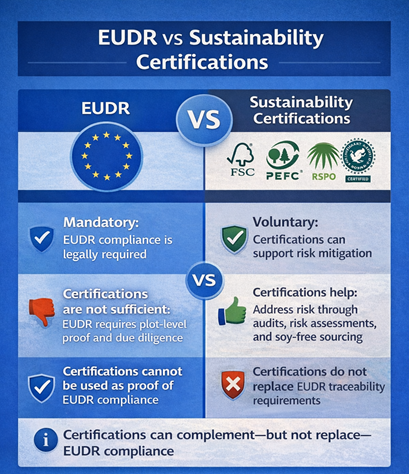
Certification schemes like FSC, PEFC, RSPO, or Rainforest Alliance are voluntary and audit-based. They can support risk mitigation, but they do not replace EUDR requirements. EUDR requires product-specific, plot-level evidence and legal accountability, not a one-time certificate or logo.
Read our complete guide to EUDR compliance and learn how to meet geolocation, due diligence, and DDS requirements without disrupting trade.
Explore our in-depth blog on the role of certifications in EUDR what they help with, where they fall short, and how to use them correctly.
Any company that places EUDR-regulated products on the EU market must be EUDR-compliant even though no formal “EUDR certification” exists. Responsibility is determined by role in the supply chain, not company size or sector.
Retain DDS references
Preserve traceability
Keep records for audits
If data is missing, unverifiable, or traceability is broken, downstream operators can become de facto first operators, inheriting full liability.
In practice, any company touching EUDR-regulated products cannot ignore compliance, even if responsibility appears upstream.
The EU Deforestation Regulation (EUDR) applies to a defined list of forest-risk commodities and a wide range of products derived from them. Coverage extends well beyond raw materials and directly affects how responsibility shifts along the supply chain.
EUDR covers coffee, cocoa, palm oil, soy, rubber, and cattle (including beef and leather). Any product placed on the EU market that contains or is made using these commodities must be proven deforestation-free and legally produced.
All timber and wood products previously regulated under the EU Timber Regulation (EUTR) are now covered under EUDR. This includes logs, sawn wood, panels, pulp, paper, furniture, and other wood-derived goods.
EUDR applies not only to raw commodities (e.g. green coffee beans, cocoa beans, logs) but also to processed and finished products such as chocolate, coffee, rubber goods, paper, and furniture. Processing does not remove EUDR obligations.
Responsibility depends on who places the product on the EU market, not on how processed it is. If a company imports a regulated product, raw or processed, it becomes the first operator and must submit a Due Diligence Statement (DDS). Companies transforming products within the EU may also become first operators if they place the transformed product on the market under their name.
In short, if a product contains an EUDR-listed commodity at any stage, it remains in scope, and traceability to the original production plot is mandatory regardless of processing level.
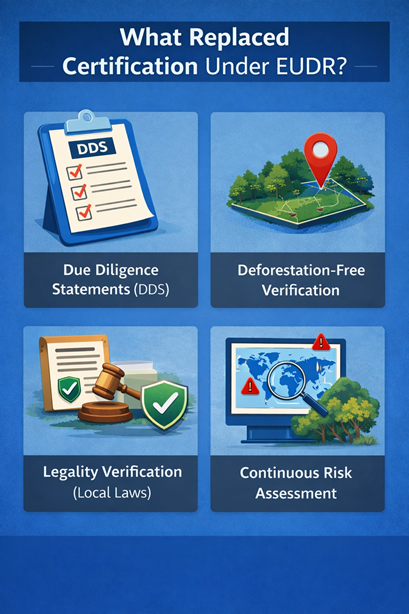
Many companies searching for EUDR certification are actually looking for clarity on the mandatory compliance requirements that regulators will audit. These requirements replace certificates and declarations with verifiable, product-specific evidence.
EUDR requires precise mapping of the land where commodities were produced. This means GeoJSON polygons that define plot boundaries not village names or single GPS points—so authorities can verify deforestation status using satellite data.
Companies must prove that products were not produced on land deforested after 31 December 2020. Accurate harvest or production dates must align with geolocation data and volumes, linking output to compliant plots.
Operators must demonstrate that production complied with local laws, including land ownership, concessions, permits, or customary use rights. This evidence is assessed alongside deforestation risk, not as a standalone check.
Products must remain traceable from origin to market. Records must show how materials move through aggregation, processing, transport, and trade without breaking the link to the original plot.
Where risks are identified, companies must document concrete mitigation actions such as supplier remediation, additional verification, or sourcing changes. Authorities assess not just the risk analysis, but also how risks were actively managed.
Together, these elements form EUDR compliance. There is no certificate to obtain only data, traceability, and accountability that stand up to regulatory scrutiny.
The EUDR due diligence process is a structured, step-by-step workflow that companies must complete before placing regulated products on the EU market. It replaces one-time audits with continuous, data-driven compliance.
Companies must collect standardized data from all relevant suppliers, including supplier identity (KYC), production details, harvest periods, volumes, and legal documentation. This forms the foundation of EUDR compliance; missing or inconsistent data can stop market access.
Each farm or forest plot must be mapped using precise GeoJSON polygon geolocation. Coordinates are validated for accuracy, completeness, and alignment with known production areas, enabling authorities to assess deforestation risk.
Geolocation data is assessed against deforestation maps, satellite imagery, and country or regional risk indicators to confirm that production did not occur on land deforested after 31 December 2020. Legal compliance with local laws is assessed in parallel.
If risks are identified, companies must take concrete mitigation measures such as requesting additional evidence, conducting enhanced verification, remediating suppliers, or changing sourcing before proceeding.
Once risks are assessed and mitigated, the operator submits a Due Diligence Statement through the EU system, formally declaring that the product is deforestation-free and legally produced.
All due diligence data, risk assessments, mitigation actions, and DDS records must be retained for at least five years and made available to authorities during inspections or audits.
Together, these steps define how EUDR compliance works in practice proof first, market access second.
Many companies fall into compliance gaps by approaching EUDR as if it were a traditional certification. These mistakes often surface only during audits or shipment blocks when it’s already too late.
Voluntary certifications (FSC, RSPO, Rainforest Alliance, etc.) can support risk mitigation, but they do not meet EUDR requirements on their own. EUDR requires product-specific, plot-level evidence, not a logo or audit report.
Self-declarations without verifiable data are insufficient. Under EUDR, responsibility remains with the operator placing the product on the EU market even if incorrect information comes from upstream suppliers.
Single coordinate points do not prove deforestation-free origin. Authorities expect GeoJSON polygons that accurately represent farm or forest plot boundaries.
Mixing products from multiple sources without volume attribution breaks traceability. Once the link between plot, volume, and shipment is lost, EUDR compliance cannot be demonstrated.
EUDR is not a one-off certification. It requires ongoing data maintenance, continuous risk assessment, and updated DDS submissions as sourcing, suppliers, or plots change.
Avoiding these pitfalls means shifting the mindset from “getting certified” to building durable, auditable compliance systems.
EUDR transforms traceability from a back-office function into a core compliance infrastructure. Manual systems that rely on spreadsheets, PDFs, and email-based declarations cannot meet EUDR’s scale, accuracy, and audit expectations.
EUDR requires plot-level geolocation, continuous risk assessment, and verifiable links between origin, volume, and product. Manual processes introduce errors, delay validation, and break traceability during aggregation or processing—putting DDS submissions and market access at risk.
Digital traceability platforms integrate satellite imagery to assess whether production plots have experienced deforestation after 31 December 2020. This enables objective, repeatable checks rather than one-time reviews.
Blockchain creates an immutable record of each transaction and transformation across the supply chain. This preserves origin data through aggregation, processing, and trade, providing an auditable chain of custody that regulators can trust.
AI automates data validation, flags inconsistencies in geolocation or volumes, and scores suppliers based on deforestation and legality risk. This allows teams to address issues early and generate DDS submissions with confidence.
TraceX EUDR Compliance Solutions brings these capabilities into a single, EUDR-ready Agentic AI workflow combining supplier onboarding, GeoJSON polygon capture, satellite-based risk analysis, blockchain-backed traceability, and automated DDS preparation. The result is scalable, audit-ready compliance without slowing trade.
EUDR is about proof, not labels.
Unlike voluntary sustainability schemes, EUDR does not reward companies with a certificate or logo. Regulators are not looking for badges, they are looking for verifiable evidence. Compliance is demonstrated through data: plot-level geolocation, deforestation risk checks, legal documentation, traceability records, and a valid Due Diligence Statement (DDS). If the proof isn’t there, the product cannot be placed on the EU market.
Not sure whether EUDR applies to your products or business model?
Read our guide on the scope of EUDR to understand which commodities, products, and operators are covered and where responsibility begins.
Geolocation is the biggest EUDR failure point.
Learn exactly what regulators expect in our deep dive on EUDR geolocation requirements, including GeoJSON polygons, validation rules, and common errors
Struggling to operationalize EUDR with spreadsheets and PDFs?
Explore how technology solutions for EUDR turn compliance into a scalable, audit-ready
No. There is no such thing as an official EUDR certification. EUDR is a legal compliance obligation, not a voluntary certification scheme. Companies must demonstrate compliance through due diligence, verifiable data, and a valid Due Diligence Statement (DDS) for each product placed on the EU market.
No. Certifications like FSC or PEFC cannot replace EUDR compliance. They may support risk mitigation and supplier assessment, but they do not meet EUDR’s mandatory requirements such as plot-level geolocation, deforestation-free verification, or DDS submission.
No authority issues “EUDR approval” in advance. Operators self-declare compliance by submitting a DDS through the EU system. National competent authorities then conduct checks, audits, and enforcement based on risk.
If a DDS is rejected or found incomplete, the product cannot be placed on or traded within the EU market. Shipments may be blocked, delayed, or withdrawn, and authorities may require corrective actions, additional evidence, or impose penalties.
All EUDR-related records, including supplier data, geolocation files, risk assessments, mitigation actions, and DDS references, must be retained for at least five years and be available to authorities upon request.