
Quick summary: Explore cocoa traceability challenges in Ghana for EUDR compliance and learn how digital systems, geolocation mapping, and transparency can ensure deforestation-free supply chains.
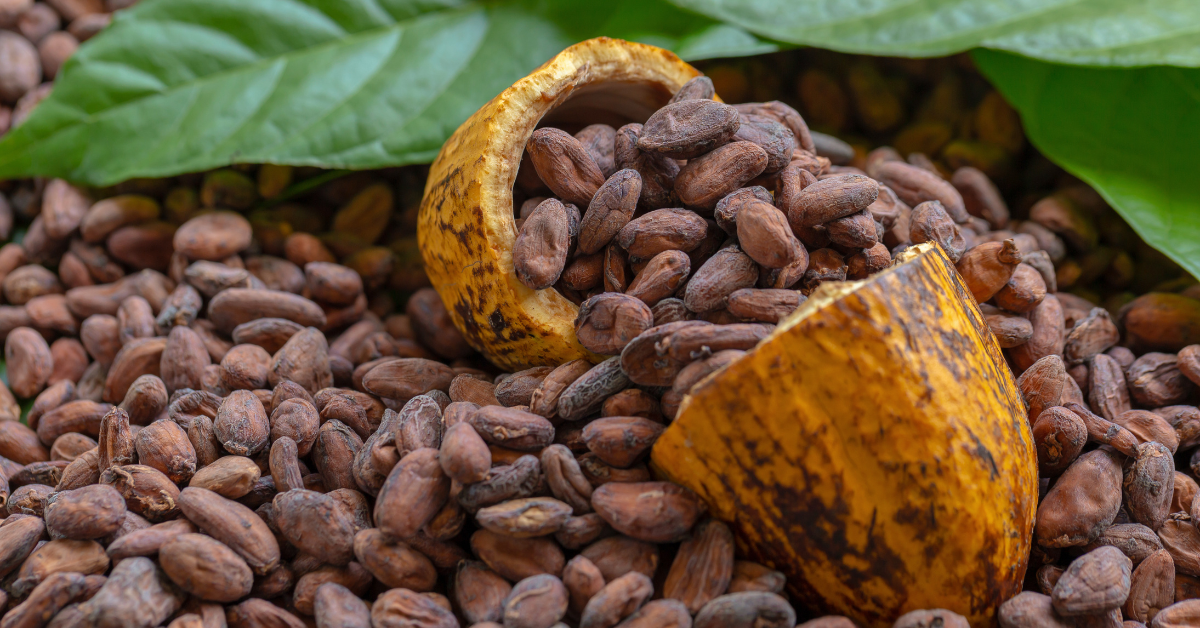
Ghana faces Cocoa Traceability Challenges for EUDR compliance due to 800,000+ smallholder farmers, paper-based records, and fragmented supply chains. The EU Deforestation Regulation (EUDR) requires all cocoa exported to the EU to be deforestation-free, legally produced, and traceable to plot level using GPS coordinates. Solutions from TraceX provide farm GPS polygon mapping, blockchain-backed proof of origin, automated Due Diligence Statements (DDS), and real-time deforestation risk monitoring, enabling Ghanaian exporters to maintain access to a market that absorbs over 60% of Ghana’s cocoa exports.
| 60%+ of Ghana’s cocoa exports go to the EU | 800K+ smallholder farmers require farm mapping | 17% of Ghana’s workforce is employed in cocoa |
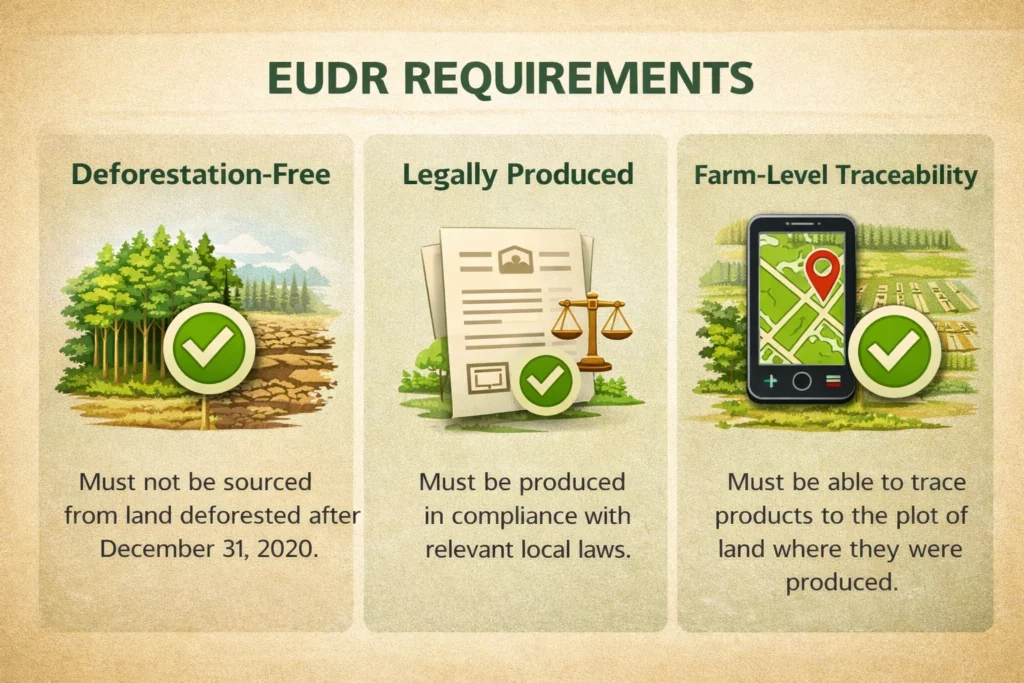
The EU Deforestation Regulation (EUDR) is a legally binding regulation that came into effect on 30 December 2024. It requires all businesses placing cocoa (and other high-risk commodities) on the EU market to prove that their products are:
Non-compliance carries significant consequences: shipment rejection at EU customs, financial penalties, and permanent loss of EU market access, a catastrophic outcome for a sector where the EU is the dominant buyer.
Ghana is the world’s second-largest cocoa producer, with approximately 750,000-900,000 metric tonnes produced annually. Over 60% of those exports are destined for the EU. Without EUDR compliance, Ghana’s cocoa sector risks losing its most valuable market entirely.
Want a step-by-step breakdown of EUDR requirements for cocoa?
See how supply chains can meet traceability, risk assessment, and due diligence standards.
Learn Cocoa EUDR Compliance
Manual compliance processes won’t scale under EUDR.
Discover the tools exporters use for traceability, risk assessment, and DDS automation.
Explore EUDR Compliance Tools for Exporters
Despite COCOBOD’s nationally coordinated system, significant structural gaps remain that make EUDR compliance challenging at scale:
The vast majority of Ghana’s cocoa is produced by smallholder farmers many operating on plots of 2–5 hectares in remote communities. These farmers often lack formal land titles, digital records, or the technical capacity to provide geolocation data independently. Without institutional support, they cannot participate in EUDR-compliant supply chains.
| 80%+ of Ghana’s cocoa comes from smallholder farms | 1M+ farmers need to be digitally onboarded for compliance |
Many Licensed Buying Companies (LBCs) and cooperatives still rely on manual registers and paper-based documentation. These systems cannot generate the GPS boundary data, time-stamped records, or digitized proof of origin that EU auditors require. Manual data collection is also error-prone and impossible to scale across thousands of farms in time-sensitive compliance windows.
A substantial portion of Ghana’s cocoa enters export streams through informal channels and multi-intermediary routes, making it nearly impossible to trace individual batches back to specific farm plots. This indirect supply chain challenge is one of the most difficult structural issues in West African cocoa compliance.
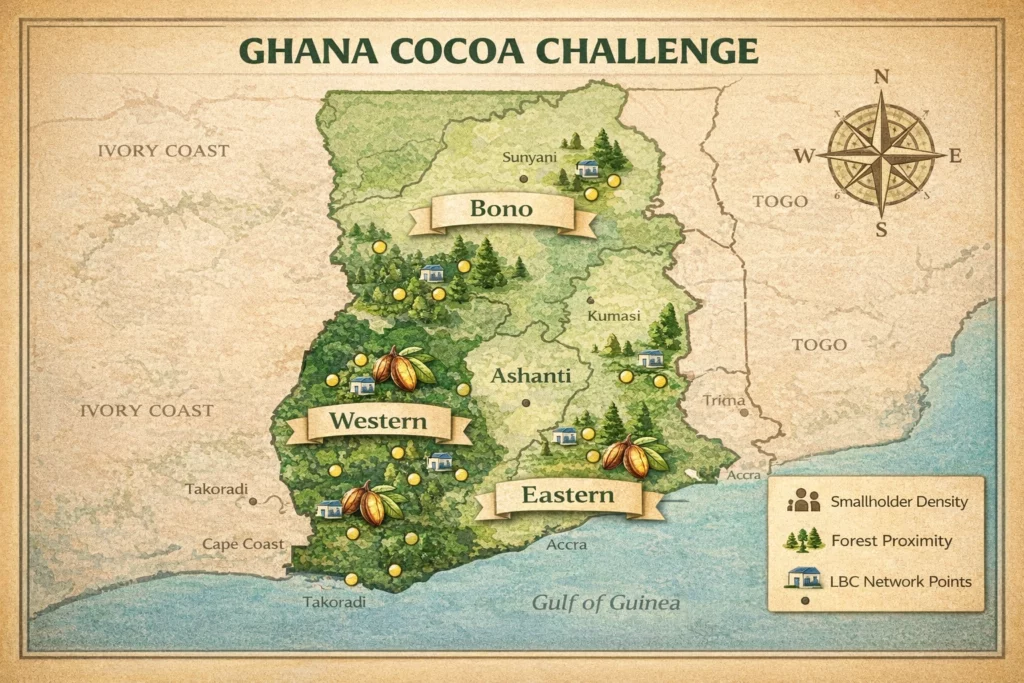
Cocoa cultivation in Ghana’s Western, Western North, and Ashanti regions overlaps with active forest zones. Illegal mining and land clearing continue to threaten deforestation-free sourcing claims. Since December 2000, Ghana’s tree cover has declined by approximately 24% a statistic that puts the country under heightened scrutiny in any EU benchmarking assessment.
Fragmented traceability systems across COCOBOD, LBCs, cooperatives, and private sustainability programs create data silos. Unclear data ownership generates friction between stakeholders, increases duplication, and makes it difficult to create the unified, verifiable supply chain record that EUDR demands.
TraceX’s purpose-built digital traceability and sustainability intelligence platform is designed specifically for supply chains navigating complex regulatory requirements like the EUDR. Here is how the platform maps to Ghana’s specific compliance challenges:
| Challenge in Ghana’s Cocoa Sector | TraceX EUDR Solution |
|---|---|
| Manual, paper-based farmer records | Digital farmer onboarding with ID verification and GPS polygon mapping |
| No plot-level geolocation data | Automated GPS boundary mapping via mobile app offline-capable |
| Inability to prove deforestation-free status | Satellite-backed deforestation risk monitoring overlaid on farm polygons |
| Fragmented data across LBCs and cooperatives | Single unified platform connecting farmers, LBCs, processors, and exporters |
| Manual Due Diligence Statement (DDS) preparation | Auto-generated, EUDR-compliant DDS reports with blockchain-backed proof of origin |
| High risk of EU market rejection | Continuous compliance monitoring with AI-powered risk alerts |
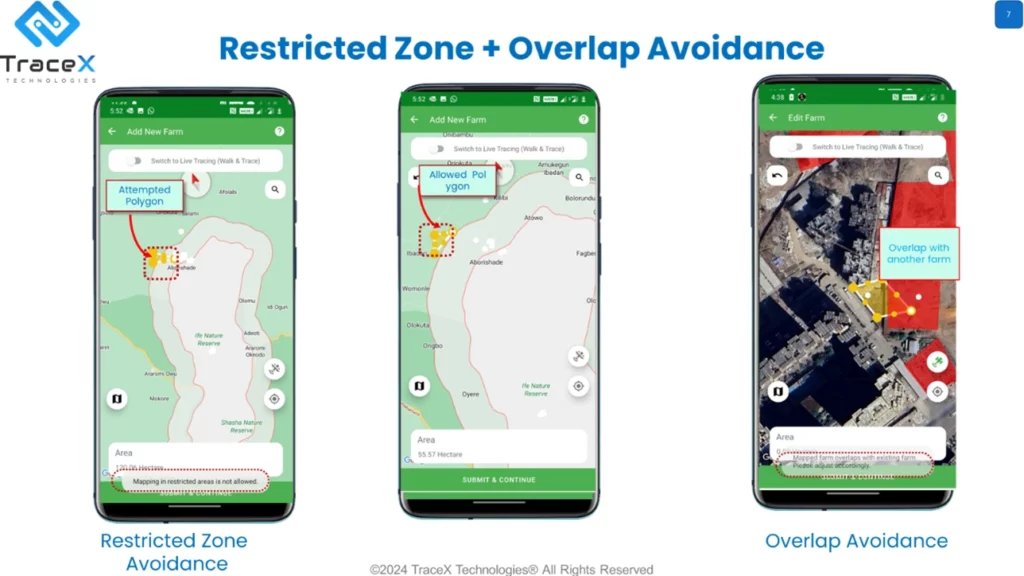
TraceX field officers use GPS-enabled mobile apps to walk the physical boundary of each smallholder farm, generating a precise polygon boundary in real time. The app works fully offline in remote communities data auto-syncs to the cloud when connectivity is restored. Each mapped plot is tied to a verified farmer profile, cooperative membership, and supporting documents including land tenure evidence and farmer ID.
Every transaction in the cocoa supply chain from farm gate purchase to export terminal is recorded on an immutable blockchain ledger. This creates a tamper-resistant chain of custody that EU buyers and auditors can independently verify, building the buyer confidence that Ghana’s cocoa exports need to maintain premium market access.
The EUDR requires operators to submit a Due Diligence Statement before any shipment enters the EU. TraceX automates DDS generation by pulling verified farm, harvest, and supplier data in real time reducing manual workload by over 60% and eliminating the risk of incomplete or inaccurate compliance filings.

| 24% decline in Ghana tree cover since 2000 | $200M estimated annual sector-wide compliance cost | 65%+ of Ghana cocoa exports absorbed by EU |
| 605,000 farms mapped under CFI initiative by 2020 — a starting point, not a finish line | 82% of direct CFI cocoa supply tracked from farm to first purchase point in Ghana |
Traceability is not simply a regulatory cost it is a competitive advantage for Ghanaian cocoa exporters who move early. The companies that invest in digital traceability infrastructure now will capture disproportionate value as the global cocoa market shifts toward verified, sustainable, premium-origin beans.
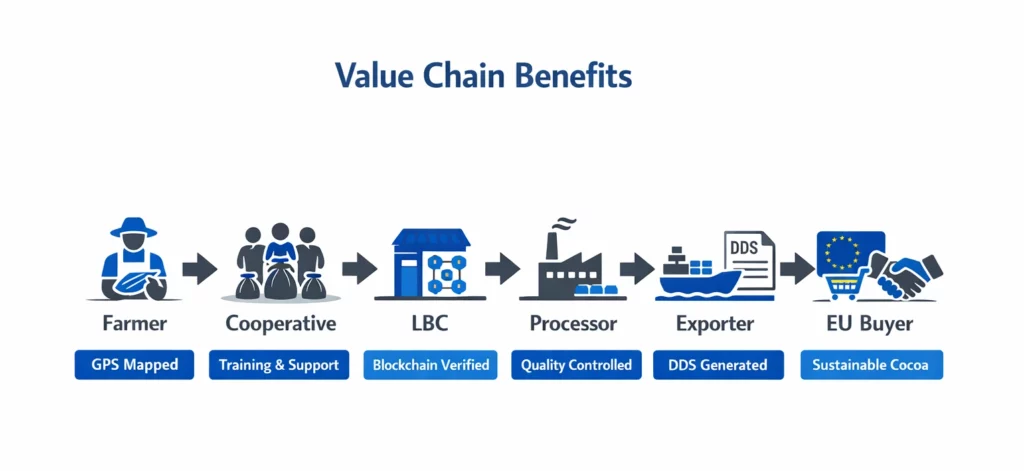
Addressing cocoa traceability challenges in Ghana is essential for ensuring compliance with the EU Deforestation Regulation and maintaining access to EU markets. While fragmented supply chains, smallholder farming structures, and limited digital infrastructure pose significant hurdles, these can be overcome through farm-level geolocation mapping, digital traceability systems, and stronger stakeholder collaboration. By investing in technology, improving data transparency, and aligning with regulatory requirements, Ghana’s cocoa sector can not only meet EUDR standards but also strengthen its global competitiveness and sustainability credentials.
Learn how to conduct EUDR due diligence step-by-step
How do you assess deforestation risk? Read this guide
Understand all EUDR requirements in one place
The EU Deforestation Regulation (EUDR) requires all cocoa exported to the EU to be deforestation-free, legally produced, and traceable to the exact farm plot of origin using GPS coordinates. For Ghana which sends over 60% of its cocoa to Europe compliance is not optional. Non-compliance risks shipment rejection, financial penalties, and permanent market exclusion.
The primary challenges are: (1) over 800,000 smallholder farmers lacking digital records or formal land titles; (2) paper-based, fragmented data systems across LBCs and cooperatives; (3) inability to provide GPS plot-level geolocation data at scale; (4) deforestation risk in forest-adjacent cocoa zones; and (5) unclear data ownership across the supply chain.
Exporters need a digital traceability platform that provides: GPS polygon farm mapping (offline-capable for remote areas), blockchain-backed proof of origin, automated Due Diligence Statement (DDS) generation, satellite-based deforestation risk monitoring, and integration with COCOBOD-licensed LBCs and cooperatives. TraceX offers all of these in a single unified platform.
A Due Diligence Statement is a mandatory document that EU operators must submit before placing cocoa on the EU market. It confirms that the product is deforestation-free, legally sourced, and fully traceable. The DDS must reference geolocation data, legality documentation, and risk assessment results. TraceX automates DDS generation, reducing manual workload by over 60%.
Without accelerated compliance investment, yes. Ghana’s EU cocoa market worth billions annually and representing over 60% of total cocoa exports is at risk if exporters cannot provide the geolocation, legality, and deforestation-free proof that EUDR requires. Early adoption of digital traceability platforms is the most effective way to protect this market access.
The Ghana Cocoa Traceability System (GCTS) is COCOBOD’s national traceability initiative providing real-time, ground-truth geolocation data from farm to port. It is currently being piloted in Assin Fosu, Assin Breku, and New Edubiase districts. The GCTS provides a foundational national infrastructure, while platforms like TraceX enable LBCs, cooperatives, and exporters to operationalize farm-level compliance on top of that infrastructure.









