
Quick summary: EUDR checklist for importers ensure compliance with supplier data, geolocation, and due diligence requirements to protect EU market access and avoid shipment delays or penalties.

If you import coffee, cocoa, soy, palm oil, rubber, beef, or timber into the EU, the EU Deforestation Regulation (EUDR) is now your reality. And the stakes are higher than most importers realize. EUDR checklist for Importers helps to get compliant, stay compliant, and use compliance as a competitive advantage.
Most importers are still operating under the assumption that sourcing responsibly is enough. It isn’t. Under EUDR, intent doesn’t count. Proof does.
That means geo-tagging every supplier, verifying deforestation-free origins down to the plot level, and submitting legally binding Due Diligence Statements (DDS) or risking shipment rejection, fines, and permanent loss of EU market access.
| €50,000+ Max fine per non-compliant shipment | 7+ Regulated commodity categories | Dec 2025 Full enforcement deadline | 100% Supply chain traceability required |
TL;DR: Importers must ensure EUDR compliance before goods enter the EU. This includes collecting verified supplier data, validating polygon-level geolocation, conducting risk assessments, and submitting a Due Diligence Statement (DDS). Missing or incorrect data can lead to shipment delays, blocked market access, and penalties.
EUDR applies to any operator or trader placing the following commodities or derivative products on the EU market:
| Commodity | Derivative Products Included | Example Use Case |
|---|---|---|
| Coffee | Roasted, ground, instant coffee | Coffee importers, roasters |
| Cocoa | Chocolate, cocoa butter, powder | FMCG brands, confectionery |
| Soy | Soy oil, soy meal, soy protein | Animal feed, food processing |
| Palm Oil | Cosmetics, food ingredients | Retail, personal care brands |
| Rubber | Natural rubber products, latex | Automotive, industrial |
| Beef / Cattle | Leather, processed meat | Fashion, food manufacturers |
| Timber / Wood | Furniture, paper, packaging | Retail, packaging |
Even if you are outside the EU, you will need to provide documentation to EU buyers. The EUDR makes no exception for product complexity or country of origin.
Critical: The Low-Risk Country Myth
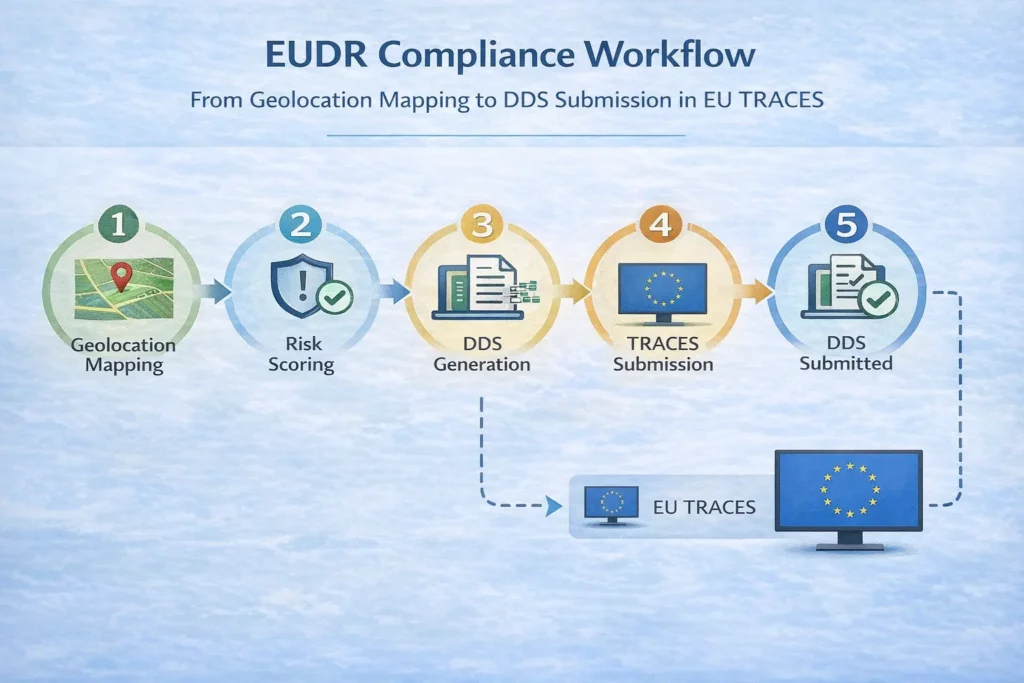
This is the foundation of EUDR compliance and the most common point of failure. Without precise geolocation, you cannot prove deforestation-free sourcing. No geolocation, no DDS. No DDS, no EU market access.
What you need to collect for each supplier:
Why Polygon Data Matters

This step determines whether your supply chain can legally enter the EU. Under EUDR, the critical compliance threshold is December 31, 2020; no commodity that caused deforestation after that date can be placed on the EU market.
Verification must include:
| Dec 31, 2020 EUDR cut-off date for deforestation | 5 Years Mandatory data retention period |
Not all suppliers carry equal risk under EUDR. Your due diligence must include a contextual risk score, not a one-size-fits-all checkbox.
| Risk Factor | Questions to Answer | Impact on DDS |
|---|---|---|
| Country Classification | Is origin country flagged for deforestation risk? | Determines scrutiny level |
| Supplier Transparency | Do suppliers provide complete documentation? | Missing docs = DDS rejection |
| Land Ownership | Is land legally recognized in local law? | Legality is mandatory |
| Certification Status | FSC, Rainforest Alliance? Note: certifications do not equal compliance | Supplementary only |
| Smallholder Risk | Multiple small farms across cooperatives? | Each plot must be verified |
The Certification Trap
The DDS is the legally binding declaration submitted in the EU’s TRACES system that proves your product is deforestation-free, legally produced, and fully traceable. Errors, missing details, or late filings can result in penalties, blocked shipments, or reputational damage.
Each DDS must include:
Critical: DDS Is Shipment-Based, Not Commodity-Based

The most common mistake importers make: treating EUDR as a one-time documentation project. It isn’t. EUDR requires continuous, verifiable evidence, and failure to maintain it could cost you your market access fast.
What a sustainable compliance system looks like:
| 60% Reduction in compliance time with automation | Zero Manual spreadsheet errors with platform approach | 24/7 Audit-ready with real-time monitoring |
| Mistake | What Goes Wrong | The Fix |
|---|---|---|
| Reusing DDS across shipments | Non-compliant batches contaminate compliant ones | File shipment-specific DDS every time |
| Relying on certifications as proof | FSC/Rainforest Alliance does not equal EUDR compliance | Supplement with plot-level traceability data |
| Manual spreadsheet-based compliance | Data inconsistencies cause DDS rejections | Migrate to a centralized compliance platform |
| DDS and traceability are still mandatory | DDS and traceability still mandatory | Complete due diligence regardless of country classification |
TraceX’s EUDR AI-powered compliance solutions is built specifically for the EUDR complexity that importers face. Instead of managing spreadsheets, email chains, and manual satellite lookups, TraceX centralizes every step of your compliance workflow.
| EUDR Requirement | Manual Approach | With TraceX |
|---|---|---|
| Geolocation mapping | Manual GPS collection, error-prone | Mobile app capture + automated geometry validation |
| Deforestation verification | External satellite tool, separate process | Built-in AI satellite analysis (JRC + Hansen datasets) |
| Risk assessment | Spreadsheet-based, inconsistent scoring | Smart SAQs + real-time risk scoring by country/supplier |
| DDS generation | Manual form-filling, formatting errors | One-click DDS in JSON/XML, auto-filed to EU TRACES |
| Audit records | Scattered documents, hard to retrieve | Centralized 5-year audit trail, always accessible |
| Supplier onboarding | Email requests, inconsistent formats | Digital onboarding with KYC and GPS-verified plots |
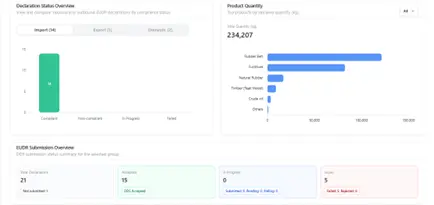
This guide is designed specifically for the compliance and procurement professionals navigating EUDR obligations, whether you are managing a single commodity or a complex multi-supplier supply chain:
Persona Spotlight: The Import Compliance Manager at Scale
EUDR compliance is not a box-ticking exercise. It is your license to operate in one of the world’s largest and most valuable commodity markets. The companies that build robust, technology-enabled traceability systems today will not just survive enforcement; they will win more EU buyers, faster.
The five steps in this checklist, geolocation, deforestation verification, risk assessment, DDS filing, and continuous compliance, are not optional. But they are achievable. With the right platform, what takes weeks manually can be completed in minutes.
| 5 Steps To full EUDR compliance | 5 Steps to full EUDR compliance | 100% Audit-ready documentation, always |
Stay ahead of regulations – explore our guide to end-to-end EUDR compliance.
Understand what effective due diligence looks like – learn how to meet EUDR requirements with confidence.
Not sure where you stand? Discover how an EUDR gap analysis can uncover compliance risks in your supply chain.
Importers must prove that their commodities are deforestation-free, conduct documented due diligence, provide plot-level geolocation data, and submit a Due Diligence Statement (DDS) via the EU TRACES system before placing products on the EU market. Non-compliance can result in shipment rejection, fines of 50,000+ per violation, and loss of EU market access.
Only if those buyers are part of the exact same shipment with identical origin, batch, risk assessment, and port details. In most cases, you need a separate DDS per shipment and per buyer. Reusing DDS files is one of the most common compliance errors and one of the most costly.
Yes. EUDR country classification (low, standard, or high risk) affects the intensity of scrutiny, but does not eliminate core due diligence obligations. All operators must still submit a DDS and trace products back to deforestation-free geolocations regardless of origin country risk level.
Digital traceability platforms like TraceX automate geolocation capture and validation, run AI-backed satellite deforestation checks, generate compliant DDS files, and connect directly to EU TRACES for instant submission reducing manual effort and ensuring consistent compliance as regulations evolve.
Non-compliance consequences include: shipment rejection at EU customs, financial penalties (up to 4% of EU annual turnover in some member states), reputational damage with EU buyers, exclusion from EU market contracts, and potential legal liability under EU law. The regulation has zero tolerance for retroactive justification.