Quick summary: The ultimate guide to food traceability covering regulations, technologies, compliance requirements, recall management, and scalable implementation strategies for modern supply chains.
Food recalls are becoming more frequent. Regulatory scrutiny is intensifying across global markets. And consumers now expect to know not just what they are buying but where it came from, how it was produced, and whether it is safe. In this environment, food traceability is no longer a back-office compliance function. It has become a frontline business risk.
Without structured food traceability systems, companies face delayed recalls, regulatory penalties, reputational damage, and permanent loss of buyer trust.
Simply put, spreadsheet-based tracking and fragmented supplier documentation cannot withstand today’s transparency demands.
Food traceability refers to the ability to track and trace food products and their ingredients across the entire supply chain from farm to processing to distribution and retail while preserving lot-level identity and transaction history. Done correctly, it enables rapid recall response, regulatory compliance, brand protection, and verified sustainability claims.
In this guide, we outline a practical, actionable framework for building scalable food traceability systems covering post-harvest capture, aggregation workflows, digital farm integration, and compliance-ready data architecture so your organization can move from reactive crisis management to proactive supply chain resilience. TraceX food traceability solutions deliver end-to-end, lot-level visibility across the supply chain digitizing farm data, preserving traceability through aggregation, and enabling compliance-ready, audit-proof transparency from origin to export.
Food traceability is the ability to track and trace food products through every stage of the supply chain from farm to fork using documented records and digital tracking technologies to ensure safety, compliance, and transparency.
As regulatory pressure and consumer scrutiny grow, many organizations use the terms traceability and transparency interchangeably. But they are not the same.
Food traceability is the structured, system-based ability to track and trace products and ingredients across the supply chain. It is operational and data-driven.
Transparency, on the other hand, is what you choose to disclose externally to regulators, buyers, or consumers.
In simple terms:
Without strong traceability systems, transparency becomes marketing rather than verifiable proof.
Most food safety regulations globally are built around a foundational rule:
Every operator must know where a product came from and where it went.
This is known as the “one-step forward, one-step back” principle.
It requires businesses to:
While this principle establishes baseline compliance, it is not sufficient for complex, multi-tier supply chains. Modern food traceability systems go beyond one-step tracking to preserve identity across aggregation, transformation, and distribution.
Effective food traceability operates on two levels:
Internal Traceability This refers to tracking materials and products within a single organization.
It includes:
Internal traceability ensures you can isolate issues quickly during a recall.
External Traceability This refers to tracking products across organizational boundaries.
It includes:
External traceability ensures continuity of data across the entire value chain.
Without integration between internal and external systems, traceability breaks at aggregation points, creating compliance and recall risk.
When an incident occurs, companies must answer two types of questions:
Backward Tracing “Where did this product come from?”
Used to:
This is critical for root-cause analysis.
Forward Tracing “Where did this product go?”
Used to:
Forward tracing determines the scope of impact.
Explore how traceability connects every stage of the food value chain
From internal and external traceability to forward and backward tracing, understanding the types of traceability is essential for building a resilient supply chain.
Read our in-depth guide on the Types of Traceability and how they impact compliance and recalls.
Regulatory requirements vary across the U.S., EU, and global markets—and staying compliant requires more than basic recordkeeping.
Explore our complete breakdown of Food Traceability Regulations and what they mean for your business.
Today, food traceability is no longer just about compliance it is about speed, precision, trust, and resilience. As supply chains stretch across borders and involve multiple intermediaries, the ability to trace products at lot-level granularity directly impacts financial exposure and brand survival.
When contamination or quality issues arise, time becomes the most critical variable.
Without structured food traceability systems, companies often resort to broad, precautionary food recalls pulling entire product lines instead of isolating specific affected batches.
Effective traceability enables:
The difference between recalling 2% of inventory versus 100% often determines whether an incident becomes manageable or catastrophic.
Food traceability is increasingly codified in regulatory frameworks worldwide.
FSMA Requirements (U.S.) Under the Food Safety Modernization Act (FSMA), companies must maintain detailed records and, under the Food Traceability Rule (Section 204), capture Critical Tracking Events (CTEs) and Key Data Elements (KDEs) for high-risk foods.
This moves traceability from reactive documentation to structured data management.
EU Traceability Mandates European regulations require operators to comply with the “one-step forward, one-step back” principle, while evolving digital traceability expectations are raising the bar for data accessibility and verification.
Global Harmonization Challenges Multinational exporters face additional complexity:
Modern food traceability systems must be designed to accommodate multi-jurisdiction compliance not just local rules.
Today’s consumers expect more than safety they demand visibility.
They want to know:
Food traceability enables:
Brands that invest in structured traceability can transform compliance infrastructure into a market differentiator.
Beyond recalls and regulations, traceability strengthens operational control.
In complex supply networks involving multiple tiers of suppliers and aggregation points, disruptions can arise from:
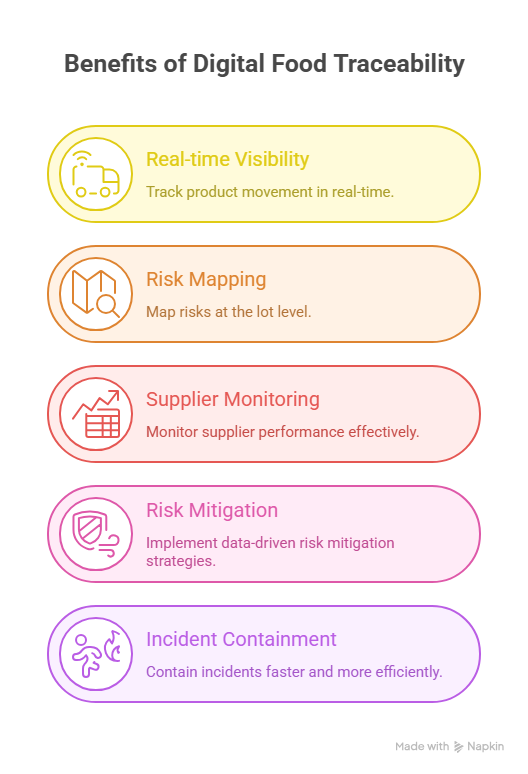
Resilience is no longer optional. It is built on structured, connected, and interoperable traceability systems.
As food supply chains grow more global and complex, regulatory expectations around food traceability are becoming stricter, more digitized, and more harmonized. By 2026, companies operating across markets must navigate evolving frameworks in the United States, the European Union, and international trade systems.
The U.S. regulatory landscape is shaped primarily by the Food Safety Modernization Act (FSMA), with major implications under FSMA Rule 204 (Food Traceability Rule).
FSMA Rule 204 requires companies handling certain high-risk foods on the FDA’s Food Traceability List (FTL) to maintain detailed, structured records that can be provided to regulators within 24 hours upon request.
The rule shifts traceability from basic supplier-customer documentation to standardized digital recordkeeping across the supply chain.
CTEs are specific points in the supply chain where traceability data must be captured.
Examples include:
Each CTE represents a moment where product identity or custody changes and where traceability data must be recorded.
At each Critical Tracking Event, companies must capture Key Data Elements (KDEs), such as:
This structured CTE + KDE model formalizes lot-level traceability and significantly raises documentation expectations, especially for processors and distributors.
In the European Union, food traceability is anchored in the General Food Law Regulation (EC) 178/2002.
This regulation establishes the foundational requirement that food operators must:
This is commonly referred to as the “one-step forward, one-step back” principle.
While the regulation sets baseline traceability requirements, enforcement expectations across EU member states may vary. Increasing digitalization initiatives and broader sustainability regulations are also pushing operators toward more structured, interoperable traceability systems.
In addition to the General Food Law Regulation (EC 178/2002), companies exporting certain commodities to the EU must comply with the EU Deforestation Regulation (EUDR), which significantly strengthens traceability requirements.
Under EUDR, operators placing or exporting in-scope commodities (such as coffee, cocoa, palm oil, soy, cattle, rubber, and wood) on or from the EU market must ensure products are:
Unlike traditional “one-step forward, one-step back” traceability, EUDR requires plot-level geolocation data for the land where commodities were produced. Companies must:
This elevates food traceability from lot-level tracking to farm-level geospatial verification.
See how digital traceability transforms sourcing, compliance, and transparency across the food and agriculture value chain
Explore our solutions for Agribusinesses
Companies operating in international markets must align not only with national regulations but also with globally recognized standards and trade requirements.
The Codex Alimentarius, developed by the FAO and WHO, provides internationally recognized food safety and traceability guidelines.
While not legally binding, Codex standards:
Traceability is embedded within Codex food hygiene and risk management frameworks.
Global trade adds another layer of complexity. Exporters must manage:
Each jurisdiction may impose different documentation formats, language requirements, and audit expectations.
Without structured digital food traceability systems, managing cross-border compliance becomes increasingly burdensome and error-prone.
Not sure how these regulations apply to your operation? Explore our compliance-focused traceability solutions.
Modern food traceability relies on a combination of technologies that capture, preserve, and transmit product identity across the supply chain. The right solution depends on operational scale, regulatory requirements, and the level of real-time visibility required.
Low-Cost Entry | Batch-Level Tracking Barcode and QR code systems are the most widely adopted and cost-effective entry point for food traceability.
They enable:
QR codes also support consumer-facing transparency by linking to origin, certification, or sustainability information.
Best suited for:
Limitations:
Real-Time Monitoring | Cold Chain Tracking Radio Frequency Identification (RFID) and IoT-enabled sensors enhance traceability by adding automation and environmental intelligence.
They enable:
For perishable foods, IoT-based cold chain monitoring is critical in preventing spoilage and regulatory non-compliance.
Best suited for:
Limitations:
Immutable Records | Multi-Party Collaboration Blockchain technology provides a decentralized ledger where transaction records cannot be altered retroactively.
It enables:
Blockchain is particularly valuable in complex international supply chains involving multiple independent actors.
However, blockchain does not replace structured data capture — it strengthens trust in recorded transactions.
Best suited for:
Limitations:
Centralized Dashboards | API Integrations | ERP Connectivity Cloud-based traceability platforms serve as the operational backbone of modern food traceability systems.
They provide:
Advanced platforms support:
Unlike standalone tools, cloud platforms unify internal and external traceability across the entire value chain.
Best suited for:
There is no single solution that fits all supply chains.
In most cases, effective food traceability combines:
The key is not the technology itself but how well it preserves lot-level identity, supports regulatory compliance, and enables rapid forward and backward tracing.
TraceX Technologies partnered with TechnoServe to implement an end-to-end digital traceability solution for coffee produced by over 3,500 farmers in the Araku Valley. The initiative digitized farm-level data capture, lot aggregation, and transaction workflows ensuring seamless traceability from farm to export. By integrating farmer onboarding, geo-mapping, harvest data recording, and batch-level tracking, the platform enhanced transparency across the value chain while streamlining data management for stakeholders. The solution also strengthened adherence to ethical sourcing standards and sustainable farming practices, enabling buyers to verify origin, production methods, and compliance with confidence.
Explore the full case study and see how TraceX enables traceability at scale
TraceX food traceability solutions enable end-to-end, lot-level visibility across agricultural and food supply chains connecting farms, aggregators, processors, exporters, and buyers on a unified digital platform. Through mobile-based data capture, geo-tagging, scan-and-transfer workflows, and real-time transaction recording, TraceX preserves product identity from origin to final shipment. The platform supports regulatory compliance (including FSMA, EU mandates, and sustainability frameworks), strengthens recall readiness, and enhances transparency through structured, audit-ready data. With centralized dashboards, ERP integrations, and role-based access controls, TraceX transforms fragmented documentation into scalable, digital traceability infrastructure that improves risk management, supplier accountability, and buyer confidence.
Food traceability is entering a new era one driven not just by regulatory mandates, but by intelligence, interoperability, and real-time transparency. Emerging innovations such as AI-powered predictive risk detection are shifting traceability from reactive recall management to proactive risk prevention, identifying anomalies, supplier risks, and contamination patterns before incidents escalate. At the same time, Digital Product Passports are redefining how structured, lifecycle-based product data is captured and shared, moving traceability beyond batch tracking toward standardized, machine-readable compliance infrastructure.
Sustainability traceability is also becoming central, with increasing demand for verifiable ESG metrics, carbon footprint transparency, and ethical sourcing validation. This evolution is supported by the push toward interoperable global data standards, enabling cross-border data exchange and harmonized reporting across jurisdictions. Finally, consumer-facing transparency tools such as QR-enabled origin storytelling and impact dashboards are transforming traceability into a brand engagement strategy.
Together, these trends signal a fundamental shift: food traceability is no longer just a safety requirement it is becoming the digital backbone of resilient, transparent, and future-ready food supply chains.
QR-based traceability enables instant lot tracking, consumer transparency, and rapid recall execution.
Read our complete guide on QR Code Traceability and how to implement it effectively.
Discover how blockchain creates tamper-resistant records and improves multi-party collaboration across complex supply chains.
Explore our deep dive on Blockchain Traceability and when it actually makes sense.
From lot-level mapping to supplier onboarding and audit readiness, best practices make all the difference.
Read our guide on Traceability Best Practices for scalable, compliance-ready systems
Food safety prevents contamination and ensures products are safe to consume.
Food traceability tracks products through the supply chain to manage recalls and identify sources of risk.
Yes, most major markets (U.S., EU, and others) mandate traceability under food safety regulations.
Requirements vary by country and product category but are legally enforceable.
Blockchain creates tamper-resistant, shared records across supply chain partners.
It enhances data integrity and trust but does not replace structured traceability systems.
Costs depend on supply chain complexity, integrations, and hardware requirements.
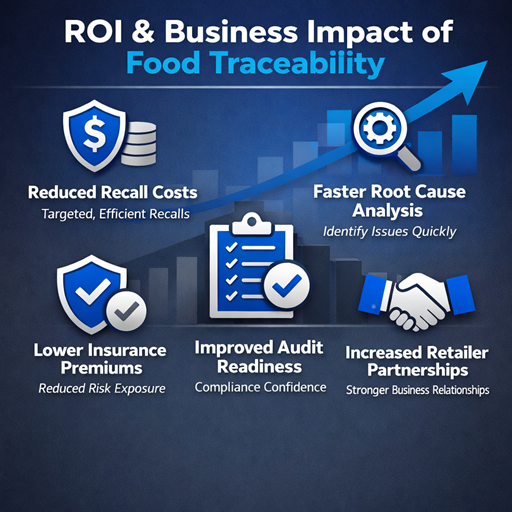
ROI is typically driven by reduced recall costs and improved compliance efficiency.
Basic systems can be implemented in 8–12 weeks.
Enterprise-scale deployments may take 3–12 months depending on scope.