
Quick summary: TraceX helps coffee companies in Portugal meet EUDR requirements with automated Due Diligence Statement (DDS) generation, farm-level traceability, and deforestation risk verification.

EUDR DDS for Coffee Supply Chain in Portugal requires Portuguese importers, roasters, processors, and traders to prove that all coffee entering the EU market is deforestation-free, legally produced, and traceable to the exact farm or plot of origin. Companies must collect geolocation data, verify land-use legality, assess deforestation risk, and submit an EU-compliant Due Diligence Statement (DDS) for every batch. With enforcement starting in 2025–2026, Portugal’s coffee sector must adopt digital traceability, supplier onboarding systems, and risk-assessment tools to maintain EU compliance and ensure transparent, responsible sourcing.
The EUDR Landscape for Coffee in Portugal
The EU Deforestation Regulation (EUDR) is reshaping how Portugal’s coffee supply chain must operate, placing strict requirements on traceability, legality verification, and deforestation-free sourcing. As a major entry point for green coffee into the EU particularly through the ports of Lisbon, Leixões, and Sines, Portugal imports significant volumes from Brazil, Colombia, Ethiopia, Vietnam, Uganda, and Honduras. These origins include several high-risk regions where coffee production has historically contributed to forest loss, land-use change, and biodiversity impacts.
Under EUDR, all green coffee beans, roasted coffee, instant coffee, and coffee-based products fall under regulation. Any operator in Portugal placing these goods on the EU market must:
This applies to all operators importers, roasters, wholesalers, and coffee brand owners.
Portugal is a key coffee-processing and distribution hub for Iberia and broader EU markets. Domestic roasters rely heavily on imported green beans, with significant downstream trade to Spain, France, and other EU countries. Under EUDR, any non-compliant batch risks:
This increases the pressure on Portuguese operators to digitize and standardize traceability workflows.
The regulation follows a phased rollout across the EU:
Failure to prepare before these deadlines increases the risk of supply chain disruption, non-compliance penalties, and loss of key EU trading relationships.
Master the step-by-step process of submitting Due Diligence Statements under the new EUDR rules.
Read the blog on filing DDS for EUDR compliance
Explore how coffee importers and roasters in Germany can achieve traceability, transparency, and compliance under EUDR.
Read the full blog on EUDR Coffee Compliance
Portugal’s coffee industry from importers and roasters to distributors and brand owners faces a complex set of operational, documentation, and supply chain challenges as the EUDR introduces stringent deforestation-free and traceability requirements. Because Portugal imports coffee from multiple high-risk geographies, the regulatory burden is significantly higher than for domestically sourced commodities.
Most coffee imported into Portugal originates from smallholder-dominated regions in Brazil, Ethiopia, Uganda, Vietnam, and Colombia.
This creates major traceability gaps that can delay DDS preparation.
Portuguese companies must confirm that all coffee was produced in compliance with:
Given the diversity of legal frameworks across Latin America, Africa, and Asia, legality verification becomes resource-intensive and prone to inconsistencies.
Under EUDR, coffee must not originate from land cleared after 31 December 2020.
Portugal’s challenge lies in verifying this for thousands of farms in countries where:
Companies must validate that every farm is compliant failure for even one plot can jeopardize entire consignments.
Coffee moves through numerous intermediaries before reaching Portugal:
Farm → Cooperative → Mill → Exporter → Importer → Roaster → Distributor
Documentation breaks easily across these nodes. Portuguese operators frequently face:
Ensuring unbroken traceability is one of the biggest structural obstacles.
Portugal imports large volumes from Brazil, Vietnam, Ethiopia countries designated medium or high risk under EUDR.
This increases the burden of:
Suppliers unwilling or unable to comply may need to be replaced, threatening supply availability.
While Portuguese companies are digitalizing rapidly, many upstream actors still rely on manual logs.
This creates friction in:
EUDR forces digital transformation along an entire global chain not just within Portugal.
Companies must build a fully documented Due Diligence System (DDS), including:
This sharply increases operational costs, especially for small and mid-sized Portuguese roasters and traders.
As EUDR enforcement approaches, Portuguese coffee importers, roasters, and distributors face increasing pressure to prove that every coffee shipment entering the EU market is deforestation-free, legally sourced, and fully traceable to the plot of origin. The TraceX EUDR Compliance Platform offers an integrated, digital-first solution that streamlines the entire Due Diligence Statement (DDS) workflow ensuring Portuguese operators stay audit-ready and compliant across global sourcing regions.
TraceX enables complete digital traceability from farm to Portuguese ports and roasteries, linking each coffee lot to verified geolocation polygons, supplier profiles, and export documents. This level of visibility is critical for Portugal, which imports coffee from high-risk regions such as Brazil, Ethiopia, Uganda, Vietnam, and Colombia.
The platform automatically compiles required EUDR data farm geolocation, legality records, risk assessments, supplier declarations into compliant DDS files. With direct integration into the EU’s submission portal, Portuguese companies can generate and upload DDS reports in a single click, eliminating manual errors and accelerating verification.
TraceX uses blockchain to create tamper-proof records of each step in the coffee journey. From farm-level production to arrival in Lisbon, Porto, or Leixões, every transaction is immutably stored, giving Portuguese importers verifiable proof of origin and maintaining full chain-of-custody transparency for auditors and EU regulators.
Since most Portuguese coffee supply originates from smallholder farmers, TraceX’s mobile onboarding tools enable cooperatives and exporters to register farmers, upload legality documents, and capture GPS boundaries seamlessly. This ensures upstream inclusivity and strengthens data completeness across fragmented sourcing networks.
With AI-powered dashboards, Portuguese coffee operators can continuously monitor deforestation alerts, supplier risk levels, legality gaps, and land-use changes in real time. This proactive intelligence helps companies identify high-risk suppliers early, avoid non-compliant shipments, and maintain uninterrupted EU market access.
By combining blockchain verification, automated DDS workflows, geospatial intelligence, and inclusive supplier onboarding, TraceX transforms EUDR compliance into a competitive advantage helping Portugal’s coffee sector achieve transparency, reduce operational burdens, and lead in responsible sourcing.
The EUDR represents a major turning point for Portugal’s coffee industry, which is heavily dependent on imports from tropical regions where deforestation risks remain high. As one of Europe’s key coffee import and re-export hubs—with major roasting operations concentrated around Lisbon, Porto, and Aveiro Portuguese companies must now demonstrate that every batch of green coffee is legally produced, deforestation-free, and traceable to precise farm-level geolocation.
For importers, roasters, private-label brands, and distributors, non-compliance risks include shipment delays, blocked consignments, loss of EU market access, and significant reputational damage. Because Portuguese supply chains often rely on intermediaries, cooperatives, and smallholder farmers across Latin America and Africa, meeting EUDR requirements demands deeper visibility and documentation than ever before.
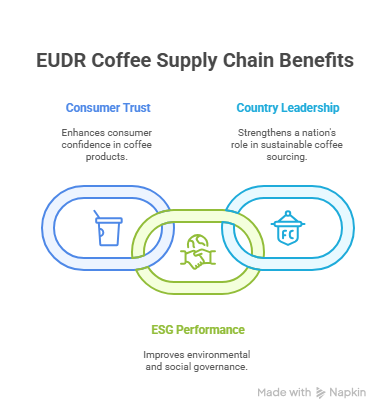
The regulation also brings new opportunities: companies that adopt digital traceability and robust due diligence systems can position themselves as leaders in sustainable sourcing, attract ESG-focused buyers, and strengthen competitiveness in the premium coffee market. By aligning with EUDR expectations early, Portugal’s coffee sector can secure stable supply networks, build stronger supplier relationships, and reinforce its role as a trusted EU gateway for responsibly sourced coffee.
Implementing EUDR DDS for the Coffee Supply Chain in Portugal is no longer optional it is a strategic necessity for ensuring uninterrupted EU market access, safeguarding brand reputation, and meeting rising sustainability expectations. By investing in digital traceability, geolocation verification, supplier onboarding, and continuous risk monitoring, Portuguese roasters, traders, and importers can achieve full compliance while building resilient, transparent, and deforestation-free sourcing networks. With the right tools and data systems in place, Portugal’s coffee industry can turn EUDR compliance into a long-term competitive advantage across European and global markets.
Understand the key components of EUDR compliance and how to streamline your DDS process efficiently.
Read the blog on EUDR Due Diligence
Learn how AI-driven automation and intelligent workflows simplify data collection, verification, and reporting.
Explore the blog on Agentic AI for EUDR
Unpack the biggest hurdles faced by importers under EUDR — and how technology can turn compliance into a competitive edge.
Explore blog on EUDR Importers
The EUDR is a regulation by the European Union aimed at preventing deforestation-linked commodities like coffee from entering the EU market. It requires full supply chain traceability and submission of Due Diligence Statements (DDS) proving compliance.
A DDS is a formal declaration confirming that coffee imported or sold in Portugal is deforestation-free and legally sourced. It must include farm-level geolocation data and risk assessment documentation.
All Portuguese importers, traders, roasters, and retailers handling coffee are required to comply. Both large corporations and small operators must provide DDS documentation for their supply chains.
Common difficulties include gathering farm-level data, verifying deforestation-free claims, managing multiple smallholders, and preparing DDS documents manually.
TraceX digitizes the entire process mapping coffee farms, verifying deforestation risks via satellite data, and auto-generating compliant DDS reports ready for submission.
Yes. TraceX is built for scalability and ease of use. It supports both large enterprises and smallholder networks, enabling simple data collection via mobile apps