
Quick summary: Traceability in the Cashew Supply Chain in Benin is essential for global market access. Learn how digital tools enable transparent, compliant, and premium cashew exports.

Traceability in the Cashew Supply Chain in Benin is critical as the country expands its role as a major West African cashew producer and exporter. With thousands of smallholders, multi-tier aggregation, and limited digital documentation, visibility into farm origin, land legality, and quality remains a challenge. Global markets and regulations now require verified, deforestation-free, and fully documented sourcing. Implementing farmer onboarding, GPS plot mapping, and batch-level digital tracking enables exporters to prove origin, reduce mixing risks, and meet compliance expectations. Strengthening traceability in Benin enhances market access, boosts buyer confidence, and supports sustainable sector growth.
Benin is a leading cashew-producing country in West Africa, supplying significant volumes of raw cashew nuts (RCN) and emerging processed kernels to global buyers. In 2023, Benin exported roughly 136,706,000 kg of cashew nuts, valued at about US $112,022,470 K. .Major production zones include Borgou, Atakora, and Plateaux regions, where smallholder farmers cultivate cashew on small plots.
The cashew supply chain generally flows through multiple layers: farmers → village collectors → regional aggregators → processors/traders → exporters. While this structure allows widespread participation, it also introduces serious traceability difficulties. Aggregation from various sources often leads to batch mixing, and most smallholders lack digital records, formal land documents, or geospatial mapping. This results in poor visibility over plantation origin, land legality, and harvest practices.
As global buyers increasingly demand ethically sourced, deforestation-free, and origin-verified cashews and regulations tighten such informal and opaque sourcing models can undermine market access and erode buyer confidence. For Benin’s cashew sector to remain competitive, stakeholders must shift rapidly toward digitized, transparent, and traceable supply chains.
Discover practical strategies for sustainable cashew sourcing
Read the full Sustainable Cashew Blog now.
From farm mapping to blockchain traceability, our Guide to Food Traceability breaks it all down. Read it now.
Benin is one of West Africa’s top cashew producers, but building a fully traceable, compliant, and export-ready supply chain requires addressing several structural, technological, and operational challenges. Overcoming these barriers with scalable, digital solutions is essential for ensuring transparency from farm to export.
Most cashew in Benin is grown by smallholder farmers managing small, scattered plots—often without land-use documentation, production records, or digital data. This lack of standardized information makes it difficult to verify origin, map plantation boundaries, or build reliable traceability profiles.
Cashew-growing regions such as Borgou, Atacora, and Pateau face challenges including low smartphone penetration, inconsistent connectivity, and limited digital literacy among farmers and intermediaries. This slows digital data capture and real-time visibility across the chain.
Benin’s cashew supply chain typically flows through several layers—village collectors, aggregators, regional agents, processors, and exporters. Because cashews are frequently mixed across these layers, visibility into individual farm origin is lost, creating a major barrier to traceability.
Accurately mapping thousands of small farms and maintaining up-to-date GPS or polygon data is resource-intensive for processors and exporters, especially without digital tools or coordinated field operations.
Farmers, collectors, or traders may hesitate to share data due to concerns about pricing, oversight, or data privacy. Earning buy-in is essential to build a transparent, collaborative, and accurately documented supply chain.
A unified, digitally enabled approach supported by farmer engagement, field training, and strong buyer-exporter partnerships can help Benin create a traceable, resilient cashew supply chain that aligns with global expectations.
TraceX Traceability platform provides the technological foundation needed to bring visibility, compliance, and trust into Benin’s cashew supply chain. By digitising activities from farm-level production to final export, the platform empowers exporters, processors, cooperatives, and global buyers to verify origin, monitor quality, and meet rising regulatory standards.
TraceX platform connects farmers, collectors, aggregators, processors, and exporters into one integrated digital ecosystem.
This supports:
This transparency eliminates blind spots and reduces the risk of undocumented or mixed-origin cashew entering the supply chain.
The platform captures GPS coordinates or polygon boundaries for each cashew farm.
This allows exporters to:
Such mapping is critical for meeting origin-verification and compliance expectations.
Using mobile field tools, farmers are digitally registered with structured data including:
This closes data gaps and builds a verified farmer database.
Each batch receives a secure digital identity from farm gate or first aggregation point. This ID travels through:
This enables complete chain-of-custody tracking and allows any shipment to be traced back to specific farms and harvest periods.
TraceX leverages blockchain to ensure that all records are:
This provides international buyers and auditors with trusted, verifiable proof of origin.
With all data digitized, the platform can automatically generate:
This reduces administrative work and ensures Benin’s exporters are always ready for inspections and regulatory reviews.
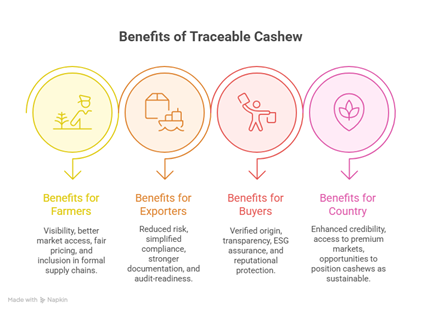
Global buyers are tightening requirements for sustainability, legality, and transparency in the cashew trade, and these shifts directly affect Benin one of West Africa’s fastest-growing cashew exporters. Regulations, corporate ESG commitments, and stricter due-diligence expectations now require exporters to prove farm origin, land legality, and deforestation-free sourcing.
For Benin, where cashew supply chains rely heavily on smallholder farmers, informal aggregation, and limited digital documentation, meeting these standards is challenging without robust traceability. Batch mixing, undocumented sourcing, and lack of geospatial mapping create risks of non-compliance, shipment delays, price penalties, or even market exclusion.
Traceability matters because it enables exporters to:
As global demand shifts toward responsible sourcing, traceability becomes essential not just for compliance, but for protecting Benin’s competitiveness, boosting farmer inclusion, and securing the future of its cashew export industry.
Traceability in the Cashew Supply Chain in Benin is critical for securing long-term market access, meeting global compliance standards, and building buyer confidence. By adopting digital farmer onboarding, GPS-based plot mapping, and batch-level tracking, Benin can transform its traditional, fragmented cashew ecosystem into a transparent and verifiable supply chain. Investing in traceability today ensures that Benin’s cashew sector remains competitive, resilient, and aligned with the rapidly evolving expectations of international markets.
Struggling with visibility gaps? Discover how traceability can fix them in our Supply Chain Traceability Blog.
Transform your food supply chain with digital tools—explore the Digital Traceability for Food Systems Blog.
See how blockchain improves trust, transparency, and auditability—start with our Blockchain Traceability Blog.
Because global markets especially the EU, US, and Asia now demand verified origin, legal sourcing, and deforestation-free supply chains. Without traceability, shipments risk rejection.
Fragmented smallholder networks, lack of farm mapping, multi-tier aggregation, limited documentation, and poor data visibility across the supply chain.
Digital platforms enable farmer onboarding, plantation mapping, batch-level tracking, blockchain proof of origin, and automated compliance reporting.
Not necessarily. Many solutions offer offline data capture, cooperative-based data entry, and low-tech mobile tools that work even in low-connectivity regions.
It provides better access to formal markets, potential price premiums, stronger buyer relationships, reduced exploitation, and inclusion in certified and compliant export value chains.