
Quick summary: Traceability in the Cashew Supply Chain in Tanzania is essential for global market access. Learn how digital tools enable transparent, compliant, and premium cashew exports.

Traceability in the Cashew Supply Chain in Tanzania is increasingly important as global markets demand verified, legally sourced, and deforestation-free cashew products. Tanzania’s cashew sector driven by smallholder farmers, cooperative unions, and auction-based marketing faces traceability gaps in farm mapping, origin verification, and batch-level tracking. Implementing digital traceability systems enables geolocation of plantations, structured farmer registration, transparent chain-of-custody records, and automated compliance documentation. Strengthening traceability improves supply-chain visibility, reduces risks of mixed or undocumented cashew lots, enhances buyer confidence, and positions Tanzania’s cashew exports competitively in regulated international markets.
Tanzania is one of Africa’s top cashew producers and exporters, supplying a significant share of the region’s raw cashew nuts (RCN) and steadily expanding its processing capacity. Key growing regions such as Mtwara, Lindi, Ruvuma, Coast, and Tanga are dominated by smallholder farmers cultivating cashew on small, dispersed plots. Tanzania exports large volumes of cashew to major markets including India, Vietnam, the EU, and the Middle East, making the sector central to rural incomes and national export earnings.
The Tanzanian cashew supply chain generally moves through several structured steps: smallholder farmers → primary cooperative societies → auction system → processors → exporters. While this system ensures organized market participation, it also brings complexity. Heavy reliance on intermediaries—cooperatives, traders, and auction mechanisms—can result in mixed sourcing, making it difficult to trace the exact origin of cashew lots. Many farmers lack digital records, formal land-use documentation, or geospatial mapping, reducing visibility into farm locations and production conditions.
These structural limitations create major traceability challenges, including weak chain-of-custody oversight, inconsistent documentation, and limited verification of land legality or environmental impact. As global buyers increasingly require ethically sourced, deforestation-free, and fully traceable agricultural commodities, traditional manual and paper-based sourcing systems are no longer adequate. To maintain access to premium international markets and meet rising compliance expectations, Tanzania’s cashew industry must transition toward digitized, transparent, and fully verifiable supply chains capable of ensuring trusted origin and production integrity.
Discover practical strategies for sustainable cashew sourcing
Read the full Sustainable Cashew Blog now.
From farm mapping to blockchain traceability, our Guide to Food Traceability breaks it all down. Read it now.
Tanzania is one of Africa’s leading cashew producers, but achieving a fully traceable, compliant, and export-ready supply chain requires addressing several structural and operational challenges. Solving these issues with scalable, technology-driven approaches is essential for building transparency and resilience from farm to export.
Most of Tanzania’s cashew is produced by thousands of smallholder farmers across Mtwara, Lindi, Ruvuma, Coast, and Tanga. Many farms lack formal land titles, digital production records, or geospatial mapping. These gaps make it difficult to verify origin, document farm boundaries, or build reliable traceability records.
Key cashew regions face challenges such as limited internet connectivity, low smartphone penetration, and limited digital literacy. These constraints make real-time data capture difficult and slow down the adoption of digital traceability systems.
Tanzania’s marketing system—moving cashews through primary cooperatives, warehouses, and public auctions—creates multiple aggregation points. This structure often leads to mixing cashews from many farms, causing a loss of origin identity and making farm-level traceability more complex.
Digitizing thousands of farms, mapping geolocations, and maintaining updated datasets requires significant investment and coordination across cooperatives, processors, and exporters. Many actors lack the resources needed to undertake full-scale digital mapping.
Farmers, primary cooperative societies, and traders may hesitate to share data due to concerns about pricing implications, transparency, or regulatory oversight. Building trust and showing clear value better pricing, improved market access, and faster payments is crucial to encourage participation.
With targeted capacity building, digital integration, and strong public–private collaboration, Tanzania’s cashew sector can overcome these challenges and build a transparent, traceable, and competitive supply chain that meets global market expectations.
TraceX’s digital traceability platform provides the technological infrastructure needed to increase visibility, strengthen trust, and support compliance across Tanzania’s cashew supply chain. By digitizing every stage from farm production to export TraceX enables exporters, processors, cooperatives, and buyers to verify origin, ensure quality, and meet international standards.
TraceX connects smallholder farmers, primary cooperative societies (AMCOS), warehouse operators, processors, and exporters into a single digital ecosystem. This delivers:
This visibility reduces blind spots and minimizes the risk of undocumented or mixed-source cashews entering export channels.
TraceX captures GPS coordinates and polygon maps for every cashew farm. This allows exporters to:
This is crucial for verifying origin and meeting compliance requirements under emerging global regulations.
Farmers are digitally registered using mobile tools. Each digital profile includes:
This structured onboarding enhances data integrity and creates a verifiable supplier base.
Every batch of cashews receives a unique digital ID at the farm gate or first aggregation point (e.g., AMCOS). The ID follows the batch through:
This ensures end-to-end chain-of-custody tracking and allows exporters to trace shipments back to specific farms and regions.
TraceX uses blockchain or an immutable ledger to ensure that all records are:
This offers buyers and auditors reliable proof of origin and eliminates risk associated with data manipulation or fraudulent claims.
Digitized records allow TraceX to automatically generate:
This reduces paperwork, accelerates export approvals, and ensures continuous compliance readiness.
A digital traceability platform transforms Tanzania’s cashew supply chain from a fragmented, opaque system into a transparent, efficient, and globally competitive value chain. It strengthens compliance, builds buyer confidence, and opens higher-value export opportunities for Tanzania’s cashew industry.
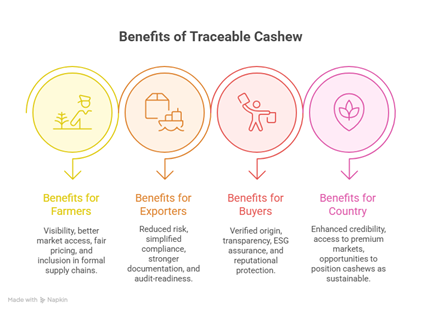
As global markets enforce stricter requirements on sustainability, legality, and sourcing transparency, traceability has become essential for Tanzania’s cashew sector. With major export destinations tightening their compliance rules, Tanzania must shift from informal, aggregated sourcing to fully verifiable supply chains to remain competitive.
High-value markets especially the European Union, United States, and Asia are rolling out stringent rules such as the EU Deforestation Regulation (EUDR). These require exporters to provide:
Without traceability, Tanzanian exporters risk non-compliance, shipment delays, and loss of market access.
Leading global processors, retailers, and food companies now expect:
Given Tanzania’s multi-tier system (farmers → AMCOS → auction → processors), traceability is critical to ensure buyers trust the product’s origin and integrity.
Opaque sourcing systems create multiple risks:
Global markets are increasingly intolerant of unknown-origin commodities, making traceability a non-negotiable requirement.
Traceable cashews bring multiple advantages:
Traceability helps Tanzania shift from bulk commodity trading to premium, differentiated, and compliant cashew exports.
For Tanzania, traceability is not just about meeting regulations it is a strategic necessity for strengthening the country’s global market position. By establishing transparent, digitally verifiable supply chains, Tanzania can:
As global demand grows for sustainable and accountable agricultural commodities, traceability is the key to securing Tanzania’s long-term cashew export success.
Traceability in Tanzania’s cashew supply chain is vital for meeting global sustainability expectations and maintaining access to high-value export markets. By adopting digital traceability systems that capture farm-level data, verify legal land use, and ensure transparent chain-of-custody tracking, Tanzania can transform its cashew sector from a largely aggregated, opaque system into a credible, compliant, and competitive value chain. Strengthened traceability enhances buyer trust, reduces compliance risks, supports smallholder inclusion, and positions Tanzania as a reliable supplier of high-quality, responsibly sourced cashews in the international marketplace.
Struggling with visibility gaps? Discover how traceability can fix them in our Supply Chain Traceability Blog.
Transform your food supply chain with digital tools—explore the Digital Traceability for Food Systems Blog.
See how blockchain improves trust, transparency, and auditability—start with our Blockchain Traceability Blog
Because global markets especially the EU, US, and Asia now demand verified origin, legal sourcing, and deforestation-free supply chains. Without traceability, shipments risk rejection.
Fragmented smallholder networks, lack of farm mapping, multi-tier aggregation, limited documentation, and poor data visibility across the supply chain.
Digital platforms enable farmer onboarding, plantation mapping, batch-level tracking, blockchain proof of origin, and automated compliance reporting.
Not necessarily. Many solutions offer offline data capture, cooperative-based data entry, and low-tech mobile tools that work even in low-connectivity regions.
It provides better access to formal markets, potential price premiums, stronger buyer relationships, reduced exploitation, and inclusion in certified and compliant export value chains.