
Quick summary: Explore the sesame supply chain from smallholder farms to global markets, including production, aggregation, processing, traceability challenges, and why digital transparency is reshaping trade.

Understanding how the sesame supply chain works and where it breaks down is critical for farmers, aggregators, traders, processors, exporters, and buyers alike. As regulations tighten and buyers demand more transparency, the traditional “commodity” approach to sesame is no longer sufficient.
Sesame is one of the world’s oldest oilseed crops, yet its supply chain remains one of the most fragmented, opaque, and risk-prone in global agricultural trade. Used widely in food, confectionery, edible oils, cosmetics, and health products, sesame is grown predominantly by smallholder farmers across Africa and Asia and exported to high-value markets such as the EU, Japan, China, South Korea, and the US.
This pillar blog breaks down the sesame value chain end-to-end, highlights key challenges, and explains why traceability and digitalisation are becoming essential for sustainable growth.
Key Takeaways
Sesame production sits overwhelmingly in the hands of smallholder farmers, who typically cultivate plots of 0.5 to 2 hectares as part of mixed-farming systems. In major producing countries such as Ethiopia, Sudan, Nigeria, Tanzania, India, Myanmar, and Pakistan, sesame is not only a cash crop but also a critical source of seasonal income, especially in rain-dependent and semi-arid regions.
Because of this production structure, sesame supply chains begin with thousands sometimes hundreds of thousands of independent farms, each operating with different practices, yields, and risk profiles. This fragmentation defines both the strength and the vulnerability of the sesame sector.
Sesame production worldwide reached approximately 9.26 million tonnes projected for 2025 on 14.8 million hectares (2020 data), with Africa dominating at 59.3% of global output in 2022 (Sudan 5.2 million ha, Tanzania 0.96 million ha, Nigeria 0.62 million ha, Ethiopia 0.45 million ha) and combined SSA producers (Sudan, Tanzania, Ethiopia, Nigeria, Burkina Faso) accounting for 57%. Smallholders form the core, cultivating on farms averaging 2-3 hectares per farmer with low yields of 150-350 kg/ha in Southern Africa, 298 kg/ha average in Mali/Senegal (up to 1,500 kg/ha max), 449-550 kg/ha in West Africa (e.g., Burkina Faso, Niger), and scaling rapidly—e.g., from 10 ha in 2021 to over 2,000 ha in 2023 via cooperatives in Sahel regions—primarily as a cash crop rivaling cotton, produced with minimal chemicals for export to China, Nigeria, and Europe. This smallholder reliance (95.9% of output from Africa/Asia) drives global market growth to $13.8-17.8 billion by 2025-2030 (5.8% CAGR), underscoring needs for climate-resilient seeds, storage systems, and traceability to sustain demand amid volatility.
Sesame is mostly grown without irrigation, depending entirely on monsoon or seasonal rainfall. While the crop is drought-tolerant, irregular rainfall patterns, delayed monsoons, or sudden dry spells can significantly affect germination, pod filling, and final yields. Climate variability therefore introduces high year-to-year uncertainty in production volumes, complicating export planning and contract fulfilment.
Most sesame farmers rely on manual or semi-manual practices for planting, weeding, harvesting, and threshing. Harvesting is particularly labour-intensive, as sesame pods shatter easily if mishandled. Limited access to machinery increases:
These factors directly influence quality consistency and timing of market supply.
Production decisions such as planting dates, varietal selection, pest management, and drying techniques are often based on generational knowledge and local experience rather than formal agronomic guidance. While this traditional expertise is valuable, the absence of structured advisory services limits the adoption of improved seed varieties, climate-smart practices, and quality management techniques that could raise productivity and resilience.
Perhaps the most significant structural issue is the lack of farm-level data. Most smallholders do not maintain:
Transactions are frequently cash-based, and records if any are paper-based or verbal. As a result, sesame production data effectively disappears once grain leaves the farm.
Although sesame is a relatively low-input and hardy crop, the absence of reliable farm-level data creates ripple effects across the entire value chain:
In essence, while sesame production starts strong at the farm level, the invisibility of smallholder data beyond the farm gate weakens the entire supply chain. Closing this data gap is becoming critical not only for compliance and quality assurance, but also for ensuring that smallholder farmers remain integrated into future, higher-value sesame markets.
Discover how blockchain brings trust, immutability, and real-time visibility to agricultural supply chains. Learn how leading food and agri companies use blockchain to prove origin, reduce risk, and meet regulatory expectations.
Read: Blockchain Traceability — How It’s Transforming Food & Agricultural Supply Chains
Understanding traceability is one thing, implementing it is another. Explore a practical, step-by-step guide to building traceability across farms, aggregation, processing, and export without disrupting your existing operations.
Read: How to Implement End-to-End Traceability in the Food Industry
The sesame supply chain is structurally vulnerable to value leakage, risk accumulation, and market access constraints. From harvest to export, a series of operational and data gaps compound, making challenges systemic rather than isolated. The following are the most critical challenges highlighted across post-harvest handling, aggregation, processing, and global trade.
Sesame’s sensitivity after harvest makes post-harvest handling one of the largest sources of value loss in the supply chain. Improper drying exposes sesame to moisture damage, mould growth, and aflatoxin risk, leading to quality downgrades or outright rejection in export markets. Poor cleaning and handling introduce impurities such as stones, dust, and plant matter, while uncontrolled storage increases the risk of pest infestation.
Without clear protocols or monitoring at the village level, quality deterioration often occurs before the grain enters formal trade channels, making recovery difficult or impossible later in the chain.
A major structural weakness of sesame supply chains is the lack of batch-level identification from harvest through storage. Sesame is frequently mixed across farmers, villages, and regions, eliminating the ability to link quality outcomes or compliance issues back to specific origins.
Once varietal or regional identity is lost, exporters are unable to:
This lack of traceability directly undermines buyer confidence and limits access to premium or regulated markets.
Aggregation represents the most fragile and opaque stage of the sesame supply chain. As sesame passes through multiple intermediaries collectors, traders, and aggregators data continuity breaks at each transaction point.
Common challenges include:
By the time sesame reaches processors or exporters, origin data is either incomplete or lost entirely, making compliance verification and buyer reporting extremely difficult.
While cleaning and processing facilities may meet technical quality standards, they often lack verified upstream data on farm origin, sustainability, or land-use practices. This creates a disconnect between physical product quality and compliance requirements.
As regulations tighten particularly in the EU, Japan, and US even high-quality sesame can face:
Processing alone is no longer sufficient; compliance increasingly depends on upstream transparency.
Global sesame buyers are shifting from volume-driven procurement to risk-aware, data-backed sourcing models. Increasing ESG commitments and regulatory obligations mean buyers now expect proof of origin, ethical sourcing, and environmental compliance alongside consistent supply.
Emerging regulations, such as EU due diligence and deforestation-linked requirements (relevant in some producing regions), amplify the risks for exporters operating opaque supply chains. Sesame suppliers unable to demonstrate traceability or sustainability face reduced buyer trust, lower prices, or market exclusion.
The combined effects of quality losses, aggregation inefficiencies, compliance delays, and rejected shipments translate into hidden costs that erode margins across the value chain. These costs are often absorbed silently through:
Without improved systems, these inefficiencies continue to accumulate, limiting the long-term competitiveness of sesame exporters.
Across harvesting, aggregation, processing, and export, the core challenge in sesame value chains is structural opacity. Quality risks, traceability gaps, and compliance pressures are no longer isolated issues they are interconnected and compounding. Addressing these challenges requires coordinated improvements in post-harvest management, batch identity preservation, and end-to-end data visibility, without which sesame exporters will struggle to meet evolving global market expectations.
Traditional sesame supply chains were designed to move volumes quickly from farm to port, prioritising speed, liquidity, and aggregation over transparency. For decades, this model worked sesame was treated as a bulk commodity, and buyers relied primarily on visual inspection and basic quality parameters.
Today’s global buyers, regulators, and food companies operate in a risk-sensitive, compliance-driven environment where origin, sustainability, and accountability matter as much as price. As a result, traceability is no longer a “nice to have” it is becoming a prerequisite for market access.
Traceability allows exporters to link each shipment back to its farm or farmer group of origin. This is critical for demonstrating where sesame was grown, under what conditions, and whether it meets buyer or regulatory requirements related to origin, sustainability, or due diligence. Farm-level origin verification is increasingly expected by buyers seeking transparency and accountability.
With batch-level traceability, sesame is tracked as it moves through harvesting, aggregation, processing, storage, and export. This preserves identity and prevents uncontrolled mixing. It also enables exporters to segregate quality grades, varieties, or origins a key requirement for premium, identity-preserved sesame markets.
Traceability transforms risk management from reactive to proactive. When origin and batch data are available, exporters can:
This is especially critical as food safety, ESG, and environmental scrutiny increase.
Faster and more confident buyer and regulator response
When regulators or buyers request information such as proof of origin, handling history, or compliance documentation traceable supply chains allow exporters to respond quickly and accurately. This reduces inspection delays, avoids shipment holds, and strengthens buyer trust.
Without verifiable traceability, exporters struggle to meet documentation requests during inspections. Missing or inconsistent records often lead to delayed clearance, additional testing, or outright rejection all of which increase costs and reputation risk.
Buyers increasingly favour suppliers who can demonstrate transparency and consistency. Exporters unable to provide traceability face growing scepticism, shorter contracts, and higher scrutiny, even if product quality appears acceptable.
Markets offering better prices or long-term contracts such as the EU, Japan, and certain multinational buyers are steadily raising their traceability and compliance thresholds. Exporters without robust traceability are pushed into lower-margin, less stable markets.
In opaque supply chains, compliance becomes manual, time-consuming, and expensive. Audits require extensive back-and-forth, document reconstruction, and field verification. Over time, these inefficiencies cost more than building traceability upfront.
The push for traceability in sesame is not isolated or temporary. It reflects a broader shift in global agri-food trade toward transparency, accountability, and sustainability. Regulatory pressure, ESG commitments, and buyer risk management are reinforcing each other and that momentum will only intensify.
For sesame exporters, the choice is clear:
In today’s sesame trade, traceability is no longer optional it is foundational.
Digitisation is rapidly reshaping how sesame moves from smallholder farms to global markets without requiring exporters or aggregators to dismantle existing trading models. Instead, platforms like TraceX enable stakeholders to layer digital traceability, compliance, and data visibility onto established supply chains, closing long-standing gaps between production and export.
TraceX Traceability Platform acts as a connective digital backbone across the sesame value chain, ensuring that data captured at each stage is linked, verifiable, and usable for both commercial and compliance needs.
TraceX enables exporters and aggregators to onboard sesame farmers digitally, creating verified farmer profiles that include identity details, location, and farm characteristics.
Instead of fragmented paper records or informal lists, each farmer becomes a digitally recognized supplier within the system. This ensures:
This is foundational for building traceability in highly fragmented sesame-producing regions.
Learn how integrated KYC, verified farmer profiles, and digital workflows can reduce risk, speed up onboarding, and improve operational efficiency across your sourcing network.
Using mobile-based tools, TraceX platform allows field teams or partners to capture GPS coordinates and polygon maps of sesame farms and plots.
This provides:
Farm mapping turns sesame from an anonymous commodity into an origin-verified product linked to real farms and geographies.
At procurement, TraceX platform digitises every transaction between farmers, collectors, and aggregators. Sesame purchases are recorded digitally and assigned batch or lot IDs, preserving traceability from the moment grain is collected.
This ensures:
Digital procurement eliminates data loss at the first aggregation point—a critical break in traditional supply chains.
TraceX platform extends traceability into warehouses and processing facilities by tracking:
Each inventory movement maintains a chain of custody, enabling exporters to know exactly which farms and batches contribute to every export consignment.
One of the greatest operational benefits of TraceX is automated compliance documentation. The platform compiles farm data, batch history, movement records, and processing data into audit-ready, buyer-ready reports.
This supports:
When information requests arise, exporters can respond with confidence without scrambling to reconstruct supply chain records.
Crucially, TraceX does not require exporters to rebuild their supply chains. Village collectors, local traders, aggregators, and processors continue operating as they do today. What changes is how data flows alongside the product.
By digitising interactions rather than disrupting them, TraceX:
In traditional sesame value chains, data disappears as the product moves upstream. TraceX reverses this dynamic by ensuring that every handoff strengthens rather than weakens traceability.
The result is a sesame supply chain that is:
Global sesame markets are undergoing a fundamental transition. What was once traded almost entirely as a bulk, anonymous commodity is increasingly being sourced as a traceable, origin-verified product. This shift is being driven by tightening regulations, heightened buyer risk awareness, and a growing preference for transparent, sustainably sourced ingredients.
In the traditional commodity model, sesame from multiple farms, regions, and even countries was mixed together, with little or no ability to trace it back to its source. Price was negotiated largely on volume, basic quality parameters, and timing. Today, that model is losing relevance particularly in premium, regulated, and long-term contract markets.
Buyers in food manufacturing, retail, and consumer brands now carry greater responsibility for what enters their supply chains. Regulatory requirements, ESG commitments, and reputational risk mean buyer decisions extend far beyond price alone.
The move toward identity-preserved sesame is not a short-term marketing exercise it reflects a structural change in how agricultural products are sourced and valued globally. As transparency becomes a baseline expectation, exporters who remain locked into anonymous bulk trade models risk commoditisation and margin erosion.
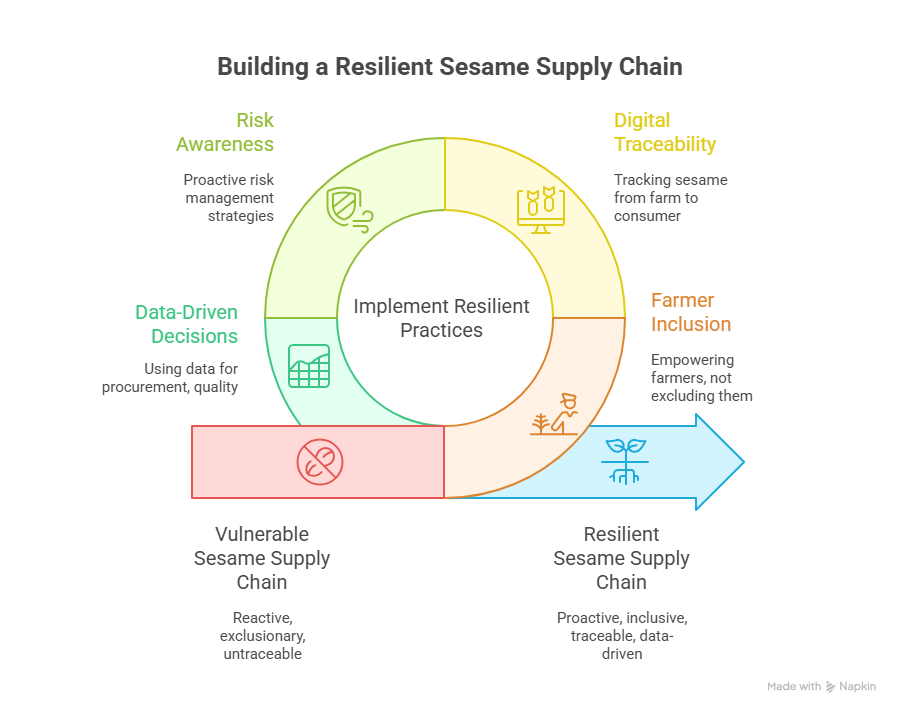
Sesame sits at a critical inflection point. Demand is rising, end markets are becoming more regulated, and buyers are shifting risk upstream, yet much of the supply chain still operates with limited visibility and weak data foundations. What once worked in a low-scrutiny, volume-driven market is no longer sufficient in an environment defined by due diligence, ESG accountability, and traceable sourcing.
Exporters and aggregators now face a clear strategic choice. Continuing with opaque, paper-based systems increases exposure to shipment rejections, buyer disengagement, and margin pressure. Investing in traceability, digital records, and transparent sourcing, on the other hand, secures market access, strengthens buyer confidence, and unlocks opportunities for differentiation and premium positioning.
Those who act early will shape the next phase of the sesame trade. By embedding traceability and data into their supply chains today, they will move beyond commodity selling to become trusted partners in global food systems resilient, compliant, and positioned to capture long-term value as the rules of trade continue to evolve.
Discover how end-to-end supply chain traceability can transform your operations. Read our latest blog to learn how visibility from farm to fork drives compliance, efficiency, and trust.”
[Read the Blog →]
Want to ensure every link in your supply chain is verified and transparent? Explore our insights on chain of custody management and how it safeguards quality, authenticity, and compliance.”
[Explore Now →]
See how digital traceability is reshaping the food industry. Learn how real-time data, batch tracking, and automated reporting can boost efficiency, safety, and market confidence.”
[Learn More →]
Most of the world’s sesame is produced by smallholder farmers cultivating small plots with limited mechanisation. Their role is central to supply availability, but fragmented production also creates challenges around data visibility, quality consistency, and traceability.
Traceability is most commonly lost during aggregation, where sesame moves through multiple collectors and traders. Batch mixing, cash-based transactions, and manual record-keeping make it difficult to link exported sesame back to its farm of origin.
Buyers and regulators increasingly require proof of origin, quality, and sustainable sourcing. Traceability reduces compliance risk, supports identity-preserved sesame, enables premium pricing, and helps exporters maintain access to regulated and high-value markets.