
Quick summary: Learn how EUDR Due Diligence (DDS) affects UK’s gloves supply chain. Understand traceability, risk assessment, origin verification, and compliance requirements for importers.
EUDR DDS for Gloves Supply Chain in UK requires glove manufacturers, importers, and distributors to submit a Due Diligence Statement proving that products placed on or exported from the UK market are deforestation-free and legally produced. This applies to gloves made from EUDR-regulated commodities such as natural rubber, leather, or cocoa-based additives. Companies must collect plot-level geolocation data, assess deforestation risk, and maintain traceable chain-of-custody records. Robust digital traceability and supplier verification are essential to meet EUDR compliance requirements and avoid trade or enforcement risks in the UK.
The UK is a major importer and distributor of medical, industrial, and food-grade gloves, supplying the NHS, private healthcare providers, food processors, and safety equipment markets. UK importers source large volumes of rubber, latex, and nitrile gloves from Southeast Asia primarily Malaysia, Thailand, Vietnam, Indonesia, and China with natural rubber inputs often originating from ASEAN countries and parts of West Africa. These sourcing regions operate under highly variable land-use regulations, forest governance frameworks, and documentation standards, creating significant challenges for EUDR-aligned verification.
UK imports of rubber surgical and protective gloves (HS 401511 & 401519) run into hundreds of millions of dollars annually, reflecting a complex, multi-tiered supply chain. Natural rubber commonly passes through smallholder farmers, aggregators, processors, and traders before reaching glove manufacturers. At these upstream stages, plot-level geolocation, deforestation-free evidence, and legality documentation are frequently absent. Commingling of latex from multiple farms and a lack of mapped plantation boundaries further weaken traceability.
Under the EUDR, UK glove importers placing goods on the EU market or re-exporting via EU hubs must submit a robust Due Diligence Statement (DDS) with precise geolocation data, deforestation risk assessments, legality checks, and verifiable chain-of-custody records. Fragmented sourcing networks and inconsistent upstream data significantly increase the risk of non-compliance, shipment delays, and restricted market access, making digital traceability, geospatial mapping, and supplier due diligence essential for the UK gloves sector.
The UK gloves sector supports:
Upstream, UK glove procurement directly links to millions of rubber farmers and factory workers across Southeast Asia, making UK demand a critical pillar of global glove supply chains.
Major UK importers / distributors:
Manufacturers / OEM suppliers (overseas):
Retail & B2B buyers:
Upstream:
Midstream:
Downstream:
UK-distributed gloves primarily serve:
While Brexit reduced frictionless EU redistribution, the UK remains a high-consumption, high-compliance gloves market, with strong procurement governance and regulatory oversight.
Import & Export Value
The UK functions primarily as an end-user and compliance-driven consumption hub, converting global glove imports into regulated, certified, and healthcare-ready supply for one of the world’s largest public health systems.
Although gloves themselves are not listed as an EUDR-regulated product, natural rubber a core input for many medical, examination, household, and industrial gloves is fully covered under the EU Deforestation Regulation (EUDR).
This places the UK gloves market under indirect but material exposure, especially for companies supplying the EU, Ireland, or Northern Ireland, or relying on EU-based customers and frameworks.
For a country that is one of Europe’s largest glove-consuming and PPE-importing markets, EUDR is a trade-access and supply continuity issue, not a theoretical ESG concern.
Key EUDR Relevance Points for the UK
EUDR readiness also future-proofs UK firms against copy-on regulations likely to emerge in the UK and other Global North markets.
Master the step-by-step process of submitting Due Diligence Statements under the new EUDR rules.
Read the blog on filing DDS for EUDR compliance
Stay Ahead of EUDR in Healthcare Supply Chains
Germany’s medical and PPE sector is entering a new era of transparency. Don’t wait for regulatory audits or shipment blocks—learn how healthcare manufacturers and importers can streamline EUDR DDS, secure supplier data, and protect market access.
Read the full guide on EUDR compliance for the healthcare sector
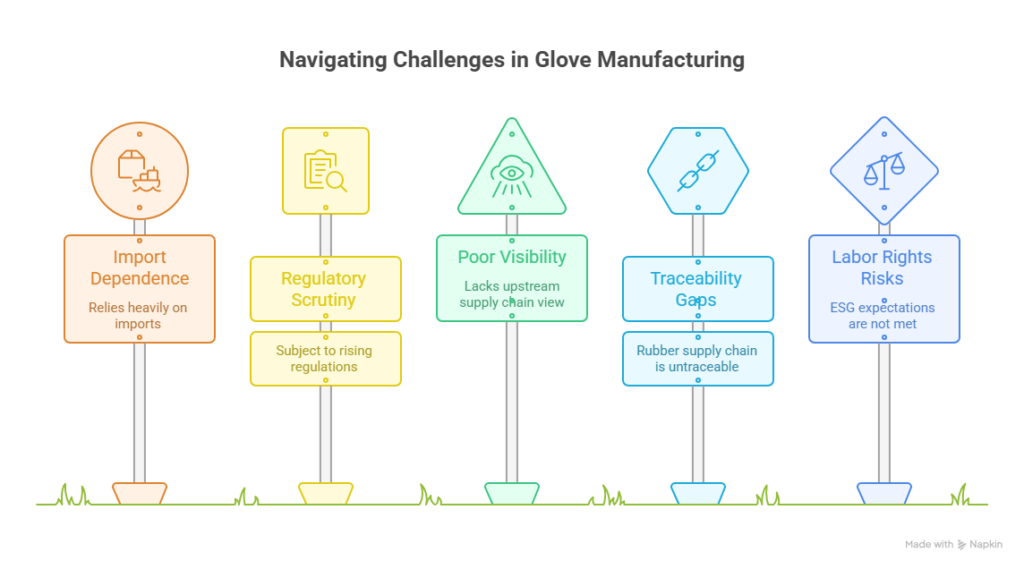
UK gloves importers and manufacturers face a distinct set of structural, regulatory, and data-integrity challenges that make EUDR exposure complex and unavoidable particularly for companies supplying the EU, Ireland, or Northern Ireland, or embedded in EU-centric healthcare and industrial value chains.
The UK relies almost entirely on imported natural rubber and nitrile-based gloves sourced from Malaysia, Thailand, Indonesia, Vietnam, China, and Sri Lanka.
These regions are dominated by smallholder rubber farming, where:
This makes EUDR-required traceability to plot-level geolocation extremely difficult, especially for legacy suppliers.
Rubber used in UK-bound gloves typically moves through:
Smallholder farms → Aggregators → Local processors → Rubber factories → Glove OEMs → Traders → UK importers
Each handoff introduces:
For UK importers, legal accountability exists downstream, while data control sits upstream.
Although the UK is outside the EU, EUDR still impacts UK glove businesses because:
This means UK firms must support DDS-ready supply chains, even when the legal filing is done by an EU-based operator.
A significant share of glove manufacturers supplying the UK cannot yet provide:
These gaps create material compliance risk for UK exporters dealing with EU-facing customers.
Nitrile and hybrid gloves introduce additional complexity. Manufacturers often source:
These inputs are rarely traceable to farm-level origins, making EUDR alignment for blended products operationally difficult.
UK PPE importers must now invest in:
For SMEs which dominate UK glove distribution this creates disproportionate cost and capability strain.
Without complete and credible EUDR-aligned data, UK glove suppliers face:
In a low-margin market, even minor compliance failures can erase profitability or market access.
For UK gloves importers and manufacturers, EUDR risk is indirect but very real.
Supply chains built for cost and volume are now being tested on traceability, legality, and deforestation-free proof.
UK firms that fail to adapt risk being screened out of EU, Ireland, and Northern Ireland supply chains, while those that act early can turn compliance into a defensive moat and commercial advantage.
TraceX EUDR Compliance Platform provides an integrated digital compliance infrastructure that helps UK glove importers, manufacturers, and distributors meet EUDR-aligned due diligence expectations particularly for natural-rubber-based medical, examination, and industrial gloves sourced from Southeast Asia and Africa.
Although the UK is outside the EU, EUDR obligations still affect UK gloves businesses supplying EU markets, Ireland, or Northern Ireland, or operating within EU-linked healthcare and industrial procurement chains. TraceX enables UK companies to collect, verify, and pass through EUDR-grade data without disrupting commercial operations.
Natural rubber used in gloves is largely sourced from fragmented smallholder systems. TraceX enables upstream suppliers to digitally submit:
This gives UK importers the verifiable origin data required by EU buyers and Finnish, Irish, and Northern Irish operators filing DDS submissions.
TraceX creates a continuous digital chain of custody across the rubber-to-glove value chain:
Latex collection → processing (cup lumps, RSS, TSR) → compounders → glove manufacturers → exporters → UK importers
Each material batch and glove shipment receives a unique digital ID, reducing risks related to commingling, aggregation, or re-processing, and enabling defensible deforestation-free sourcing claims.
TraceX platform automates the capture and validation of all EUDR-relevant documentation, including:
Supplier sustainability Built-in data checks flag missing, inconsistent, or high-risk records pre-shipment, reducing exposure for UK importers supporting EU-facing customers.
Using GIS and satellite analytics, TraceX provides ongoing land-use monitoring to identify:
Each supplier, batch, and shipment is assigned a dynamic EUDR-aligned risk score, helping UK businesses prioritise mitigation before contracts or shipments are affected.
TraceX platform compiles geolocation, legality, and risk intelligence into a structured, submission-ready DDS data package, enabling:
Multilingual mobile tools and guided onboarding workflows help:
in Malaysia, Thailand, Indonesia, Vietnam, and West Africa adopt EUDR-aligned traceability quickly, without requiring advanced digital infrastructure.
All traceability and compliance records are anchored on blockchain, ensuring:
This level of data integrity is increasingly expected by EU healthcare and industrial buyers.
UK gloves businesses gain live visibility into:
This enables proactive resolution of issues before shipments move into EU or Northern Ireland supply chains.
TraceX platform integrates with SAP, Oracle, Microsoft Dynamics, and leading logistics platforms used by UK PPE distributors allowing compliance to run alongside procurement, inventory, and fulfilment workflows.
For the UK gloves supply chain, EUDR Due Diligence Statement (DDS) requirements are no longer a peripheral compliance issue they are a commercial access requirement for any business connected to EU, Irish, or Northern Irish markets. Even though gloves are not explicitly listed under EUDR, the regulation’s coverage of natural rubber places UK importers, manufacturers, and distributors squarely within its impact zone.
As EU buyers push traceability and liability upstream, UK firms must be able to produce plantation-level origin data, legality proof, and deforestation-free assurance on demand. Companies that fail to do so risk shipment disruption, contract loss, and exclusion from regulated procurement frameworks. Conversely, those that invest early in digital traceability, geospatial verification, and DDS-ready data systems will secure continuity, buyer trust, and long-term resilience.
Understand the key components of EUDR compliance and how to streamline your DDS process efficiently.
Read the blog on EUDR Due Diligence
Learn how AI-driven automation and intelligent workflows simplify data collection, verification, and reporting.
Explore the blog on Agentic AI for EUDR
Unpack the biggest hurdles faced by importers under EUDR and how technology can turn compliance into a competitive edge.
Read blog on Challenges for EU Importers
Gloves made from natural rubber fall under EUDR because rubber is a regulated commodity. UK’s glove importers must prove deforestation-free, legally sourced rubber.
Importers must collect plot-level geolocation of rubber farms, verify legal harvesting, assess deforestation risk, and submit a Digital Due Diligence Statement before placing gloves on the EU market.
Most natural rubber comes from smallholder farmers in Southeast Asia and Africa, where limited mapping, informal trade, and supply commingling create traceability gaps.
Manufacturers must ensure full traceability for rubber used in surgical, household, and industrial gloves. Non-compliance risks shipment delays, fines, and market restrictions.
They must provide farm geolocation, legality records, land-use rights, supply chain traceability documents, and proof of deforestation-free sourcing.
Yes. Platforms like TraceX automate origin mapping, supplier data collection, risk scoring, and DDS generation, reducing manual compliance efforts and ensuring audit-ready records.