
Quick summary: Learn how EUDR Due Diligence (DDS) affects Poland’s gloves supply chain. Understand traceability, risk assessment, origin verification, and compliance requirements for importers.
EUDR DDS for Gloves Supply Chain in Poland requires importers and manufacturers to demonstrate deforestation-free sourcing for all natural rubber used in medical, industrial, and protective gloves. Although gloves are not directly listed under EUDR, natural rubber is a regulated commodity, triggering mandatory Due Diligence Statements (DDS). Polish importers sourcing from Southeast Asia and West Africa must submit plantation-level geolocation, legality documentation, risk assessments, and verifiable chain-of-custody for every shipment. Non-compliance exposes companies to border delays, penalties, and restricted access to EU healthcare and industrial markets.
Poland plays a significant role in Europe’s import, warehousing, and redistribution of medical, industrial, and food-grade gloves. Polish importers source large volumes of rubber, latex, and nitrile gloves from Southeast Asia primarily Malaysia, Thailand, Vietnam, Indonesia, and China as well as natural rubber inputs originating from West Africa and ASEAN countries. These origins operate under differing land-use regulations, forest governance systems, and documentation practices, making EUDR-compliant origin verification highly inconsistent.
In 2023, Polish imports of rubber surgical and protective gloves (HS 401511 & 401519) reached substantial levels, reflecting the sector’s scale and complexity. Much of the natural rubber used in glove production flows through multi-tiered chains involving smallholders, aggregators, processors, and traders, where plot-level geolocation, land-use evidence, and deforestation-free documentation are often incomplete or missing. Commingling of latex and lack of mapped farm boundaries further complicate traceability.
Under the EUDR, Polish glove importers must submit a fully compliant Due Diligence Statement (DDS) including precise plantation coordinates, proof of legality, risk assessments, and verifiable chain-of-custody. Fragmented upstream networks and inconsistent documentation significantly increase the risk of non-compliance, shipment delays, or restricted EU market access. These vulnerabilities make digital traceability, supplier onboarding, and geospatial mapping essential for Poland’s gloves sector to meet upcoming enforcement requirements.
Poland’s glove sector supports:
Upstream, the supply chain links to millions of rubber farmers and glove factory workers across Southeast Asia.
Upstream:
Midstream:
Downstream:
Polish gloves are primarily re-exported to:
With modern ports and logistics infrastructure, Poland is emerging as a key PPE distribution hub for Central and Eastern Europe.
Poland converts global glove imports into certified, compliant, and value-added supply flows for domestic use and EU distribution.
Although gloves themselves are not explicitly listed as an EUDR-regulated commodity, natural rubber—the main material for many medical, industrial, and household gloves—is fully covered under EUDR. This makes Poland a key European import and distribution hub with significant exposure to EUDR compliance requirements in the PPE sector.
Master the step-by-step process of submitting Due Diligence Statements under the new EUDR rules.
Read the blog on filing DDS for EUDR compliance
Stay Ahead of EUDR in Healthcare Supply Chains
Germany’s medical and PPE sector is entering a new era of transparency. Don’t wait for regulatory audits or shipment blocks—learn how healthcare manufacturers and importers can streamline EUDR DDS, secure supplier data, and protect market access.
Read the full guide on EUDR compliance for the healthcare sector
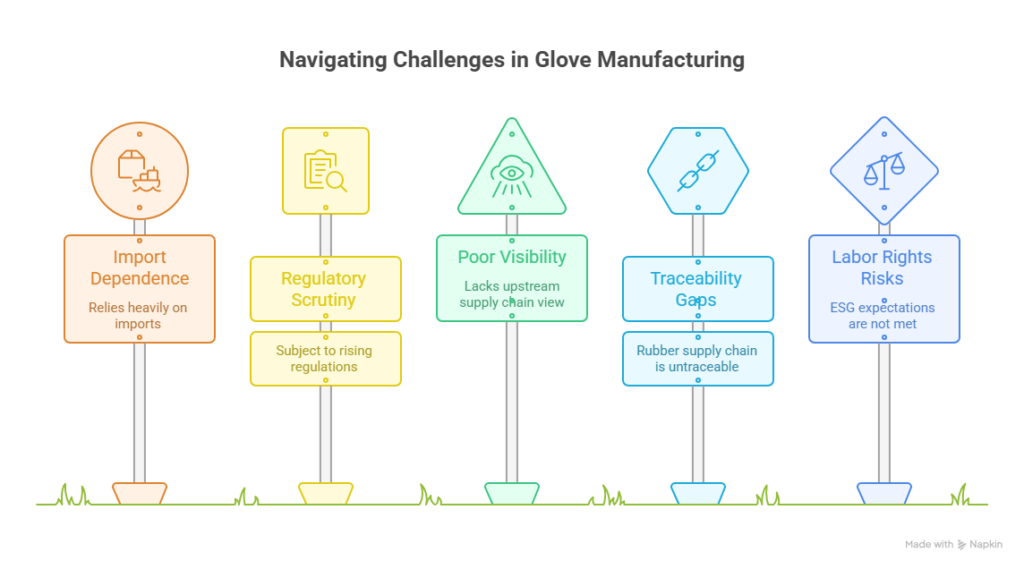
1. Complex Supply Chains
2. EUDR Compliance Requirements
3. Risk of Non-Compliance
4. Market and Operational Pressures
5. ESG and Buyer Expectations
Polish glove importers and manufacturers face regulatory, operational, and market challenges due to multi-tiered, international supply chains, traceability gaps, and EUDR compliance obligations. Investing in digital traceability, supplier onboarding, and geospatial verification can reduce risks, ensure uninterrupted EU market access, and strengthen competitive positioning.
TraceX EUDR Compliance Platform provides an integrated digital compliance infrastructure that helps Polish glove importers, distributors, and logistics hubs meet emerging EUDR-aligned due diligence requirements, particularly for natural-rubber-based gloves sourced from Asia and Africa. As Poland serves as a growing PPE distribution hub for Central and Eastern Europe, it faces complex upstream traceability challenges. The TraceX EUDR Compliance Platform digitizes supplier data, plantation geolocation, processing records, and risk intelligence, enabling Polish companies to generate complete, audit-ready Due Diligence Statements (DDS) without disrupting operations.
Natural rubber used in medical, industrial, and household gloves often originates from fragmented smallholder systems. TraceX platform allows suppliers to upload:
This provides Polish importers with verified origin data required for legality and sustainability assurance under EUDR.
TraceX platform digitally links every stage of the rubber value chain:
latex collection → processing (cup lumps, RSS, TSR) → compounders → glove manufacturers → exporters → Polish importers.
Each batch receives a traceable digital ID, eliminating blind spots caused by mixing, aggregation, or re-processing, and enabling defensible deforestation-free sourcing.
The platform automates the capture of all key documentation:
Smart validation checks flag missing or inconsistent records before shipment, reducing compliance risk for Polish importers.
Using GIS and satellite analytics, TraceX platform provides continuous land-use monitoring to detect:
Every shipment or supplier batch receives an auto-generated risk score aligned with EUDR requirements.
TraceX platform compiles all geolocation, documentation, and risk data into a complete, submission-ready DDS, ensuring glove shipments entering Polish ports meet EUDR due diligence standards.
Multilingual mobile tools and onboarding workflows help glove suppliers across Malaysia, Thailand, Indonesia, and West Africa adopt EUDR-aligned traceability quickly, including smallholders and mid-tier processors.
Every record is anchored on blockchain, providing tamper-proof traceability essential for Polish customs checks, audits, and regulatory investigations.
Polish importers gain visibility across:
This enables proactive issue resolution before goods arrive at Polish ports.
TraceX platform integrates with SAP, Oracle, Microsoft Dynamics, and logistics platforms used across Polish PPE distribution hubs, allowing compliance to run in parallel with procurement and inventory management.
For Poland’s glove importers and distributors, EUDR compliance is not just a regulatory obligation it is essential for maintaining seamless access to EU markets. By adopting digital traceability platforms, integrating geolocation data, and automating Due Diligence Statement (DDS) generation, Polish companies can mitigate risks from multi-tiered rubber supply chains, ensure verified deforestation-free sourcing, and strengthen ESG credentials. These measures not only reduce the likelihood of shipment delays, fines, or market rejection but also position Poland’s gloves sector as a reliable, transparent, and compliant hub within the European PPE ecosystem.
Understand the key components of EUDR compliance and how to streamline your DDS process efficiently.
Read the blog on EUDR Due Diligence
Learn how AI-driven automation and intelligent workflows simplify data collection, verification, and reporting.
Explore the blog on Agentic AI for EUDR
Unpack the biggest hurdles faced by importers under EUDR and how technology can turn compliance into a competitive edge.
Read blog on Challenges for EU Importers
Gloves made from natural rubber fall under EUDR because rubber is a regulated commodity. Polish glove importers must prove deforestation-free, legally sourced rubber.
Importers must collect plot-level geolocation of rubber farms, verify legal harvesting, assess deforestation risk, and submit a Digital Due Diligence Statement before placing gloves on the EU market.
Most natural rubber comes from smallholder farmers in Southeast Asia and Africa, where limited mapping, informal trade, and supply commingling create traceability gaps.
Manufacturers must ensure full traceability for rubber used in surgical, household, and industrial gloves. Non-compliance risks shipment delays, fines, and market restrictions.
They must provide farm geolocation, legality records, land-use rights, supply chain traceability documents, and proof of deforestation-free sourcing.
Yes. Platforms like TraceX automate origin mapping, supplier data collection, risk scoring, and DDS generation, reducing manual compliance efforts and ensuring audit-ready records.