
Quick summary: Traceability in the Shea Supply Chain in Uganda is essential for global market access. Learn how digital tools enable transparent, compliant, and premium cashew exports.

Traceability in the Shea supply chain in Uganda is increasingly essential as global buyers demand proof of ethical sourcing, quality consistency, and deforestation-free production. Uganda’s Shea sector, dominated by wild-harvested Shea from the Northern and West Nile regions, faces challenges such as informal collector networks, limited documentation, and fragmented processing. Implementing Traceability in the Shea Supply Chain in Uganda enables exporters to map tree locations, verify collector identities, ensure sustainable harvesting practices, and maintain batch-level quality records. This strengthens market access for EU and U.S. buyers, supports certification, enhances farmer income transparency, and builds a resilient, compliant value chain.
Uganda is one of East Africa’s growing shea producers, with natural shea parklands concentrated in the Northern and West Nile regions, including Karamoja, Lango, Acholi, and West Nile sub-regions. Shea trees (Vitellaria nilotica) grow wild in these savannah ecosystems, and harvesting is predominantly carried out by women collectors, who supply nuts to local traders, cooperatives, and processors.
Uganda produces an estimated 25,000–35,000 metric tons of raw shea nuts annually, with exports largely focused on shea butter, crude shea oil, and kernels. Export revenue fluctuates between USD 8–12 million per year, depending on seasonal production and international demand, with key markets including the EU, U.S., Japan, and the Middle East for cosmetic, food, and nutraceutical applications.
The Ugandan shea supply chain follows a multi-layered path: women collectors → community aggregators → cooperatives → processors → exporters. While this structure supports widespread livelihood participation, it also creates significant traceability and quality-control gaps. Heavy dependence on informal intermediaries leads to mixed lots and origin ambiguity, making it difficult for exporters to verify exact sourcing locations or sustainability practices. Most collectors lack digital records, geotagged parkland data, or standardized quality documentation, limiting visibility into harvest areas, ecosystem health, and compliance factors such as zero deforestation and fair labor practices.
These systemic challenges weaken chain-of-custody tracking and restrict Uganda’s ability to credibly demonstrate environmental and social compliance an increasingly critical requirement for global markets. With rising buyer expectations for deforestation-free sourcing, ethical production, and verifiable origin under standards like Organic, Fairtrade, UEBT, and regulatory frameworks such as the EU Deforestation Regulation (EUDR), traditional manual systems are no longer adequate.
To sustain and grow its export footprint, Uganda’s shea sector must transition to digitized, transparent, and traceable supply chains. Enhanced geolocation mapping, digital collector records, batch-level traceability, and verified sustainability indicators will not only strengthen market access but also improve incomes and resilience for the women and rural communities who form the backbone of Uganda’s shea economy.
Ready to Build a Fully Transparent Shea Supply Chain?
Discover how digital tools can streamline documentation, verify origin, and strengthen buyer confidence.
Explore the full guide to Forestry-to-Factory Traceability in Shea Supply Chains
From farm mapping to blockchain traceability, our Guide to Food Traceability breaks it all down.
Read it now.
Uganda’s shea sector, though growing steadily, faces several structural and operational challenges that hinder its full potential for export and sustainable development:
In short, Uganda’s shea industry requires digitized traceability, standardized quality management, and smallholder empowerment to meet global compliance, improve market access, and enhance rural livelihoods.
If you want, I can also generate a parallel section showing exactly how TraceX’s digital traceability platform addresses all these challenges in Uganda’s shea sector. Do you want me to do that?
The TraceX Traceability Platform delivers the digital infrastructure needed to bring transparency, compliance, and reliability to Uganda’s shea supply chain. By digitizing every step from parkland nut collection to aggregation, processing, and export, TraceX helps exporters, processors, cooperatives, and global buyers verify origin, monitor quality, and meet international sustainability and regulatory standards.
TraceX platform connects all supply chain actors women collectors, local traders, cooperatives, aggregators, processors, and exporters into a single digital ecosystem, enabling:
• Real-time tracking of nut movement
• Secure data flow across all nodes
• Centralized monitoring of collection, aggregation, processing, and export
This eliminates blind spots and ensures only verified, compliant shea moves through the supply chain.
The platform captures GPS coordinates or polygon maps for Uganda’s shea collection zones, allowing exporters to:
• Validate collection boundaries
• Confirm community-access and land-use rights
• Demonstrate deforestation-free, sustainable sourcing
• Maintain audit-ready geospatial records
Accurate mapping strengthens origin verification, critical for global buyers.
Using mobile tools, TraceX registers collectors and farmer groups with authenticated data:
• Collector identity and contact details
• GPS-linked collection areas
• Land-access or community rights documentation
• Harvest and yield records
• Cooperative or aggregator affiliations
This builds a verified digital network, reducing documentation gaps.
Each shea batch is assigned a unique digital ID from collection to export, ensuring complete chain-of-custody across:
• Parkland harvesting
• Local traders
• Cooperatives and aggregation points
• Processing centers
• Export documentation
Exporters can trace shipments back to specific communities and harvest periods.
All supply chain records are secured on blockchain:
• Immutable and tamper-proof
• Time-stamped and audit-ready
• Accessible to authorized stakeholders
Buyers gain verifiable proof of origin, critical for premium markets.
Digitized data allows TraceX platform to automatically produce:
• Traceability and origin verification reports
• Sustainability and ESG documentation
• Compliance records aligned with global regulations
• Buyer-specific due diligence reports
• Complete digital audit trails
This reduces manual workload and ensures Uganda’s exporters remain ready for international market requirements.
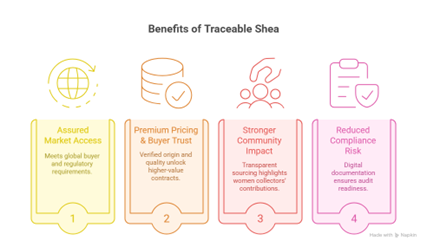
Uganda’s shea sector is increasingly exposed to global regulatory and market pressures that make traceability non-negotiable. Regulations require importers to provide verifiable proof that shea is sourced from deforestation-free areas. Similarly, sustainability certifications such as Fairtrade, Organic, and Rainforest Alliance are growing prerequisites for accessing premium international markets.
Key Insights & Trends:
Trend: The market is shifting from volume-based trading to quality, certified, and traceable supply, making digital traceability not just a compliance requirement but a strategic advantage for Uganda’s shea exporters.
This combination of regulatory pressure and market demand underscores the urgency for Uganda’s shea sector to digitize and certify its supply chain, ensuring global market access, premium pricing, and sustainable livelihoods for women collectors.
Traceability in Uganda’s shea supply chain is no longer optional it is essential for maintaining global market access, meeting regulatory standards like EUDR, and satisfying the growing demand for ethically sourced, deforestation-free products. By digitizing parkland collection, implementing GPS-based farm mapping, and adopting batch-level tracking, exporters can ensure full chain-of-custody from collector to buyer. These measures not only enhance compliance and transparency but also unlock premium market opportunities, strengthen ESG alignment, and support sustainable livelihoods for rural women collectors, positioning Uganda’s shea sector for long-term competitiveness and growth.
Struggling with visibility gaps? Discover how traceability can fix them in our Supply Chain Traceability Blog.
Transform your food supply chain with digital tools—explore the Digital Traceability for Food Systems Blog.
See how blockchain improves trust, transparency, and auditability—start with our Blockchain Traceability Blog
Because global markets especially the EU, US, and Asia now demand verified origin, legal sourcing, and deforestation-free supply chains. Without traceability, shipments risk rejection.
Fragmented smallholder networks, lack of farm mapping, multi-tier aggregation, limited documentation, and poor data visibility across the supply chain.
Digital platforms enable farmer onboarding, plantation mapping, batch-level tracking, blockchain proof of origin, and automated compliance reporting.
Not necessarily. Many solutions offer offline data capture, cooperative-based data entry, and low-tech mobile tools that work even in low-connectivity regions.
It provides better access to formal markets, potential price premiums, stronger buyer relationships, reduced exploitation, and inclusion in certified and compliant export value chains.