
Quick summary: Explore the complete guide to the EU Green Deal: understand its climate neutrality goals, key regulations like ESPR and DPP, global business impacts, and how compliance shapes trade, sustainability, and competitiveness across Europe and beyond.

The EU Green Deal is the European Union’s comprehensive strategy to achieve climate neutrality by 2050 through policies targeting emissions reduction, circular economy, clean energy, sustainable agriculture, and biodiversity protection. It includes regulatory frameworks such as the Fit for 55 Package, Carbon Border Adjustment Mechanism (CBAM), and sustainable finance rules that reshape how businesses produce, trade, and report. The EU Green Deal aims to decouple economic growth from resource use while ensuring a fair transition across sectors. For companies operating in or exporting to the EU, compliance with Green Deal measures is now a critical market requirement.
The EU Green Deal is the European Union’s comprehensive roadmap to transform its economy and achieve climate neutrality by 2050. It matters because it reshapes how businesses operate, how governments design policy, and how global trade partners access the EU market, requiring strict sustainability, emissions reduction, and traceability standards. As the core of Europe’s climate strategy, it integrates decarbonization across all sectors energy, industry, transport, buildings, and agriculture to meet the EU’s 2030 and 2050 targets. Its key pillars include climate action, clean energy expansion, sustainable industry and agriculture, biodiversity protection, circular economy practices, sustainable mobility, and green finance regulations such as CSRD, CBAM, and the EU Taxonomy.
Key takeaways
The EU Green Deal, introduced in December 2019, is the European Union’s master plan to transform its economy into a climate-neutral, resource-efficient, and socially inclusive system by 2050. It provides a comprehensive roadmap for reducing greenhouse gas emissions, restoring biodiversity, transitioning to clean energy, and redesigning industrial, agricultural, and transport systems to operate within planetary boundaries.
The Green Deal was shaped by mounting climate science warnings, the EU’s obligations under the Paris Agreement, growing geopolitical pressures around energy security and raw-material dependence, and the need to build a more resilient, competitive, and innovation-driven economy. It is not just an environmental plan it is a full economic transformation strategy.
By integrating climate goals across finance, industry, agriculture, trade, infrastructure, and consumer markets, the EU Green Deal sets the direction for all future EU regulations, including carbon pricing, sustainable finance, circular economy laws, and supply-chain due diligence rules. It serves as Europe’s blueprint for long-term sustainability leadership and global market influence.
The EU Green Deal is a fundamental contract between the EU, its member states, and the business community. It sets binding, legally enforced targets, the cornerstone of which is the European Climate Law.
To hit these goals, the European Commission developed the “Fit for 55” package a massive overhaul of existing EU laws and the introduction of new regulations across every sector.
The Green Deal is built on several key policy areas that together form the backbone of the EU’s green transition:
This is where the regulatory heavy-hitters like the Ecodesign for Sustainable Products Regulation (ESPR) live. The focus is on moving away from a ‘take-make-dispose’ model to one where products are durable, repairable, and recyclable. Key features include the Digital Product Passport (DPP), which mandates transparency and traceability for products like batteries and textiles, and strict standards to minimize waste.
This pillar enforces the emissions goals. It strengthens the Emissions Trading System (ETS), which puts a price on carbon for heavy industry and aviation. Critically, it introduces the Carbon Border Adjustment Mechanism (CBAM) often called a carbon tariff which taxes imports from countries with less strict carbon pricing, aiming to prevent “carbon leakage” (where production moves abroad to avoid EU rules).
The goal is to decarbonize the energy system by massively increasing the share of renewable energy (like wind and solar) and phasing out fossil fuels. It pushes for greater energy efficiency in all sectors.
The Renovation Wave strategy aims to double the annual energy renovation rate of buildings, making them more energy-efficient and supporting the use of sustainable building materials.
This includes major investment in rail and public transport, but most famously, the regulation effectively mandates that all new cars sold in the EU must be zero-emission vehicles by 2035.
This comprehensive strategy aims to make food systems fair, healthy, and environmentally friendly. Targets include reducing the use of chemical pesticides and fertilizers, promoting organic farming, and ensuring food security.
This involves restoring degraded ecosystems, protecting 30% of the EU’s land and sea areas, and implementing the Zero Pollution Action Plan to eliminate pollution of air, water, and soil.
The EU Green Deal is an export. Because the EU is a massive consumer market, its standards effectively become global standards for any company that wants to trade there.
In short, the EU Green Deal is reshaping global value chains, making sustainability and traceability non-optional operating costs for the next decade. It’s a powerful driver of innovation, but also a formidable compliance challenge.
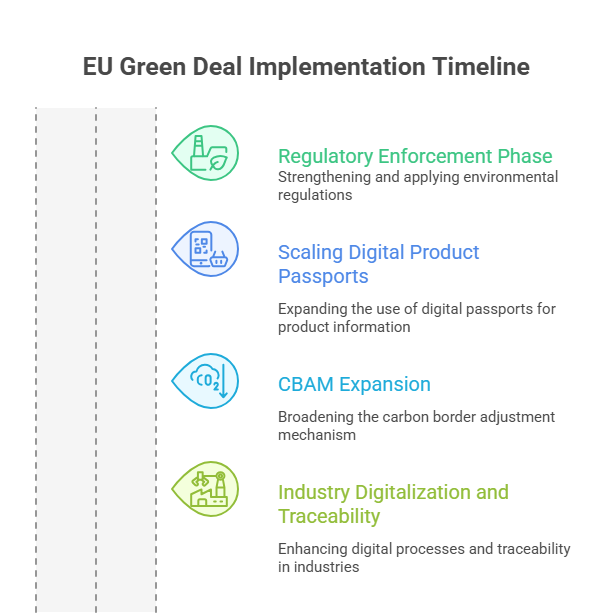
The EU Green Deal was formally launched in December 2019 as Europe’s roadmap for transforming its economy into a climate-neutral, resource-efficient system. During this phase, the EU set out its long-term vision, established governance structures, aligned it with the Paris Agreement, and initiated legislative proposals across energy, agriculture, industry, mobility, and biodiversity. The European Climate Law (2020) made climate neutrality by 2050 legally binding, laying the foundation for future regulatory actions.
Between 2021 and 2024, the EU moved from vision to implementation by adopting a series of landmark regulations. These include:
From 2025 onward, most Green Deal regulations enter active enforcement. This period will see:
The final phase focuses on completing the structural transformation required to reach net-zero emissions by 2050. Key actions will include large-scale adoption of clean technologies such as green hydrogen, carbon capture, advanced bioeconomy solutions, fully electrified mobility systems, and circular production models.
Cities, industries, and energy networks will shift toward near-zero emissions, while agriculture and land-use sectors must achieve major carbon-sink enhancements. By 2050, the EU targets a fully climate-neutral economy with sustainable resource cycles, resilient ecosystems, and a competitive green industrial base.
The EU Green Deal was created in response to converging scientific, economic, social, and geopolitical pressures that demanded a fundamental transformation of Europe’s development model. At its core, the initiative recognizes that climate change, biodiversity loss, and resource depletion threaten long-term stability and that delayed action would carry far greater costs than proactive transition.
The EU Green Deal is grounded in robust climate science showing accelerating global warming, extreme weather events, ocean acidification, and ecosystem collapse. Reports from the IPCC warn that without rapid emissions reductions, the world will surpass 1.5°C of warming, triggering irreversible impacts. Europe, already experiencing heatwaves, wildfires, droughts, and floods, adopted the Green Deal to prevent catastrophic climate risks and safeguard environmental resilience.
The Green Deal aims to position Europe as a global leader in the low-carbon economy. Transitioning early allows the EU to:
Beyond environmental goals, the Green Deal addresses critical societal needs. Air pollution, heat stress, and ecosystem degradation threaten public health, while climate change disrupts agriculture and food supply chains. The Green Deal promotes cleaner energy, sustainable food production, and healthier living environments. It also aims to generate millions of green jobs and ensure a “just transition” so that workers and communities dependent on carbon-intensive sectors are not left behind.
The EU Green Deal aligns the EU’s climate ambition with the Paris Agreement, committing Europe to limit global warming well below 2°C and pursue efforts toward 1.5°C. It transforms Paris commitments into binding EU law through the European Climate Law, setting clear milestones for 2030 and 2050. This alignment ensures coordinated international action and reinforces the EU’s leadership in global climate diplomacy.
The EU Green Deal operates through a multilayered governance framework involving EU institutions, member states, and international agreements. Its structure ensures that climate ambitions translate into enforceable laws, measurable progress, and coordinated action across Europe.
The European Commission is the central architect and regulator of the EU Green Deal.
The European Climate Law (2021) is the legal backbone of the EU Green Deal.
The EU Green Deal is Europe’s operational roadmap for fulfilling its commitments under the Paris Agreement.
The EU Green Deal establishes some of the world’s most ambitious climate targets to accelerate the decarbonization of all major economic sectors.
The Green Deal drives a fundamental transformation of Europe’s energy system toward sustainability, security, and affordability.
Nuclear energy remains one of the most debated components of Europe’s climate strategy.
The CEAP is a core Green Deal pillar designed to shift Europe from a linear “take–make–waste” model to a regenerative, circular economy.
The SPI transforms how products are designed, manufactured, and sold across the EU.
The Industrial Strategy aligns European manufacturing with net-zero goals.
Digitalization supports circularity by improving data access and traceability.
The EU aims to drastically limit waste generation and optimize material usage.
The ESPR replaces the traditional Ecodesign Directive with a broader sustainability framework.
The DPP is a digital record attached to every regulated product, enabling full lifecycle visibility.
ETS is Europe’s flagship carbon-pricing mechanism.
Several additional regulatory frameworks support the Green Deal’s core objectives:
The EU Green Deal fundamentally reshapes how companies around the world access the European market. As the EU tightens environmental rules across products, supply chains, and imported raw materials, exporters must adapt to new compliance, documentation, and traceability expectations. These changes are not optional non-compliant products risk being rejected, penalized, or removed from EU markets entirely.
Exporters selling into the EU must comply with a wide range of new sustainability-driven regulations under the Green Deal, including ecodesign rules, carbon footprint reporting, responsible sourcing, and environmental performance standards. This affects manufacturers in Asia, Africa, and Latin America as much as companies in Europe. Whether exporting electronics, textiles, food, batteries, machinery, or raw materials, businesses must demonstrate that their products meet the EU’s strict requirements on durability, energy efficiency, recyclability, packaging, emissions, and chemical safety. Compliance is shifting from voluntary to mandatory, with regulators conducting market surveillance and customs checks.
The Green Deal introduces unprecedented visibility expectations across global value chains. Exporters must trace materials, components, and inputs back to their origin, documenting how they were produced and whether they meet EU sustainability thresholds. This includes tracking carbon intensity, hazardous substances, recycled content, land-use impacts, raw material provenance, and end-of-life pathways. Sectors such as textiles, electronics, agri-food, batteries, timber, and renewable raw materials face the highest levels of traceability scrutiny. Importers must be able to map suppliers sometimes down to farm, factory, or mine-level or risk failing EU audits.
The Green Deal expands documentation obligations through several regulatory instruments:
Exporters who fail to meet EU Green Deal requirements face significant market access consequences. Non-compliant goods may be:
Despite its ambition, the EU Green Deal faces several implementation challenges and criticisms across economic, political, and regulatory dimensions. One of the most significant concerns is the high cost of compliance, particularly for industries undergoing mandatory decarbonization, product redesign, and new traceability requirements. Companies must invest in cleaner technologies, data systems, and sustainable materials—costs that often outweigh short-term returns, especially in energy-intensive sectors such as steel, chemicals, and manufacturing.
A major structural challenge is the preparedness gap among SMEs, which make up the majority of European and global suppliers. Many small and medium-sized enterprises lack the technical capacity, digital tools, sustainability expertise, or financial resources needed to comply with new rules such as ESPR, DPP, EUDR, and CSDDD. This creates a risk of exclusion from EU supply chains, potentially widening inequalities between large corporations and smaller suppliers.
The Green Deal also faces political and member state disagreements, as different countries carry different economic structures, energy mixes, and social priorities. Eastern and Southern European states often emphasize affordability and energy security, while Western and Northern states push for accelerated climate ambition. These political tensions delay regulatory negotiations and lead to uneven implementation across the bloc.
Finally, the EU Green Deal is often criticized for its regulatory complexity. The interconnected web of laws—ranging from carbon pricing and biodiversity rules to sustainable product regulations—creates a compliance landscape that is difficult for businesses to navigate. Overlapping requirements, evolving timelines, and dense technical documentation contribute to confusion, slower adoption, and rising compliance costs.
Together, these challenges highlight the need for coordinated support, streamlined rules, and digital tools to help businesses especially SMEs achieve Green Deal alignment without compromising economic resilience.
Technology solutions streamline compliance, traceability, and sustainability in complex supply chains by digitizing data, mapping farm or production sites, and automating reporting. Platforms from TraceX enable end-to-end visibility, batch-level tracking, and blockchain-secured records, helping businesses meet EU Green Deal, EUDR, or ESG requirements efficiently while reducing risks, improving audit readiness, and enhancing global market access.
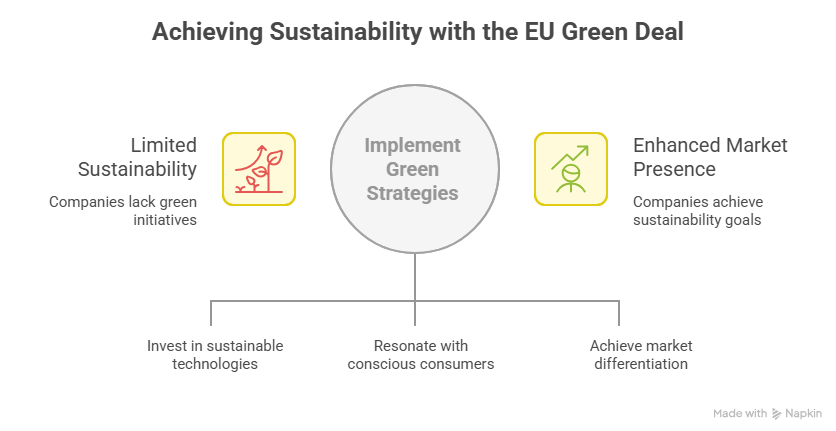
Understanding the EU Green Deal is critical because it represents a transformative policy framework reshaping Europe’s economy and global trade. For businesses, early comprehension and action are strategic imperatives: compliance timelines, regulatory complexity, and market expectations are evolving rapidly, and delayed adaptation can result in lost market access, fines, or reputational damage. Beyond legal obligations, the Green Deal links sustainability directly to competitiveness: companies that integrate energy efficiency, emissions reduction, and circular economy practices can lower costs, improve resilience, and access premium markets. In essence, early alignment ensures not only regulatory compliance but also strengthens global market positioning and long-term business viability.
Learn how your business can achieve carbon neutrality
Stay compliant with Europe’s evolving rules
Download the complete EU Sustainability Regulations Guide.
Understand how EUDR will reshape global supply chains
A comprehensive EU policy framework aiming to make Europe climate-neutral by 2050, promoting sustainability, resource efficiency, and reduced emissions across all sectors.
Non-EU exporters must meet EU sustainability, traceability, and product standards (e.g., ESPR, DPP) to access EU markets, or risk restricted market access and compliance penalties.
Key regulations include the ESPR (Ecodesign for Sustainable Products Regulation), Digital Product Passport (DPP), EU Emissions Trading System (ETS), Batteries Regulation, Packaging & Packaging Waste Regulation, and Corporate Sustainability Due Diligence (CSDDD).
Yes, for regulated products under ESPR, the DPP is mandatory to provide traceability, recyclability, and environmental information across the product lifecycle.
The EU aims to achieve net-zero greenhouse gas emissions by 2050, with a 55% emissions reduction target by 2030 as an intermediate milestone.
ESPR expands ecodesign beyond energy efficiency to include full product sustainability, durability, repairability, recyclability, and circularity, applying mandatory standards to a wider range of products.