
Quick summary: Traceability in the sesame supply chain in Togo ensures verified origin, quality control, and regulatory compliance, helping exporters meet global buyer standards and secure sustainable market access.

Traceability in the Sesame Supply Chain in Togo is increasingly critical as global buyers demand verified origin, quality assurance, and deforestation-free sourcing. Togo’s sesame sector is dominated by smallholder farmers, village aggregators, and informal traders, creating gaps in documentation, batch tracking, and export compliance. Strengthening traceability enables accurate farmer identification, geolocation of production zones, and transparent chain-of-custody from harvest to shipment. For exporters, robust traceability systems reduce contamination risks, ensure consistent quality, and meet EU and global due-diligence requirements. Improving traceability in the Sesame Supply Chain in Togo is now essential for market access, price premiums, and long-term industry competitiveness.
Togo is an emerging sesame producer in West Africa, steadily strengthening its position in global supply chains. Major production zones including Oti, Kara, Savanes, Centrale, and Plateaux are dominated by smallholder farmers cultivating sesame on small, scattered plots. Annual production averages 50,000–70,000 metric tons, with key export destinations such as Japan, China, Turkey, the EU, and the Middle East, where Togolese sesame is valued for its high oil content and clean flavor profile.
Togo’s sesame export landscape ranks it #30 globally with a 0.13% share of total sesame seed exports (47 shipments tracked via 20 exporters to 26 buyers), highlighted by H1 2025 exports to China at 113 million kg worth $166.92 million (avg. $1.47/kg, 2nd top supplier behind Niger), positioning Togo as a key West African player amid global exports of ~1.8 million tonnes ($3.2 billion) in recent years. Production leverages smallholder systems in savanna zones, contributing to Africa’s dominance (59% global output), with organic variants driving growth toward the $17.77 billion market by 2025, targeting premium China/EU demand despite competition from Nigeria/Ethiopia.
The supply chain typically follows a multi-layered route: farmers → village collectors → regional aggregators → processors/traders → exporters. While this structure supports thousands of rural households, it introduces major traceability and quality challenges. Sesame sourced from multiple villages is often bulked at early stages, making it difficult to identify precise farm origins. Most farmers lack digital records, geolocation mapping, or documented land tenure, which limits transparency into production practices, seed varieties, and soil or input management.
These systemic gaps create weak chain-of-custody systems, inconsistent quality documentation, and limited verification of food safety, sustainability, or due-diligence compliance. With global buyers tightening requirements around traceability, deforestation-free sourcing, pesticide compliance, and ethical supply chains, Togo’s traditional manual processes are struggling to meet international expectations.
To remain competitive and expand into premium markets, Togo’s sesame sector must accelerate its shift toward digital traceability, structured data capture, and transparent sourcing models. Strengthening end-to-end visibility from farm-level production zones to final export lots will be essential to securing market access, boosting price premiums, and building long-term resilience in Togo’s fast-growing sesame industry.
Explore the full guide to Traceability in Sesame Supply Chains
From farm mapping to blockchain traceability, our Guide to Food Traceability breaks it all down. Read it now.
Togo is an emerging sesame producer in West Africa, but its sector faces structural, operational, and sustainability challenges that impact productivity, quality, and global competitiveness:
• Most production comes from smallholders cultivating small, scattered plots.
• Limited access to improved seeds, fertilizers, and pest management reduces yield and consistency.
• Village collectors, regional aggregators, processors, and exporters create multiple intermediaries.
• Seed mixing and lack of origin documentation compromise traceability and quality.
• Manual or no record-keeping prevents farm-to-export traceability.
• Weak adoption of digital tools limits compliance with international sustainability and quality standards.
• Poor drying, storage, and handling raise aflatoxin and contamination risks.
• Inconsistent quality reduces buyer confidence and access to premium markets.
• Farms on unregistered or communal land make legality verification difficult.
• Lack of environmental documentation complicates international sourcing compliance.
• Drought, erratic rainfall, and soil degradation threaten yields and livelihoods.
• Women collectors, central to the sector, face limited training, finance, and market access.
• Global buyers demand ethically sourced, non-GMO, traceable sesame.
• Manual systems risk shipment rejection, penalties, and reduced competitiveness.
The TraceX Traceability Platform provides the digital infrastructure to bring visibility, compliance, and trust to Togo’s sesame supply chain. By digitizing farm-level production through aggregation, processing, and export, the platform enables exporters, cooperatives, and buyers to verify origin, monitor quality, and meet international regulatory and sustainability standards.
TraceX platform connects all supply chain actors farmers, collectors, cooperatives, aggregators, processors, and exporters into a single digital ecosystem, allowing:
• Real-time product tracking
• Seamless data sharing across nodes
• Centralized monitoring of production, aggregation, processing, and export
• Accurate mapping of sesame farms
• Verification of land-use rights and legality
• Proof of deforestation-free and responsible sourcing
• Digital audit-ready records for buyers
• Farmer profiles, contact information, and cooperative affiliations
• Farm location linked to GPS
• Planting, harvest, and yield records
• Land-use documentation where available
• Each sesame batch receives a unique digital ID from harvest to export
• Full chain-of-custody across collection points, aggregation centers, processing, and shipment
• Enables export tracing by farm, season, and handling point
• Immutable, tamper-proof, time-stamped, and audit-ready data
•Verifiable by authorized stakeholders, building buyer trust
• Origin and chain-of-custody reports
• Sustainability, ESG, and due-diligence files
• Buyer-specific compliance and audit-ready documentation
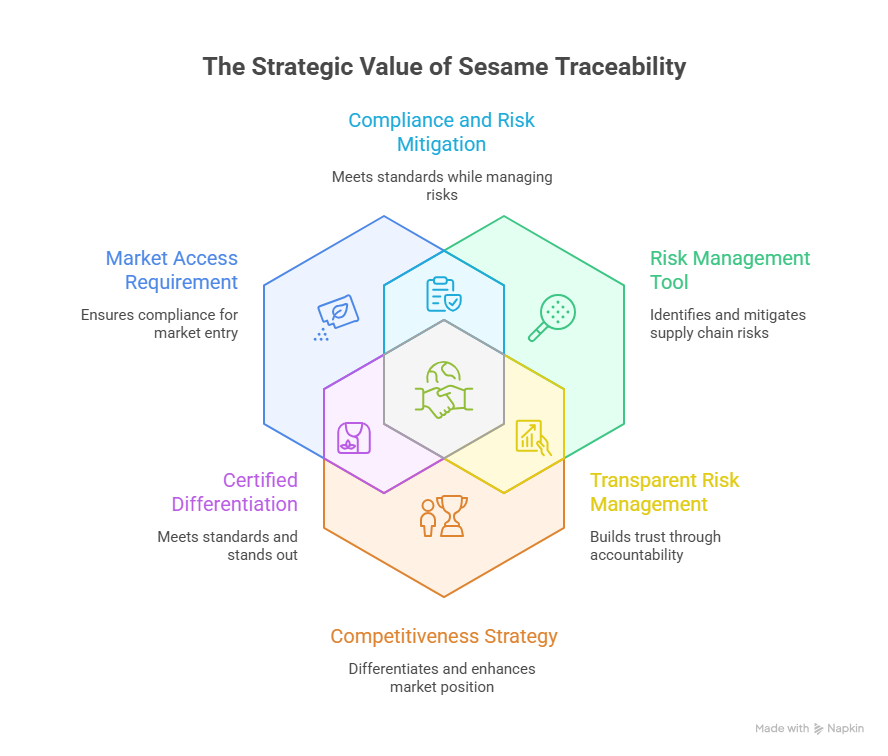
Togo is an emerging sesame exporter in West Africa, and evolving global regulations and buyer expectations are reshaping how sesame must be produced, documented, and exported. Market access is increasingly determined by traceability, compliance, and verified sustainability, not just volume or price.
International markets, particularly the EU, UK, and North America, are enforcing stricter sustainability and due-diligence requirements:
• EU Deforestation Regulation (EUDR): Requires proof that sesame is deforestation-free, legally produced, and fully traceable to origin.
• Human Rights & Environmental Due Diligence (CSDDD-style laws): Buyers must ensure sesame is not linked to illegal land use or labor violations.
• Food safety and contamination controls: Traceability is critical for managing aflatoxin risk, recalls, and liability.
For Togo’s sesame exporters, this means farm-level GPS data, batch traceability, and digital audit trails are essential. Without them, sesame risks:
• Export rejections
• Shipment delays
• Loss of buyer trust and access to regulated markets
Global buyers increasingly demand:
• Verified farm origin
• Digital chain-of-custody records
• Non-GMO and responsible sourcing
• Ethical labor and land-use compliance
• ESG and sustainability reporting readiness
Even traditional markets like China and India now value consistent quality, documentation, and traceable sourcing. Traceability is insurance against supply chain risk.
Togo’s sesame sector still relies on paper-based records, aggregated sourcing, and informal intermediaries. These methods cannot:
• Meet digital due-diligence requirements
• Enable rapid audits
• Isolate contamination or quality issues
• Provide credible sustainability claims
Exporters using manual systems face higher costs, slower shipments, and risk of penalties.
Digital traceability unlocks:
• Access to premium and regulated markets
• Eligibility for certifications and preferred supplier programs
• Stronger buyer relationships and long-term contracts
• Pricing stability and improved bargaining power
Traceability transforms Togo from a commodity supplier to a trusted, reliable exporter.
A digitized sesame supply chain:
• Boosts Togo’s export credibility
• Reduces rejection incidents and reputational risk
• Supports sustainability and farmer inclusion
• Aligns the sector with global trade norms
Early adoption of digital traceability positions Togo to compete globally; delayed action risks marginalization in premium sesame markets.
Traceability is no longer optional for Togo’s sesame industry it is a critical driver of market access, sustainability, and export competitiveness. By adopting digital traceability systems, from farm-level GPS mapping to batch-level tracking and audit-ready documentation, Togo can ensure verified origin, consistent quality, and compliance with global regulations. Strengthening traceability not only enhances buyer confidence and unlocks premium markets but also empowers smallholder farmers and promotes sustainable practices. For Togo to secure its place in the global sesame trade, investing in transparent, verifiable, and technology-driven supply chains is essential.
Struggling with visibility gaps? Discover how traceability can fix them in our Supply Chain Traceability Blog.
Transform your food supply chain with digital tools—explore the Digital Traceability for Food Systems Blog.
See how blockchain improves trust, transparency, and auditability—start with our Blockchain Traceability Blog.
Traceability in the sesame supply chain in Togo refers to the ability to track sesame seeds from farm-level production through aggregation, processing, and export using digital records, batch identification, and chain-of-custody systems.
Traceability helps Togolese exporters meet international regulations, manage food safety and quality risks, and satisfy buyer requirements for ethical, non-GMO, and responsibly sourced sesame.
Key challenges include fragmented smallholder farming, multi-tiered informal aggregation, lack of digital farm records, poor post-harvest handling, and limited land-use documentation.
Digital traceability enables GPS farm mapping, digital farmer onboarding, batch-level tracking, and automated compliance reporting, improving transparency, efficiency, and export readiness.
Yes. Buyers in the EU, Asia, and the Middle East increasingly prefer traceable sesame. Verified origin and compliance allow Togolese exporters to reduce rejection risk and access premium or long-term contracts.