
Quick summary: Learn how to onboard suppliers for Digital Product Passports (DPPs) at scale, ensuring compliance, traceability, and operational efficiency with structured processes and digital platforms

Supply chain complexity and fragmented supplier data challenge DPP compliance. Onboarding suppliers for Digital Product Passports (DPPs) at scale requires a structured, multi-tier approach. Companies should segment suppliers by criticality, standardize required data (identity, certifications, material composition, ESG metrics), and implement digital self-service portals for automated data collection and validation.
Manual supplier onboarding and inconsistent data capture remain major bottlenecks for companies implementing Digital Product Passports (DPPs). These inefficiencies delay certification, compromise traceability, and increase the risk of non-compliance under ESPR, Battery, and other circular-economy regulations. Scalable, structured supplier onboarding leveraging tiered approaches, standardized identifiers, and digital self-service platforms ensures accurate, verifiable supplier data. This approach not only accelerates certification readiness but also strengthens operational efficiency, enabling businesses to maintain continuous regulatory compliance while supporting the transparency and circularity that modern supply chains demand.
Providing training, clear compliance guidelines, and persistent identifiers (GTINs, GLNs) ensures traceability across all lifecycle stages. Integrating multi-tier supplier data into interoperable DPP platforms enables audit-ready reporting, continuous ESPR compliance, and operational efficiency, turning fragmented supply chain data into a verified, scalable foundation for circular-economy readiness.
Key Takeaways
Supplier onboarding is a critical step in ensuring that Digital Product Passports (DPPs) are accurate, verifiable, and compliant with regulatory frameworks like the EU Ecodesign for Sustainable Products Regulation (ESPR), Battery Regulation, and other circular-economy mandates. Effective onboarding ensures that every supplier contributing to a product’s lifecycle from raw materials to components is registered, validated, and integrated into the digital traceability system.
Traceability is the backbone of DPP compliance. Onboarding suppliers properly ensures that all critical information supplier identity, material composition, certifications, batch numbers, and processing events is captured and linked to the product’s lifecycle. This allows companies to produce audit-ready records, meet due diligence obligations, and provide verifiable proof of sustainability and circularity for regulatory authorities or buyers.
DPPs rely on event-based data to track products across their entire lifecycle. Onboarding suppliers effectively allows companies to connect each supplier’s inputs and transformations directly to lifecycle events such as material sourcing, manufacturing, assembly, and packaging creating a seamless chain of custody. This linkage is crucial for compliance with ESPR, enabling regulators and auditors to verify that each stage adheres to circular economy principles, including repairability, recyclability, and responsible sourcing.
Without structured supplier onboarding, companies risk incomplete or inconsistent data. Missing information, delayed responses, or unverified supplier inputs can break traceability, resulting in non-compliance, audit failures, or delayed product certification. In worst-case scenarios, regulatory penalties, shipment rejections, or market access restrictions can occur. By implementing a systematic onboarding process, businesses reduce these risks, maintain regulatory compliance, and ensure continuous readiness for ESPR and other DPP-driven audits.
In short, supplier onboarding is not just an administrative step it is a foundational practice that guarantees DPP integrity, supports lifecycle-wide traceability, and protects businesses from compliance and operational risks.
Explore how supplier engagement makes or breaks DPP compliance →
Understand the role of DPPs at every stage of the product lifecycle →
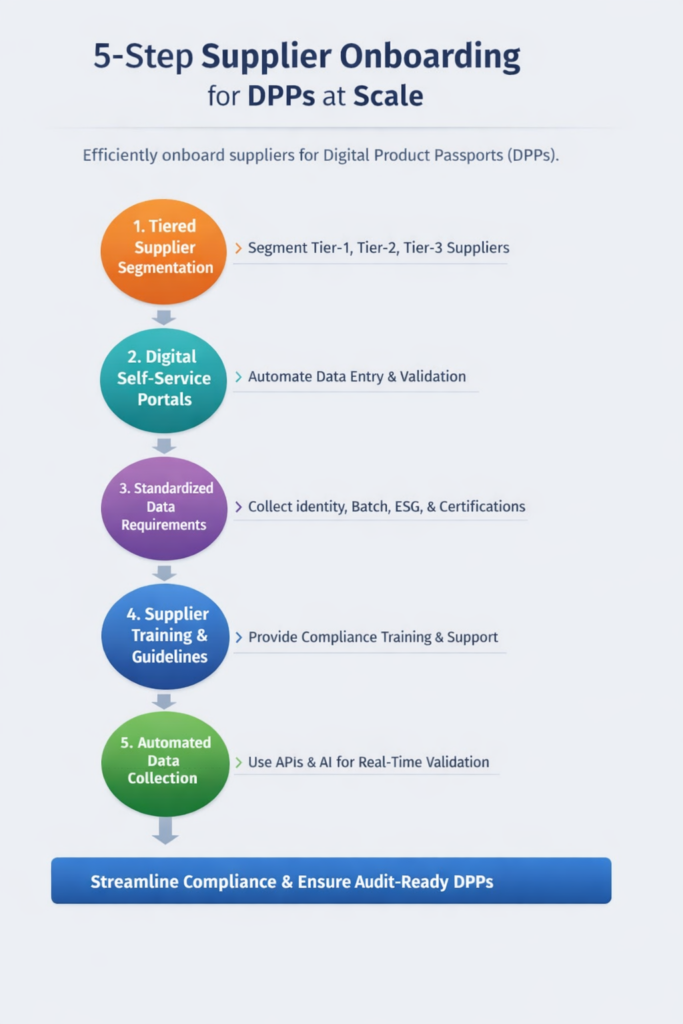
Effective onboarding begins with segmenting suppliers according to their criticality, contribution to the product, and potential regulatory impact.
This tiered approach minimizes effort and ensures resources are focused on suppliers that pose the greatest regulatory and operational risk.
Manual spreadsheets or paper-based forms are slow, error-prone, and difficult to scale. Digital portals streamline supplier onboarding by standardizing data collection and enabling real-time updates.
Digital portals also create transparency across the supply chain, ensuring all stakeholders access the same verified data in real time.
Consistency in data is critical for audit-ready DPP compliance. Every supplier must submit mandatory, structured information.
Without standardization, DPPs risk data gaps that can result in non-compliance, greenwashing allegations, or delayed market access.
Even with the best digital platforms, suppliers need guidance to meet DPP requirements effectively.
Consistent training ensures suppliers are aligned with the company’s compliance goals, reduces errors, and strengthens collaboration across multi-tier supply chains.
Manual data entry is inefficient and error-prone. Automation is key to scaling supplier onboarding while maintaining accuracy and compliance.
By automating data collection and validation, companies can scale onboarding across hundreds or thousands of suppliers without compromising traceability or compliance.
Onboarding suppliers for DPPs at scale requires a structured, multi-step approach: segment suppliers by risk, implement digital self-service portals, standardize data collection, provide ongoing training, and leverage automation for validation and traceability. This ensures complete, verified supplier data feeds directly into DPPs, reduces compliance risk, accelerates regulatory readiness, and strengthens operational efficiency across global supply chains.
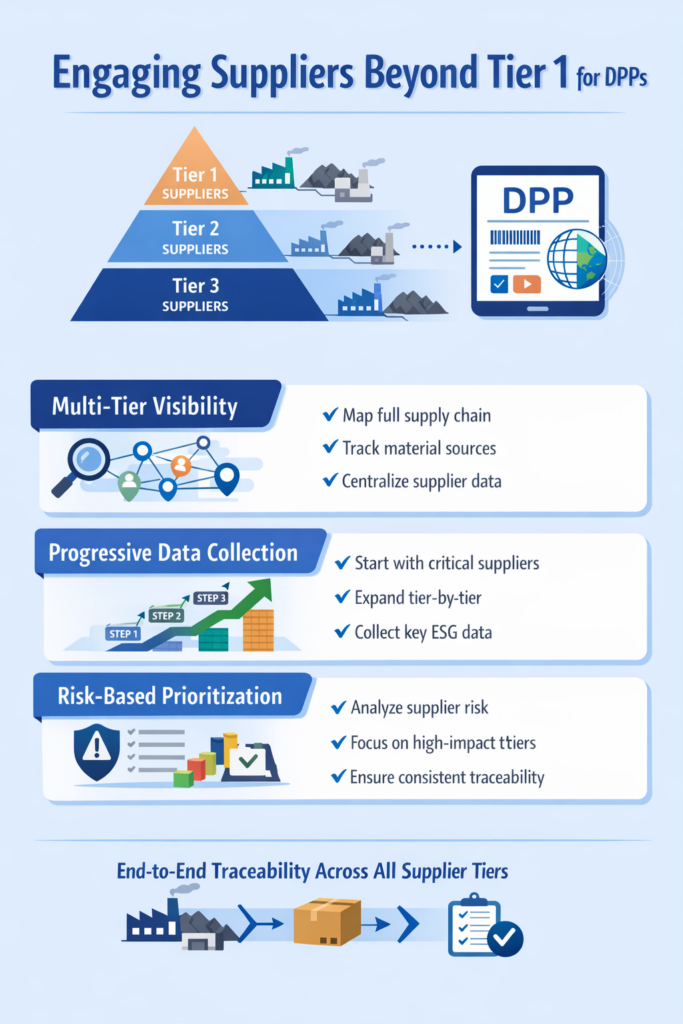
While Tier-1 suppliers directly supply components or raw materials, the true sustainability and regulatory compliance of products depend on the upstream tiers Tier-2 and Tier-3 suppliers. Engaging beyond Tier 1 requires mapping the entire supply network, identifying key materials and components, and establishing transparent reporting mechanisms. Using digital platforms with a centralized supplier portal allows companies to collect, store, and analyze data across tiers, ensuring visibility of material origins, certifications, and transformations from the point of extraction to assembly.
Directly onboarding thousands of upstream suppliers at once can overwhelm both the suppliers and compliance teams. Instead, a phased or progressive data collection strategy works best. Companies can start with critical suppliers based on material impact, ESG risk, or regulatory importance, and then gradually extend to lower-priority suppliers. For example, in the electronics or battery sector, upstream suppliers providing key metals like cobalt or lithium should be prioritized for DPP data capture, including material composition, certifications, and lifecycle events.
Not all suppliers carry the same level of risk for compliance or sustainability. A risk-based approach helps companies allocate resources efficiently: prioritize suppliers that provide high-risk materials, are located in regions with weak regulatory enforcement, or have complex production processes. Once prioritized, traceability must be consistent across all tiers. Persistent identifiers (GTINs, GLNs, SSCCs) and batch-level tracking ensure that material flows can be traced from upstream sources to final products. AI-enabled platforms like TraceX can automate validation, flag gaps in upstream reporting, and maintain audit-ready DPPs across multiple tiers.
Effective engagement beyond Tier 1 is not just a compliance exercise it is the foundation of a fully traceable, circular supply chain. Progressive onboarding, multi-tier visibility, and risk-based prioritization allow companies to ensure that every product entering the market has verifiable, audit-ready data captured at every stage of its lifecycle.
Onboarding suppliers for Digital Product Passports (DPPs) at scale is not without hurdles. Companies often encounter fragmented data, as suppliers operate across multiple regions, systems, and reporting formats. This inconsistency makes it difficult to consolidate complete, auditable information required for ESPR, Battery, and circular-economy compliance.
Another frequent challenge is resistance to new digital workflows. Suppliers, especially smaller or traditional operations, may be hesitant to adopt portals, standardized reporting templates, or automated data collection methods. Limited familiarity with DPP requirements or fear of increased workload can slow adoption.
Quick fixes to these challenges rely on structured, proactive onboarding strategies:

Digital platforms have transformed supplier onboarding from a slow, manual, and error-prone process into a streamlined, scalable, and traceable operation essential for Digital Product Passports (DPPs) under ESPR, Battery Regulation, and circular economy mandates.
Traditional onboarding often relies on spreadsheets, PDFs, or email exchanges, which create fragmented, inconsistent data. Digital platforms provide a single, centralized portal where suppliers can submit all required information, including:
This standardized input ensures completeness and accuracy, reducing manual follow-ups and errors. Persistent identifiers like GTINs and SSCCs link suppliers directly to products and batches, creating an audit-ready record for DPPs.
Once data is captured, platforms offer real-time dashboards that allow supply chain teams to monitor supplier compliance and performance across multiple criteria. Key features include:
This immediate visibility helps companies identify risks before they become audit issues, ensuring continuous DPP compliance.
Many supply chains extend beyond Tier-1 suppliers, involving Tier-2 and Tier-3 suppliers whose data is harder to access. Digital platforms capture and consolidate data across multiple tiers, enabling companies to:
This end-to-end visibility is critical for regulatory compliance and circular economy initiatives, particularly when demonstrating material provenance, repairability, and recyclability in DPPs.
Platforms from TraceX enhance these capabilities with AI-driven workflows and API integrations:
By combining AI, automation, and centralized data capture, TraceX allows organizations to onboard suppliers at scale, maintain continuous compliance, and create verified digital records that support traceability, sustainability, and market access.
Effective supplier onboarding is the backbone of Digital Product Passport (DPP) compliance and traceability. By segmenting suppliers, standardizing data, leveraging digital portals, and automating validation, companies can scale onboarding across multi-tier supply chains, reduce audit risks, and maintain continuous ESPR and circular economy compliance. Platforms from TraceX enable end-to-end visibility, AI-powered data validation, and audit-ready reporting, transforming fragmented, manual processes into a structured, reliable, and future-ready DPP ecosystem. Early investment in structured onboarding not only ensures regulatory compliance but also strengthens supplier collaboration and operational efficiency.
Explore how GS1 identifiers power interoperable DPPs →
Learn the architecture behind scalable Digital Product Passports →
Read how supplier mapping enables end-to-end traceability →
Supplier onboarding ensures complete, standardized, and verifiable data, which is essential for traceability, audit readiness, and meeting ESPR and other circular economy regulations.
By segmenting suppliers by risk and criticality, using digital self-service portals, automating data validation, and implementing AI-enabled workflows, companies can efficiently onboard Tier-1, Tier-2, and Tier-3 suppliers.
Platforms like TraceX centralize supplier data, enable real-time monitoring, automate validation, and generate audit-ready reports, ensuring continuous compliance and end-to-end DPP traceability.