
Quick summary: Learn how Rainforest Alliance Certification in Nigeria helps exporters access premium markets, ensure ethical and sustainable production, and strengthen smallholder farmer livelihoods. Explore certification requirements, processes, and digital traceability solutions.
As global consumers and businesses increasingly demand ethically sourced and environmentally responsible products, exporters face mounting pressure to prove the sustainability of their supply chains. Yet, many exporters struggle with complex compliance requirements, fragmented smallholder networks, and limited visibility into farm-to-market traceability. These challenges not only hinder access to premium markets but also increase the risk of regulatory penalties and reputational damage. Rainforest Alliance certification offers a credible solution, enabling exporters to demonstrate sustainable sourcing, improve supply chain transparency, and meet international buyer expectations while supporting the livelihoods of smallholder farmers.
Rainforest Alliance (RA) certification empowers exporters by verifying sustainable practices across environmental, social, and economic pillars, unlocking premium EU/US markets, reducing supply chain risks, and ensuring EUDR compliance through end-to-end traceability and deforestation-free claims. Exporters gain credibility via the trusted green frog seal (recognized by 5% of Fortune 500), accessing $1B+ retail value in certified cocoa/coffee while boosting yields 10-20% and farmer incomes through climate-resilient training.
Key Takeaways
Rainforest Alliance Certification is a globally recognized standard that verifies farms, cooperatives, and supply chains adhere to strict sustainability, environmental, and social criteria. It focuses on promoting responsible agricultural practices, protecting ecosystems, conserving biodiversity, and improving the livelihoods of smallholder farmers.
At its core, the certification ensures that workers are treated fairly, with safe working conditions, fair wages, and respect for labour rights, including gender equality and prohibition of child or forced labour. Environmentally, it emphasizes sustainable land use, reduced pesticide use, soil and water conservation, and preservation of forests and wildlife habitats. Economically, it provides farmers access to international markets, a Fairtrade-like premium for certified products, and long-term support for improving farm productivity and sustainability practices.
Globally, Rainforest Alliance certification is highly valued by importers, retailers, and brands, particularly in the EU, North America, and Asia, where consumers increasingly demand ethically sourced and environmentally responsible products. For exporters, this recognition not only enhances brand credibility but also differentiates their products in competitive markets, building buyer trust and enabling access to premium pricing opportunities.
In essence, the certification is more than a compliance badge it is a strategic tool that aligns sustainability goals with business growth, creating shared value for exporters, smallholders, and global supply chain partners.
Discover How Sustainability Certifications Transform Your Agri-Business
From Farm to Market: How Sustainable Sourcing Drives Impact
Rainforest Alliance certification opens doors to high-value export markets where consumers and retailers increasingly demand sustainably and ethically sourced products. In regions like the EU, North America, and Asia, certified products are often preferred by multinational brands and retailers, giving exporters a competitive advantage. By demonstrating compliance with global sustainability standards, exporters can secure long-term contracts, enter premium pricing segments, and differentiate themselves from non-certified competitors.
Certification signals a commitment to environmental stewardship, ethical labour practices, and responsible sourcing, which enhances brand reputation with buyers and end consumers. It also helps exporters meet ESG reporting requirements, which are increasingly critical for institutional investors, multinational corporations, and regulatory compliance. Rainforest Alliance certification provides independent verification that supply chains are traceable, transparent, and socially responsible, reducing reputational risk and supporting sustainable growth strategies.
Many certified commodities, such as cocoa, coffee, and cashew, are produced by smallholder farmers. Rainforest Alliance certification promotes fair wages, safe working conditions, and access to technical training, improving farm productivity and income stability. Premiums from certified products are often reinvested into community development, cooperative capacity building, and climate-resilient practices. By supporting smallholder livelihoods, exporters contribute to more resilient supply chains and sustainable sourcing ecosystems, which ultimately benefits their long-term business viability.
In short, Rainforest Alliance certification is not just a compliance tool it is a strategic lever that enhances market access, strengthens credibility, and drives social and environmental impact throughout the supply chain.
To achieve Rainforest Alliance certification, exporters and producer groups must meet rigorous environmental, social, and operational standards:
Rainforest Alliance certification follows a structured, step-by-step approach:
In essence, Rainforest Alliance certification combines environmental stewardship, social responsibility, and operational rigor, providing exporters with credibility, market access, and a pathway to sustainable growth.
A major challenge is that most agricultural commodities, especially cocoa, coffee, and cashew, are produced by smallholder farmers scattered across different regions. Coordinating these dispersed farmers to follow uniform sustainability practices, adhere to environmental and labour standards, and maintain consistent production quality is complex. Without strong cooperative structures, exporters may struggle to ensure compliance across the entire supply chain.
Rainforest Alliance certification demands comprehensive record-keeping farm management data, input usage, labour records, and batch traceability. Many smallholder farmers rely on informal or paper-based systems, creating gaps in documentation. These gaps make audits challenging, slow down certification, and increase the risk of non-compliance. Exporters must implement systems to capture accurate, verifiable data from the farm level to processing and export.
Certification requires initial fees, audits, training for farmers, and investment in monitoring and reporting systems. For small-scale exporters or cooperatives, these costs can be significant. Beyond initial certification, ongoing compliance such as audits, recertification, and continuous monitoring—adds recurring expenses. Exporters must balance these costs with potential market premiums and long-term benefits from accessing ethically conscious buyers.
In short, while Rainforest Alliance certification unlocks premium markets, exporters must overcome coordination, traceability, and cost challenges to maintain compliance and maximize its value.
Rainforest Alliance certification requires accurate, verifiable data from farm to export, which can be a challenge in smallholder-dominated supply chains. Sustainable Sourcing Platforms from TraceX help exporters and cooperatives bridge this gap by providing end-to-end visibility across the supply chain.
As of 2026, Rainforest Alliance (RA) certification has shifted from being a “nice-to-have” badge to a critical operational tool for global market access and regulatory compliance.
Here is the breakdown of why it is considered “worth it” for exporters and smallholders in the current landscape:
In the 2026 trade environment, certification is often the “ticket to entry” for premium European and North American retail chains.
This is the single biggest “worth it” factor in 2026. Certification has evolved into a Compliance-as-a-Service model.
The ROI of certification is increasingly measured in Resilience, not just immediate price bumps.
Summary Table: The Value Exchange
| Stakeholder | Short-Term Gain | Long-Term Strategic Value |
| Smallholder Farmer | Immediate Cash Premium (Minimums). | Climate-resilient soil and consistent market demand. |
| Exporter | Access to EU/US “Premium” contracts. | Reduced cost of EUDR/ESG data collection. |
| Brand/Buyer | Legal “Safe Harbor” for Green Claims. | Guaranteed, traceable, and ethical supply chain. |
Rainforest Alliance Certification empowers exporters to meet the rising demand for ethically sourced and environmentally responsible products. Beyond compliance, it provides access to premium global markets, strengthens brand credibility, and fosters long-term partnerships with buyers who value transparency and sustainability. For smallholder farmers, it offers structured support, fair pricing, and capacity-building opportunities that improve livelihoods. By integrating digital traceability tools and robust farm management practices, exporters can reduce compliance risks, enhance supply chain transparency, and position their products as competitive, ethical, and high-value offerings in the international market.
Discover how responsible sourcing can transform your agri-business
Ethical supply chains drive trust and compliance
Learn how Rainforest Alliance certification helps meet EU Deforestation Regulation (EUDR) standards.
Rainforest Alliance Certification verifies that agricultural products are produced sustainably, with fair labour practices, biodiversity protection, and responsible farm management.
Cocoa is the primary certified crop, with coffee, cashew, and palm oil also eligible. Certification often involves smallholder cooperatives.
Certification typically takes 6–12 months, depending on farmer readiness, documentation, and audit schedules.
Yes. Exporters can obtain chain-of-custody certification by working with certified producer groups or cooperatives.
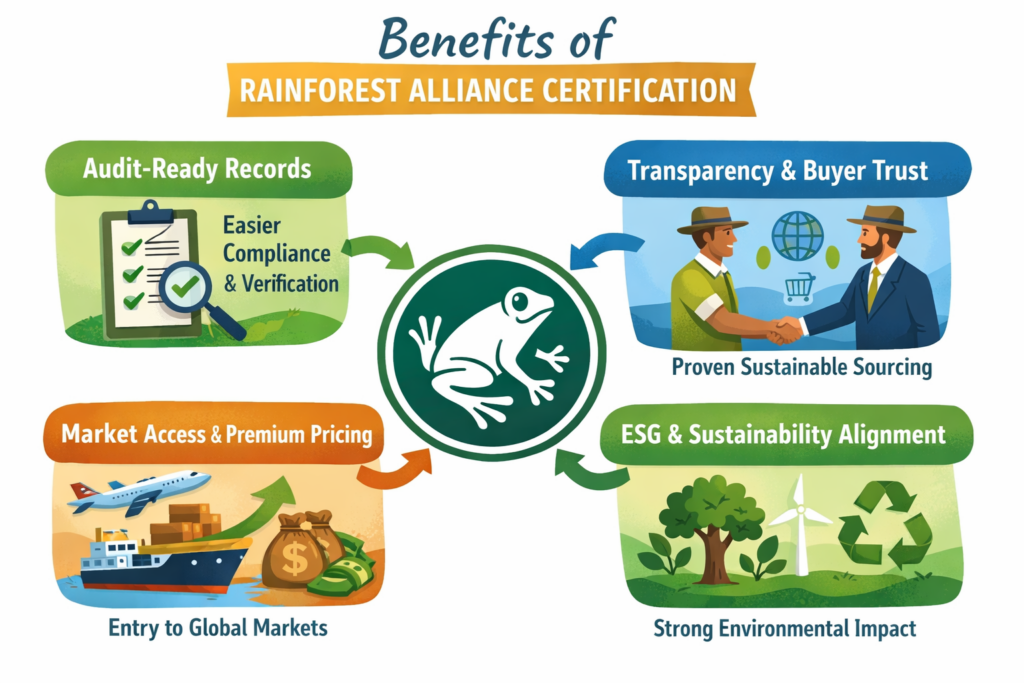
Benefits include access to premium markets, audit-ready records, ESG alignment, buyer trust, and improved operational efficiency.