
Quick summary: Digital Product Passports only scale with a common global language. GS1 for DPP provides that foundation through standardized identifiers, Digital Link, and data models—enabling interoperable, compliant, and future-proof DPPs that support ESPR, EPR, and circular business models across industries.

Digital Product Passports fail without a common language. Today, fragmented product data, proprietary QR codes, and non-interoperable systems make DPPs costly, unreliable, and impossible to scale across borders. GS1 for DPP solves this by providing the global standards backbone that unifies identification, data sharing, and traceability across value chains. Built on GS1 standards, GS1 for DPP enables compliant, interoperable Digital Product Passports, helping organizations meet ESPR and EPR requirements while accelerating circularity and long-term regulatory readiness.
GS1 for DPP enables Digital Product Passports by providing globally standardized identifiers, data models, and interoperability frameworks. GS1 standards such as GTINs, Digital Link, and EPCIS ensure consistent product identification, traceability, and trusted data exchange across value chains. By aligning product data from raw materials to end-of-life, GS1 for DPP supports regulatory compliance, transparency, and scalable implementation of Digital Product Passports across industries and markets.
Key Takeaways
GS1 is a global, neutral, not-for-profit organization that develops and governs standards enabling products, locations, and assets to be uniquely identified and their data shared across international supply chains. Its standards, such as GTINs, barcodes, EPCIS, and Digital Link, form the common language of global trade, used by millions of companies and mandated or referenced by regulators worldwide.
Regulators trust GS1 because its standards are globally harmonized, vendor-neutral, and proven at scale across industries. They reduce ambiguity, enable cross-border interoperability, and support auditability, key requirements for Digital Product Passports under frameworks like ESPR and EPR. Brands trust GS1 because it ensures data consistency, future proofing, and compatibility with existing enterprise systems and trading partners.
GS1-based DPPs use globally unique identifiers and open standards, allowing product data to be accessed, exchanged, and verified across systems and countries. Proprietary approaches rely on closed identifiers or custom QR codes, leading to data silos, limited scalability, higher long-term costs, and regulatory risk.
GS1 enables interoperability, trust, and regulatory alignment for Digital Product Passports.
Learn how GTINs, GLNs, and batch/serial identifiers create a global digital identity for DPPs and enable traceability at scale.
Explore GS1 Identifiers for Digital Product Passports
Understand how GS1 Digital Link and standardized QR codes connect physical products to compliant, future-proof Digital Product Passports.
Read Our Guide to DPP Data Carriers (QR Codes & GS1 Digital Link)
A Digital Product Passport (DPP) is a standardized digital record required under the EU’s Ecodesign for Sustainable Products Regulation (ESPR). It makes product information accessible throughout the lifecycle from design and sourcing to use, repair, and end-of-life via a digital carrier such as a QR code or web link.
A DPP typically includes:
DPPs enable transparency, circularity, and enforcement of sustainability rules. The EU is mandating them to support climate goals, empower consumers, and ensure traceability setting a model that other regions are expected to follow.
At the core of any scalable DPP is unambiguous identification. GS1 for DPP uses globally unique identifiers governed by GS1 to ensure products and related data can be trusted and exchanged across borders and systems.
Together, these identifiers give each product a persistent digital identity required for regulatory-grade DPPs.
GS1 Digital Link connects a physical product to its Digital Product Passport using a standardized, web-based URI encoded in a QR code or data carrier. Instead of hardcoding information, the link dynamically resolves to the correct DPP record.
This avoids fragmented QR strategies while keeping DPPs future-proof.
Beyond identification and access, GS1 data standards define how digital product passport information is structured and exchanged to ensure machine-readability for regulators. Standardized data models support consistent fields for materials, carbon footprint, durability, repairability, and sustainability claims.
GS1 for DPP turns Digital Product Passports from static documents into interoperable, trusted digital infrastructure.
| Feature | GS1 Digital Link (The Open Standard) | Proprietary QR (The Walled Garden) |
| Interoperability | Universal. One code works for POS scanners, customs agents, recyclers, and consumer phones globally. | Limited. Usually requires a specific app or proprietary software to “unlock” the data. |
| Regulatory Acceptance | High. Aligns with ISO/IEC 15459 and is the preferred framework for EU Digital Product Passports. | Varies. May fail to meet “Open Standard” requirements in certain EU Delegated Acts. |
| Scalability | Seamless. Identifiers (GTINs) are already used by 2M+ companies; easily scales across all global regions. | Difficult. Requires custom integration for every new partner, retailer, or regional database. |
| Vendor Lock-in Risk | Minimal. You own your GS1 ID. If you switch software providers, your QR codes remain valid and functional. | High. If you leave the vendor, your QR codes may break (the “Dead Link” trap) or require expensive redirection. |
| Long-term Cost | Lower Total Cost of Ownership (TCO). Leverages existing barcode infrastructure and avoids “re-labeling” fees. | Hidden Costs. High costs for custom API maintenance and potential re-coding if standards change. |
| Data Flexibility | Dynamic. Uses “Resolvers” to point one QR to multiple destinations (Manuals, Certs, or Resale) based on context. | Static/Fixed. Often points to a single, hard-coded landing page controlled by the vendor. |
GS1-enabled Digital Product Passports provide the technical foundation regulators expect for enforceable, cross-border compliance. By using globally harmonized identifiers and data standards from GS1, DPPs move beyond static disclosures to become verifiable, audit-ready compliance tools.
Under the Ecodesign for Sustainable Products Regulation (ESPR), products must disclose standardized, lifecycle-based information in a digital, accessible format. GS1 identifiers (such as GTINs and batch/serial data) ensure each DPP is uniquely linked to the correct product, while GS1 data standards support consistent, machine-readable information required by regulators.
GS1-enabled DPPs align naturally with Extended Producer Responsibility (EPR), ESG reporting, and supply chain due diligence laws by connecting product data to locations, materials, and processes. This enables traceability of origin, substances, and environmental impact across suppliers and geographies critical for compliance with evolving sustainability and human-rights regulations.
Because GS1 standards are globally recognized and vendor-neutral, they support verifiable data exchange between brands, authorities, and auditors. Standardized identifiers and event data reduce ambiguity, support evidence-based audits, and enable reliable verification of claims.
By eliminating proprietary identifiers and manual data mapping, GS1-enabled DPPs reduce compliance risk, streamline reporting, and future-proof organizations against regulatory change turning compliance from a cost centre into a scalable capability.
GS1 for DPP provides a common, cross-sector foundation for traceability, transparency, and circularity while allowing each industry to meet its specific regulatory and operational needs. Built on standards from GS1, GS1-enabled DPPs scale consistently across global value chains.
GS1 identifiers link garments to fiber composition, country of origin, and care instructions. Batch- and item-level identification supports traceability of materials, verification of sustainability claims, and enables reuse, resale, and textile recycling key for circular fashion and ESPR compliance.
In electronics and batteries, GS1 identifiers connect products to critical raw materials, carbon footprint data, and safety information. Serial and batch-level traceability supports repair, recalls, battery passports, and responsible end-of-life handling, while meeting strict regulatory and safety requirements.
For FMCG, GS1 identifiers enable accurate packaging data, recyclability instructions, and material disclosures at scale. Digital Product Passports powered by GS1 support EPR reporting, reduce packaging waste, and provide consumers and recyclers with clear, actionable information via a single QR code.
In automotive and electric vehicles, GS1 identifiers enable traceability of components, batteries, and materials across complex supply chains. This supports compliance, recall management, lifecycle carbon reporting, and circularity strategies such as remanufacturing and battery reuse.
Across industries, GS1 for DPP turns regulatory requirements into interoperable, future-proof digital infrastructure.
While GS1 for DPP defines the standards, digital platforms are what turn them into working, scalable Digital Product Passports. They operationalize GS1 identifiers, links, and data models into day-to-day business workflows bridging regulation, supply chains, and IT systems.
Platforms embed GS1 identifiers (such as GTINs, GLNs, and batch/serial numbers) directly into product master data, supplier onboarding, and lifecycle management processes. GS1 Digital Link is implemented as a dynamic access layer, ensuring each physical product reliably resolves to its correct, up-to-date DPP record across markets and use cases.
Modern DPP platforms aggregate data from multiple sources suppliers, LCA tools, ERP systems, and logistics providers using GS1 data standards as the common structure. This enables consistent capture of materials, carbon footprints, compliance attributes, and lifecycle events (manufacture, repair, resale, recycling), while maintaining traceability and auditability.
Example: Platforms enabling GS1-compliant DPPs at scale
Regulatory Compliance Platform from TraceX operationalizes GS1 standards by providing ready-made infrastructure for GS1-compliant DPPs. They allow brands to deploy a single, standards-based DPP across products and regions, reducing implementation complexity, accelerating compliance with ESPR and EPR, and future-proofing digital passport strategies as regulations evolve.
In practice, digital platforms are the execution layer that makes GS1 for DPP usable, scalable, and commercially viable.
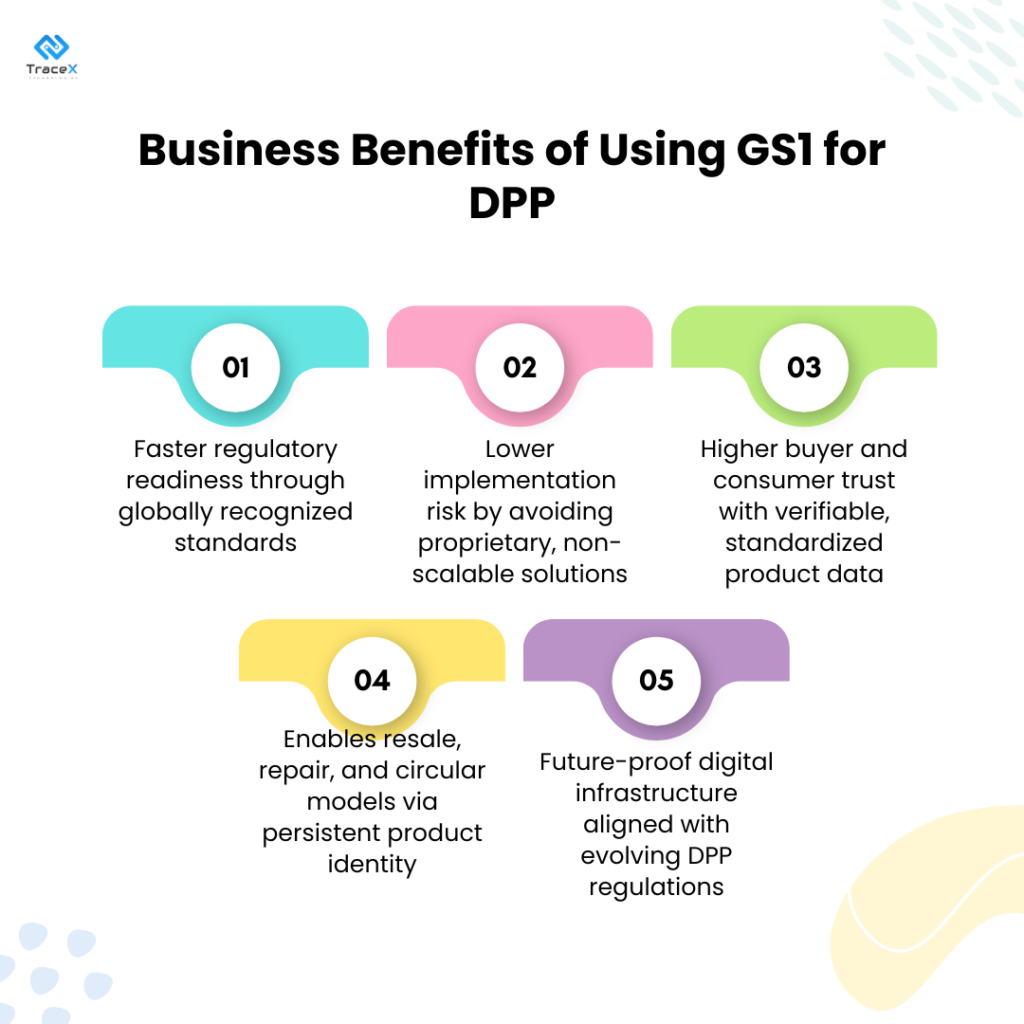
Adopting GS1 for DPP is a structured, phased process that helps brands and manufacturers move from regulatory readiness to long-term value creation.
Start by defining which products and markets fall under DPP regulations and what data is required (materials, origin, carbon, compliance). Align internal teams—sustainability, IT, supply chain, and legal—around a single DPP strategy built on GS1 standards to avoid fragmented implementations.
Register with GS1 to obtain a company prefix. This enables the creation of globally unique identifiers such as GTINs for products, GLNs for locations, and batch or serial identifiers for traceability. These identifiers form the digital backbone of every GS1-based DPP.
Select a DPP platform that natively supports GS1 identifiers, GS1 Digital Link, and GS1 data standards. The right partner should integrate easily with ERP, PLM, and LCA systems, support audit-ready data, and scale across products and geographies as regulations evolve.
DPP regulations will be introduced by product category and over time. Build your GS1-based DPP infrastructure once, then expand data depth and coverage in phases. This approach reduces risk, spreads investment, and ensures continuous compliance as new requirements come into force.
Digital Product Passports without GS1 are silos, not systems isolated data points that cannot scale across borders, partners, or regulations. GS1 for DPP provides the foundational layer for interoperable, compliant, and circular product data, enabling trusted exchange across the entire value chain. For business and technology leaders, the strategic takeaway is clear: Building a DPP on GS1 is not a short-term compliance fix, but a long-term digital infrastructure decision that underpins resilience, transparency, and sustainable growth.
Understand how GS1 identifiers, data standards, and Digital Link form the global backbone for interoperable, compliant DPPs.
Read Our Deep Dive on GS1 Standards for Digital Product Passports
Learn how GS1 EPCIS captures lifecycle events—manufacture, shipment, repair, recycling—to create audit-ready, end-to-end product traceability.
Explore GS1 EPCIS and Event-Based Traceability for DPPs
See how GS1 standards, data platforms, carbon tools, and lifecycle systems come together to operationalize DPPs at scale.
Discover the Modern DPP Technology Stack
GS1 is not explicitly mandated by law, but regulators strongly favor globally recognized, interoperable standards. Using GS1 for DPP aligns with ESPR requirements and significantly reduces compliance and interoperability risk compared to proprietary approaches.
GS1 Digital Link is a standard that connects a physical product to its Digital Product Passport via a web-based URI encoded in a QR code. It enables dynamic, updatable, and role-based access to DPP data across the product lifecycle.
Yes. GS1-based DPPs use a single product identity and data structure to support ESPR, EPR, ESG reporting, and supply chain due diligence requirements—avoiding duplicate systems and data silos.
GS1 QR codes are globally unique, standards-based, and interoperable. Proprietary QR codes create closed systems, increase long-term costs, and risk non-compliance as regulations evolve.
Companies register with GS1 for identifiers, then deploy a DPP platform that natively supports GS1 identifiers, Digital Link, and standardized data models—allowing phased, scalable rollout across products and markets.









