
Quick summary: Traceability in the soy supply chain in Benin ensures verified origin, quality control, and regulatory compliance, enabling exporters to meet global buyer requirements and secure sustainable access to regional and international markets.

Traceability in the Soy Supply Chain in Benin enables end-to-end visibility from smallholder farms through aggregation, processing, and export. It ensures soybeans can be linked to verified origins, production practices, and transaction records, reducing risks related to quality, deforestation, and informal sourcing. As regional and international buyers increase due-diligence, food safety, and ESG requirements, traceability in the soy supply chain in Benin is becoming essential for market access, audit readiness, and building trust with regulated and premium export markets.
Benin’s Soy Export Landscape
Benin is an emerging soybean producer in West Africa, with cultivation concentrated in central and northern regions such as Borgou, Alibori, Collines, and Zou. Soy production is largely smallholder-driven, with farmers operating on fragmented plots and selling through a layered supply chain: smallholder farmers → village collectors → regional aggregators → processors → exporters. Soybeans are primarily used for domestic food processing, animal feed, and regional trade, with growing interest from international buyers seeking non-GMO and sustainably sourced soy. Benin emerged as a top-15 global soybean exporter in 2023, shipping $113M worth (168.7M kg), ranking 4th in national exports to China ($52.1M), Pakistan ($29.9M), UAE ($19.1M), and India ($4.18M) up massively from prior years amid production surging to 520K tons (2023, 15.17% CAGR from 257K tons in 2019). A Dec 2024 export ban on unprocessed soybeans aims to spur local processing (soy meal/feed), with 2024/25 farmgate price at 275 CFA/kg ($0.44/kg); imports remain low at $1.04M mainly from Togo/Burkina Faso Benin’s soy export volumes remain modest but are gradually expanding, driven by regional demand within West Africa and cross-border trade to neighbouring countries. The sector, however, is highly informal. Most soy moves through multiple aggregation points with limited documentation, resulting in mixed sourcing, variable quality, and weak chain-of-custody. Farm-level data such as geolocation, land-use history, and input records are largely absent, making traceability and compliance difficult to demonstrate. As global and regional buyers increasingly require deforestation-free, legally sourced, and fully traceable soy, Benin’s traditional paper-based systems are proving inadequate. To scale exports and strengthen competitiveness, Benin’s soy sector must invest in digital traceability, farmer registration, and verifiable data systems that support transparent, compliant, and market-ready soy supply chains.
From farm mapping to blockchain traceability, our Guide to Food Traceability breaks it all down. Read it now. Explore how sustainability and traceability are transforming soy sourcing. Read our blog on Sustainable Soy Supply Chains to learn how responsible sourcing, digital traceability, and compliance-ready practices help exporters reduce risk, meet global regulations, and build long-term buyer trust. Key Challenges for Benin’s Soy Sector Benin’s soy sector is expanding rapidly but faces structural, operational, and sustainability challenges that limit traceability, quality consistency, and export competitiveness.
1. Smallholder-Dominated and Fragmented Production
Soy production in Benin is largely driven by smallholder farmers across Borgou, Alibori, Collines, Zou, and Plateau regions. Farms are small, scattered, and predominantly rain-fed, making yield forecasting and standardization difficult. Limited access to certified seeds, fertilizers, mechanization, and extension services constrains productivity and quality consistency.
Typical flow: farmers → village collectors → regional aggregators → processors → traders/exporters. Multiple handovers lead to loss of origin data, mixed sourcing, and weak chain-of-custody controls. Exporters and processors struggle to trace soy back to specific farms or production zones.
Most farmers and collectors rely on paper-based or informal records. Farm boundaries, land-use history, input use, and harvest data are rarely digitized. These gaps limit traceability, audit readiness, and access to premium or regulated markets.
Poor drying, storage, and handling practices increase risks of moisture damage, pests, and contamination. Inconsistent grading and lack of standardized quality checks reduce acceptance by higher-value buyers.
Many soy farms operate under customary or communal land systems without formal titles. Limited land-use documentation complicates legality verification and deforestation-free sourcing claims.
Soy production is exposed to erratic rainfall, drought, and soil fertility decline. Climate variability affects yields, farmer incomes, and long-term supply reliability.
Smallholders and aggregators often lack credit for storage, mechanization, and quality improvement. Insufficient processing, warehousing, and logistics infrastructure increases post-harvest losses and constrains export readiness.
Regional and international buyers increasingly require traceable, non-GMO, responsibly sourced soy. Weak traceability systems expose exporters to price discounts, shipment rejections, or exclusion from regulated markets.
How a Digital Traceability Platform Like TraceX Can Work for Benin’s Soy Sector
The TraceX Traceability Platform provides a scalable digital foundation to bring transparency, compliance, and efficiency to Benin’s soy value chain—from farm to export
. End-to-End Digital Visibility Across the Soy Value Chain
TraceX connects farmers, collectors, cooperatives, aggregators, processors, and exporters into a single digital ecosystem, enabling:
Real-time tracking of soy movement Centralized visibility across sourcing, aggregation, processing, and trade Seamless coordination across fragmented supply chain actors
This ensures only verified, traceable soy enters regional and international markets.Farm-Level GPS & Polygon Mapping
TraceX captures precise GPS points or polygon boundaries for soy farms, enabling exporters to:
Verify farm locations and production zones Support land-use and legality checks Demonstrate responsible and deforestation-free sourcing Maintain geospatial records for buyer and regulatory audits
Digital Onboarding of Smallholder Farmers
Mobile-first tools digitally register soy farmers with structured data, including:
Farmer identity and contact details GPS-linked farm locations Available land-use or tenure information Planting, harvest, and yield data Links to cooperatives or aggregators
This creates a verified digital farmer network and improves upstream visibility.Batch-Level Digital IDs for Full Chain-of-Custody
Each soy batch is assigned a unique digital ID that follows it through:
Farm harvest Village collection Regional aggregation and storage Processing facilities Export documentation
Exporters can trace shipments back to specific farms, seasons, and handling points with confidence.Blockchain-Backed Data Integrity
All traceability records are secured using blockchain technology, ensuring data is:
Tamper-proof and immutable Time-stamped and audit-ready Transparently verifiable by authorized stakeholders
This strengthens buyer trust and supports access to premium markets.Automated Reports & Compliance Documentation
Digitized data automatically generates:
Origin and chain-of-custody reports Sustainability and ESG documentation Buyer-specific compliance files
End-to-end digital audit trails
This reduces manual effort, improves accuracy, and keeps Benin’s soy exports market ready.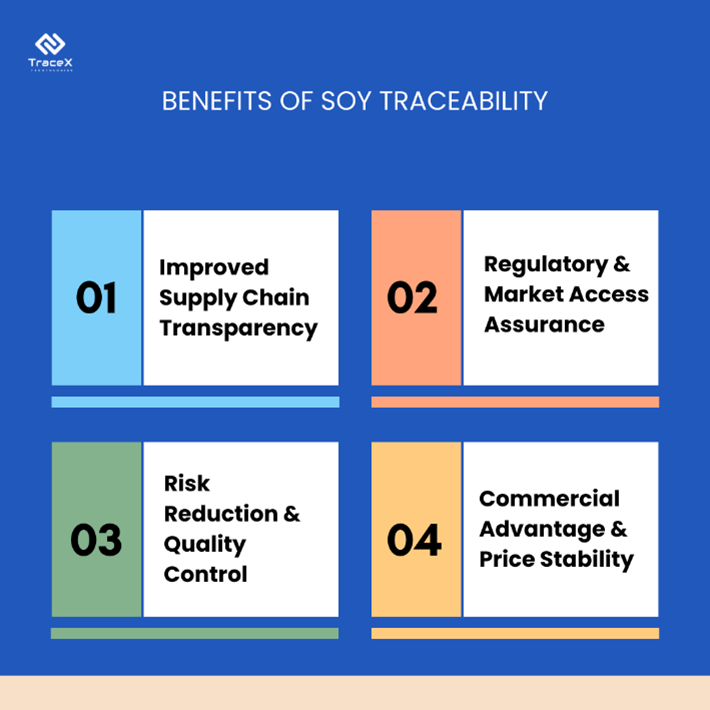
Benin is one of West Africa’s fastest-growing soybean producers, with soy increasingly positioned as a strategic export crop. However, global regulatory shifts and evolving buyer expectations are fundamentally changing how soy must be produced, documented, and traded. Market access is no longer driven by volume and price alone traceability, compliance, and verified sustainability are now decisive for competitiveness.
Key importing markets, particularly the EU, UK, and international commodity buyers, are tightening due-diligence requirements for soy and other land-based commodities. Key regulatory drivers include:
For Beninese soy exporters, farm-level traceability, batch identification, and digital audit trails are quickly becoming mandatory. Without them, exporters face shipment rejections, buyer delisting, and exclusion from regulated markets.
Global processors, traders, and food and feed manufacturers increasingly prioritize transparency and risk mitigation. Buyers sourcing from Benin now expect:
Even in price-sensitive regional markets, traceability is becoming a prerequisite to reduce regulatory, reputational, and supply risks. For buyers, traceability now functions as supply-chain risk insurance.
Benin’s soy sector remains largely informal and paper-based, with multiple aggregation layers and limited digital records. These traditional systems cannot:
As global scrutiny increases, exporters relying on manual systems face higher compliance costs, slower audits, and elevated risk of market exclusion.
Digitally traceable soy allows Benin’s exporters to:
Traceability shifts competition away from pure volume toward verified origin, compliance, and consistency.
At a national level, traceable soy supply chains help Benin to:
Countries that digitize soy supply chains early will shape future global trade flows. For Benin, traceability is no longer optional it is essential for long-term competitiveness and export growth.
Struggling with visibility gaps? Discover how traceability can fix them in our Supply Chain Traceability Blog.
Transform your food supply chain with digital tools—explore the Digital Traceability for Food Systems Blog.
See how blockchain improves trust, transparency, and auditability—start with our Blockchain Traceability Blog.
Traceability in the soy supply chain in Benin is critical for complying with global regulations, meeting buyer expectations, and unlocking access to premium markets. By adopting digital farm mapping, batch-level traceability, and audit-ready reporting, Benin’s soy producers and exporters can improve transparency, strengthen quality control, and demonstrate responsible sourcing. Investing in traceability not only safeguards market access but also enhances smallholder inclusion, reduces risk, and positions Benin’s soy sector for sustainable, export-led growth in regional and international markets.
Traceability in the soy supply chain in Benin refers to the ability to track soybeans from smallholder farms through aggregation, processing, and export using digital records, batch identification, and verifiable chain-of-custody systems.
Traceability helps Beninese soy exporters meet global buyer expectations, comply with food safety and sustainability requirements, reduce sourcing risks, and maintain access to regulated and premium markets
Key challenges include fragmented smallholder production, informal aggregation, limited digital farm records, mixed sourcing at collection points, and weak documentation of land use and production practices.
Digital traceability enables GPS-based farm mapping, structured farmer onboarding, batch-level tracking, and automated reporting, improving transparency, audit readiness, and supply chain efficiency.
Yes. Buyers increasingly favor traceable soy to reduce regulatory and reputational risk. Verified origin and compliance strengthen buyer confidence, reduce shipment rejections, and support long-term, higher-value contracts.