
Quick summary: Organic Certification in Kenya explained for exporters: standards, certification process, traceability requirements, and how to access EU and US organic markets.
Organic Certification in Kenya is regulated through accredited certification bodies and aligned with international standards required by export markets such as the EU, UK, and US. Exporters must ensure certified organic production practices, documented input use, farm inspections, and full traceability from farm to shipment. Compliance includes adherence to organic standards, internal control systems for smallholders, and audit-ready records. For Kenyan exporters, organic certification is essential for market access, price premiums, and credibility in regulated global organic supply chains.
What Is Organic Certification in Kenya?
Organic Certification in Kenya is a formal, third-party verification process that confirms agricultural products are produced, processed, and handled in accordance with internationally recognized organic standards without synthetic fertilizers, pesticides, GMOs, or prohibited chemicals. Certification is issued by accredited international bodies aligned with EU Organic, USDA Organic (NOP), Ecocert, Control Union, or Soil Association standards; local claims alone are not sufficient for export markets.
Kenya is one of Africa’s leading organic producers, with an estimated 180,000–200,000 certified organic producers and approximately 150,000–170,000 hectares under organic management. The sector has grown steadily over the past two decades, driven by strong demand from the EU and US for traceable, sustainably produced crops. Organic certification has supported improved farmer incomes, soil health, and long-term sustainability, particularly among smallholders.
Kenya’s organic sector is anchored by coffee, tea, cocoa, macadamia, avocado, mango, pineapple, herbs, spices, and vegetables, with smallholder farmers (typically under 5 hectares) forming the backbone of production. Certified organic land is estimated at 1–2% of total agricultural area, with growth supported by cooperative-based and group certification models.
Kenya’s organic certification landscape has grown steadily, with 62,626 certified organic farms covering 171,298 hectares as of 2022 (up from 8,004 farms/84,538 ha in 2007), representing ~0.6% of agricultural land amid rising urban demand for safe produce. KOAN facilitated 1,634 PGS certifications (2,520 acres 2023), focusing vegetables (64% of 347 products, e.g., cabbage/carrots), fruits, roots; market gaps in passion fruit/arrowroots signal expansion potential.
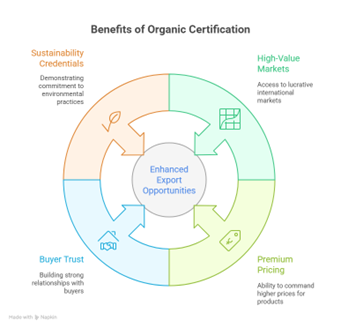
Organic exports from Kenya generate tens of millions of dollars annually, with price premiums typically ranging from 15–40% over conventional products. Exporters increasingly rely on digital traceability and audit-ready data systems to meet certification audits, buyer requirements, and emerging regulations such as EUDR and ESG due-diligence obligations.
Key certifiers operating in Kenya include Ecocert, Control Union, Soil Association Certification, and IMOcert, supported by national stakeholders such as the Kenya Organic Agriculture Network (KOAN). Verified, traceable organic certification remains essential for Kenyan exporters to legally market products as organic and maintain access to premium global markets.
Why Organic Certification Matters
Explore how organic certification impacts export eligibility, price premiums, and buyer trust in global agricultural markets.
Sustainability Is Now a Market Requirement
Learn how sustainability certifications are reshaping sourcing decisions across global agri-value chains.
Who Needs Organic Certification in Kenya?
Any Kenyan business exporting products marketed as organic to international markets must hold valid organic certification. This includes exporters of high-demand commodities such as coffee, tea, cocoa, macadamia, avocado, mango, pineapple, herbs, spices, vegetables, and processed agricultural products, especially where buyers require verified organic sourcing.
Processors, aggregators, packhouses, and exporters must also be certified if they process, store, blend, package, or handle organic products. Organic certification must cover the entire value chain, not just farm-level production.
For exporters targeting the European Union, United States, and other premium markets, organic certification is mandatory to legally label products as organic and access higher-value buyers. Without certification, shipments risk rejection, contract termination, or price penalties. In practice, organic certification in Kenya is a market-access requirement, not an optional credential.
Key Organic Certification Standards Relevant to Kenyan Exports
Kenyan exporters must comply with the organic standard required by their destination market:
Selecting the correct certification standard is critical. Certification must align with the destination market to ensure legal organic labelling, buyer acceptance, and uninterrupted exports from Kenya.
Organic Certification Process in Kenya
1. Farm Registration and Land History Verification
The process begins with registering individual farms or farmer groups with an accredited certification body. Exporters must submit documented land-use history for the previous 2–3 years, proving that no prohibited synthetic fertilizers, pesticides, or GMOs were used during the conversion period. This determines whether farms qualify for immediate certification or must undergo a transition phase.
2. Internal Control System (ICS) Setup (for Smallholders)
For group certification common in Kenya’s coffee, tea, macadamia, fruit, and vegetable sectors an Internal Control System (ICS) is required. The ICS defines farmer registration, internal inspections, training, approved input management, recordkeeping, and corrective actions. It allows thousands of smallholders to be certified under a single certificate while maintaining consistent organic compliance.
3. Inspection and Audit by an Accredited Certifier
Accredited certification bodies such as Ecocert, Control Union, Soil Association Certification, and IMOcert conduct on-site inspections. Audits cover farm practices, storage and packhouse facilities, processing units, segregation controls, traceability records, and ICS effectiveness. Sampling, residue testing, and document checks may also be performed.
4. Compliance Corrections (If Required)
If non-conformities are identified, exporters must implement corrective actions within a defined timeframe. This may include updating records, retraining farmers, improving segregation, or tightening input controls. Certification is granted only after corrective measures are verified and approved.
5. Certification Issuance and Annual Renewal
Once compliance is confirmed, an organic certificate typically valid for 12 months is issued. Annual renewal requires continuous compliance, updated farm and transaction records, and repeat inspections, making ongoing monitoring and digital traceability essential.
Why Is Traceability Critical for Organic Exports from Kenya?
Traceability is the backbone of organic certification and export compliance. Buyers and regulators require verifiable proof that products labelled as organic meet standards at every stage of the value chain. In Kenya, traceability begins at the farm and plot level, with each certified plot registered, mapped, and linked to approved organic practices.
During aggregation, packing, and processing, batch-level segregation and documentation prevent mixing organic and conventional products. Each batch must be traceable back to specific farms, harvest dates, and farmer groups through lot numbers, transaction records, and processing logs.
A continuous chain of custody from farm to export connects farmers, cooperatives, processors, exporters, and logistics providers into a single audit trail. This not only supports organic certification but also aligns with EU due-diligence requirements, EUDR, and ESG sourcing expectations, reducing compliance risk and securing access to premium global organic markets.
ommon Challenges for Kenyan Organic Exporters
How Digital Platforms Simplify Organic Certification in Kenya
Digital traceability platforms from TraceX replace fragmented, manual workflows with a centralized system for managing organic compliance at scale. Through digital farmer onboarding, TraceX captures verified farmer profiles, mapped farm plots, certifications, and organic practice data directly at the source creating a strong foundation for audits and certification.
Real-time compliance monitoring allows exporters to track input use, field activities, and ICS performance continuously, helping identify risks before they escalate into audit findings. The TraceX platform also generates audit-ready documentation, including farm records, batch-level traceability, and chain-of-custody reports significantly reducing audit preparation time and non-compliance rates.
By standardizing data, automating traceability, and centralizing compliance workflows, TraceX enables Kenyan exporters to reduce certification risk, improve audit outcomes, and scale organic exports while maintaining access to premium global markets.
Turning Organic Certification into an Export Advantage in Kenya
Organic certification in Kenya has evolved from a compliance requirement into a strategic export advantage. For exporters, success depends on strong farm-level traceability, effective ICS implementation, and audit-ready documentation across diverse smallholder supply chains.
Exporters that invest in structured data, digital traceability, and continuous compliance reduce certification risk, strengthen buyer confidence, and secure higher price premiums. In today’s competitive export environment, certified organic is not just about how crops are grown it’s about how credibility, transparency, and trust are consistently demonstrated to global buyers.
Ethical Sourcing Matters
Discover how ethical sourcing practices build trust, reduce risks, and create value across agricultural supply chains.
Build a Responsible Supply Chain
Explore strategies for creating transparent and accountable supply chains that meet global sustainability expectations.
Digitally Transform Your Sustainability Efforts
Learn how digital platforms are enabling real-time monitoring, reporting, and compliance in agriculture and agribusiness.
Frequently Asked Questions (FAQ’s)
Organic certification in Kenya is issued by accredited international certification bodies approved under standards such as the EU Organic Regulation and USDA Organic (NOP), often working through licensed inspection partners operating in Kenya.
Certification timelines vary. Farms transitioning from conventional production typically undergo a 2–3 year conversion period, followed by inspection and audit before organic certification is granted.
Group certification using an Internal Control System (ICS) is not legally mandatory but is the most practical and cost-effective approach for Kenyan exporters working with large numbers of smallholder farmers.
No. Products cannot be legally labelled or marketed as “organic” in the EU, US, or other premium markets without third-party organic certification issued by an accredited certifier.
High-demand organic crops from Kenya include coffee, tea, macadamia, avocado, mango, pineapple, herbs, spices, and vegetables, driven by EU and US buyers seeking certified, traceable, and sustainably produced goods.









