Quick summary: Discover how Farm Management for Traceability helps agribusinesses achieve plot-level visibility, EUDR compliance, and audit-ready sourcing. Learn why structured farm data is now critical supply-chain infrastructure.

Farm management for traceability is no longer a sustainability add-on. It has become the operational backbone of modern agribusiness. Across global supply chains, regulatory pressure from frameworks like EUDR, rising ESG due diligence expectations, and increasing buyer scrutiny are pushing accountability all the way to the farm and often to the individual plot.
Yet many organizations are still trying to prove compliance using spreadsheets, PDFs, cooperative-level declarations, and disconnected field records. These systems were never designed to deliver plot-level geolocation, volume traceability, or audit-ready documentation at scale. The result? Last-minute fire drills before Due Diligence Statements, shipment delays, rejected claims, and growing exposure to deforestation and sourcing risks.
At the same time, climate volatility and land-use change are intensifying scrutiny. Buyers now demand proof not promises of where products were grown and under what conditions. Farm management for traceability solves this by turning farms into structured, continuously updated data assets linking farmers, plots, crops, and transactions in a single system that supports procurement, sustainability, and compliance simultaneously.
In this guide, we’ll break down what agribusinesses must get right to move from reactive documentation to proactive, system-based traceability that protects market access and strengthens supply chain control.
Key Takeaways
Farm management for traceability is the structured, continuous capture and management of farm- and plot-level data linking farmers, geolocated plots, crops, inputs, harvest volumes, and post-harvest transactions into a single, connected system that supports sourcing, compliance, and reporting.
It goes beyond record-keeping. It creates a living, verifiable data foundation that allows agribusinesses to prove where products were grown, under what conditions, and how they moved through the supply chain.
Farm registration is a one-time event:
It quickly becomes outdated.
Continuous farm data management means:
Traceability depends on longitudinal data, not one-off snapshots.
Certification documents show that an audit occurred at a specific point in time.
They do not guarantee: Ongoing compliance, Data continuity and Volume-to-plot linkage
Operational traceability embeds compliance into daily workflows. This makes compliance repeatable not reactive.
Regulations such as EUDR, evolving ESG due diligence requirements, and increasing buyer scrutiny have shifted accountability to the farm and plot level.
Today, farm-level data is no longer a sustainability detail, it is:
Without structured farm management for traceability, supply chains rely on assumptions. With it, agribusinesses gain operational control, defensible sourcing decisions, and the ability to respond confidently to audits, regulators, and buyers.
In short, farm-level data has moved from background documentation to core supply-chain infrastructure.
Still relying on spreadsheets and manual tracking?
Read our complete Guide to Digital Farm Management to understand how farm data becomes supply chain infrastructure.
Want to move from paper compliance to verifiable sustainability?
Read our blog on Farm Management for Sustainability to see how structured farm systems support certifications and ESG goals.
Traceability no longer begins at the warehouse, processor, or export terminal. It begins at the farm and increasingly, at the plot level. Regulatory enforcement, buyer expectations, and brand risk exposure have pushed accountability upstream. Companies that fail to establish farm-level visibility now face operational, legal, and reputational consequences.
Regulation is the primary force driving traceability back to the farm.
The EU Deforestation Regulation (EUDR) requires companies placing commodities on the EU market to provide precise geolocation data typically polygon-based farm or plot boundaries. Village-level or cooperative-level origin is no longer sufficient.
Companies must submit structured DDS filings confirming that products are:
These filings depend entirely on accurate farm-level data.
Under EUDR, production must not originate from land deforested after 31 December 2020. This can only be verified when farm plots are mapped and validated against satellite imagery.
Enforcement mechanisms are becoming more active across EU member states. Authorities can:
Without farm-level traceability, compliance becomes guesswork and guesswork fails under enforcement.
Regulation is only one side of the equation. Market pressure is equally powerful.
Buyers in the EU, US, Japan, and other regulated markets increasingly require:
Self-declarations and aggregated reports are no longer enough.
Traceability is required for exports from Southeast Asia, Latin America, Africa, and India
Exporting countries are experiencing intensified scrutiny, especially in commodities such as:
Exporters must demonstrate that farm-level systems exist and function not just that certifications are held.
Traceability has become a competitive differentiator. Companies that cannot provide structured, verifiable farm data risk losing access to premium and regulated markets.
Beyond compliance and buyer contracts, traceability now directly impacts brand reputation.
Public claims must be substantiated
Companies are making sustainability claims around:
If these claims cannot be supported by verifiable farm-level data, they create legal and reputational exposure.
Risk of shipment holds and audit failures
Traceability gaps commonly result in:
In a hyper-transparent global environment, a single traceability failure can trigger broader scrutiny across supply chains.
Farm management for traceability only works when it is built on structured, scalable foundations. These are not “nice-to-have” features; they are the minimum requirements for creating verifiable, compliance-ready, farm-level data that supports procurement, exports, and sustainability at scale.
Traceability begins with identity.
Every system must establish:
Want to see how integrated KYC transforms farmer onboarding from paperwork to compliance-ready workflows?
Read the case study: Enhancing Farmer Onboarding with Integrated KYC Validation.
Without structured identity management, traceability breaks before it begins.
Modern compliance frameworks require proof at the plot level not just at the farm or village level.
Key components include:
Plot-level digitization transforms farm data from descriptive to defensible.
Data quality is determined at the point of entry.
Effective farm management systems provide:
Manual, paper-based systems create delays and errors. Mobile-first systems create immediate, validated data.
Traceability often collapses after harvest when aggregation begins.
Strong farm management systems must support:
Without post-harvest traceability, farm-level data loses its downstream value.
Collecting data is not enough. It must be validated and monitored continuously.
Critical capabilities include:
Risk visibility turns traceability from reactive reconstruction into proactive control.
Farm management for traceability is often misunderstood as a “field tool.” In reality, it serves multiple enterprise functions that depend on reliable farm-level data to reduce risk, protect revenue, and maintain market access.
Here’s who benefits most—and why it matters.
Primary Focus: Risk-Controlled Sourcing
Procurement is under pressure to secure supply while avoiding compliance exposure. Farm management for traceability provides:
For procurement, traceability becomes a risk filter, not just a reporting requirement.
Primary Focus: Verifiable Claims & Continuous Impact Monitoring
Sustainability teams are accountable for public claims, ESG disclosures, and certification outcomes.
Farm management for traceability enables:
For sustainability teams, traceability turns narrative into evidence.
Primary Focus: Regulatory Readiness & Audit Resilience
Compliance teams carry legal accountability under regulations such as EUDR and global due diligence frameworks.
Farm management for traceability supports:
For compliance teams, traceability reduces anxiety and liability.
Primary Focus: Market Access & Operational Continuity
Exporters and traders operate at the point where compliance failure becomes commercial disruption.
Farm management for traceability delivers:
For exporters, traceability protects revenue flow.
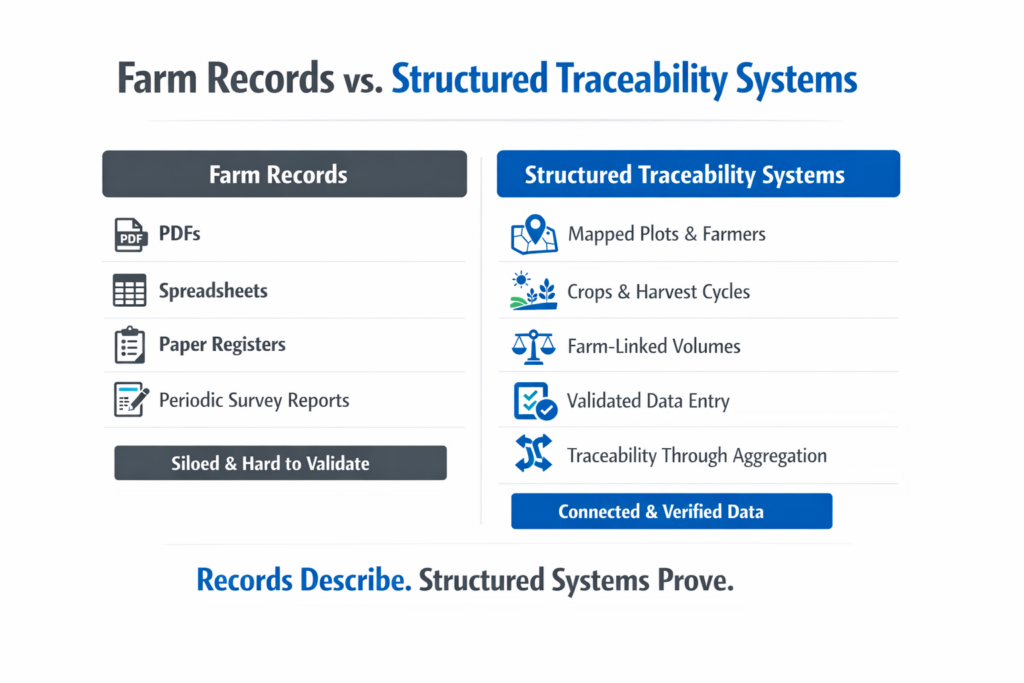
Modern traceability regulations and buyer standards require structured, plot-level, continuously validated data. Traditional record-keeping systems were never built for that level of scrutiny.
Handwritten and inconsistent records lack real-time validation, making them error-prone and difficult to digitize accurately at scale.
The result is missing farm, volume, or harvest data and no reliable audit trail when compliance is required.
• Spreadsheet Silos
Multiple disconnected versions across teams require manual reconciliation before audits or DDS submissions.
Inconsistent farmer or plot IDs, no ERP integration, and slow reactive updates create traceability gaps.
Mixed volumes without farm-level attribution break the link between farmer, plot, batch, and shipment.
Declarations replace verifiable evidence, making plot-level deforestation-free proof impossible.
• No Plot-Level Mapping
Village-level coordinates replace precise GPS polygons, with no linkage to specific plots or seasons.
Without geospatial overlays, risk assessments rely on assumptions instead of verified deforestation data.
• Manual Audit Preparation
Teams scramble to reconstruct data weeks before audits, chasing last-minute documents from suppliers.
Gaps surface only when shipments are in motion, with heavy reliance on emails, PDFs, and declarations.
Farm management for traceability is not a one-size-fits-all model. Regulatory intensity, export exposure, smallholder participation, and buyer expectations vary by region. However, the common denominator is clear: farm-level data is becoming the foundation of market access.
The European Union is currently the most regulation-driven traceability environment globally.
Countries like Vietnam and Indonesia are major exporters of coffee, rubber, palm oil, and timber sectors heavily impacted by EUDR and global ESG scrutiny.
Latin American supply chains are highly export-oriented, especially in coffee, cocoa, soy, and beef.
Many African supply chains, particularly cocoa, coffee, timber, and palm, are deeply intertwined with donor-funded sustainability programs and EU-bound exports.
Across regions, the drivers differ, but the direction is the same:
In every case, farm management for traceability is becoming supply-chain infrastructure the system that connects farms, plots, volumes, compliance, and exports into a defensible, verifiable framework.
TraceX Farm Management Solutions are designed not as isolated tools, but as structured traceability infrastructure turning farm data into a defensible, enterprise-ready asset that supports procurement, sustainability, compliance, and export operations simultaneously.
Traceability regulations such as EUDR require plot-level geolocation using boundary polygons, not single GPS pins.
What to look for:
How TraceX supports this:
TraceX enables GPS-verified polygon mapping directly from the field. Plots are digitally linked to farmer profiles, crops, and harvest cycles. Built-in geolocation validation and satellite checks reduce DDS rejection risk and strengthen compliance evidence.
Field adoption determines data quality. If field teams avoid the system, traceability collapses.
What to look for:
How TraceX supports this:
TraceX provides mobile-first applications designed for real-world field conditions. Data is captured once, validated instantly, and synced when connectivity is available minimizing errors and eliminating duplicate manual entry.

Traceability cannot live in isolation. Farm data must flow into procurement, compliance, and enterprise systems.
What to look for:
How TraceX supports this:
TraceX integrates farm-level data directly into procurement and ERP workflows. This ensures that sourcing decisions, contracts, shipments, and compliance filings all rely on a single, structured source of truth.
Collecting data is not enough. The system must proactively surface risks.
What to look for:
How TraceX supports this:
TraceX includes built-in risk scoring engines that flag incomplete geolocation, aggregation risks, and potential compliance gaps early before shipments move or DDS submissions are filed.
Pilots are easy. Scaling is hard.
What to look for:
How TraceX supports this:
TraceX is designed for agribusiness scale supporting thousands (or tens of thousands) of farmers across crops and regions. Its architecture ensures longitudinal farmer records, cross-season continuity, and large-scale transaction handling without performance degradation.
Agribusinesses operate across countries with different compliance expectations.
What to look for:
How TraceX supports this:
TraceX enables multi-region deployments with centralized dashboards and region-specific compliance configurations. Whether sourcing from Southeast Asia, Africa, or Latin America for EU markets, farm-level traceability remains consistent and audit-ready.
Farm management is no longer a sustainability add-on or a reporting requirement handled once a year. It has become core supply-chain infrastructure, the foundation that determines whether sourcing decisions are defensible, audits are smooth, and market access remains protected.
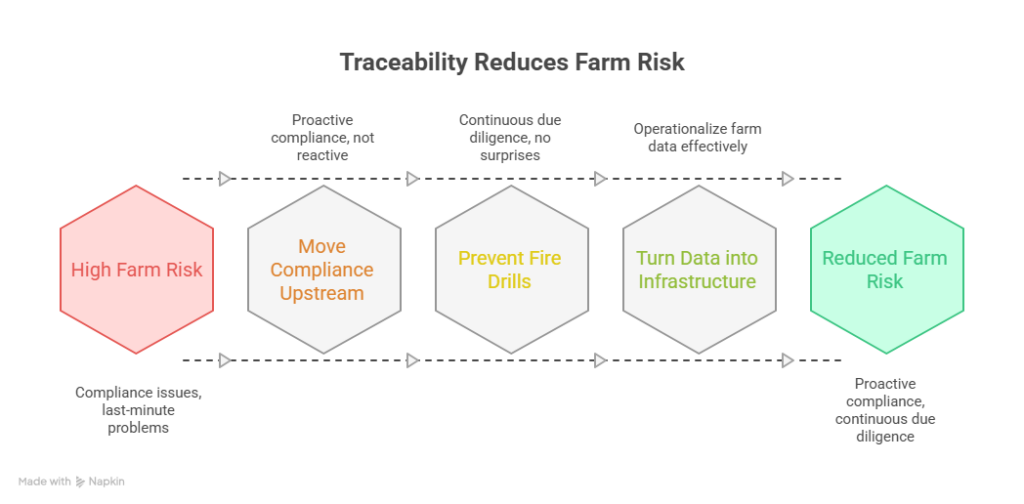
Reactive compliance waits for audits, buyer queries, or shipment holds before fixing gaps. Structured traceability builds control upstream at the farmer, plot, and transaction level long before products move. In a world of tightening regulations, buyer scrutiny, and ESG accountability, structured traceability is not just about proving compliance. It is about gaining operational control, protecting reputation, and building a resilient supply chain designed to withstand scrutiny not react to it.
Export markets demand proof, not promises.
Read our guide on Farm Management for Exports to protect market access and reduce shipment risk.
Still managing suppliers through spreadsheets and emails?
Learn how digital procurement solutions streamline sourcing and reduce reconciliation time.
Farm Management for Traceability is a structured digital system that captures, validates, and links farm-level data, including farmer identity, plot geolocation, crops, harvest volumes, and transactions to ensure end-to-end supply chain transparency and compliance.
Plot-level polygon mapping enables accurate deforestation risk checks, regulatory compliance (such as EUDR), and proof of origin. Risk and land-use change occur at the plot level not at the village or cooperative level.
It enables precise geolocation capture, supplier validation, harvest-volume traceability, and structured data required for Due Diligence Statements (DDS), reducing shipment delays and rejection risks.
Procurement teams gain supplier risk visibility, sustainability teams can substantiate claims, compliance teams achieve audit readiness, and exporters secure smoother customs clearance and EU market access.
Paper registers, spreadsheets, and cooperative-level declarations cannot provide real-time validation, preserve traceability through aggregation, or meet modern regulatory and buyer expectations for verifiable, structured data.