Quick summary: Traceability in the arecanut value chain enables farm-to-export transparency, reduces compliance risks, improves quality consistency, and unlocks premium global markets. Discover how digital traceability drives ROI.

The global arecanut trade is entering a new era, one defined by compliance, transparency, and accountability. What was once a traditionally managed supply chain is now facing increasing scrutiny from regulators, buyers, and international markets. For exporters and processors, traceability in the arecanut value chain is no longer a “value add.” It is fast becoming a license to operate.
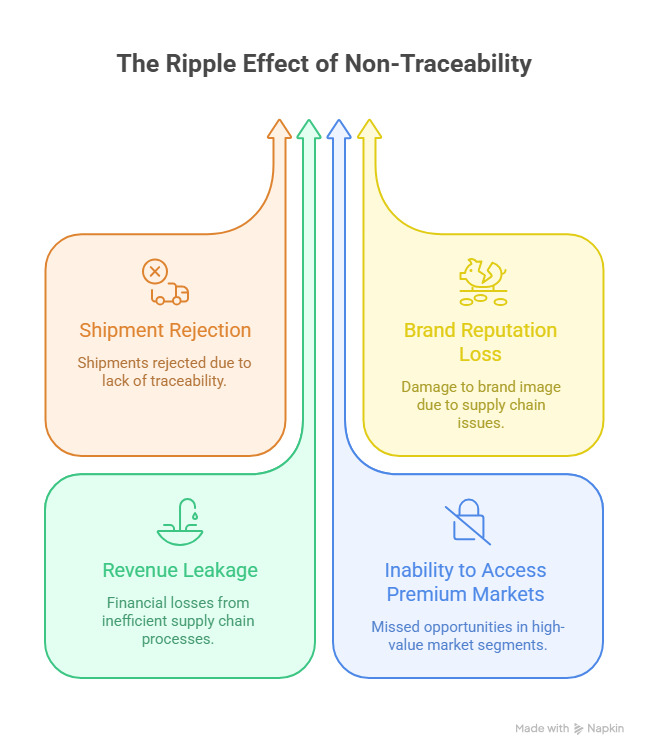
Exporters and processors are facing mounting pressure from tightening global compliance standards, inconsistent batch quality, adulteration risks, and growing buyer demands for farm-level transparency. Shipment rejections, pricing disputes, and lack of visibility across fragmented sourcing networks are eroding margins and threatening long-term contracts. Without a structured traceability framework, arecanut businesses struggle to prove origin, ensure quality consistency, and access premium international markets. The need for a transparent, digitally enabled supply chain has never been more urgent. TraceX digital traceability solutions empower exporters and processors with end-to-end farm-to-export visibility, enabling compliance-ready documentation, batch-level tracking, and data-driven supply chain optimization.
Key Takeaways
The arecanut supply chain is multi-layered, fragmented, and heavily dependent on smallholder farmers and intermediaries. Each stage plays a critical role in determining quality, compliance readiness, and export potential. However, without structured systems, visibility across these stages remains limited making traceability difficult to achieve.
The value chain begins at the farm level, where arecanut is cultivated, harvested, dehusked, and dried. Farming practices such as fertilizer usage, pest control methods, irrigation standards, and post-harvest drying techniques directly impact quality and safety.
Since arecanut cultivation is largely managed by small and marginal farmers, data collection at this stage is often informal or undocumented. This creates the first major traceability gap.
After harvesting, arecanut is sold to local traders or aggregation centers. At this stage, nuts from multiple farmers are pooled together, sorted loosely, and moved toward processors.
Aggregation improves supply efficiency but often mixes produce from different origins, making it difficult to track back to individual farms unless structured lot identification systems are in place.
Processors clean, boil (in certain varieties), dry, grade, and sort arecanut into different quality categories. Grading standards vary across regions, which can lead to inconsistencies in export batches.
If incoming lots are not properly tagged and recorded, quality deviations identified during export cannot be traced back to source farms or aggregation centers.
Graded arecanut is packed into labeled sacks or containers and stored before dispatch. Storage conditions humidity, pest exposure, ventilation significantly influence product quality.
Without digital lot tracking, packaged goods often lose farm-level identity, reducing transparency for buyers and auditors.
Exporters handle compliance documentation, phytosanitary certifications, customs clearance, and logistics. International buyers increasingly demand proof of origin, processing history, and quality documentation.
In the absence of end-to-end traceability, exporters rely on fragmented paperwork, which increases the risk of rejection, delays, or compliance penalties.
Want to see how digital traceability works in action?
Discover how technology like batch tracking, blockchain, and ERP integration transforms agri supply chains.
Read Our Complete Guide to Digital Traceability
Understand how structured farm management systems strengthen compliance, improve quality consistency, and build export-ready supply chains.
Read: Farm Management Best Practices for End-to-End Traceability
Traceability in the arecanut industry refers to the ability to track and verify the movement, transformation, and handling of arecanut across every stage of the value chain from cultivation and harvesting to processing, packaging, and export. It ensures that each batch can be traced back to its source and forward to its final destination using documented, verifiable records.
In a fragmented supply chain dominated by smallholder farmers and multiple intermediaries, traceability creates structured visibility. It connects farm-level data, quality parameters, processing history, and compliance documentation into a unified system that exporters and buyers can rely on.
Forward traceability tracks the movement of arecanut from its origin to its final buyer.
It answers questions such as:
This is especially important for managing recalls, responding to quality disputes, and ensuring shipment-level transparency.
Backward traceability works in reverse—it identifies the origin of a specific batch.
It helps exporters determine:
Backward traceability is critical during export inspections and compliance audits, where authorities require proof of origin and production history.
Internal traceability monitors movement within a facility, whether at aggregation centers or processing units.
It tracks:
Without internal traceability, product identity can be lost once batches are mixed or re-packed, breaking the traceability chain.
Blockchain-enabled traceability uses decentralized digital ledgers to record every transaction and movement within the supply chain.
Key advantages include:
For export-focused arecanut businesses, blockchain systems can provide strong credibility in global markets where documentation authenticity is closely scrutinized.
The shift toward traceability is being driven by regulatory pressure, market expectations, and competitive dynamics.
Importing countries are tightening phytosanitary requirements, origin verification protocols, and documentation standards. Exporters must now provide structured records covering sourcing, processing, and handling practices.
Without traceability systems, compliance becomes reactive and paperwork-heavy—raising the risk of non-conformance.
Food safety concerns related to contamination, chemical residues, and improper processing are increasing globally. Authorities demand transparency into cultivation practices, chemical usage, and processing conditions.
Traceability systems enable exporters to:
Shipment rejections due to documentation gaps, inconsistent quality, or regulatory non-compliance can result in significant financial losses. In some cases, repeated non-compliance can damage long-term trade relationships.
With structured traceability:
Large international buyers and institutional importers increasingly prioritize suppliers who offer end-to-end transparency. Many now require farm-level origin data and digital traceability documentation as part of procurement criteria.
Suppliers that provide verified traceability often benefit from:
The arecanut supply chain is structurally complex and highly fragmented. While this ecosystem supports millions of smallholders and traders, it also creates significant operational and compliance challenges especially for exporters targeting regulated international markets.
Below are the most pressing barriers affecting transparency, consistency, and profitability.
Arecanut cultivation is largely driven by small and marginal farmers operating independently across different regions.
This fragmentation leads to:
Without digital farmer profiling and structured onboarding, building farm-level traceability becomes extremely challenging.
Grading parameters often vary across regions and aggregation centers. Moisture content, size classification, processing techniques, and quality definitions may differ significantly.
As a result:
In the absence of standardized grading protocols tied to batch-level records, maintaining consistency across shipments becomes difficult.
Multiple intermediaries operate between farmers, aggregators, processors, and exporters. While they play an important role in sourcing and logistics, their involvement can reduce supply chain visibility.
Common issues include:
This opacity weakens traceability and increases compliance risks for exporters.
Exporting arecanut requires multiple layers of documentation, including origin certificates, phytosanitary approvals, quality certifications, and customs declarations.
When records are maintained manually:
Managing regulatory requirements without an integrated traceability system significantly increases administrative burden.
Quality disputes often arise due to:
Without traceability, exporters struggle to identify whether the issue originated at the farm, aggregation center, or processing facility. This makes resolution slow, costly, and reputationally damaging.
Digital traceability shifts the arecanut supply chain from fragmented, paper-based operations to a connected, data-driven ecosystem. Instead of relying on manual registers and informal aggregation, every movement from farm harvest to export dispatch is digitally recorded, verified, and linked.
Mobile-based farm data capture applications enable structured onboarding of farmers and real-time recording of:
This creates a verified digital farmer identity and establishes the foundation for backward traceability.
Batch and lot tracking systems assign unique identification codes to each consignment at aggregation or processing stages. These codes remain linked as the product moves through grading, packaging, storage, and export.
This allows businesses to:
QR codes placed on packaging allow stakeholders—buyers, auditors, and regulators to access product-level data instantly.
When scanned, a QR code can reveal:
Blockchain technology stores supply chain transactions on a decentralized, tamper-proof ledger. Each update harvest entry, lot creation, shipment dispatch is time-stamped and permanently recorded.
Key benefits include:
For export-focused arecanut businesses, blockchain enhances credibility, particularly when dealing with strict regulatory markets or institutional buyers.
Integrating traceability systems with Enterprise Resource Planning (ERP) platforms connects operational, financial, and compliance data into one unified ecosystem.
This enables:
Try our End to End Traceability Solutions
TraceX traceability solutions provide end-to-end digital visibility across the agricultural and food supply chain, enabling businesses to track products from farm to final export with accuracy and transparency. The platform digitizes farmer onboarding, batch creation, processing activities, and shipment documentation through mobile data capture, QR-code tagging, and blockchain-backed records. By integrating traceability with ERP and compliance systems, TraceX helps exporters, processors, and aggregators maintain audit-ready documentation, reduce rejection risks, and meet global regulatory standards. The solution not only strengthens compliance and food safety assurance but also enables premium market access, data-driven sourcing, and stronger buyer trust through verifiable, tamper-proof supply chain records.
TechnoServe transformed fragmented coffee supply chains into a fully traceable, transparent system from smallholder farms to global buyers.
By digitizing farmer registration, capturing verified geolocation data, and strengthening cooperative recordkeeping, they enabled farm-to-export traceability and prevented mixing of compliant and non-compliant volumes.
The result: improved transparency, audit-ready documentation, reduced compliance risk, and stronger buyer confidence.
This case proves that even complex smallholder-based coffee supply chains can achieve end-to-end traceability strengthening regulatory readiness while improving market access and long-term value chain resilience.
Read the Case Study: Brewing Transparency with TraceX
Digital traceability in the arecanut value chain does not benefit just one segment—it creates value across the ecosystem. By improving transparency, accountability, and data visibility, it aligns incentives from farm to export market.
Transparent Pricing
With batch-level traceability and quality-linked data, farmers are paid based on measurable parameters rather than subjective assessments.
Benefits include:
When pricing becomes data-backed, farmers gain stronger negotiating power and improved income stability.
Access to Premium Buyers
Exporters and institutional buyers increasingly prefer traceable sourcing networks. Digitally onboarded farmers become part of verified supply chains that meet export compliance standards.
This opens opportunities for:
Traceability transforms smallholder participation from informal trading to structured market integration.
Digital Transaction Records
Farm-level digital records create transaction histories that can be used for:
Over time, digital identity strengthens farmers’ economic resilience and integration into formal supply networks.
Quality Consistency
Structured batch tracking enables aggregators and processors to monitor:
With traceability insights, quality control becomes proactive rather than reactive. Inconsistent suppliers can be identified early, reducing downstream risk.
Faster Recalls
If contamination or quality issues arise, digital lot tracking allows businesses to:
Instead of recalling entire consignments, targeted action minimizes operational disruption.
Data-Driven Sourcing
Traceability systems generate valuable sourcing intelligence, including:
Aggregators can optimize procurement strategies based on performance data rather than assumptions, improving overall efficiency.
Compliance Readiness
Digital traceability systems automatically maintain origin records, processing history, and documentation trails required for export audits.
This results in:
Exporters move from reactive paperwork management to proactive compliance assurance.
Reduced Rejection Rates
Shipment rejections are often caused by documentation gaps or unverifiable origin claims. With end-to-end traceability:
This significantly lowers the risk of costly consignment rejections and trade disruptions.
Global Buyer Trust
Transparency builds credibility. When exporters can provide buyers with digital proof of:
It enhances long-term trust and differentiates them from non-traceable competitors.
Buyers increasingly prefer suppliers who offer visibility, accountability, and structured documentation making traceability a competitive advantage rather than just a compliance tool.
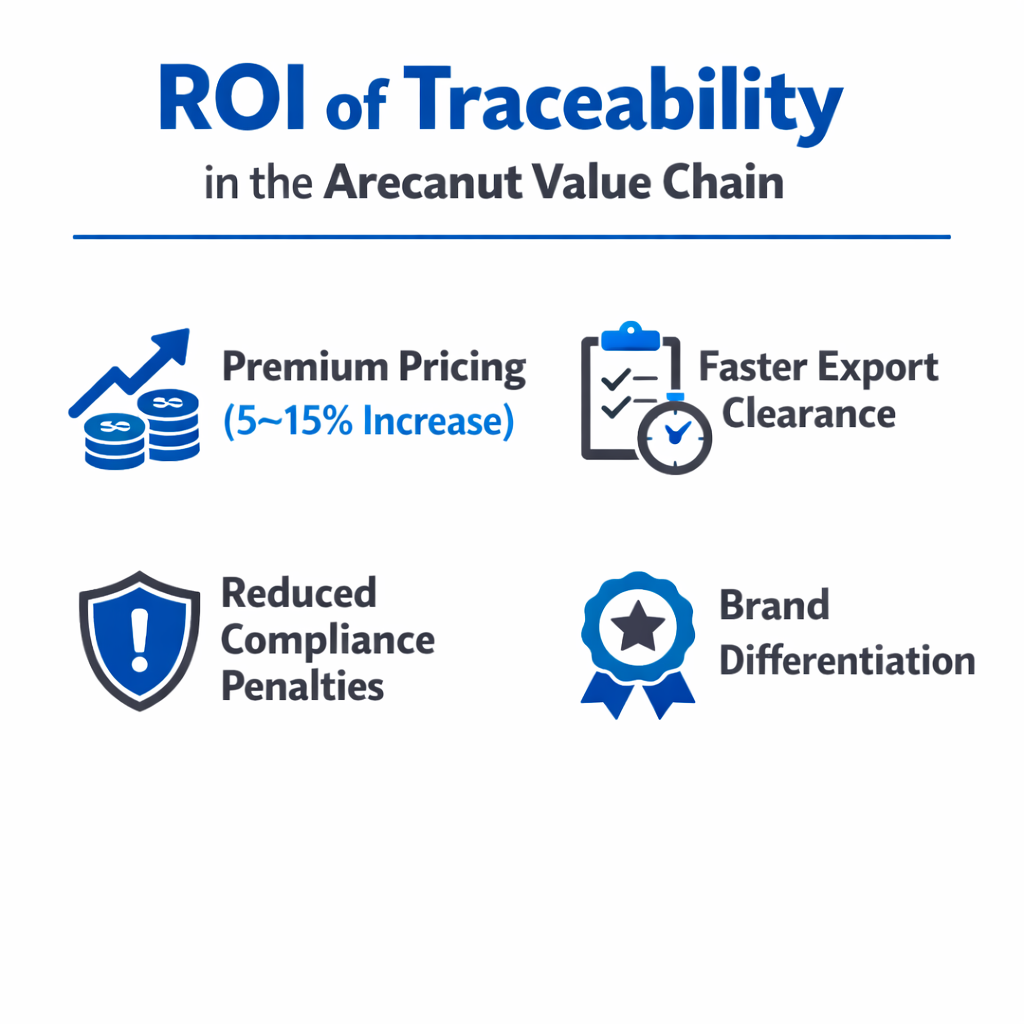
Traceability in the arecanut value chain is no longer a future initiative it is a present-day business imperative. As global markets demand higher transparency, stricter compliance, and consistent quality standards, exporters and processors must move beyond fragmented, paper-based systems. Digital traceability enables farm-level visibility, batch-level accountability, and audit-ready documentation that strengthens buyer trust and reduces operational risk. More importantly, it transforms transparency into measurable ROI unlocking premium pricing, faster export clearances, and long-term global market access. Businesses that invest in structured traceability today position themselves not just for compliance, but for sustained competitive advantage from farm to global markets.
Discover how modern digital traceability systems automate CTEs, capture KDEs, and ensure audit-ready reporting.
Read: The Complete Guide to Digital Traceability Systems
Traceability requirements vary across food segments from fresh produce to dairy and seafood.
See how traceability works across different food industry sectors.
Read: Traceability in the Food Industry Explained
Compliance is just the baseline.
Learn the best practices leading food companies use to build scalable, audit-ready traceability programs.
Read: Best Practices for Food Traceability
Traceability in the arecanut value chain refers to the ability to track arecanut from farm cultivation through processing, packaging, and export using digital systems and batch tracking technologies.
Traceability ensures compliance with import regulations, reduces shipment rejection, improves quality control, and increases buyer trust.
Blockchain creates tamper-proof digital records of each transaction and movement within the supply chain, improving transparency and auditability.
Mobile farm data capture apps, QR codes, batch management systems, IoT devices, and ERP integrations are commonly used.