
Quick summary: EUDR Coffee Compliance for Importers: A Readiness Guide covering traceability, risk assessment, due diligence requirements, penalties, and how to prepare before EU enforcement deadlines.

The clock is ticking for coffee importers placing products on the EU market. Under the EU Deforestation Regulation, every shipment must now be backed by verified proof that it is deforestation-free, legally produced, and fully traceable to farm-level geolocation data. For many businesses, EUDR Coffee Compliance for Importers isn’t just a regulatory task it’s a complete transformation of how supply chains are mapped, monitored, and documented. If you’re importing green or roasted coffee into the EU, the risks of non-compliance are real and growing.
To stay ahead of enforcement and protect market access, importers are turning to TraceX EUDR solutions for automated traceability, satellite-based deforestation monitoring, and streamlined due diligence management all designed specifically to simplify EUDR readiness at scale.
Key Takeaways
EUDR coffee compliance requires importers placing coffee on the EU market to prove their products are deforestation-free, legally produced, and supported by geolocation traceability data under the EU Deforestation Regulation (EUDR). Importers must conduct due diligence, risk assessments, and submit declarations before placing products on the market.
Under the EUDR framework, coffee importers are legally responsible for ensuring that every shipment entering the EU market meets three core conditions:
Coffee must not be grown on land that was deforested after the regulation’s cut-off date (31 December 2020). Importers must verify this using farm-level geolocation coordinates and satellite monitoring tools.
The coffee must comply with all relevant laws in the country of origin — including land-use rights, environmental protection, labor laws, and tax regulations.
Before placing coffee on the EU market, importers must:
Unlike previous sustainability frameworks that relied heavily on certifications, EUDR shifts accountability directly to the importer as the “operator.” This means:
Failure to comply can result in fines (up to 4% of EU turnover), shipment seizures, and temporary market bans.
In short, EUDR coffee compliance for importers is not just paperwork it is a traceability-driven, risk-based regulatory obligation that requires supply chain transparency down to the farm level before coffee can legally enter the EU market.
Dive deeper into regulatory requirements, traceability best practices, supplier risk mitigation strategies, and technology frameworks designed specifically for coffee importers navigating the EU Deforestation Regulation.
Read our in-depth blog on EUDR Coffee Compliance
Want a step-by-step action plan?
Read the EUDR Compliance Importers Checklist to quickly assess gaps in your traceability, risk assessment, documentation, and Due Diligence Statement workflows.
Access the EUDR Compliance Checklist for Importers
The EU Deforestation Regulation (EUDR) is a landmark EU law designed to prevent products linked to deforestation from being placed on or exported from the EU market. It shifts the burden of proof onto companies, especially importers, to demonstrate that commodities are deforestation-free, legally produced, and traceable to origin.
For coffee importers, this is not a voluntary sustainability initiative. It is a legally binding compliance requirement that directly affects sourcing, documentation, and market access.
The core objective of the EUDR is to reduce the EU’s contribution to global deforestation and forest degradation. It targets commodities most commonly associated with forest loss
Companies must now prove that products entering the EU have not been grown on land deforested after 31 December 2020.
For coffee importers, this means every shipment must be backed by verified farm-level geolocation data and deforestation risk analysis before it can legally enter the market.
Coffee is specifically included in the regulation because cultivation in certain producing regions has historically contributed to deforestation.
This classification means:
Importers sourcing from countries with elevated deforestation risk may face additional due diligence obligations.
Understanding your role under EUDR is critical.
Operators
If you are the first entity placing coffee on the EU market (e.g., an importer bringing coffee from a non-EU country into the EU), you are considered an operator. Operators must:
Traders
Traders purchase and sell coffee already placed on the EU market. Their obligations are lighter but still require traceability and record-keeping.
For most non-EU coffee importers selling into Europe, the role will fall under “operator,” meaning full compliance responsibility applies.
The regulation entered into force in 2023, with enforcement obligations phased in:
However, waiting until enforcement begins is risky. Importers must:
Because supply chain mapping and data collection can take 6–18 months, 2026–2027 is not the start of preparation it is the compliance deadline.
The EUDR fundamentally transforms coffee sourcing from a commercial transaction into a regulated, data-driven compliance process.
Importers who prepare early gain:
Those who delay face operational disruption, financial penalties, and reputational damage.
In short, the EUDR is not just another sustainability requirement it is a structural shift in how coffee supply chains must operate to legally serve the EU market.
Under the EU Deforestation Regulation, your compliance obligations depend on your role in the supply chain. For coffee businesses, determining whether you are an operator or a trader is critical because the legal responsibility level differs significantly.
If you import coffee from a non-EU country and place it on the EU market for the first time, you are considered an operator under EUDR.
This applies to:
Being classified as an operator means you are legally responsible for conducting due diligence and proving compliance before the product enters the EU market.
EUDR distinguishes between SMEs (Small and Medium-sized Enterprises) and non-SMEs, but both must comply.
Non-SMEs:
SMEs:
Important:
If you are an SME importing directly from outside the EU, you still act as an operator and must conduct full due diligence.
The “first placer,” the company that introduces coffee into the EU market, carries the highest compliance burden.
Responsibilities include:
If authorities find non-compliance, the first placer is the primary accountable entity even if the issue originated at the farm level.
Yes, but context matters.
If coffee:
Compliance obligations may apply again depending on whether the product is considered newly placed on the market.
If no prior Due Diligence Statement exists for that specific batch, the re-importing entity may need to assume operator responsibilities.
Because batch traceability is central to EUDR enforcement, documentation continuity is essential in re-import cases.
To meet obligations under the EU Deforestation Regulation, coffee importers must implement a structured, evidence-based due diligence system. Compliance is built around three non-negotiable pillars: traceability, risk assessment, and formal declaration.
EUDR requires importers to trace coffee back to the exact land where it was grown not just the cooperative, exporter, or region.
Importers must collect precise latitude and longitude data for every farm or plot supplying coffee. For smallholders, this means capturing individual plot-level coordinates rather than centralized collection points.
For larger farms or plantations, polygon mapping is required to define the full boundary of the production area. This allows authorities to verify whether any part of the land overlaps with deforested zones after the 31 December 2020 cut-off date.
Satellite monitoring tools are often used to cross-check these polygons against historical forest cover data.
Importers must securely store geolocation and traceability data for regulatory review. Documentation must be:
Failure to produce geolocation evidence during an inspection can result in non-compliance findings.
Once geolocation data is collected, importers must assess the likelihood that the coffee is linked to deforestation.
The European Commission will classify producing countries as low, standard, or high risk. This affects the intensity of due diligence required.
However, even sourcing from a “low-risk” country does not eliminate the need for traceability and verification.
Importers must evaluate:
If risk is identified as more than negligible, mitigation measures must be implemented before placing the product on the market.
All risk assessments, findings, mitigation actions, and supporting evidence must be documented and retained. Authorities may request proof that a structured evaluation process was conducted not just a supplier declaration.
This shifts compliance from reactive paperwork to proactive risk management.
Before coffee can legally enter the EU market, importers must submit a formal declaration.
Operators must upload a Due Diligence Statement (DDS) through the EU’s centralized Information System. This statement confirms that:
Each declaration is linked to a specific shipment or batch.
The DDS must include:
Without a valid DDS reference number, products cannot legally be placed on the EU market.
Authorities can conduct inspections and audits to verify:
Non-compliance can lead to fines, confiscation of goods, and market access restrictions.
While the requirements under the EU Deforestation Regulation are clear, execution is where most coffee importers struggle. Achieving full EUDR coffee compliance for importers requires operational transformation not just policy updates.
Many coffee supply chains rely on fragmented networks of smallholder farmers. Collecting:
across hundreds or thousands of growers is time-consuming and resource-intensive. In regions with limited digital infrastructure, data collection can take months and errors are common.
Suppliers may resist sharing detailed farm-level data due to:
Importers are legally responsible, yet they often depend on upstream actors who are not fully prepared or motivated to comply.
Even when coordinates are provided, issues often include:
Authorities may reject incomplete or inaccurate geolocation data, putting entire shipments at risk.
EUDR requires structured documentation across:
Managing this across multiple origins, suppliers, and shipment batches quickly becomes overwhelming especially for importers sourcing from high-volume regions.
Many importers initially attempt compliance using spreadsheets and email-based workflows. This creates:
Manual systems significantly increase compliance exposure as enforcement begins.
Meeting the requirements of the EU Deforestation Regulation requires more than manual tracking it demands digital, data-driven systems. For coffee importers, technology is the backbone of scalable, audit-ready compliance.
Here’s how modern compliance solutions from TraceX support EUDR readiness:
Advanced satellite imagery and geospatial analytics verify whether farm plots overlap with deforested land after the 31 December 2020 cut-off date. This enables importers to validate deforestation-free claims with objective, third-party data rather than relying solely on supplier declarations.
Technology platforms assess country-level risk, supplier history, and geolocation data to generate automated deforestation risk profiles. This reduces manual analysis and ensures consistent, documented risk evaluation aligned with EUDR requirements.
Digital onboarding portals streamline the collection of:
With structured workflows and validation checks, importers can standardize data collection across fragmented smallholder networks.
A centralized compliance dashboard stores all documentation geolocation data, risk assessments, mitigation measures, and Due Diligence Statements in one secure, traceable system. This ensures audit readiness and faster response to regulatory inspections.
Integration with ERP and procurement systems enables automatic linking of shipment batches to Due Diligence Statements. This reduces duplication, improves accuracy, and ensures compliance workflows are embedded into daily operations.
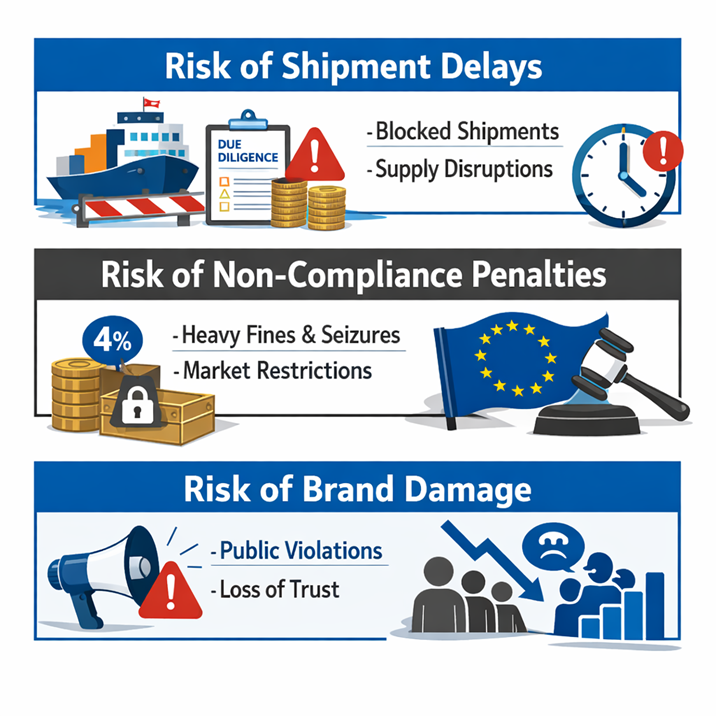
Failure to comply with the EU Deforestation Regulation carries serious financial, operational, and reputational consequences for coffee importers.
Authorities can impose penalties of up to 4% of a company’s annual EU turnover. For high-volume importers, this can translate into substantial financial losses.
Non-compliant shipments may be seized or removed from the market. This not only impacts revenue but can also disrupt downstream contracts and customer commitments.
Repeated or severe violations can result in temporary bans from placing products on the EU market, directly affecting business continuity and competitive positioning.
Regulators may publicly disclose the names of non-compliant operators. In sustainability-focused markets, this can damage brand credibility, strain retailer relationships, and attract investor scrutiny.
Step 1: Map Your Supply Chain End-to-End
Step 2: Collect Farm-Level Geodata
Step 3: Assess Deforestation Risk
Step 4: Mitigate & Document
Step 5: Submit Due Diligence Statement
Step 6: Continuous Monitoring
EUDR Coffee Compliance for Importers: A Readiness Guide is not just about understanding regulation it’s about operational preparedness. The shift toward mandatory geolocation traceability, documented risk assessment, and formal due diligence submissions under the EU Deforestation Regulation represents a structural change in how coffee supply chains must function.
Importers that act early can digitize their value chains, strengthen supplier collaboration, and protect uninterrupted access to the EU market. Those who delay risk shipment disruptions, financial penalties, and reputational damage. The deadline is not the time to prepare it is the time to comply.
Get a comprehensive breakdown of regulatory scope, operator obligations, risk benchmarking, penalties, and strategic readiness planning.
Read our complete guide to EUDR Compliance
Learn how to structure your due diligence system, conduct deforestation risk assessments, implement mitigation measures, and maintain defensible documentation.
Explore our blog on EUDR Due Diligence
Need clarity on the EU Information System process? This guide walks you through required data fields, submission workflows, validation steps, and common filing errors to avoid.
Learn how to file a DDS under EUDR
Yes. Even if a country is benchmarked as low risk, importers must still collect geolocation data, conduct due diligence, and submit a Due Diligence Statement.
No. Certifications can support documentation but do not replace the importer’s legal responsibility to conduct and document EUDR-specific due diligence.
SMEs may have simplified reporting in certain scenarios, but if you are the first placer on the EU market, full operator obligations still apply.
Without verifiable plot-level data, you cannot demonstrate deforestation-free compliance. Technology-enabled mapping and supplier onboarding solutions may be required.
Immediately. Supply chain mapping, data collection, and system implementation can take months. Waiting until enforcement begins significantly increases compliance risk.