
Quick summary: Mapping the battery value chain is essential for Digital Battery Passport compliance. Learn why upstream transparency reduces risk, cost, and regulatory delays.

The battery value chain is under more scrutiny today than ever before, yet most companies are still trying to solve transparency at the final stage: the Digital Battery Passport.
That’s a costly mistake.
By the time you’re generating passport data, the real compliance risk has already happened upstream, across fragmented suppliers, opaque raw material sourcing, and inconsistent emissions data. The Digital Passport doesn’t create transparency. It simply exposes whether you built it early enough.
For battery manufacturers, OEMs, and energy storage providers, the question is no longer if transparency is required; it’s how far upstream your visibility truly goes.
Transparency cannot begin with a QR code it must begin with mapping, verifying, and digitizing the battery value chain from raw material extraction to end-of-life recovery. TraceX Digital Product Passport solutions enable organizations to build upstream traceability foundations before passport deployment, connecting suppliers, automating data capture, and ensuring regulatory-ready battery value chain transparency from day one.
If you’re preparing for Digital Battery Passport compliance, the real work starts earlier than you think.
Key Takeaways
The Digital Battery Passport is a regulatory requirement under the EU Battery Regulation that mandates lifecycle data transparency, including carbon footprint, sourcing, and performance data for industrial and EV batteries.
It requires companies to disclose verified information on carbon footprint, raw material sourcing, recycled content, performance, durability, and end-of-life handling. The regulation was proposed and implemented under the policy framework of the European Commission as part of the EU’s broader sustainability, circular economy, and climate neutrality goals.
For many organizations, the Digital Battery Passport feels like the finish line. It’s the visible output of a much deeper transformation happening across the entire battery value chain.
The passport itself is simply the interface. The real challenge lies in collecting verified, standardized, and auditable data from upstream suppliers long before that data is ever linked to a QR code.
While the Digital Battery Passport provides structured access to battery lifecycle data, it does not create that data. Companies must:
Without upstream battery value chain transparency, the passport becomes a compliance bottleneck rather than a competitive advantage.
In other words, the Digital Battery Passport is the output. The battery value chain is the foundation.
If you’re preparing your organization for Digital Battery Passport compliance, don’t stop here. Explore our in-depth resources designed to help you move from awareness to implementation:
Read: “The Complete Guide to the Digital Battery Passport”
Understand data requirements, implementation timelines, technical architecture, and how to future-proof your battery value chain before deadlines hit.
Read: “EU Battery Regulation Explained: What Manufacturers Must Do Now”
True transparency in the battery value chain requires visibility across every stage from mineral extraction to end-of-life recovery. The Digital Battery Passport will only be as strong as the data collected at each of these interconnected steps.
Below is a breakdown of where the biggest risks and compliance gaps typically occur.
This is the most risk-exposed segment of the battery value chain.
ESG Risks
Mining operations often face scrutiny related to water usage, land degradation, labor conditions, and community impact. Poor upstream oversight can quickly translate into reputational and regulatory exposure for downstream manufacturers.
Scope 3 Emissions Exposure
Raw material extraction is carbon-intensive. Without primary emissions data from mining operators, companies must rely on secondary estimates increasing reporting inaccuracies under EU carbon footprint requirements.
Conflict Mineral Implications
Cobalt and other critical minerals may originate from high-risk regions. Due diligence obligations require traceability systems capable of verifying ethical sourcing practices beyond Tier 1 suppliers.
Once extracted, minerals undergo chemical processing and refinement often across multiple countries.
Limited Visibility
Many companies lose traceability at this stage due to intermediaries, traders, and mixed material streams.
Carbon Footprint Hotspots
Refining is energy-intensive and frequently powered by fossil fuels. Without verified energy-source data, calculating accurate battery carbon footprints becomes difficult.
This is where materials transform into battery cells and modules.
Data Standardization Challenges
Suppliers operate with different reporting systems, formats, and levels of digital maturity. Harmonizing data inputs for compliance reporting becomes operationally complex.
Supplier Onboarding Barriers
Many upstream suppliers lack structured ESG data collection processes. Engaging them requires digital tools, clear frameworks, and ongoing governance.
Battery modules are integrated into electric vehicles or energy storage systems.
Data Fragmentation
OEMs must consolidate lifecycle data from multiple suppliers while aligning it with internal ERP, PLM, and sustainability systems.
Cross-Border Compliance Complexity
Products sold into the EU must comply with the EU Battery Regulation regardless of manufacturing origin. This creates regulatory alignment challenges across global supply networks.
The battery value chain does not end at first use.
Material Recovery Traceability
Recyclers must document recovered material volumes, recycled content percentages, and reintroduction into new batteries, all of which feed future passport requirements.
Circular Economy Reporting
EU policy increasingly links battery compliance to circularity metrics, including collection rates, recycling efficiencies, and secondary raw material usage.
Each stage feeds critical data into the Digital Battery Passport. If even one layer lacks transparency, downstream reporting becomes incomplete, inconsistent, or non-compliant.
Mapping the full battery value chain isn’t just about regulatory readiness; it’s about building a resilient, audit-ready, and future-proof supply ecosystem.
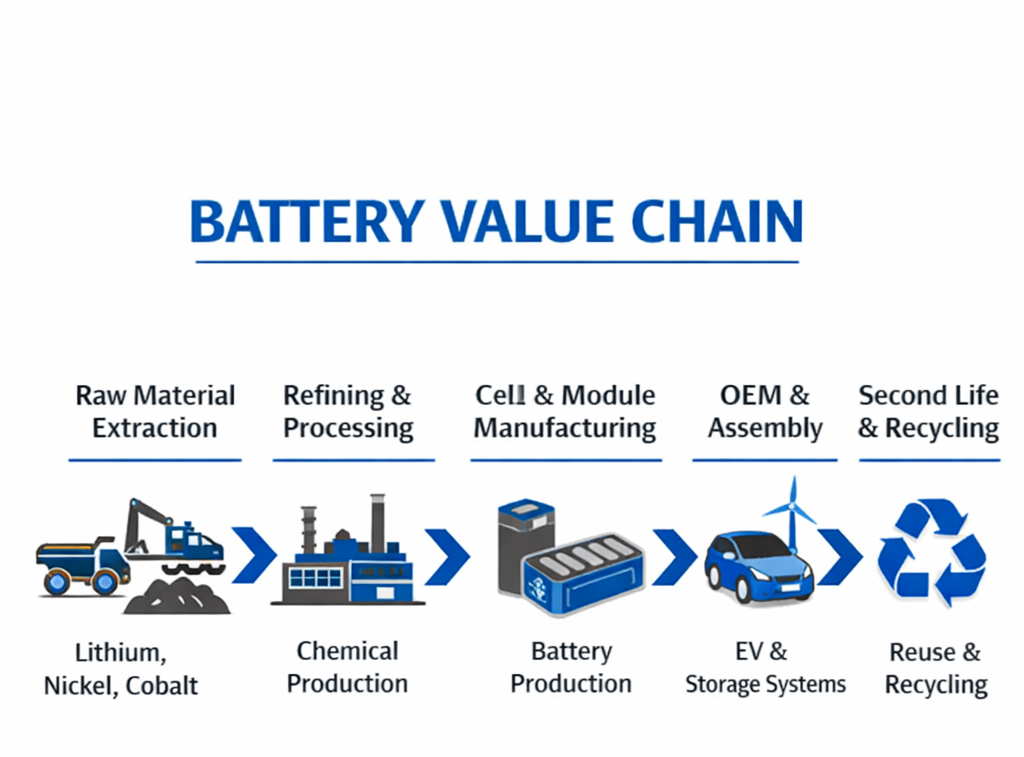
For many organizations, Digital Battery Passport implementation is treated as an IT project. In reality, it’s a supply chain transformation initiative.
By the time a passport is generated, the underlying data should already be verified, standardized, and audit-ready. If upstream systems are weak, the passport becomes a compliance exposure point rather than a competitive asset.
Battery transparency must begin upstream because the Digital Battery Passport relies entirely on verified supplier data across the battery value chain. Without early supplier engagement, emissions tracking, and traceability systems, compliance gaps will delay market access and increase regulatory risk.
In the battery value chain, small upstream blind spots quickly escalate:
When these gaps reach OEM level, they are harder and more expensive to correct. Data must be chased retroactively across multiple tiers often across jurisdictions.
Upstream transparency ensures that each data point entering the Digital Battery Passport is validated at the source, not reconstructed later.
Waiting until passport deadlines approach creates operational strain:
Early value chain mapping allows companies to build structured workflows, automate reporting, and spread implementation costs over time rather than absorbing them under regulatory pressure.
Proactive compliance is significantly less expensive than reactive correction.
Under the EU Battery Regulation, economic operators placing batteries on the EU market must meet strict due diligence, carbon footprint, and traceability requirements.
Failure to provide compliant Digital Battery Passport data may result in:
Transparency that begins upstream protects downstream market eligibility.
Battery manufacturers and OEMs are increasingly evaluated on:
Institutional investors, rating agencies, and sustainability frameworks expect verifiable supply chain data not estimates. Weak upstream governance can impact ESG scores, access to capital, and brand reputation.
In short, the battery value chain is no longer just an operational function it is a financial and reputational risk vector.
Organizations that begin mapping, digitizing, and validating their battery value chain early will not only meet regulatory requirements they will gain resilience, credibility, and long-term competitive advantage.
Battery manufacturers and OEMs are no longer preparing for a distant compliance horizon they are operating within an active regulatory shift. Policymakers and global coalitions are rapidly formalizing requirements that demand full battery value chain transparency, not partial reporting.
Institutions such as the European Parliament have strengthened sustainability legislation to ensure lifecycle accountability for batteries placed on the EU market. At the same time, industry-led initiatives like the Global Battery Alliance are setting voluntary but increasingly influential global standards for battery traceability, ESG performance, and digital passport frameworks.
Together, regulatory and industry forces are accelerating the timeline for action.
Under EU requirements, industrial and EV batteries must disclose their carbon footprint across the lifecycle.
This means companies must:
If upstream data is incomplete, companies risk non-compliant or delayed declarations directly impacting their ability to sell into regulated markets.
Minimum recycled content levels for materials such as cobalt, lithium, and nickel are becoming mandatory.
To comply, organizations must:
Without structured value chain mapping, verifying recycled content claims becomes operationally complex and high risk.
The regulation requires economic operators to implement supply chain due diligence policies covering:
This shifts responsibility downstream. OEMs and manufacturers are accountable for risks occurring multiple tiers upstream making supplier onboarding and monitoring critical.
The Digital Battery Passport will be accessible via a QR code linked to structured digital records.
This means:
A passport without verified upstream inputs becomes a compliance liability rather than a transparency tool.
The regulatory pressure is not approaching it is already reshaping the battery value chain.
To understand the real impact of early battery value chain mapping, consider the following scenario based on typical compliance transformation journeys within the EV battery sector.
A mid-sized European EV battery manufacturer supplying two global automotive OEMs.
As regulatory pressure intensifies under the EU Battery Regulation, the company conducted an internal compliance assessment and identified critical gaps across its battery value chain:
The company initiated early-stage battery value chain mapping two years before passport deadlines.
Key actions included:
Instead of treating compliance as a reporting exercise, the organization treated it as infrastructure modernization across the battery value chain.
Within 18 months, measurable improvements were recorded:
Most importantly, by the time Digital Battery Passport implementation began, the required lifecycle data was already structured, verified, and system-ready.
Early battery value chain mapping transforms compliance from a reactive obligation into a strategic advantage.
Rather than scrambling to assemble passport data under deadline pressure, organizations that invest upstream gain:
In battery compliance, transparency isn’t a last-mile task it’s a foundational capability.
Preparing for Digital Battery Passport compliance requires more than data collection it requires structured battery value chain governance. Below is a practical five-step framework organizations can implement now to reduce regulatory risk and avoid last-minute disruption.
Start by identifying every supplier connected to your battery value chain — not just direct vendors.
Without multi-tier visibility, upstream ESG and due diligence risks remain hidden until audit time.
Conduct a structured gap assessment against Digital Battery Passport requirements under the EU Battery Regulation.
Key questions:
This step establishes your true compliance baseline.
Suppliers often provide ESG and emissions data in inconsistent formats.
To reduce reporting friction:
Standardization ensures that battery value chain data is comparable, audit-ready, and machine-readable.
Manual spreadsheets cannot support Digital Battery Passport complexity.
A centralized traceability system enables:
Technology transforms transparency from a periodic task into a continuous process.
Finally, ensure your internal sustainability, compliance, and operations teams align reporting frameworks with evolving EU standards.
This includes:
Alignment reduces the risk of rework and ensures that when Digital Battery Passport deadlines arrive, your battery value chain data is already structured for submission.
Explore our Industry-Specific Battery Compliance Solutions to see how Digital Battery Passport and battery value chain transparency requirements impact your sector and what readiness looks like in practice.
The Digital Battery Passport may be the visible symbol of compliance, but the real work begins deep within the battery value chain. Organizations that delay upstream mapping, supplier engagement, and emissions verification risk turning regulatory deadlines into operational crises.
True readiness requires early visibility across raw materials, refining, manufacturing, and recycling long before passport data is published. Companies that build transparency now will not only meet EU requirements with confidence, but also strengthen supplier resilience, improve ESG performance, and gain a competitive advantage in regulated markets.
In the evolving battery economy, transparency is not a reporting exercise it is a strategic capability.
Get a clear breakdown of the Ecodesign for Sustainable Products Regulation (ESPR), its scope, phased implementation timeline, and what DPP requirements mean for manufacturers placing products on the EU market.
Explore the ESPR–DPP Regulation Guide
Learn how upstream supplier mapping, carbon data validation, and material traceability form the backbone of DPP readiness and why spreadsheets won’t scale.
Discover How to Enable DPP Traceability →
Understand how DPP supports transparency from raw materials to recycling, enabling circular economy reporting, ESG disclosure, and lifecycle performance optimization.
Explore the Lifecycle Impact of DPP →
Carbon footprint, recycled content, material sourcing, performance metrics, and end-of-life handling information.
Phased implementation beginning 2025–2027 depending on battery type
Economic operators placing batteries on the EU market.
Yes, under due diligence and carbon reporting provisions.