
Quick summary: EUDR Requirements Explained: Learn the key compliance rules, geolocation mapping, due diligence statements, risk assessments, and how businesses can meet EU deforestation regulation requirements.
A single missing farm coordinate could prevent your product from entering the EU market. The EU Deforestation Regulation (EUDR) is transforming how global supply chains operate. Companies placing commodities such as coffee, cocoa, soy, palm oil, cattle, rubber, and timber on the EU market must now prove that their products are deforestation-free, legally produced, and traceable to the exact production plot. Understanding and implementing EUDR requirements is no longer optional it is essential for maintaining market access and avoiding regulatory penalties.
For importers, exporters, and supply chain operators, these new obligations introduce significant operational challenges. Without robust traceability systems and structured due diligence processes, companies risk shipment delays, rejected consignments, and compliance investigations.
Key Pain Points Businesses Face with EUDR Requirements
TraceX EUDR solutions help companies simplify compliance by enabling farm-level geolocation mapping, satellite-based deforestation verification, automated risk assessments, and streamlined Due Diligence Statement (DDS) generation, ensuring your supply chain meets EUDR requirements with confidence.
The EU Deforestation Regulation (EUDR) requires companies placing certain commodities on the EU market to prove that their products are deforestation-free, legally produced, and fully traceable to the exact production plot where they were grown or sourced. This regulation shifts responsibility directly to operators and traders, meaning companies must conduct structured due diligence before selling or exporting products within the EU.
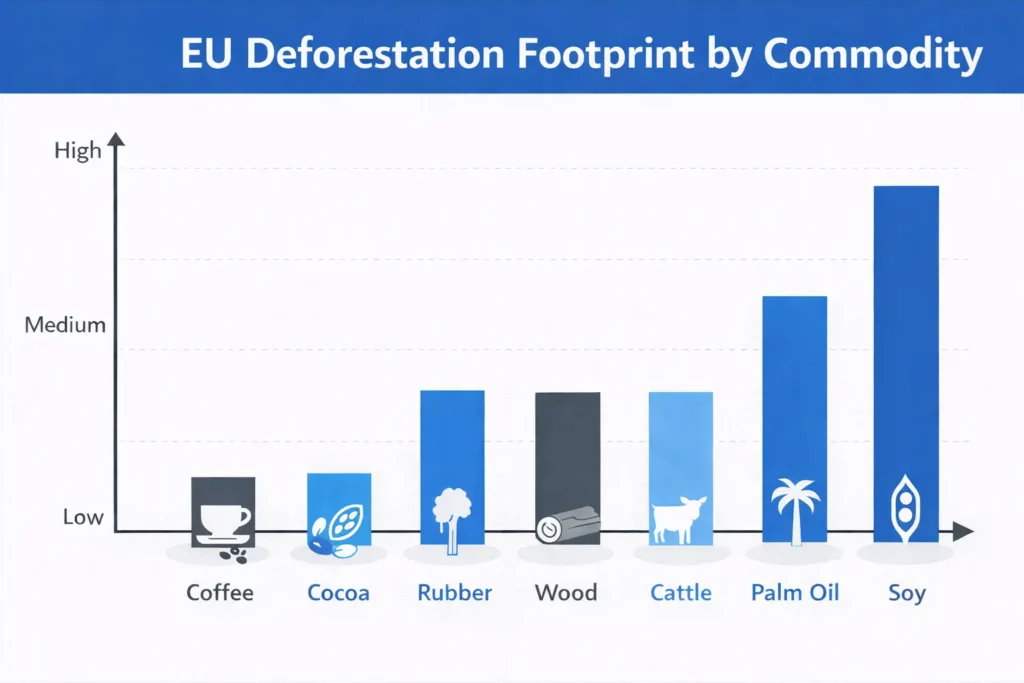
The EU is responsible for ~16% of global deforestation linked to international trade, as the second-largest importer of forest-risk commodities (after China at 24%), primarily through soy (27%), palm oil (26%), cocoa (10%), and coffee (9%) based on 2017-2018 data.
Need a clear roadmap to meet EU deforestation rules? Explore our complete guide to EUDR compliance for global supply chains.
Struggling with farm mapping requirements? Learn how to meet EUDR geolocation requirements using GPS points and polygon mapping.
The EU Deforestation Regulation (EUDR) is transforming global supply chains because it shifts responsibility directly onto companies by requiring verifiable proof that the commodities they place on the EU market are not linked to deforestation. Instead of relying on general supplier declarations or sustainability claims, businesses must now provide data-backed evidence, including geolocation mapping, satellite verification, and structured due diligence assessments.
Market access is now directly tied to compliance. Products that cannot demonstrate deforestation-free production or lack proper due diligence documentation may be blocked from entering the EU market. This creates strong incentives for companies to digitize traceability systems, map supplier farms, and implement robust compliance frameworks.
EUDR is also part of a broader trend of global regulatory convergence. Similar laws already exist or are emerging in other markets, such as the US Lacey Act, which addresses illegal timber trade, and the UK Forest Risk Regulation, which targets commodities linked to illegal deforestation. Together, these regulations are pushing companies toward greater transparency, traceability, and sustainability across global supply chains.
EU imports around 45-48 million bags of coffee annually (e.g., 45M bags or 2.7M tonnes in 2023, rising to 48.3M bags in 2024), representing ~30% of global trade, with Germany and Italy leading.
Agriculture drives ~90% of global deforestation (80% direct conversion to cropland/pasture, plus shifting cultivation), with commodities like soy, beef, palm oil, cocoa, and coffee as top culprits amid 10M ha/year total loss
Learn how companies conduct EUDR risk assessments with TraceX
One of the most critical EUDR requirements is collecting precise geolocation data for every production plot supplying the commodity. This data enables companies and regulators to verify whether products originate from land that has remained deforestation-free after the 31 December 2020 cut-off date. Without accurate farm-level geolocation information, businesses cannot conduct reliable deforestation checks or submit compliant Due Diligence Statements.
For small production plots typically under 4 hectares companies can collect GPS point coordinates that represent the center location of the farm. These latitude and longitude coordinates provide a basic geographic reference that allows regulators to identify where the commodity was produced.
However, for larger farms exceeding 4 hectares, the regulation requires polygon mapping. Polygon mapping defines the exact boundaries of the production plot by connecting multiple GPS points around the perimeter of the farm. This creates a digital outline of the farm area, which can be overlaid on satellite imagery and forest monitoring datasets.
Collecting and managing this data across large supplier networks can be complex. Digital compliance platforms help simplify this process by enabling companies to collect geolocation data through mobile mapping tools, store farm coordinates in centralized databases, and integrate this information with broader supply chain traceability systems. This integration allows operators to link each shipment or batch of commodities directly to verified production plots.
Polygon mapping plays a crucial role in ensuring accurate EUDR compliance verification.
As a result, polygon-level geolocation data has become a foundational element of modern EUDR-compliant supply chain management.
Over 80% of smallholder farms globally lack digital geolocation mapping, creating significant compliance challenges for regulations like EUDR and DPP, as evidenced by low digital service adoption
The EU Deforestation Regulation requires operators to submit a Due Diligence Statement (DDS) before placing commodities such as coffee, cocoa, soy, palm oil, cattle, rubber, or timber on the EU market. The DDS confirms that the company has conducted proper due diligence and verified that the products are deforestation-free, legally produced, and assessed as having negligible risk.
To create a compliant DDS, companies must collect and organize several types of supply chain information. This includes production plot geolocation data, details about the commodity and supplier, country of origin, and evidence that the product complies with the regulation’s deforestation and legality requirements. The DDS must also include the results of the company’s risk assessment, confirming that the supply chain has been evaluated and that any identified risks have been mitigated.
Another critical component is supplier documentation. Operators must maintain records such as supplier declarations, production site information, and relevant legality documents demonstrating compliance with the laws of the producing country. These documents provide supporting evidence for the risk assessment and help demonstrate that the operator has conducted thorough due diligence.
Digital compliance platforms help streamline this process by integrating supply chain data into a structured system. By linking geolocation data, supplier records, and risk assessment outcomes in a centralized platform, companies can generate DDS reports more efficiently and ensure that all required information is included.
Once the necessary data is compiled, the platform can support integration with the EU information system, allowing operators to prepare and submit the DDS electronically. This reduces manual work, improves accuracy, and ensures that submissions align with the regulatory format required by EU authorities.
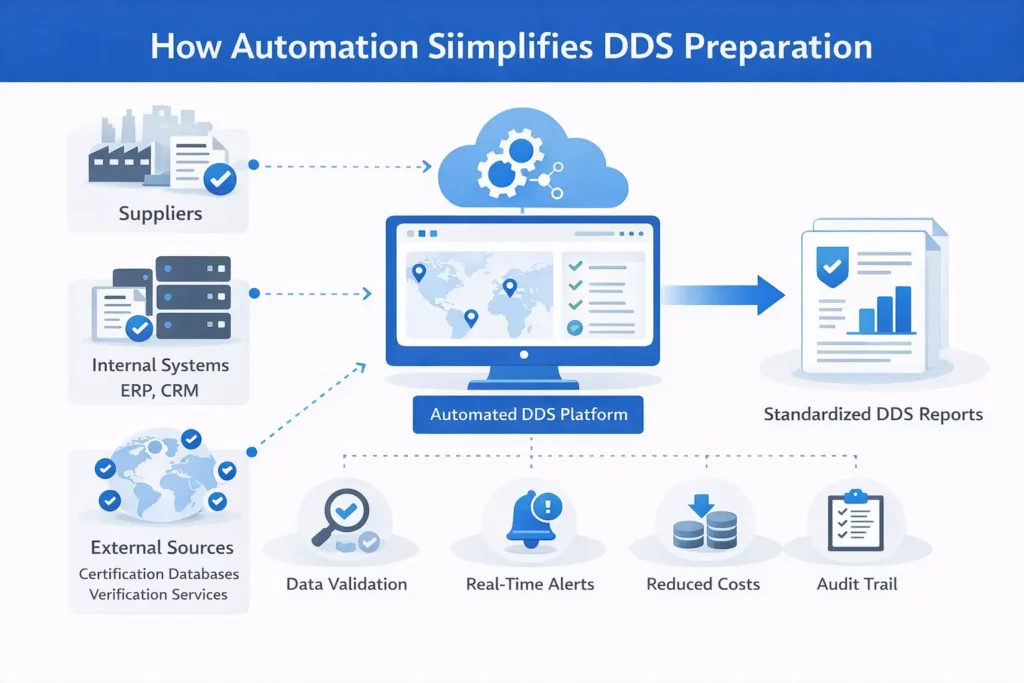
Automation plays a key role in simplifying the DDS preparation process. Instead of collecting compliance data manually from multiple sources, platforms can aggregate supplier data across the supply chain and organize it in a standardized structure.
The system can also verify geolocation information, ensuring that GPS coordinates or farm polygons are properly linked to each supplier and production plot. This step helps confirm that the data used in the risk assessment is accurate and complete.
Finally, automated tools can generate structured compliance reports, compiling risk assessment outcomes, supplier documentation, and geolocation data into a DDS-ready format. This enables companies to submit Due Diligence Statements confidently while maintaining full transparency and audit readiness under EUDR requirements.

EUDR requires companies to conduct structured risk assessments before submitting a Due Diligence Statement. This process ensures that operators evaluate whether their supply chains are linked to deforestation or illegal production and determine whether the risk can be classified as “negligible.” Without a documented risk assessment process, companies cannot legally place covered commodities on the EU market.
One important component of the risk assessment is country risk benchmarking. The European Commission classifies countries as low, standard, or high risk based on factors such as deforestation prevalence, governance quality, and enforcement capacity. Operators sourcing from higher-risk regions may be required to apply enhanced due diligence measures and conduct more detailed supply chain checks.
Another key factor is supply chain complexity analysis. Companies must assess how many actors are involved in the sourcing chain from farmers and cooperatives to traders and exporters. The more intermediaries involved, the higher the potential risk of traceability gaps, mixed commodity lots, or incomplete supplier documentation. Evaluating supply chain complexity helps companies identify where additional monitoring or verification may be needed.
Structured risk assessments also rely heavily on satellite-based deforestation verification. By overlaying farm geolocation data with satellite imagery and deforestation monitoring datasets, companies can confirm whether production plots have experienced forest loss after the EUDR cut-off date of 31 December 2020.
In addition, platforms often support supplier risk scoring, where suppliers are evaluated based on factors such as location risk, documentation quality, traceability readiness, and compliance history. This scoring helps operators prioritize monitoring efforts and apply targeted mitigation measures.
The final objective of the EUDR risk assessment process is to determine whether the risk of deforestation is negligible. This determination requires a combination of multiple verification methods.
Over 80% of EU commodity imports (e.g., cocoa, coffee) originate from smallholder supply chains, increasing traceability complexity under EUDR/DPP, as smallholders produce 90% global cocoa and 70% coffee—much feeding EU markets (45-48M coffee bags, 60%+ cocoa).
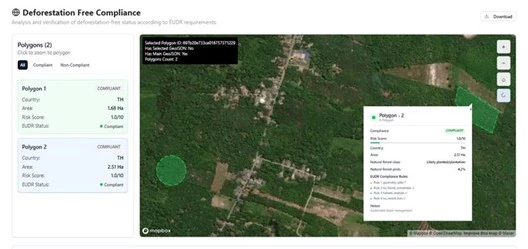
To comply with EUDR, operators must verify that production areas have not experienced deforestation after 31 December 2020, which is the regulation’s official cut-off date. This verification is critical because commodities produced on land that was deforested after this date cannot legally be placed on the EU market. As a result, companies must rely on data-driven methods to confirm that their sourcing areas remain deforestation-free.
One of the primary tools used for this verification is satellite monitoring. Satellite imagery provides continuous observation of land-use changes across the globe, allowing companies to track forest cover and detect potential deforestation events in production regions. These satellite systems can monitor changes in vegetation cover and identify areas where forests may have been cleared or degraded.
Another important resource is historical forest cover data. By analyzing historical satellite imagery and forest datasets, companies can determine what the land looked like before and after the 2020 cut-off date. This historical perspective helps confirm whether the land used for commodity production was already agricultural land or if it was previously forested.
Many monitoring platforms also rely on tree cover loss alerts, which notify users when forest cover changes occur within specific geographic areas. These alerts are generated using satellite-based algorithms that detect rapid changes in vegetation patterns, helping companies identify potential deforestation risks early.
To complete the verification process, companies perform overlay analysis with farm polygons. Farm boundaries mapped as polygons are overlaid on satellite imagery and forest monitoring datasets. This allows operators to check whether any part of the production plot overlaps with areas where forest loss occurred after 31 December 2020.
By combining satellite monitoring, historical forest data, deforestation alerts, and polygon-based analysis, companies can confidently determine whether their sourcing areas comply with EUDR’s deforestation-free requirement.
Global Forest Watch reports approximately 10 million hectares of forest lost annually worldwide (gross tree cover loss), with recent FAO data refining to 10.9M ha/year (2015-2025) and net loss at 4.1M ha/year after gains.
EUDR requires companies to maintain due diligence records for a minimum of five years after placing commodities on the EU market. These records must be available for inspection by competent authorities at any time during this period. As a result, businesses must implement reliable systems to store, organize, and retrieve compliance data efficiently.
Digital platforms support this requirement through secure digital document storage, allowing companies to maintain all compliance-related information in a centralized repository. This includes geolocation data, supplier declarations, risk assessment results, satellite verification reports, and Due Diligence Statements (DDS). By storing these documents digitally, organizations can ensure that information remains accessible, protected, and organized throughout the retention period.
Another key capability is supplier record management. Platforms enable companies to maintain structured profiles for each supplier, linking farm geolocation data, production information, legality documentation, and compliance history. This structured approach ensures that all records associated with a particular supplier or production plot can be easily retrieved when needed.
Platforms also generate audit-ready compliance reports, which compile the required documentation into standardized formats that regulators can review. These reports help companies demonstrate that proper due diligence procedures were followed before placing products on the EU market.
Additionally, digital systems enable data traceability for regulators by linking supply chain data from production plots to shipments within a transparent data structure. This traceability allows authorities to verify that each product batch complies with EUDR requirements.
Digital recordkeeping plays a critical role in ensuring smooth regulatory compliance.
The EU Deforestation Regulation (EUDR) introduces strict traceability and due diligence obligations for companies placing forest-risk commodities on the EU market. Businesses must now demonstrate that their supply chains are deforestation-free, legally compliant, and fully traceable to the exact production plots.
Key compliance elements such as polygon-level geolocation mapping and satellite-based deforestation verification have become central to meeting EUDR requirements. To achieve this, companies need structured systems for risk assessment, supplier verification, and long-term recordkeeping.
Digital compliance platforms can significantly simplify this process by automating data collection, monitoring deforestation risks, generating Due Diligence Statements, and maintaining audit-ready records. By adopting these tools early, companies can reduce compliance risks while ensuring continued access to EU markets.
Ready to submit your Due Diligence Statement? Learn the exact steps to file a DDS under EUDR without compliance errors.
Can AI automate EUDR compliance? Discover how Agentic AI solutions are transforming EUDR risk monitoring and due diligence.
Need a clear risk evaluation framework? Learn how to conduct a structured EUDR risk assessment step by step.
Yes. Any operator or trader placing covered commodities such as coffee, cocoa, soy, palm oil, cattle, rubber, or timber on the EU market must comply with EUDR requirements and submit a Due Diligence Statement.
Yes. Companies must provide precise geolocation data for production plots, including GPS coordinates or polygon mapping for farms larger than 4 hectares.
Products may be blocked from entering the EU market, and companies could face regulatory penalties or investigations.
No. Certifications can support sustainability practices but do not replace EUDR due diligence requirements, including geolocation verification and deforestation checks.
Yes. Digital compliance platforms can help collect geolocation data, conduct risk assessments, generate Due Diligence Statements, and maintain records for the five-year retention requirement.