
Quick summary: Learn how to achieve EUDR Compliance in the Charcoal Supply Chain with plot-level traceability, legal sourcing verification, and digital chain of custody systems that ensure deforestation-free EU trade.
A bag of charcoal may look simple, but proving where every piece of wood came from is now a regulatory requirement. With the EU Deforestation Regulation raising the bar on traceability and legality, companies trading charcoal can no longer rely on paper trails and supplier declarations. EUDR Compliance in the Charcoal Supply Chain demands verifiable, plot-level proof that products are deforestation-free, legally sourced, and fully traceable from forest origin to export shipment.
For charcoal businesses, this shift exposes serious operational gaps:
Digital traceability is becoming essential, and TraceX EUDR Solutions help companies build an end-to-end chain of custody, verify forest origins, and meet EU compliance with confidence.
Key Takeaways
The EU Deforestation Regulation (EUDR) turns charcoal from a low-visibility commodity into a high-scrutiny product requiring proof of legal and deforestation-free origin. What was once traded largely on supplier declarations and paper documentation must now be backed by verifiable, geospatial, and audit-ready evidence. For companies exporting to or operating within the European Union, compliance is no longer optional it is a market access requirement.
A key shift is that charcoal is officially classified as a wood-based product under the EUDR scope. This means it is treated similarly to timber and other forest-derived commodities, even though it is a processed fuel product. Because charcoal originates from harvested wood, regulators require companies to demonstrate that the raw material was sourced responsibly and without contributing to deforestation.
~70-90% of global charcoal exports are linked to forest-risk regions (e.g., sub-Saharan Africa/Nigeria charcoal drives 30%+ degradation); EU imports ~677K tons annually (2024, $192M value, Germany/Netherlands/France top).
Charcoal traded in international markets is classified under the HSN Code 4402 (Harmonized System of Nomenclature), which covers wood charcoal, including shell or nut charcoal, whether or not agglomerated. This classification is important because regulatory frameworks, customs declarations, and trade compliance checks use HSN codes to determine product scope.
Under the EU Deforestation Regulation (EUDR), products falling within wood-based customs classifications including HSN 4402 are treated as forest-risk commodities. Even though charcoal is a processed product, it is derived directly from harvested wood, bringing it fully within the regulation’s scope. As a result, companies importing or placing charcoal on the EU market must comply with the same requirements applied to timber and other wood products.
The regulation also introduces mandatory due diligence obligations. Importers and traders placing charcoal on the EU market must collect, verify, and submit detailed supply chain information. This includes supplier data, origin details, risk assessments, and mitigation measures. Companies must also file formal due diligence statements confirming compliance placing legal accountability directly on operators.
Another major requirement is plot-level geolocation and deforestation-free proof. Businesses must trace charcoal back to the exact forest plots where the source wood was harvested. These geocoordinates are used to verify that no deforestation occurred after the regulation’s cutoff date. Satellite monitoring and geospatial validation are increasingly necessary to support these claims.
Finally, firms must ensure legal harvest verification. This involves documentation proving that wood was sourced in accordance with local laws covering land rights, forest management, environmental protection, and labor standards.
Together, these requirements transform charcoal sourcing into a traceability-driven, compliance-intensive supply chain.
Unsure whether your products fall under the regulation?
Explore our detailed guide on EUDR Scope to see which commodities, derivatives, and HS codes are covered and what that means for your supply chain.
Need clarity on what compliance actually requires?
Read our breakdown of EUDR Requirements covering due diligence, geolocation data, deforestation checks, and operator obligations.
Charcoal production is strongly linked to deforestation, informal operations, and weak traceability. Unlike many regulated forest products that move through structured industrial supply chains, charcoal often originates in fragmented, loosely monitored networks that make it difficult to verify legality and environmental impact. This combination of ecological risk and supply chain opacity has placed charcoal under increasing regulatory scrutiny.
Fuelwood/charcoal contributes 25-67% to forest degradation in sub-Saharan Africa (e.g., 30% forest cover change in Mozambique, often equaling or exceeding deforestation); ~90% of charcoal production is informal (low barriers, unregulated). Up to 2 kilns/ha in hotspots (80% AGB removal), 50%+ of cover change in producing regions like Nigeria/Ghana (3.5-3.7%/yr total loss).
These structural challenges make charcoal one of the most compliance-sensitive forest commodities in global trade.
Compliance hinges on three pillars: traceability, legality, and risk assessment. The EU Deforestation Regulation (EUDR) places clear accountability on importers and operators to prove that products entering the EU market are deforestation-free and legally sourced. This shifts responsibility from upstream suppliers to the companies placing goods on the market, requiring robust documentation and verifiable data systems.
A foundational requirement is the geolocation of harvest plots. Importers must collect precise geographic coordinates of the land where the source wood was harvested. This plot-level data enables authorities to verify origin claims using satellite monitoring and geospatial analysis. Without accurate geolocation, traceability claims are considered incomplete.
Companies must also provide proof of no deforestation after the regulatory cutoff date. This means demonstrating that the land used for sourcing raw materials has not experienced deforestation or forest degradation since the specified timeline under EUDR. Satellite imagery, historical land-use records, and geospatial risk tools are typically used to validate compliance.
Another essential pillar is legal harvesting documentation. Importers must ensure that wood sourcing complies with local laws governing land tenure, forest management, environmental protection, labor rights, and trade regulations. This requires verifiable permits, licenses, and supplier records.
EUDR further mandates the submission of formal due diligence statements. Before placing goods on the EU market, operators must declare that they have assessed supply chain risks and taken mitigation steps where necessary. These declarations are legally binding and subject to regulatory review.
Additionally, sourcing regions are assigned risk classifications (low, standard, or high risk countries). Importers sourcing from higher-risk regions face stricter scrutiny, deeper due diligence, and greater compliance documentation requirements.
EUDR also impacts how materials are handled across supply chains:
Together, these requirements demand rigorous, data-backed compliance systems rather than paper-based assurances.
Charcoal’s transformation process breaks conventional traceability systems. Unlike minimally processed commodities that retain their original form, charcoal undergoes physical and logistical changes that make it difficult to preserve origin identity across the supply chain. As wood moves from forests to export markets, both the material and its documentation pass through multiple disconnected stages, creating visibility gaps that complicate compliance.
A major barrier is the presence of multiple intermediaries across the value chain. The journey typically involves harvesters cutting wood, transporters moving logs, kiln operators converting wood into charcoal, local traders aggregating output, and exporters consolidating shipments for international buyers. Each handoff introduces new actors, record-keeping practices, and documentation formats. Without standardized digital systems, traceability often breaks at these transition points.
Traceability becomes even harder due to the material transformation from wood to charcoal. During the carbonization process, identifiable logs are converted into uniform charcoal pieces, removing visible markers that could link the final product to a specific forest source. Once transformed, physical verification of origin becomes nearly impossible without pre-existing digital records and batch tagging.
Supply chain practices further weaken traceability through batch mixing at aggregation points. Charcoal from different forest sources, kiln sites, or regions is frequently combined during storage, transport, or export consolidation to optimize logistics. This commingling destroys source-level identity, making it impossible to prove that a specific shipment came from compliant harvest plots.
Compounding these issues are paper-based documentation risks. Manual records are prone to errors, loss, duplication, and even intentional manipulation. Paper trails also slow verification processes and make real-time compliance monitoring unfeasible.
Charcoal trade typically involves 4-6 intermediaries on average (producers, transporters, wholesalers, retailers, plus brokers/agents), per value chain analyses in Africa like Kenya/Mozambique. Manual handoffs across informal chains (90% production) risk 30-50% data loss (incomplete records, no geolocation), amplifying EUDR non-compliance. Firms spend 20-40% of procurement time (2-5 days/shipment) on manual document checks, delaying EU clearance amid rejections
Together, these structural challenges make end-to-end traceability in charcoal supply chains uniquely complex, demanding digital chain-of-custody systems that preserve origin data from forest plot to final shipment.
End-to-end digital traceability enables identity preservation across the charcoal lifecycle. As regulatory expectations tighten, companies can no longer rely on fragmented records or supplier declarations to prove product origin. A digital chain of custody creates a continuous, verifiable data trail that follows materials from forest harvest to export shipment ensuring compliance, transparency, and audit readiness.
Modern tools make digital custody systems practical and scalable:
Together, these technologies transform charcoal traceability from a paperwork burden into a reliable digital compliance system.
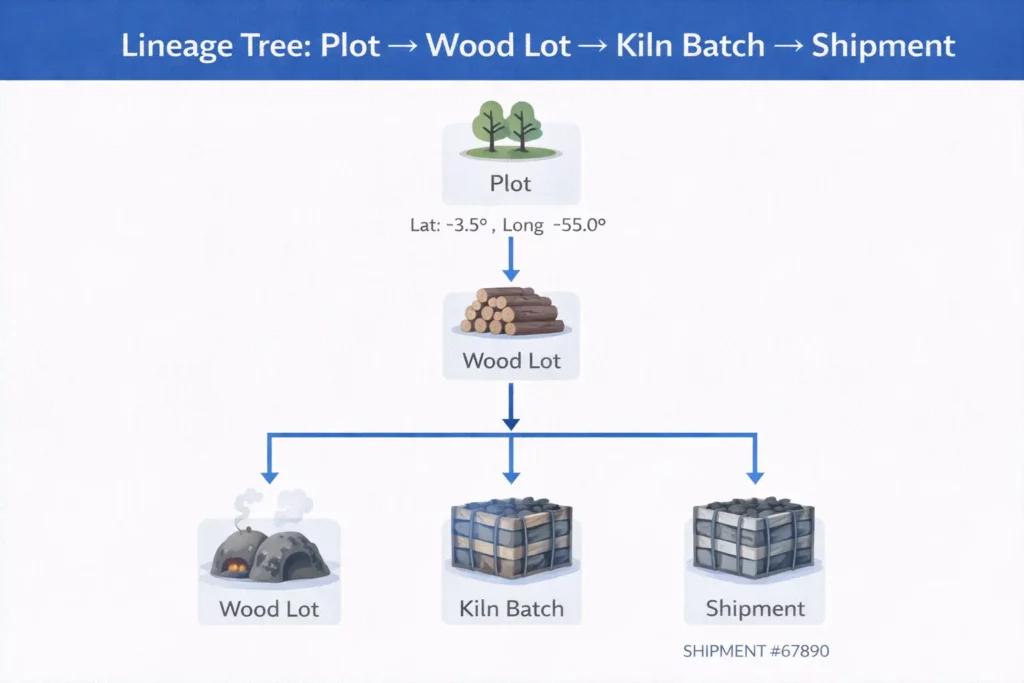
Compliance requires restructuring sourcing and supplier engagement. Meeting EUDR obligations is not just a documentation exercise it demands operational changes across how charcoal supply networks are organized, verified, and monitored. Companies must move away from opportunistic, trader-driven sourcing toward structured, accountable supplier ecosystems.
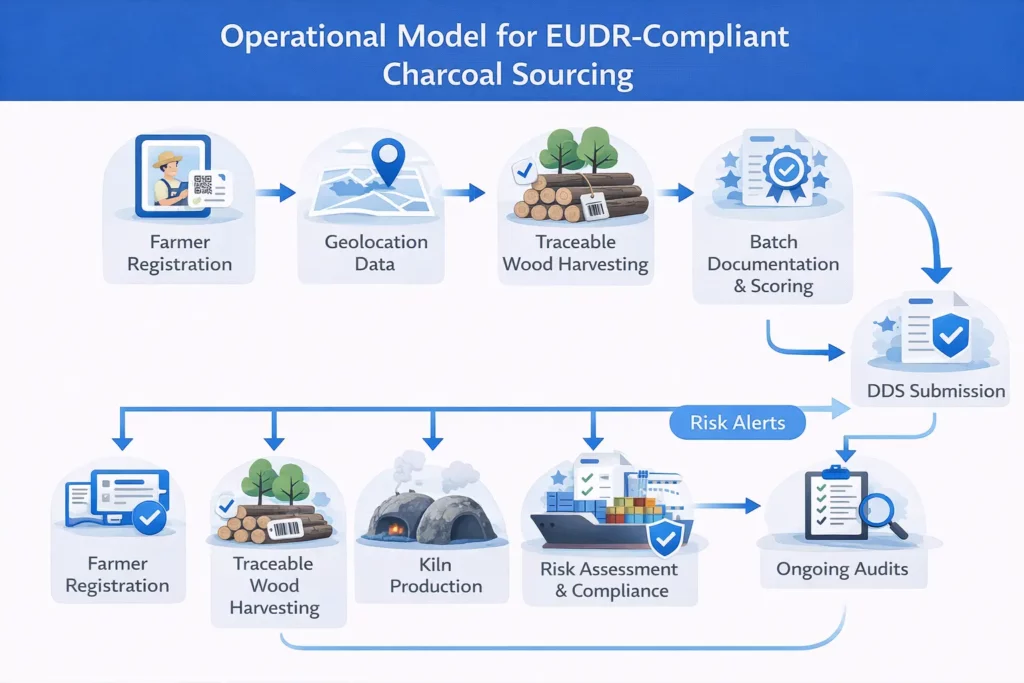
Together, these operational measures transform charcoal sourcing into a controlled, transparent, and regulation-ready supply model.
Charcoal supply chains are complex, fragmented, and transformation-heavy making EUDR compliance particularly difficult. Multiple intermediaries, material conversion from wood to charcoal, batch mixing, and paper-based documentation create major traceability gaps. TraceX EUDR Solutions are purpose-built to close these gaps through an end-to-end digital chain of custody that connects forest origin to export shipment with verifiable, audit-ready data.
At the sourcing stage, TraceX enables plot-level geo-mapping of forest areas supplying wood. Precise geolocation coordinates are captured and validated against deforestation risk layers, helping companies prove that raw materials originate from compliant, deforestation-free plots. Forest concessions, permits, and legal harvest documents are digitized and linked directly to these mapped plots, establishing a verified legality foundation.

As harvesting begins, the platform creates digital source lots tagged to specific plots, harvesters, timestamps, and volumes. This lot identity travels forward even as the material changes form. During carbonization, TraceX supports kiln batch traceability, digitally linking charcoal output to the input wood lots used in each kiln cycle—preserving lineage through material transformation.
To prevent compliance breaches caused by commingling, TraceX enables segregation-aware logistics workflows. Verified materials are tracked separately across storage, aggregation, and transport stages, ensuring identity preservation and defensible chain-of-custody records.
Field realities are addressed through mobile-first data capture tools that allow harvesters, transporters, and kiln operators to upload records in real time—even in low-connectivity environments. This replaces error-prone paper trails and eliminates manual data consolidation.
TraceX also delivers automated due diligence workflows. Importers can generate compliance-ready reports, risk assessments, supplier documentation packs, and digital audit trails aligned with EUDR requirements significantly reducing reporting time and regulatory risk.
By unifying forest verification, batch traceability, supplier management, and compliance reporting on a single platform, TraceX transforms charcoal sourcing into a transparent, regulation-ready supply ecosystem.
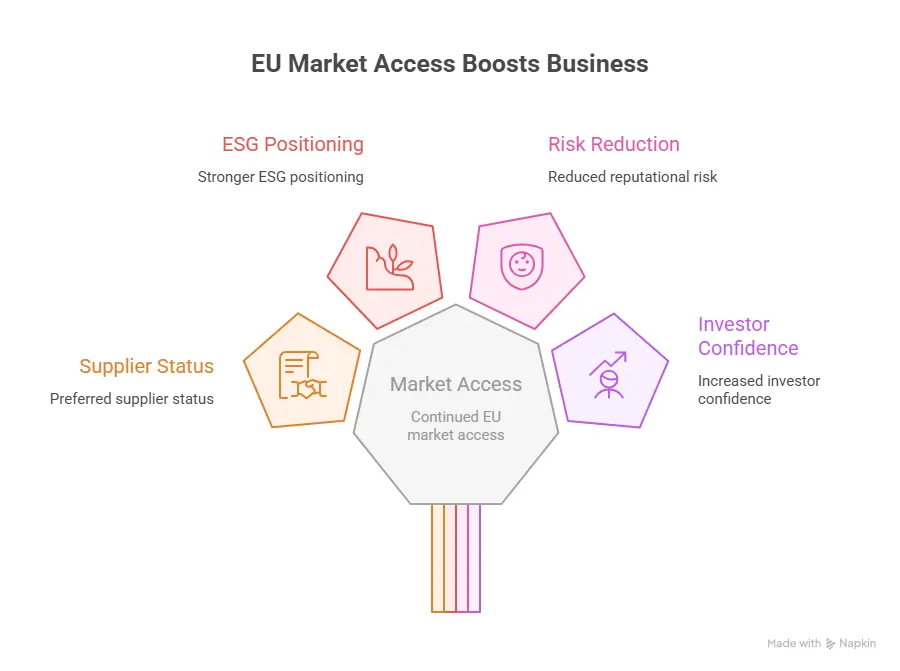
Charcoal has moved from being a low-visibility fuel product to a regulated forest-risk commodity under evolving global sustainability laws. For companies trading with the European Union, compliance is no longer optional traceability and legal sourcing are mandatory requirement for market access. Businesses must now prove exactly where raw materials originate, demonstrate that sourcing is deforestation-free, and maintain verifiable documentation across every stage of the supply chain. In this new regulatory environment, manual paperwork and fragmented supplier records are no longer sufficient. A digital chain of custody that preserves material identity from forest plot to export shipment is essential for scalable, audit-ready compliance. Organizations that invest in structured traceability systems today will not only reduce regulatory risk but also build stronger buyer trust, ESG credibility, and long-term supply chain resilience.
Not sure how to evaluate your sourcing exposure?
Read our guide on EUDR Risk Assessment to learn how to identify high-risk regions, suppliers, and deforestation exposure across your supply chain.
Struggling to prove product origin across complex supplier networks?
Explore our deep dive on Digital Traceability for EUDR and see how chain-of-custody systems enable plot-to-product transparency.
Need clarity on what regulators expect from operators and traders?
Understand the full process in our practical guide to EUDR Due Diligence, including documentation, verification steps, and compliance workflows.
Yes. Charcoal is classified as a wood-based product, so it must meet the same deforestation-free and legality requirements as timber.
Yes. With structured onboarding, geo-mapping, and digital data capture, even fragmented supplier networks can meet traceability standards.
No. Digital traceability and chain-of-custody platforms can integrate with existing systems without requiring full ERP replacement.
It is challenging but achievable using geolocation tools, digital lot tracking, and satellite verification technologies.
While there is an upfront investment, compliance reduces regulatory risk, protects EU market access, and strengthens buyer trust, delivering long-term value.