
Quick summary: Timber legality verification requires more than a paper trail it demands digital audit systems, GPS-backed sourcing maps, and AI-parsed supplier docs. Here's every document and system your compliance team needs.

A single shipment of timber can pass through multiple forests, traders, mills, and exporters before it reaches global markets. Yet regulators, buyers, and certification bodies increasingly ask a simple question: Can you prove exactly where this timber came from and that it was harvested legally? With regulations tightening across global markets and growing scrutiny around deforestation and illegal logging, timber legality verification has become a critical requirement for exporters, importers, and manufacturers. Buyers now expect verifiable documentation, traceable sourcing records, and proof that timber complies with national laws and international regulations.
However, for many companies, proving legality is far from straightforward. Fragmented documentation, manual record-keeping, and limited visibility across supplier networks often make it difficult to validate timber origins or demonstrate compliance during audits. When supplier data is incomplete or inconsistent, even legitimate supply chains can face delays, rejected shipments, or regulatory risks.
TraceX Timber Traceability Solutions enable companies to digitally track timber from forest to final product, capturing geolocation data, verifying supplier documentation, and creating a transparent, audit-ready record that supports timber legality verification and regulatory compliance.
TL;DR – What You Need to Know
Timber legality verification is the process of confirming that harvested wood products were sourced legally with valid harvesting licenses, an unbroken chain of custody, and full compliance with the country of harvest’s forestry laws. Exporters shipping to the EU or US must maintain a documented, auditable proof chain from forest plot to finished product, or risk shipment rejection and significant fines.
Timber legality verification is not just document collection. It’s the process of systematically proving with traceable, auditable records that timber and timber-derived products were harvested under valid legal authorization in the country of origin.
At its core, verification covers three questions:
These questions apply to solid wood, plywood, pulp, paper, and any product where wood is a significant component. For exporters targeting EU or US markets, the answer must be backed by documentation that can withstand regulatory scrutiny and, increasingly, digital audit systems.
Want to understand how timber moves from forest to finished products?
Explore our blog on the timber supply chain to learn how sourcing, processing, and global trade are connected.
Struggling to prove timber origin and legality across your supply chain?
Read our guide on timber traceability to see how digital systems enable transparent, verifiable sourcing from forest to market.
Markets don’t just want legal timber; they want provable legality. Retailers, manufacturers, and financial institutions face reputational and legal exposure if their supply chains include timber of uncertain origin.
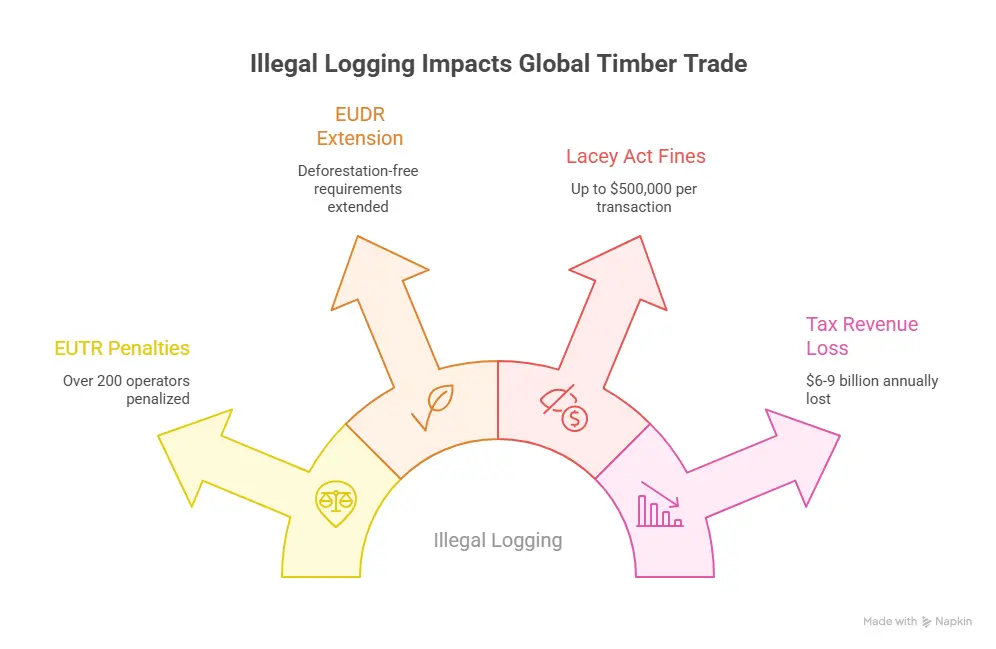
The regulatory landscape has sharpened considerably. The EU Timber Regulation (EUTR), in force since 2013, prohibits placing illegally harvested timber on the EU market and requires operators to maintain due diligence systems. Its successor framework, the EUDR, goes further, requiring geospatial deforestation checks for timber and derived products.
Failing to prove timber legality isn’t an administrative inconvenience. Actual enforcement consequences include:
What documents do you actually need? The specific requirements vary by importing country and certification framework, but the essential document set covers five categories:
The foundational proof. These are government-issued authorizations confirming that the specific forest area was legally allocated for harvesting. Required documents include:
Critical detail: Licenses must be current and cover the specific species and volumes being exported. Expired permits or volume overruns are among the most common audit failures.
CoC certificates track timber from the forest to the first point of sale. FSC (Forest Stewardship Council) and PEFC (Programme for the Endorsement of Forest Certification) are the two globally recognized CoC frameworks.
Each link in the supply chain, logger, sawmill, processor, and trader must hold a valid CoC certificate. Gaps in the chain break the legal proof. Auditors look for continuous, unbroken certification across every custody transfer.
For timber species listed under CITES (Convention on International Trade in Endangered Species), additional permits are mandatory:
Over 250 tree species are listed on CITES Appendix II or III, including Rosewood (Dalbergia spp.) and many tropical hardwoods. Misidentifying species is a high-risk compliance failure.
Movement of timber must be documented at every transit point:
Under EUTR/EUDR, any operator placing timber on the EU market must prepare and retain a Due Diligence Statement. The DDS documents the operator’s risk assessment process, describing the source, conducting a country-of-origin risk analysis, and recording the mitigation measures applied.
Paper-based verification fails at scale. When supply chains span hundreds of smallholder concessions across three countries, manual document collection creates gaps, inconsistencies, and fraud risks. Digital verification systems address this by creating structured, auditable, tamper-resistant records.
Here’s how the core technology layers work:
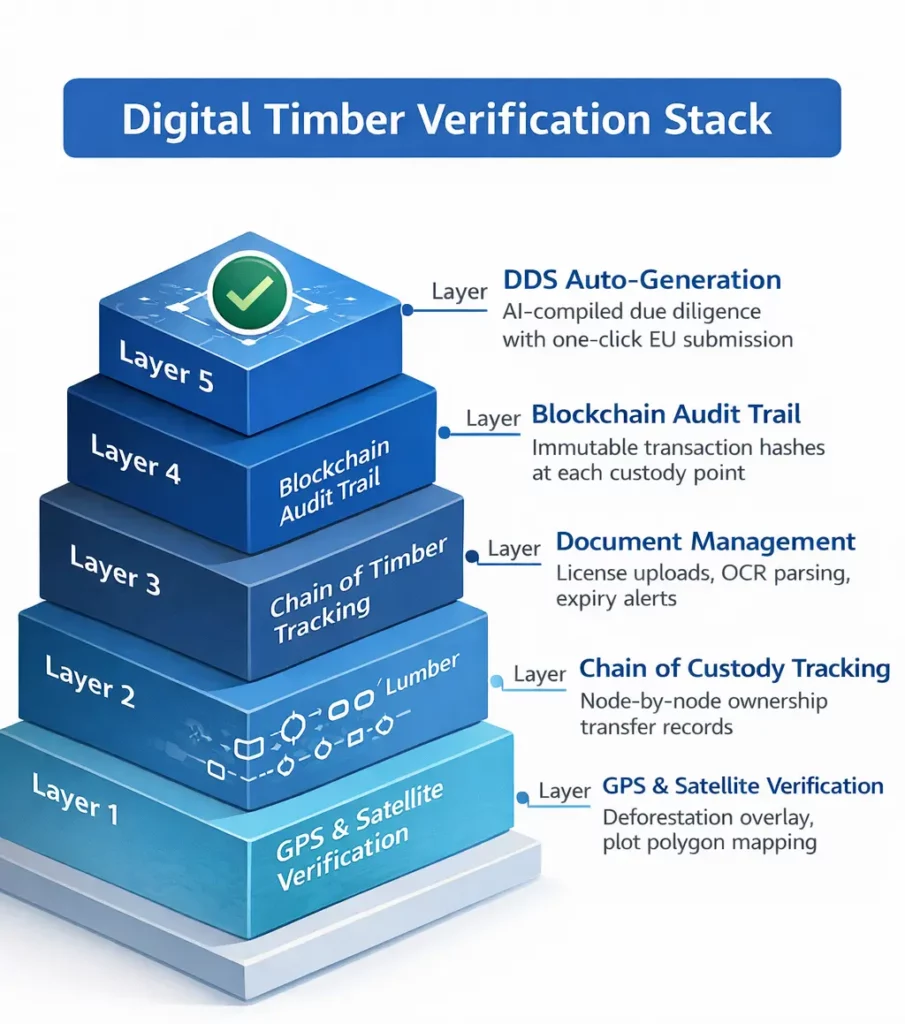
Modern timber verification requires knowing exactly where timber came from, down to the parcel coordinates. GPS polygon mapping captures the precise boundaries of licensed harvesting plots. These coordinates are then cross-referenced against satellite datasets, including:
Any overlap between the GPS-mapped source area and known deforestation zones triggers an immediate compliance flag before the shipment is processed.
Traditional document management systems can be edited, backdated, or lost. Blockchain-based systems solve this by creating an immutable record of every document upload, approval, and transfer event.
Each custody transfer in a blockchain-secured system generates a hash a unique cryptographic fingerprint of the transaction. If any document is altered after logging, the hash mismatch is immediately detectable. This makes the audit trail tamper-proof, exactly what regulators and third-party auditors need to see.
One of the most significant operational improvements in compliance technology is agentic AI document parsing. Instead of manually reviewing hundreds of supplier documents, harvesting licenses, CoC certificates, tax records, and land deeds, AI systems can:
TraceX’s agentic AI does exactly this: auto-parsing supplier documents from emails and uploaded files, extracting compliance-critical data, and flagging issues before they reach the due diligence review stage.
Many exporters are still operating under EUTR assumptions. EUDR changes the game significantly. Here’s the critical comparison:
| Dimension | EUTR (EU Timber Regulation) | EUDR (EU Deforestation Regulation) |
|---|---|---|
| Effective Date | March 2013 | Dec 30, 2025 (large operators); June 2026 (SMEs – extended) |
| Products Covered | Timber and wood products | Timber + cattle, cocoa, coffee, palm oil, soy, rubber |
| Deforestation Check | No explicit deforestation date cutoff | Must be deforestation-free after December 31, 2020 |
| Due Diligence | Risk-based DDS required | Enhanced DDS with GPS coordinates mandatory |
| Geo-mapping | Not explicitly required | Fines up to 4% of the EU’s annual turnover |
| Operator Liability | Civil penalties | Digital submission to the EU TRACES system is required |
| Digital Systems | Paper acceptable | FSC/PEFC is insufficient alone – requires geospatial data |
| Certification | Accepted as risk mitigant | Accepted as a risk mitigant |
What does a compliant timber legality verification workflow actually look like? Here’s the operational sequence that audit-ready exporters follow:
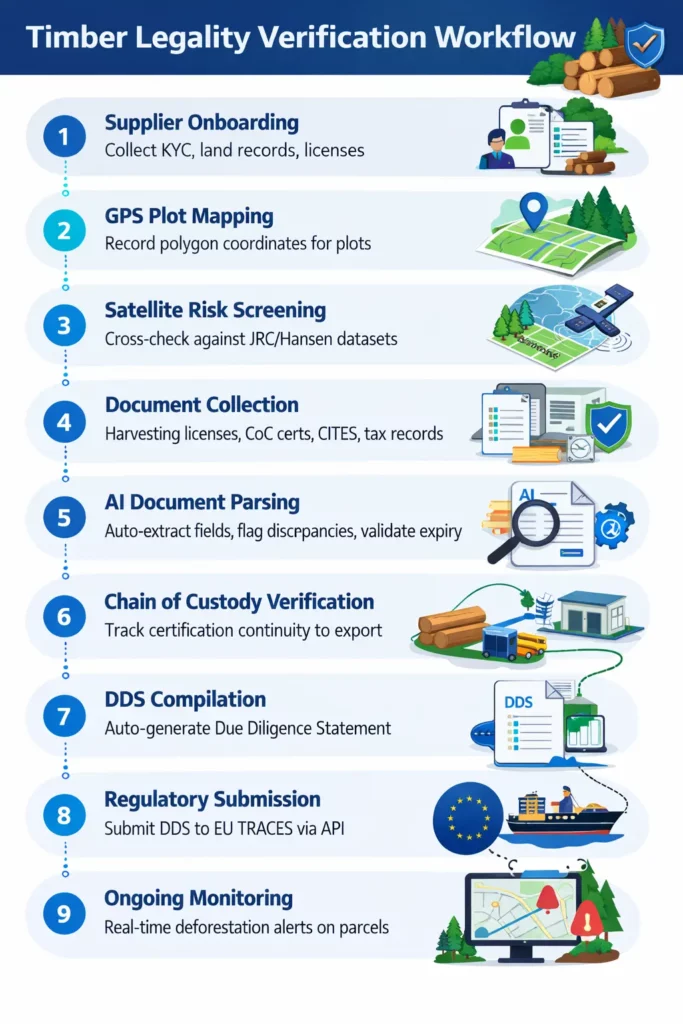
Each step must be documented. Regulators don’t just want the output; they want evidence of the process. A clean DDS with no supporting workflow documentation is a red flag in an audit.
48% of timber operators in an EU compliance review reported gaps in the chain of custody documentation (European Forest Institute, 2023)
Knowing what fails helps you build systems that don’t. The most frequent causes of timber compliance audit failure are:
License validity periods are often overlooked when shipments are planned months in advance. Automated expiry alert systems eliminate this, as a compliance platform flags approaching expirations before procurement teams commit to volume.
A single unverified link, a processor without current FSC certification, or a trader who changed certification bodies mid-year breaks the entire chain. Continuous CoC monitoring across all supply nodes is essential.
Timber species names vary by country, dialect, and trade name. Without verified botanical name confirmation (cross-referenced against CITES databases), species errors create major liability. AI systems can standardize species identification against authoritative taxonomic databases.
This is the fastest-growing audit failure. Operators who relied entirely on paper licenses pre-EUDR now face rejection because they can’t produce GPS polygon data for source plots. Retroactive GPS mapping of existing supplier bases is now an urgent operational priority.
A Due Diligence Statement is only as strong as the evidence behind it. Auditors routinely request the source documents that informed the DDS. If those files don’t exist, are inconsistent, or are locked in email threads, the DDS fails scrutiny.
TraceX’s AILPA Solutions was built specifically for the verification challenges that timber and agri-commodity exporters face, including fragmented supplier data, manual document workflows, and the growing demand for GPS-backed, audit-ready compliance records.
Here’s what TraceX delivers for timber compliance teams:
| Challenge | TraceX Capability |
|---|---|
| Manual document collection from hundreds of suppliers | Agentic AI auto-parses supplier emails and uploads extracts license numbers, dates, species, volumes |
| No GPS data for source plots | Offline-first mobile apps enable field agents to capture GPS polygon coordinates in remote forest areas |
| Deforestation risk assessment for each plot | Satellite cross-check against JRC, Hansen, and Sentinel-2 datasets automated risk score per plot |
| DDS creation is manual and error-prone | Auto-generated DDS from verified data pool one-click export in PDF, XML, or CSV |
| EU TRACES submission | API-direct integration no manual re-entry of DDS data into EU portal |
| Blockchain audit trail | Every document upload, approval, and custody transfer is immutably logged |
| Real-time deforestation monitoring | Ongoing satellite alerts on all active supply parcels – not just at onboarding |
TraceX is already deployed by exporters in India, Southeast Asia, and Africa, handling rubber, timber, coffee, and other regulated commodities. The platform’s offline-first design is particularly important for timber supply chains where supplier operations span areas with limited connectivity.
Timber legality verification has crossed a threshold. The combination of EUTR enforcement history and EUDR’s geospatial requirements means that document checklists alone no longer constitute a defensible compliance position.
Exporters who win in regulated markets are those who’ve moved from reactive document collection to proactive, digital verification systems with GPS-validated source maps, unbroken chain of custody records, and audit-ready DDS backed by blockchain-secured evidence.
The technology to do this exists. The regulatory expectation is already set. The question is whether your compliance workflow is built for where timber trade is now or where it was three years ago.
Confused about the differences between EUDR and EUTR?
Read our detailed comparison of EUDR vs EUTR to understand what has changed and what businesses must do to stay compliant.
Looking for the right tools to simplify forest compliance?
Explore our guide to forest compliance tools that help companies manage traceability, documentation, and regulatory reporting.
Why is illegal logging still a major risk for global timber supply chains?
Read our blog to understand the impact of illegal logging and how traceability helps ensure legal and responsible timber sourcing.
Under EUDR, operators must provide: (1) valid harvesting licenses or concession agreements, (2) GPS polygon coordinates of all source plots validated against satellite deforestation data, (3) chain of custody certificates (FSC or PEFC) across all supply nodes, (4) species documentation with botanical names, and (5) a formally prepared Due Diligence Statement submitted to EU TRACES. Paper documentation alone is no longer sufficient; geospatial data is now mandatory.
FSC certification is a strong indicator of legal sourcing and reduces EUTR/EUDR due diligence burden significantly, but it’s not a complete substitute under EUDR. EUDR specifically requires GPS-backed deforestation-free evidence linked to a December 31, 2020 cutoff date. FSC audits certify management practices but don’t always capture the parcel-level geospatial data EUDR regulators require. Operators must pair FSC documentation with GPS mapping to be fully compliant.
GPS polygon mapping precisely defines the coordinates of every harvesting plot. These coordinates are cross-referenced against satellite deforestation monitoring datasets (JRC, Hansen, Sentinel-2) to confirm the plot has not been subject to illegal deforestation post-December 2020. This spatial evidence is the cornerstone of EUDR compliance for timber and it replaces vague geographic descriptions with verifiable, auditable location data.
A Due Diligence Statement is a formal declaration that an operator has assessed and mitigated the risk of illegal timber entering the EU supply chain. It must document: the product and source country, the risk assessment methodology, the evidence collected (licenses, GPS data, CoC certificates), and the risk mitigation measures applied. Under EUDR, DDS must be submitted digitally to the EU TRACES system before placing timber products on the EU market.
Purpose-built compliance platforms like TraceX provide end-to-end timber legality verification GPS polygon mapping, AI document parsing, blockchain audit trails, and automated DDS generation with EU TRACES integration. Generic document management systems lack the satellite cross-referencing, species validation, and regulatory submission capabilities that modern timber compliance requires. As EUDR enforcement tightens in 2026, dedicated compliance platforms are becoming operational standard for major exporters.