
Quick summary: DAFF infringement notices under Australia's Illegal Logging Prohibition Act: understand penalties, common violations, and how importers can ensure compliance through due diligence and traceability.

A DAFF infringement notice issued under the Illegal Logging Prohibition Act 2012 (as updated by the 2024 Amendment Act and Rules) is a formal enforcement action signalling that your timber due diligence system or how you applied it to a specific shipment has failed to meet Australia’s legal standard. It is not a preliminary warning. It triggers an enforceable investigation with financial penalties of up to $19,800 for strict liability offences, up to $165,000 (or 5 years imprisonment) for fault-based offences, and civil penalties of up to $33,000. DAFF may also publish the details of your non-compliance on its public website.
If you’ve received one or your compliance team is bracing for contact here’s what’s actually happening, what the law requires, what DAFF will check, and what you need to do before the deadline on your notice.
Australia’s illegal logging laws have been in place since 2012 and were significantly strengthened on 3 March 2025 when the Illegal Logging Prohibition Rules 2024 came into force. Under this framework, DAFF (the Department of Agriculture, Fisheries and Forestry) conducts compliance assessments of timber importers and processors to verify that due diligence was completed before regulated products entered Australia. When an assessment finds deficiencies, DAFF’s enforcement toolkit includes infringement notices, which are issued under Part 5 of the Regulatory Powers (Standard Provisions) Act 2014.
This is not the same as a Requirement to Give Information and Produce Documents notice (which is a compliance assessment tool). An infringement notice is issued when DAFF has already assessed your practices and found a contravention. The legal process has begun.
Infringement notices are issued by inspectors appointed under the Illegal Logging Prohibition Act 2012. The framework is administered by DAFF and applies to any person who imports regulated timber products into Australia or processes Australian-grown raw logs. As of 3 March 2025, the notice window was extended to 24 months from the date of an alleged contravention up from the standard 12-month timeframe, meaning DAFF can look back further into your import history.
A routine compliance assessment begins with a Requirement to Give Information and Produce Documents notice, which is the initial request for your due diligence records. An infringement notice comes after DAFF has reviewed your response and found a contravention of the Act or Rules. The legal burden is now on you to demonstrate that your due diligence was lawful, not DAFF’s burden to prove it wasn’t.
Approximately 9% of Australia’s timber imports were estimated to be illegally logged before the 2012 laws were introduced.
A 2024 DAFF timber testing trial found approximately 25% of sampled products were inconsistent with their declared species, origin, or both.
Australia’s illegal logging framework provides DAFF with a graduated, flexible enforcement toolkit, meaning the response is calibrated to the severity of your non-compliance. But “graduated” doesn’t mean lenient. The Amendment Act 2024 deliberately strengthened enforcement powers, adding new penalty tiers and the ability to publish non-compliance publicly.
Strict liability offences don’t require DAFF to prove intent, only that the contravention occurred. These include failing to complete due diligence before importing regulated timber or failing to keep required records. Each penalty unit is currently $330 (effective 7 November 2024), meaning a 60-penalty-unit strict liability offence carries a maximum fine of $19,800.
Fault-based offences apply where there’s evidence of knowledge or recklessness regarding non-compliance for example, importing timber you knew or suspected was illegally logged. These carry penalties of up to $165,000 in fines, five years imprisonment, or both. Civil penalties of up to $33,000 may also apply as an alternative to criminal prosecution.
Beyond financial penalties, the Amendment Act 2024 introduced the ability for DAFF to publish information about criminal convictions, civil penalty orders, and enforceable undertaking orders on its public website, including the identity of your business. For timber importers whose buyers include government agencies or sustainability-conscious brands, public naming is often more damaging than the fine itself.
| Offence Type | Trigger | Maximum Penalty | Additional Consequence |
|---|---|---|---|
| Strict Liability | Due diligence not completed / records not kept | Up to $19,800 | Infringement notice on record |
| Fault-Based (Criminal) | Knowledge / recklessness re: illegal timber | Up to $165,000 or 5 years imprisonment | Criminal conviction |
| Civil Penalty | Contravention of Act or Rules | Up to $33,000 | Civil penalty order |
| All Tiers | DAFF discretion | Public naming on DAFF website | Reputational exposure |
| Injunction / Undertaking | Systemic non-compliance | Court-enforceable compliance order | Mandatory corrective action |
The 24-Month Lookback Is New and Significant
Under the old framework, DAFF had 12 months to issue an infringement notice from the date of an alleged contravention. The 2024 Amendment Act doubled this to 24 months. That means shipments imported in early 2024, before the new Rules came into force, can still be the subject of enforcement action issued in 2026. Importers who assumed prior shipments were safely outside the enforcement window are incorrect.
When DAFF selects you for a compliance assessment, it sends a Requirement to Give Information and Produce Documents notice specifying a response deadline. This leads to a full review of your due diligence system and how you applied it to a specific regulated timber product or log consignment. If that review reveals contraventions, the infringement notice follows.
Avoid penalties and shipment delays – learn AILPA due diligence requirements
Before March 2025, importers could rely on the Community Protection Question (CPQ) on the Integrated Cargo System as a compliance touchpoint. That mechanism has been removed. Under the Rules 2024, due diligence is now entirely self-managed you must have a written system, apply it, and keep records without a formal checkpoint at the border to prompt compliance. This structural change means DAFF is now conducting back-end audits on importers who may never have updated their internal processes.
DAFF also now has explicit power to take, test and analyse physical samples of timber products using timber identification technologies including portable imaging equipment and cross-reference species and origin claims against reference databases. The 2024 trial found approximately 25% of sampled products had inconsistencies in declared species or origin. This creates an entirely new class of evidence risk that didn’t exist before.
Once you have a DAFF notice in hand, the response deadline printed on it is fixed. There are no standard extensions. The steps you take in the first 48-72 hours determine whether you respond credibly or give DAFF grounds to escalate.
Your first written response sets the legal record. An incomplete or inconsistent response to a compliance assessment can accelerate escalation to an infringement notice or prosecution. If you’ve already received an infringement notice, the same principle applies retain legal counsel with regulatory and trade law experience before you communicate formally with DAFF.
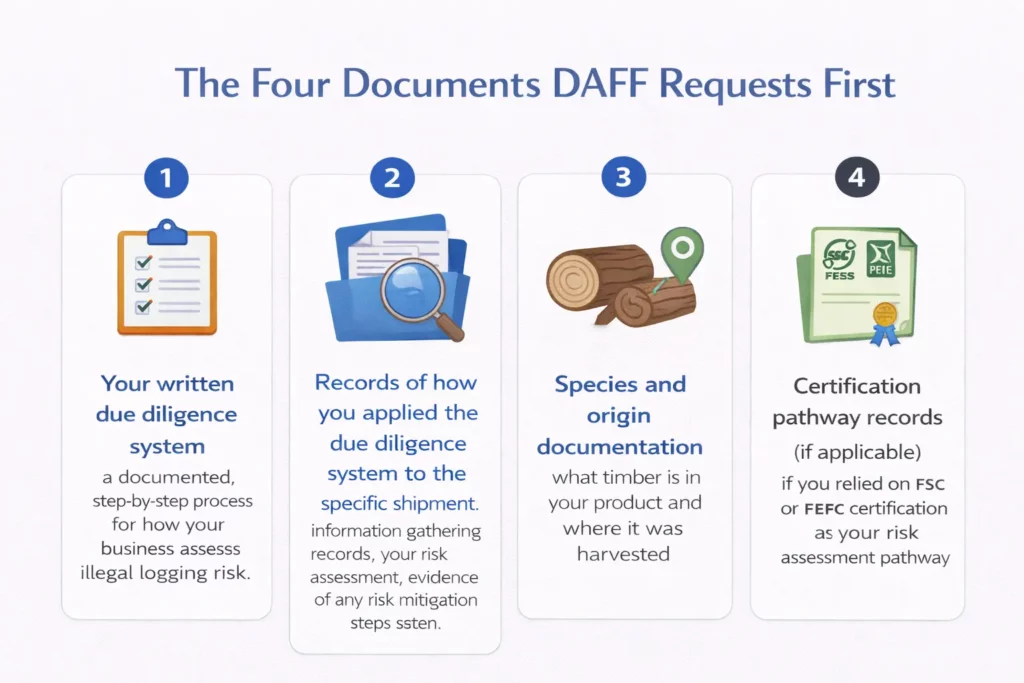
Map what DAFF will ask for against what you can currently produce. Specifically:
DAFF provides an optional response template for importers issued a Requirement to Give Information notice. Use it it signals cooperation and structures your response around what the department actually looks for. Your evidence package must demonstrate that due diligence was conducted before import, not assembled retrospectively.
DAFF’s 2024 timber testing trial which found approximately 25% of sampled products inconsistent with declared species or origin reveals the core problem: many importers rely on supplier declarations they can’t independently verify. When DAFF cross-references your records against physical timber testing or country-specific risk data, supplier-provided paperwork alone doesn’t hold up.
DAFF has explicitly warned that FSC or PEFC Chain of Custody manuals are not sufficient to meet the due diligence obligations under the Rules 2024. Many importers assume their existing certification covers their compliance obligations. It doesn’t. The Rules require a distinct, written due diligence system that encompasses information gathering, risk assessment, risk mitigation (where required), and record keeping regardless of what certifications you hold.
Think FSC certification is enough? See where it falls short under AILPA
The most common failure mode in DAFF investigations is records that exist but were completed after the goods arrived in Australia. The Rules are explicit: your due diligence must be completed before importing. A risk assessment dated after your import declaration is not compliant and DAFF can identify this from document metadata and timestamps.
Importers sourcing through traders or intermediaries rather than directly from mills frequently can’t trace species and origin to the forest level. DAFF’s risk assessment framework requires you to identify what timber is in your product and where it was harvested. If your supplier can’t tell you, you’re expected to take additional steps to mitigate the risk or decline the import.
Australia’s illegal-logging framework is designed to reduce price undercutting from illegal timber, with prior estimates suggesting up to US$500 million of annual timber imports may come from potentially high-risk sources, while DAFF’s enforcement toolkit now includes timber identification technologies beyond the border.
The gap between “failed DAFF assessment” and “audit-ready” is almost always a documentation system problem, not a sourcing problem. Importers who pass DAFF investigations share a common capability: a written due diligence system that was designed around the Rules 2024, applied consistently, and generates records that can be produced within hours of a notice.
The Rules 2024 require a documented system covering four steps: information gathering, risk assessment, risk mitigation (where applicable), and record keeping. Each step must be documented for every regulated import. DAFF provides a Due Diligence Toolkit for importers download it and use it as the baseline for your internal process.
Every regulated timber product you import requires you to know the species and harvest location. This information needs to come from your supply chain which means your supplier onboarding process must capture it. For importers sourcing from multiple suppliers across high-risk countries, this is a data management challenge. Country Specific Guidelines (CSGs) published by DAFF help you assess what documentation to expect from suppliers in key markets.
DAFF investigators check when records were created. A digital supply chain traceability system one that timestamps every information gathering step, risk assessment, and mitigation action is dramatically more defensible than paper-based records assembled into a folder at audit time. AILPA Solutions from TraceX provide audit-ready supply chain documentation with blockchain-backed data integrity, making it technically impossible for investigators to question whether records were created retrospectively.
Responding to a DAFF notice after the fact including legal costs, evidence assembly, potential fines, and the reputational cost of public naming costs significantly more than implementing a proactive compliance system. More importantly, once DAFF has flagged your business, your risk profile in DAFF’s risk-based assessment framework increases. Repeat engagement is more likely, not less.
Sustainable compliance under the Illegal Logging Prohibition Rules 2024 means having a system that generates compliant due diligence records as a routine output of your procurement process not as a reactive exercise when DAFF asks. Continuous supplier monitoring, automated risk flags for high-risk origin countries, and timestamped record keeping turn a legal obligation into a commercial advantage: faster imports, lower audit risk, and defensible supply chain claims for buyers who ask.
Explore TraceX’s AILPA Solutions
A DAFF infringement notice under Australia’s illegal logging laws is a serious enforcement action not a compliance nudge. Since September 2025, the transition period is over and DAFF is operating with the full enforcement toolkit introduced by the 2024 Amendment Act: infringement notices, civil penalties, criminal prosecution, and public naming.
The difference between a warning letter and a $165,000 fine comes down to whether your written due diligence system exists, whether it meets the Rules 2024 (not the old Regulation), and whether you can prove it was applied before each regulated import arrived in Australia.
Most importers who receive a DAFF notice don’t have a sourcing problem. They have a documentation system problem. The first step is knowing where your gaps are before DAFF tells you.
New to AILPA? Start with the complete compliance guide
Do you know your timber sourcing risk? Find out
A DAFF infringement notice is a formal enforcement action issued under Part 5 of the Regulatory Powers (Standard Provisions) Act 2014 for alleged contraventions of the Illegal Logging Prohibition Act 2012 and Rules 2024. Any person or business that imports regulated timber products into Australia or processes Australian-grown raw logs can receive one. As of March 2025, DAFF has 24 months from the alleged contravention date to issue a notice.
Penalties depend on offence type. Strict liability offences (where intent doesn’t need to be proven) carry up to $19,800. Fault-based offences where knowledge or recklessness is established carry up to $165,000 in fines, five years imprisonment, or both. Civil penalties of up to $33,000 may apply as an alternative. DAFF can also publish details of non-compliance on its public website, including the business name and nature of the contravention.
DAFF typically requests: (1) a copy of your written due diligence system; (2) records demonstrating how you applied the system to the specific timber product or log consignment under assessment, including information gathering, risk assessment, and any risk mitigation steps; (3) species and origin documentation; and (4) certification records if applicable. All records must pre-date the relevant import.
No. DAFF has explicitly clarified that holding FSC or PEFC certification or having a Chain of Custody manual from your certification body is not sufficient to meet your due diligence obligations under the Illegal Logging Prohibition Rules 2024. While certification informs one of two available risk assessment pathways, you still need a separate written due diligence system and records showing it was applied before each import.
The Illegal Logging Prohibition Rules 2024 replaced the old Regulation on 3 March 2025, introducing updated due diligence pathways, strengthened enforcement powers (including timber testing capabilities), a 24-month infringement notice window, and the ability to publish non-compliance publicly. The 6-month education-focused transition period ended in September 2025. Full enforcement is now in effect.