
Quick summary: Explore 5 real-world EUDR compliance failures and learn how missing supplier data, poor traceability, and weak due diligence can disrupt market access, delay shipments, and trigger regulatory penalties.
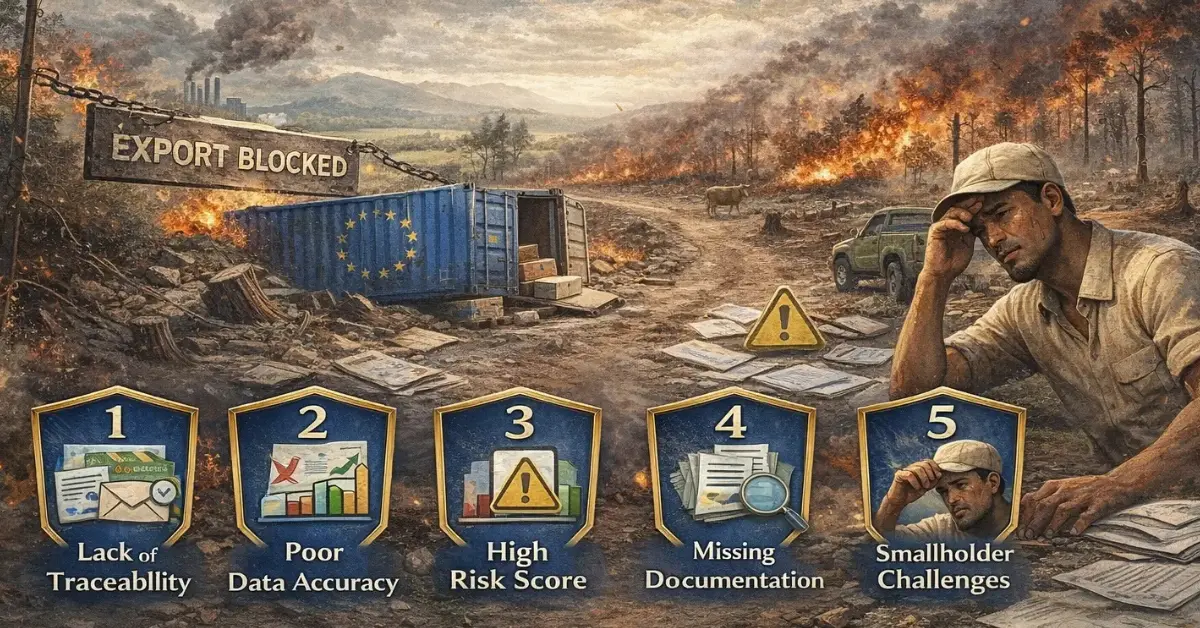
Most EUDR non-compliance won’t come from illegal sourcing. It will come from data that lives in the wrong place, risk assessments that can’t survive scrutiny, and supply chains where one unknown actor contaminates an otherwise clean batch. This article maps the five real-world EUDR failures with the exact scenario each one creates at audit time.
Most companies think EUDR is about avoiding deforestation. And it is, but that’s the outcome. In practice, most failures won’t come from illegal sourcing. They’ll come from operational blind spots: disconnected data, risk assessments that can’t be defended, and traceability gaps at the last mile of the supply chain.
The EU Deforestation Regulation came into force for large operators on December 30, 2025. For the agri-food industry, it represents the most significant supply chain compliance shift in a generation. Yet the companies most at risk are not the ones with bad sourcing intentions, they’re the ones whose internal systems were never built for the level of traceability EUDR demands. TraceX EUDR solutions help bridge this gap by enabling end-to-end traceability, automated supplier data collection, and audit-ready compliance workflows across global supply chains.
Understanding where compliance breaks down before your shipment reaches the border is the difference between EU market access and a 50,000 euro fine per violation. Here are five blind spots, each with a real-world scenario that shows exactly how they play out.
1. Most EUDR failures are operational, not intentional. They happen in disconnected systems, undocumented risk processes, and data gaps at the farm level.
2. The 5 blind spots: Siloed data systems, undocumented risk assessments, mixed-batch aggregation, smallholder last-mile gaps, TRACES over-focus.
3. The fix: connected data infrastructure + plot-level traceability + defensible, documented risk decisions all before shipment reaches the border.
EUDR: THE COMPLIANCE LANDSCAPE IN NUMBERS
| €50K+ Maximum fine per violation under EUDR Art. 25 | 95% | 5,000+ Commodity shipments now requiring plot-level DDS |
| Blind Spot | Common Assumption | What Actually Fails |
|---|---|---|
| Siloed data systems | “Country benchmarks are sufficient.” | Cannot reconcile shipment – plot – DDS at audit |
| “Negligible risk” labels | “95% compliant is fine.” | No documented mitigation = DDS rejected |
| Mixed-batch aggregation | “Our operations are fully compliant.” | 5% unknown volume = entire shipment at risk |
| Smallholder last-mile gaps | “Our operations are fully compliant” | No plot-level GPS = cannot prove origin |
| TRACES portal over-focus | “We just need to learn the system” | Portal works; the underlying data is broken |
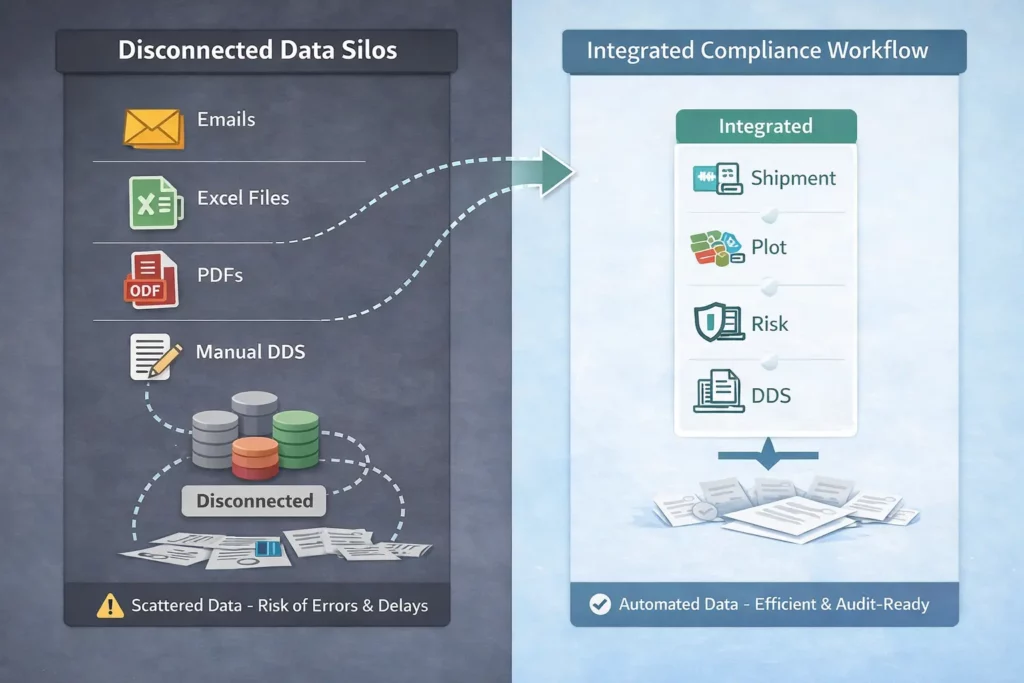
A European importer sources timber from 12 suppliers across Southeast Asia. Everything they need for EUDR compliance exists, but it is scattered across four disconnected places.
FAILURE 1: Siloed Data Architecture
The scenario: A European timber importer. All the right data exists. Nothing connects.
Supplier data lives in email threads. Geolocation coordinates are stored in a shared Excel file. Risk analysis narratives are saved as PDFs, one per supplier. DDS submissions are handled manually and filed individually. No system can cross-reference which shipment maps to which plot or which risk file.
The issue wasn’t compliance; it was data architecture. At audit time, no one could reconcile which shipment mapped to which plot, or which risk assessment supported which DDS.
Most companies built their data systems before EUDR existed. ERP platforms, supplier management tools, and logistics software were never designed to link geospatial data to risk assessments and compliance declarations into a single auditable chain.
What EUDR Article 9 Actually Requires
Operators must maintain records that allow competent authorities to verify the due diligence statement for at least 5 years.
This means: every DDS must be traceable in sequence to a specific plot, a specific geolocation dataset, and a specific risk assessment. On demand. In one system.
Companies need a single connected system where supplier records, GPS coordinates, risk scores, and DDS filings are linked by a common identifier, not manually cross-referenced at audit time. TraceX’s EUDR compliance platform provides exactly this: every DDS links back to verified plot-level geolocation and automated risk scoring in one auditable chain.
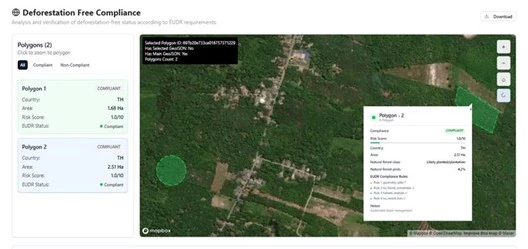
A cocoa exporter classifies all sourcing as low risk, based on country-level benchmarks from a third-party sustainability index. The DDS is filed. Everything looks compliant until a competent authority review.
FAILURE 2: Undocumented Risk Classification
The scenario: A cocoa exporter. Country benchmarks used. No documentation of the process.
Risk classification based on country-level scores, not plot-level verification. No satellite imagery consulted or retained. No record of what mitigation measures were taken. No audit trail showing how the ‘negligible risk’ conclusion was reached. Authorities asked: ‘What steps did you take?’ and there was no answer.
Root Cause: The DDS wasn’t rejected because of deforestation. It was rejected because the risk wasn’t defensible. Under EUDR, documenting your risk process is as critical as the outcome of it.
EUDR Article 10 requires operators to demonstrate, not just claim, that they took all necessary steps to reach their risk conclusion. Referencing a country benchmark without plot-level validation does not satisfy this requirement when a competent authority asks for specifics.
What actually satisfies the standard:
EUDR Recital 26 – A Critical Nuance
Recital 26 explicitly states that relying solely on country benchmarks is insufficient where specific supply chain characteristics create heightened risk.
The burden of proof lies with the operator, not the competent authority. You must be able to prove your process, not just your conclusion.
Risk classification must be documented at the plot level, not the country level. TraceX automates real-time deforestation alerts using GRC and Hansen datasets, generating a complete audit trail for every risk decision. When authorities ask, ‘How did you reach this conclusion?’ the answer is available in two clicks.
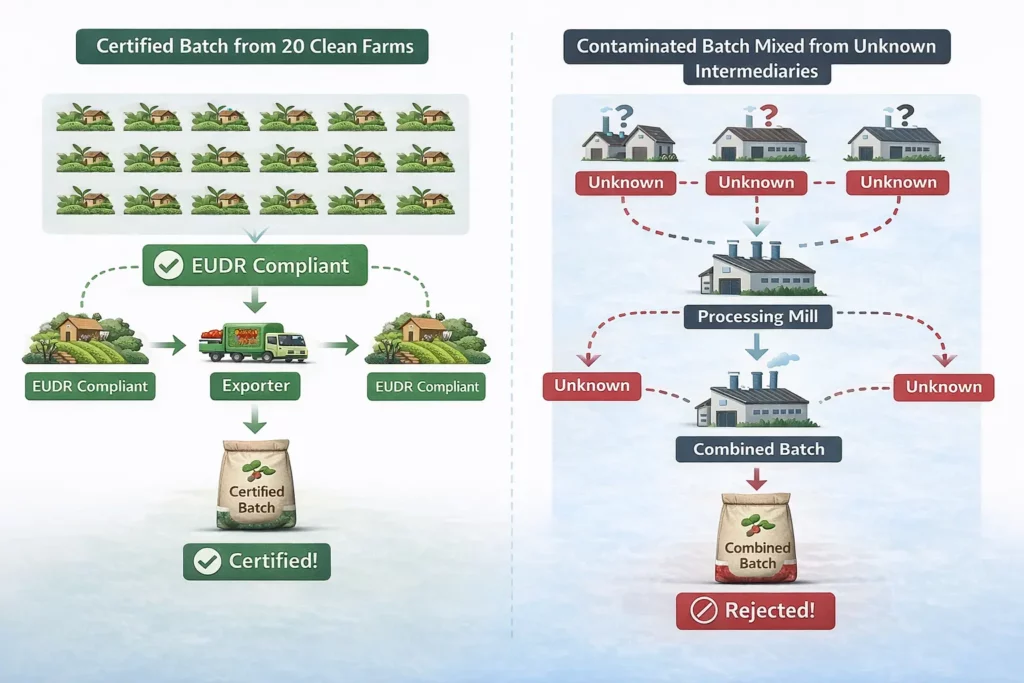
A palm oil processor aggregates supply from 23 sources. Twenty are fully verified, GPS confirmed, deforestation checks passed, and documentation is complete. There are intermediary aggregators whose ultimate farm origins are undocumented.
FAILURE 3: Mixed-Batch Aggregation Risk
The scenario: A palm oil processor. 20 verified farms. 3 unknown intermediaries. One batch.
All 23 supply sources are processed together in a single batch. The DDS covers the combined shipment as a whole. 95% of the volume is traceable to verified, deforestation-free plots. 5% of volume has no traceable origin, three intermediaries with no farm-level data. Under EUDR, the entire shipment is non-compliant.
Root Cause: Aggregation hides risk until it’s too late. EUDR does not allow partial compliance – 5% unknown volume puts 100% of the shipment at risk of refusal or confiscation.
This scenario is not an edge case. Most mid-to-large commodity processors work with a mix of direct farm relationships and multi-tier intermediaries. The intermediary layer is where traceability breaks down because aggregators buy from multiple farmers without passing on individual plot-level data to downstream processors.
EUDR Article 3 – The 100% Rule
Products placed on the EU market must be deforestation-free. This is not a threshold requirement it applies to 100% of the product volume.
Mixed batches containing any unverified volume are treated as entirely non-compliant. There is no proportionality clause.
Companies need to map their supply chain to the plot level, including through intermediaries. TraceX’s offline-first mobile apps enable field agents to capture geotagged plot data directly from farmers in remote areas before the product enters the aggregation layer. Supplier onboarding workflows collect GPS coordinates, land tenure records, and crop data, even in areas with no internet connectivity.
A specialty coffee company has an impeccable internal compliance programme. ESG reports are current. Sustainability certifications are in order. Their own operations are fully auditable. But they source from 5,000 smallholder farmers across three origin countries.
FAILURE 4: Last-Mile Data Gap in Smallholder Supply Chains
The scenario: A coffee company, 5,000 smallholder farmers. Fully compliant company. No plot-level data.
Farmers maintain paper-based records with no digital systems. No GPS mapping of individual plots has ever been conducted. Language barriers and limited digital literacy make standard onboarding tools unusable. The company cannot provide plot-level geolocation for any of its 5,000 supply sources. Without this data, EUDR DDS cannot be completed, regardless of how clean the company’s own operations are.
Root Cause: The weakest link isn’t the company, it’s the last mile of data collection. A fully compliant operation can be blocked at the border by a data gap it never directly controls.
More than 70% of global tropical commodity production comes from smallholders (FAO, 2024). These farmers typically operate on plots under 2 hectares, in areas with limited road infrastructure, unreliable mobile connectivity, and without the administrative capacity to generate the kind of digital records EUDR demands.
The Smallholder Scale Problem
If a company sources from 5,000 farmers and each requires GPS mapping, document collection, and verification, that is 5,000 individual onboarding workflows.
Without the right technology: 6-12 months of manual fieldwork.
With the right platform (offline-first, multilingual, field-agent-led): 6-8 weeks.
Plot-level data collection must happen at the farm gate, not the processor. TraceX’s offline-first Android apps were built specifically for emerging market supply chains: field agents capture GPS coordinates, land tenure documents, and crop data without internet connectivity, syncing when available. Multilingual smallholder portals covering 12 languages across major commodity-producing regions enable farmers to participate in their own language. TraceX currently supports supply chain digitisation across coffee, cocoa, spices, and palm oil sourcing in India, Africa, and Southeast Asia.
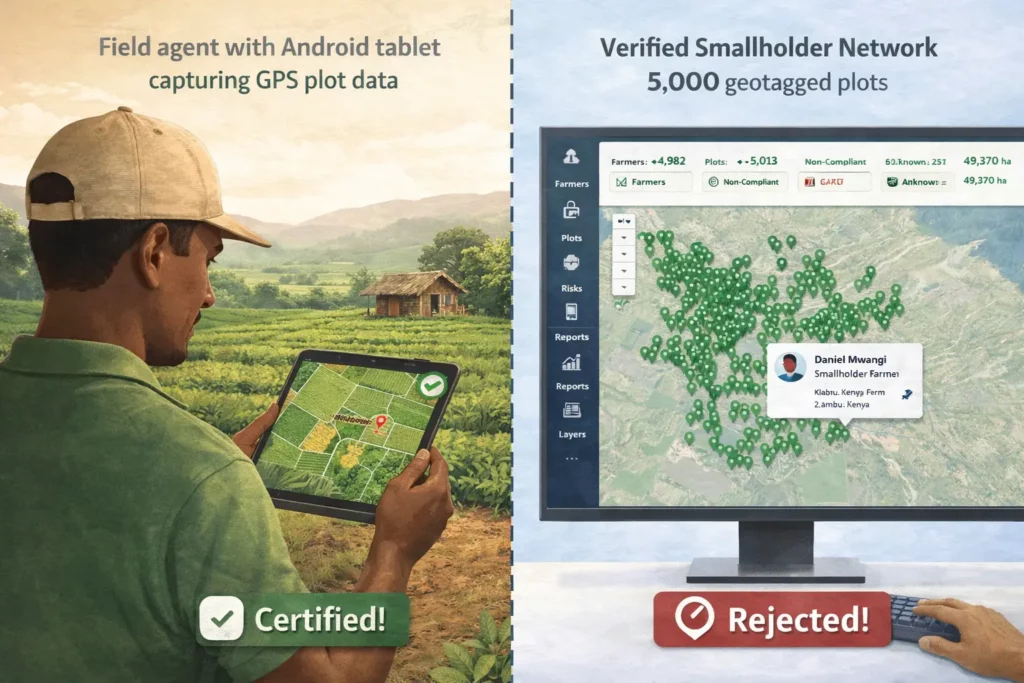
See how a leading tire company achieved EUDR compliance – explore the power of large-scale polygon mapping in action.
A procurement team at a major food group spends three weeks in intensive TRACES training sessions. They navigate the EU portal interface, work through submission workflows, and feel prepared for the compliance deadline. When first submissions go live, the portal works exactly as trained.
FAILURE 5: Portal Readiness Without Data Readiness
The scenario: Three weeks of TRACES training. Portal works perfectly. Submissions fail.
The TRACES submission portal functions correctly. Geolocation data is missing for 40% of supply sources. Supplier documents are inconsistently formatted across origin countries. Risk justification narratives reference country benchmarks without plot evidence. Multiple DDS submissions are returned or flagged not because of portal errors, but because the underlying data is incomplete.
Root Cause: TRACES wasn’t the challenge data preparation was. The portal is the last 5% of the compliance process. The other 95% is data collection, validation, risk assessment, and documentation all of which must happen before anyone logs in.
TRACES is the most visible part of EUDR compliance because it’s the final interface. This visibility creates a cognitive bias: teams over-invest in portal training and under-invest in the underlying data infrastructure that makes portal submissions viable.
What TRACES Requires You to Already Have
GPS coordinates for all plots of land associated with the product.
Product and operator information – HS codes, quantities, countries of origin.
A completed, documented risk assessment with methodology.
Evidence of mitigation measures where risk was initially identified.
TRACES is the submission mechanism. None of this data originates in the portal it must be collected, validated, and structured before the first field is populated.
EUDR compliance preparation must start with data infrastructure, not portal training. TraceX integrates directly with the EU TRACES system via API, enabling automated DDS generation and one-click submission. But the platform’s real value is upstream: AI-powered document parsing extracts supplier KYC and land tenure data from email attachments automatically, automated risk scoring runs against satellite datasets in real time, and audit-ready reports are exportable in PDF, XML, and CSV so that when a user opens TRACES, the data is already clean, complete, and submission-ready.
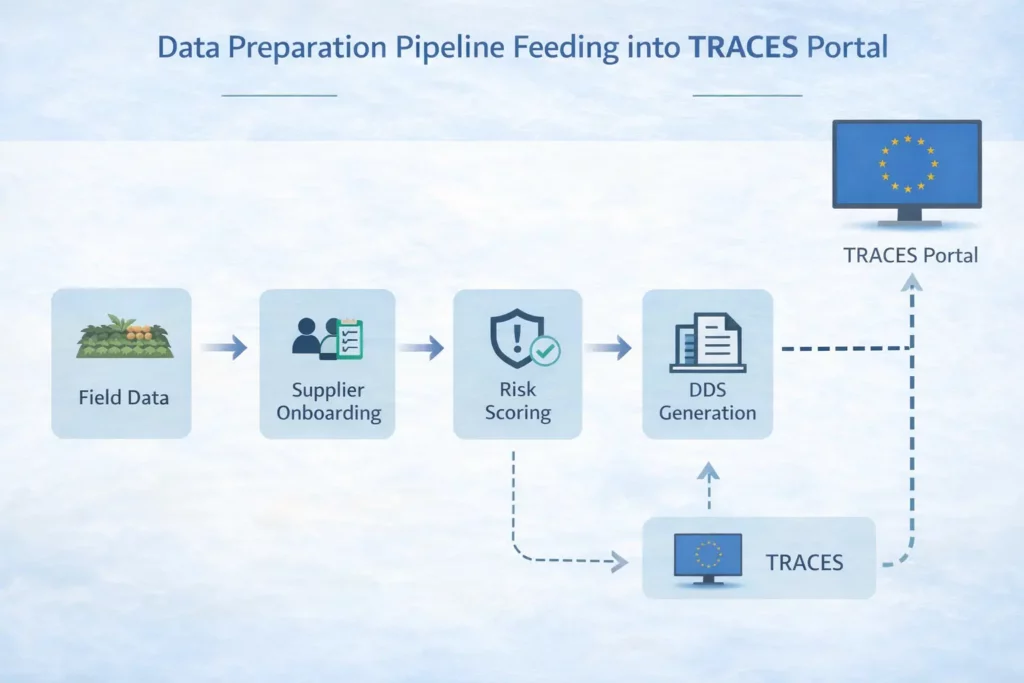
Taken together, these five failures point to a single structural truth: EUDR compliance is fundamentally a data problem, not a policy problem.
Most companies already have policies that prohibit sourcing from deforested land. Most have sustainability commitments on paper. The companies that will fail under EUDR are not the ones with bad intentions; they’re the ones whose data systems were never designed to produce the level of verifiable, traceable, plot-level evidence the regulation demands.
| Old Question | New Question |
|---|---|
| “Do we have the documents?” | “Can we prove this end-to-end, with data, for any individual shipment, on demand?” |
These are very different standards. The first can be met with a filing cabinet. The second requires a connected data infrastructure.
The Three Capabilities EUDR Actually Demands
1. Connected data systems – supplier records, geolocation, risk assessments, and DDS linked by a common identifier and auditable in sequence.
2. Traceability at the right level – plot-level GPS for every unit of supply, including through intermediaries and smallholder last-mile sources.
3. Defensible risk decisions – documented methodology, satellite-validated analysis, and a clear audit trail for how each risk conclusion was reached.
For organisations evaluating EUDR compliance platforms, the right questions are the ones that map directly to the five failures above, not just ‘does this platform submit DDS?’
| Blind Spot | What Typically Fails | TraceX Capability |
|---|---|---|
| Siloed data systems | Data in emails, Excel, PDFs with no common record | Single connected platform – supplier, GPS, risk, and DDS linked by record ID |
| Undocumented risk | Country benchmarks, no methodology audit trail | Automated risk scoring (GRC, Hansen) + full methodology documentation |
| Batch aggregation | Plot-level traceability for all supply sources, including multi-tier intermediaries | Plot-level traceability for all supply sources including multi-tier intermediaries |
| Smallholder data gaps | Paper records, no GPS, no connectivity | Offline-first Android apps + 12-language smallholder portals for field GPS capture |
| TRACES over-focus | Data prep done manually, incomplete at submission | AI document parsing + TRACES API integration + one-click DDS generation |
Use this checklist to identify which of the five failures apply to your supply chain. If you can’t answer ‘yes’ to all ten, you have an open compliance risk before your next shipment cycle.
How to Interpret Your Score
10 / 10 – Your compliance infrastructure is robust. Stress-test under simulated audit conditions.
7-9 / 10 – Specific gaps create shipment risk. Address ‘no’ answers before the next supply cycle.
Below 7 – Significant structural gaps. Prioritise data infrastructure now, not portal training.
The headline risk of EUDR sourcing from deforested land gets most of the attention. But the cases that will actually create failures in 2026 and beyond won’t announce themselves. They’ll happen quietly: in a set of GPS coordinates that were never collected, in a risk assessment that couldn’t withstand scrutiny, in a batch where three of 23 suppliers turned out to be intermediaries with no farm-level data.
The companies that will navigate EUDR successfully are not necessarily the ones with the most sustainable supply chains. They’re the ones with the most connected, defensible, and auditable data infrastructure.
The compliance question has changed. It’s no longer ‘do we believe our supply is clean?’ It’s ‘can we prove it?’ By the time a non-compliance issue reaches the border, it’s already too late to fix. The window to build the data infrastructure EUDR requires is now before the next shipment cycle, not during it.
New to EU TRACES? Explore how it supports compliance and traceability across EU supply chains.
Understand the role of smallholders in EUDR – learn how to balance compliance with inclusive sourcing.
Struggling with aggregation under EUDR? Discover how to maintain traceability across mixed supply chains.
The EU Deforestation Regulation (Regulation 2023/1115) requires operators and traders placing certain commodities on the EU market to prove that those products did not contribute to deforestation after December 31, 2020. It covers cattle, cocoa, coffee, palm oil, soy, wood, rubber, and derived products. Large operators had a compliance deadline of December 30, 2025. SMEs have until June 30, 2026.
A DDS is the formal declaration that operators must submit to EU TRACES NT before placing a relevant commodity on the EU market. It must reference GPS coordinates for all plots of land associated with the product and must be supported by a documented risk assessment demonstrating the product is deforestation-free. Submissions without plot-level geolocation cannot be accepted.
Certifications can support your compliance case as evidence inputs, but they do not satisfy EUDR on their own. EUDR requires plot-level GPS coordinates and a documented risk assessment at a level of granularity most certification schemes do not provide. They should be used as one input within a broader due diligence process, not as a substitute for it.
Penalties include fines of at least 4% of annual EU turnover, temporary exclusion from public procurement, and confiscation of non-compliant products and associated revenues. Member states set specific penalty levels within EU minimums. Non-compliance also creates significant reputational risk and can result in loss of EU buyer relationships.
TraceX provides an end-to-end EUDR compliance platform: AI-powered supplier document parsing, GPS polygon mapping validated against JRC and Hansen satellite data, automated risk scoring with real-time deforestation alerts, DDS auto-generation, and direct API integration with EU TRACES for submission. It is built specifically for agri-food supply chains sourcing from emerging market smallholder networks, the highest-risk compliance scenario under EUDR.