Quick summary: EUDR Interoperability & Integration: Discover why disconnected systems create compliance risks and how integrated data, traceability, and workflows ensure accurate, audit-ready due diligence.
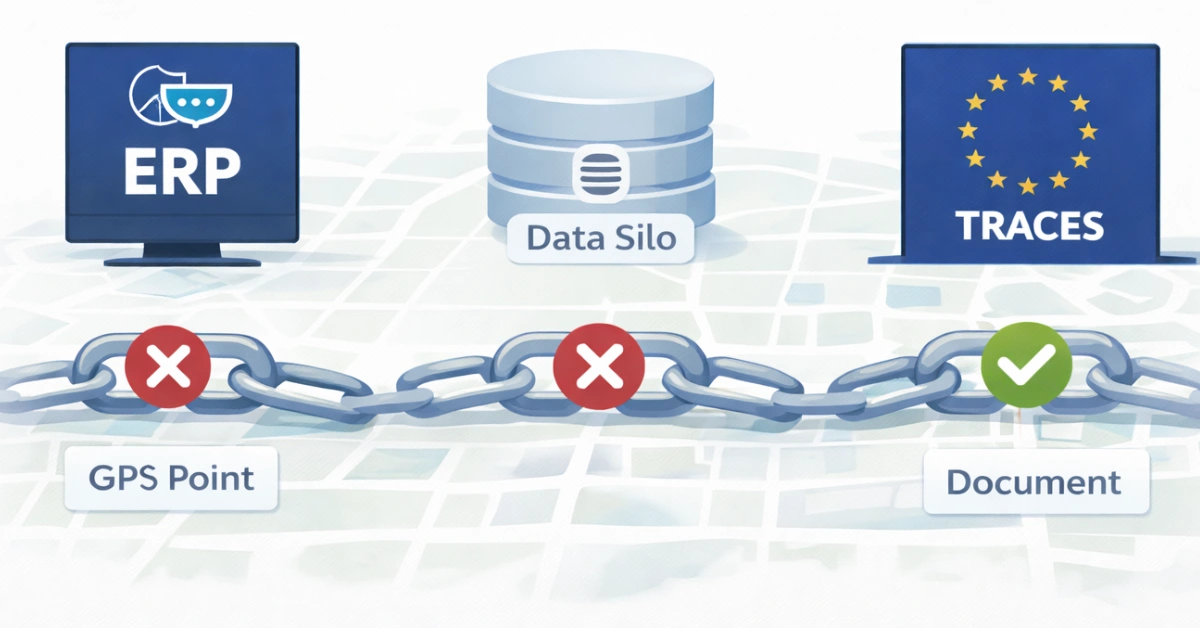
The EU Deforestation Regulation doesn’t just require traceability; it demands that all your systems talk to each other. If your ERP, traceability platform, satellite monitoring tools, and EU TRACES filing system aren’t integrated, you’re facing compliance failures, DDS rejections, and blocked shipments before goods ever reach the border. EUDR Interoperability and Integration is the foundation of compliance because disconnected systems don’t just slow you down, they create blind spots that regulators won’t overlook.
This guide explains: what interoperability means under EUDR, why integration gaps cause the most compliance failures, how to connect your existing stack to EU-DDS/TRACES, and how TraceX EUDR Solutions eliminates these gaps with an API-first platform.
€50,000+ Maximum fine per infringement for EUDR non-compliance under EU Regulation 2023/1115
Dec 30, 2026 EUDR deadline passed for large & medium operators — SMEs due June 30, 2027
7 Commodities Products in scope: soy, palm oil, coffee, cocoa, beef, wood & rubber — all requiring plot-level traceability
Most EUDR conversations focus on traceability. But the harder challenge is interoperability: making every system, platform, and stakeholder in your supply chain work as one.
Definition
Interoperability under EUDR = the capacity of different entities in the supply chain (producers, processors, traders, regulators, auditors) to share, access, and process compliance data effectively – using the same data, in real time, toward the same goal.
Think of your supply chain like a group chat. Farmers, suppliers, processors, traders, and regulatory bodies all need to be on the same page. But what happens when different data formats are used across platforms (farmers using WhatsApp, ERPs storing supplier addresses not GPS polygons), messages get lost between systems (compliance docs living in email threads and spreadsheets), and no one is actually reading the messages (data silos mean compliance teams don’t see risk in time)?
This isn’t a metaphor it’s the reality for most agri-commodity supply chains today. And under EUDR, it results in DDS rejections.
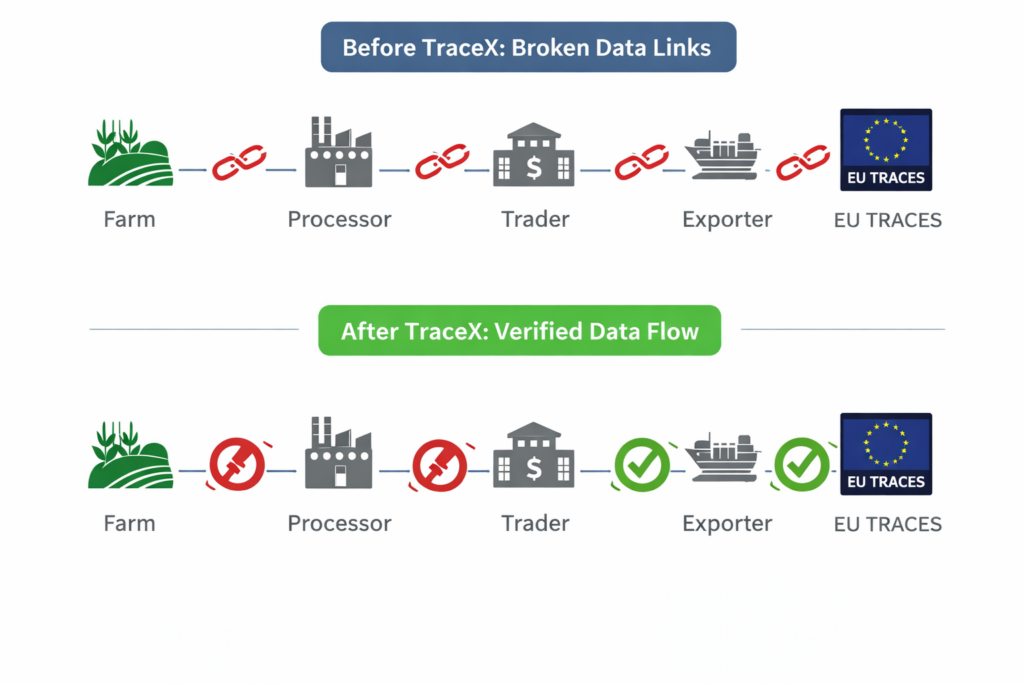
Based on patterns observed across EUDR-regulated supply chains, three systemic gaps generate the majority of DDS rejections and compliance failures:
Traditional ERP systems were built for transactions, inventory, and finance not environmental compliance at farm level. Under EUDR, three critical requirements fall completely outside standard ERP capabilities:
~60% Of DDS rejections stem from data gaps that trace back to ERP-traceability integration failures
When traceability platforms, ERP systems, audit tools, and regulatory reporting systems can’t communicate, compliance teams are forced into manual workarounds:
Each manual step introduces error. At scale hundreds of smallholder suppliers across multiple sourcing regions this becomes unsustainable under EUDR’s documentation requirements.
TRACES (Trade Control and Expert System) is the EU’s official platform for EUDR DDS submissions. Without a valid TRACES submission, products cannot legally enter the EU market. Yet most companies still treat TRACES as a manual upload destination not an integrated endpoint.
EUDR is not just regulation it’s a system you must navigate flawlessly. Download the Complete EUDR Compliance Guide.
These terms are often used interchangeably, but they serve distinct roles in an EUDR compliance architecture:
| Concept | What It Means | EUDR Application |
|---|---|---|
| Interoperability | Different systems and stakeholders can share and process data using shared standards | Producers, processors, traders, and EU-DDS all use compatible data formats for geolocation, DDS, and risk data |
| Integration | Systems operate as a unified whole – data flows automatically without manual intervention | Your ERP, traceability platform, satellite monitoring, and TRACES file all update from a single data source |
Both are required. Interoperability establishes the data standard. Integration automates the flow. Without both, compliance is manual, fragmented, and prone to failure.
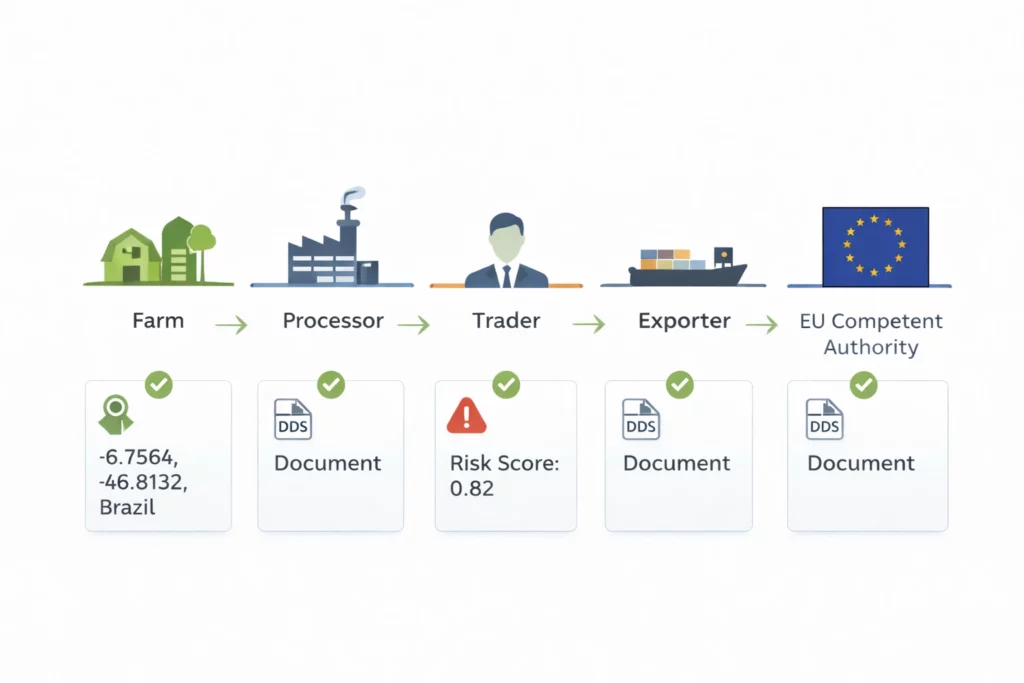
A fully integrated EUDR compliance stack moves data from the field to EU TRACES without manual intervention. Here’s how each layer connects:
Layer 1 – Field Data Capture: GPS polygon mapping, crop data, ownership docs collected via mobile app, validated offline
Layer 2 – ERP Sync: Supplier profiles, shipment data, and procurement records pulled via pre-built ERP connectors (SAP, Oracle, etc.)
Layer 3 – Risk Assessment: AI satellite deforestation checks (Hansen GFC + Sentinel-2), automated risk scoring, supplier KYC verification
Layer 4 – TRACES Filing: Auto-generated DDS in JSON/XML, EORI + HS code validation, direct API submission to EU TRACES
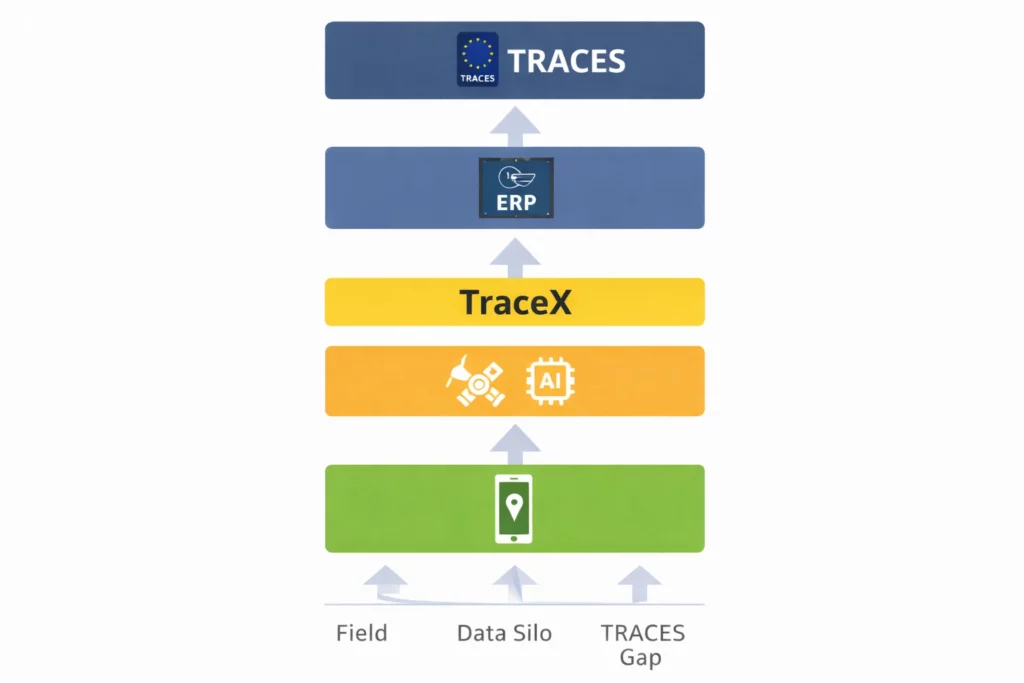
TraceX EUDR Solutions enables this complete stack with an API-first, ERP-agnostic architecture. Key integration capabilities include:
Interoperability and integration are not optional add-ons for EUDR they are the foundation of chain of custody management. The regulation requires businesses to demonstrate an unbroken data trail from plot of land to port of export. Any gap in this chain is a compliance failure.
5 Years Required data retention period under EUDR – all DDS, risk assessments, and supporting docs must remain accessible and auditable
For chain of custody to hold under EUDR audit conditions, three things must be true simultaneously:
| Factor | Disconnected Systems | TraceX Integrated Platform |
|---|---|---|
| DDS Generation | Manual, error-prone, days to compile | Automated in 1-click, validated JSON/XML |
| Geolocation Data | Siloed in field apps, not linked to ERP | GPS-verified plots synced to all systems |
| TRACES Filing | Manual upload, frequent rejections | Direct API to EU-DDS, near-zero rejections |
| Audit Readiness | Fragmented docs across teams | 5-year immutable blockchain-backed trail |
| Deforestation Risk | Not assessed or manually checked | AI satellite monitoring, real-time alerts |
| ERP Compatibility | Custom builds per system | Pre-built ERP connectors, API-agnostic |
Different supply chain actors face different EUDR integration challenges. Here’s how TraceX addresses each:
See how TraceX helps agribusinesses
If you’re unsure whether your current systems can meet EUDR’s integration requirements, start with these questions:
If the answer to any of these is ‘no’ or ‘we’re not sure’ that’s the gap EUDR compliance audits will find first.
Confused About DDS Filing Requirements? Follow a clear, structured guide to avoid submission errors.
Not Sure If You’re EUDR-Ready? Discover the key gaps that could delay your compliance.
Unsure What a Good DDS Looks Like? Review practical examples to guide your submission.
It means your ERP must be connected via API to a platform that can capture farm-level geolocation data, run deforestation risk checks, and generate TRACES-ready DDS output. ERPs cannot do this natively. TraceX provides pre-built connectors that bridge your ERP with full EUDR compliance capabilities without requiring a custom build.
Only if your platform supports EU TRACES API integration with DDS validation. Most legacy traceability tools generate reports, not TRACES-compatible submissions. TraceX’s API layer converts your existing supply chain data into validated DDS format and files directly to the EU Information System.
EUDR DDS must be submitted in JSON or XML format via the EU TRACES portal. They must include validated geolocation coordinates (GeoJSON polygon or point), EORI numbers, HS commodity codes, and legality documentation. TraceX auto-generates and validates all of these elements before submission.
You need an audit-ready system that provides instant access to all DDS submissions, risk assessments, supplier records, and geolocation data retained for 5 years. TraceX centralizes all compliance documentation with blockchain timestamping, making authority audits a dashboard view rather than a manual documentation scramble.
Rejected DDS submissions can block shipments at EU customs, causing significant trade disruption and financial loss. Common rejection causes include geometry validation errors, missing EORI numbers, and data mismatches between the DDS and supporting documentation. TraceX’s agentic AI pre-validates all submissions before filing, reducing rejection rates to near zero.