
Quick summary: Explore how Vietnam cocoa exporters can achieve EUDR compliance through digital traceability, geolocation mapping, and blockchain verification. Learn how platforms like TraceX simplify Due Diligence Statement (DDS) creation, ensure deforestation-free sourcing, and future-proof cocoa exports to the EU market.

EUDR Compliance for Cocoa Exporters in Vietnam requires full traceability of cocoa beans back to farm-level geolocation, proof of legal land use, and verification that no deforestation has occurred after December 2020. Vietnamese exporters must collect polygon GPS data, assess supplier risk, and submit an accurate Due Diligence Statement (DDS) before placing cocoa on the EU market. With fragmented smallholder networks and limited digital records, meeting EUDR standards demands robust traceability tools, satellite-supported monitoring, and structured supplier onboarding. Strengthening data systems now ensures seamless compliance, protects market access, and enhances Vietnam’s competitive positioning in the EU cocoa sector.
Vietnam is an emerging cocoa origin with growing relevance in the global chocolate supply chain. Cocoa cultivation is concentrated in the Central Highlands, Southeast, Mekong Delta, and South-Central Coast, regions such as Dak Lak, Dak Nong, Binh Phuoc, Dong Nai, and Ben Tre, where diversified agroforestry systems support high-quality, fine-flavor cocoa. Vietnam produces approximately 5,000-6,000 metric tonnes of cocoa annually, with production driven largely by smallholder farmers integrated into mixed cropping systems. The EU, United States, Japan, and specialty chocolate makers worldwide increasingly source Vietnamese cocoa for its fruity flavor profile and strong fermentation characteristics.
Vietnam exports raw cocoa beans (HS 1801), cocoa nibs and liquor and paste (HS 1803), cocoa butter (HS 1804), cocoa powder (HS 1805), and artisanal chocolate ingredients (HS 1806). While bean volumes remain modest, Vietnam’s rapidly expanding craft chocolate and processing sector is strengthening local value addition and attracting premium buyers.
Sustainability programs by cooperatives, exporters, and NGOs have advanced farmer training, agroforestry promotion, pest-management improvements, and certification schemes such as Fairtrade and Rainforest Alliance. As the EU Deforestation Regulation (EUDR) becomes a critical market requirement, Vietnam’s cocoa sector is investing heavily in GPS polygon mapping, farm-level traceability, supplier documentation, and legality verification to protect its growing EU market share. Digital traceability initiatives are being scaled across key cocoa regions to ensure compliance readiness.
With continued investment in technology, quality control, and climate-resilient agroforestry systems, Vietnam is well positioned to strengthen its role as a high-quality, sustainable, and EUDR-ready cocoa origin for global chocolate manufacturers.
Want to see how digital technology is reshaping sustainability compliance? Explore our latest blog on Digital Traceability for EUDR
Curious how cocoa exporters can stay ahead of new EU deforestation rules? Our in-depth blog on EUDR Cocoa Compliance explains the regulation’s full impact.
Vietnam’s cocoa industry, spread across the Central Highlands, Southeast, Mekong Delta, and South-Central Coast, faces significant operational, technical, and compliance challenges as the EU Deforestation Regulation becomes mandatory. With thousands of smallholders cultivating cocoa in mixed agroforestry systems and fragmented landscapes, meeting EUDR’s strict traceability, legality, and geolocation standards requires major transformation across the entire supply chain.
Vietnam must map thousands of smallholder cocoa farms across diverse agroforestry landscapes. Farms intercropped with coconut, cashew, pepper, and fruit trees complicate polygon mapping. Patchy farm records, inconsistent documentation, and informal land boundaries are common. Remote farming communities have limited digital connectivity. Exporters must deploy digital traceability systems, train farmers, and map plots accurately to meet EU requirements.
Cocoa must be proven not to originate from land deforested after 31 December 2020. Historical land-use data in Vietnam is inconsistent across provinces. Expansion of agroforestry into forest margins is difficult to verify. Overlapping land-use designations between agriculture and forestry zones create uncertainty. Exporters must invest in satellite monitoring and third-party risk assessments.
Vietnam’s land governance framework, based on Red Books, Green Books, and allocation certificates, still has gaps. Many cocoa farmers lack updated land-use rights certificates. Informal land arrangements exist within ethnic minority communities. Administrative delays in land registration and documentation are common. EUDR requires proof of legal land-use, demanding extensive verification efforts from exporters.
Vietnam’s cocoa sector is dominated by smallholders cultivating 1-3 hectare plots. Limited digital literacy exists in rural provinces like Dak Lak, Dak Nong, and Ben Tre. Low awareness of EUDR requirements, reluctance to share personal or land information, and varied record-keeping practices all create barriers. Exporters must invest heavily in farmer training and continuous field outreach.
EUDR compliance introduces significant costs for Vietnam’s cocoa exporters: polygon mapping and GPS data collection, satellite-based verification, digital traceability platforms and data servers, training for cooperatives and collectors, and legal and due-diligence auditing requirements. These costs are hard to absorb in a sector with fluctuating production volumes and smallholder-dependent value chains.
Vietnam’s cocoa supply is largely mixed at fermentation centers and collector networks. Segregating compliant from non-compliant cocoa, redesigning post-harvest hubs and aggregation points, and preventing contamination during transport, drying, and fermentation are all required. Traditional mass-balance certification systems are no longer sufficient under EUDR.
Vietnamese exporters must maintain extensive digital datasets and generate Due Diligence Statements (DDS) for every shipment. Harmonizing data from farmer groups, cooperatives, collectors, fermentaries, and exporters is challenging. Ensuring accuracy, completeness, and alignment across multiple actors, preparing for EU audits and data inspections, and managing personal data in compliance with GDPR all require a robust data governance system.
Farmers in areas near forest zones in Dak Lak, Gia Lai, or Dak Nong may be classified as high-risk. Exporters face tough decisions: excluding farmers to meet compliance timelines, which may cause livelihood impacts, or investing heavily in remediation, training, and land regularization. This creates social, economic, and supply-security risks.
Despite progress in digital agriculture, Vietnam faces fragmentation in provincial data systems, cooperative management models, exporter-level traceability efforts, and NGO-driven sustainability programs. Limited harmonization creates inconsistencies that complicate EUDR compliance.
EUDR imposes demanding new requirements across traceability, farm legality, risk monitoring, and data governance. For Vietnam’s cocoa exporters, meeting these obligations requires strong digital systems, national coordination, and significant investment in farmer-level capacity building.
The EU Deforestation Regulation requires Vietnam’s cocoa exporters to prove that every shipment entering the EU is deforestation-free, legally sourced, and fully traceable to its farm of origin. With cocoa grown by thousands of smallholders across Dak Lak, Dak Nong, Ben Tre, Binh Phuoc, Dong Nai, and other regions, manual systems cannot meet EUDR’s stringent documentation and geolocation requirements. The TraceX EUDR Compliance Platform provides an end-to-end digital infrastructure that automates due diligence, strengthens traceability, and ensures Vietnam’s uninterrupted access to EU markets.
TraceX platform links farmers, cooperatives, collectors, fermentaries, processors, and exporters into a unified digital ecosystem. Each cocoa batch receives a unique digital identity connected to GPS-mapped farm polygons and verified farmer records. This creates a fully auditable chain of custody that satisfies EUDR’s traceability mandates.
Using mobile tools, field officers can capture farm polygons, land-use documentation, fermentation and drying data, purchase and aggregation records, and processing and export information. The platform automatically compiles an EUDR-compliant Due Diligence Statement (DDS), cutting weeks of manual work down to hours.
Every transaction from harvesting to fermentation to export logistics is recorded on an immutable blockchain ledger, guaranteeing verified farm-level origin, tamper-proof documentation, and full transparency for EU buyers and regulators. This strengthens confidence in Vietnam’s sustainable cocoa exports.
TraceX platform simplifies mapping for thousands of smallholders through mobile-enabled GPS tools, providing accurate polygon mapping, digitization of land certificates or locally recognized tenure documents, and integration of certifications such as Rainforest Alliance and Fairtrade. This reduces the risk of sourcing from non-compliant areas.
TraceX solution integrates satellite imagery and AI analytics to monitor land-use change, forest encroachment, expansion of cocoa farms into protected areas, and emerging high-risk zones. Exporters receive real-time alerts to verify EUDR compliance before export.
The platform enables seamless integration among farmer cooperatives, provincial agriculture departments, exporters and processors, certification bodies, and EU importers and buyers. This harmonizes data, minimizes duplication, and reduces border-clearance delays.
With blockchain transparency, AI-driven risk scoring, satellite-backed monitoring, and automated DDS workflows, TraceX helps Vietnam’s cocoa exporters transform EUDR compliance into a market advantage. Exporters can demonstrate verifiable sustainability, strengthen EU partnerships, and position Vietnam as a credible, high-quality, deforestation-free cocoa origin.
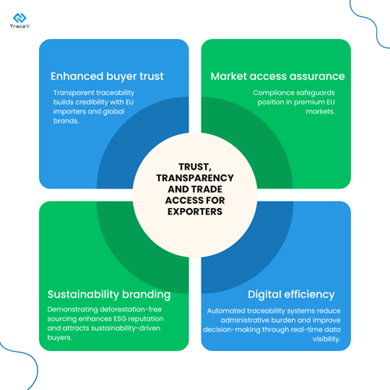
EUDR compliance is critical for Vietnam’s cocoa industry as the EU represents one of its most promising growth markets for premium, traceable, and sustainably sourced cocoa. While Vietnam’s cocoa production remains smaller than that of West Africa, its high-quality, fine-flavor beans, particularly from the Mekong Delta, Central Highlands, and Southeast regions, are increasingly sought after by European specialty chocolate makers. Failure to meet EUDR requirements risks market exclusion, shipment delays, higher inspection rates, and loss of competitiveness to fully compliant origins.
EUDR demands farm-level polygon mapping, proof of deforestation-free cultivation, and verified land-use legality, areas where Vietnam’s cocoa value chain still faces structural gaps, including smallholder fragmentation, inconsistent documentation, and varying sustainability practices across provinces. Compliance therefore becomes essential not only for maintaining access to EU buyers but also for attracting investment, improving farm productivity, and strengthening Vietnam’s reputation as a reliable source of ethically produced cocoa.
By aligning with EUDR, Vietnam can modernize its cocoa supply chain, enhance transparency, raise farmer incomes, and position itself strongly in the premium global chocolate market.
EUDR Compliance for Cocoa Exporters in Vietnam is not just a regulatory requirement it is a strategic pathway to elevate the country’s cocoa sector on the global stage. By investing in digital traceability, farm mapping, legality verification, and deforestation monitoring, Vietnam can strengthen exporter credibility, secure long-term EU market access, and enhance the value of its fine-flavor cocoa. With coordinated action from farmers, processors, cooperatives, and government agencies, Vietnam is well positioned to build a resilient, transparent, and sustainably managed cocoa supply chain that meets and exceeds EUDR expectations.
Understand the key components of EUDR compliance and how to streamline your DDS process efficiently. Read the blog on EUDR Due Diligence
Learn how AI-driven automation and intelligent workflows simplify data collection, verification, and reporting. Explore the blog on Agentic AI for EUDR
Discover how digital onboarding bridges the gap between smallholders and EUDR compliance. Read our blog: Smallholder Onboarding for EUDR Compliance
EUDR compliance requires Vietnam cocoa exporters to prove that all cocoa exported to the EU is deforestation-free, legally produced, and traceable to the exact farm or cooperative where it was grown. Exporters must provide geolocation data, legality documents, and evidence that cocoa farms were not linked to deforestation after 31 December 2020
The EU is one of Vietnam’s largest cocoa markets, absorbing more than 65% of its cocoa exports. Compliance ensures continued EU market access, strengthens Vietnam’s reputation as a sustainable cocoa origin, and aligns the sector with global demand for ethically sourced, environmentally responsible cocoa.
Exporters must:
Key challenges include:
Compliance enhances transparency, builds buyer confidence, improves sustainability credentials, and secures long-term access to premium EU markets. It also drives sector modernization, increases farmer inclusion, and positions Vietnam as a trusted supplier of deforestation-free, high-quality cocoa.