Quick summary: Discover 5 supply chain traceability challenges—data inconsistency, workflow silos, last-mile data gaps, offline failures, and partial adoption—and how to fix them before your next audit.
The five biggest supply chain traceability challenges are: (1) data inconsistency from fragmented systems, (2) workflow misalignment between field and back-office teams, (3) lack of user clarity at the last mile, (4) offline connectivity failures in remote sourcing regions, and (5) partial platform adoption that leaves entire supply chain tiers untracked. Each break ends-to-end visibility in a distinct, compounding way. End-to-end supply chain traceability fails for a predictable set of reasons, and most of them aren’t technical. They’re structural. The five challenges explored in this article, data inconsistency, workflow misalignment, lack of user clarity, offline connectivity, and partial adoption, account for the majority of traceability gaps that expose food and agri-businesses to compliance risk, recall vulnerability, and ESG reporting failure.
Gartner research indicates that many digital initiatives fail to reach production or intended outcomes, with only about 48% meeting or exceeding targets.
The cost isn’t just operational, it’s regulatory. With EUDR enforcement active for large operators and CSRD reporting obligations expanding in 2025-2026, a broken traceability system isn’t a back-office problem anymore. It’s a market access problem.
This article breaks down each challenge, precisely what causes it, how it compounds with the others, and what a credible fix looks like in practice.
Before diagnosing what breaks visibility, it’s worth being precise about what ‘end-to-end’ actually requires. True end-to-end supply chain visibility means that every transformation event, from farm plot to processing facility to retail shelf, is digitally recorded, timestamped, and tamper-proof in a single, unified system.
That means data captured at the farmgate (GPS coordinates, input usage, harvest volumes) must connect seamlessly to data captured at the factory (batch processing, certification documents) and at the logistics layer (shipment records, cold chain compliance). When any link in that chain is missing, unverifiable, or stored in a disconnected system, visibility collapses.
McKinsey research shows that deep supply-chain visibility remains weak: in one survey, only 2% of companies could identify third-tier supplier risks, and in a later survey, only 42% reported visibility into tier-two or beyond.
For agri-food businesses operating across dozens of smallholder geographies, that number is even lower.
Non-compliance can stop your supply chain. See how to prevent it
What does true end-to-end traceability look like? Discover the 5-layer framework
Data inconsistency is the most pervasive traceability failure. It happens when product information is captured in different formats, at different levels of granularity, across incompatible systems ERP databases, paper records, WhatsApp messages from field agents, and Excel spreadsheets maintained by procurement teams.
The result: when an auditor or regulator asks you to trace a batch of coffee back to a specific farm plot in Karnataka, your systems produce three different answers. That’s not a data quality problem. It’s a systems architecture problem.
Most traceability audits don’t fail because data is missing. They fail because the same data exists in multiple places with inconsistent values. The shipment weight in the ERP differs from the farmgate record by 12kg. That 12kg discrepancy can void an EUDR Due Diligence Statement entirely.
The fix requires a blockchain-backed single source of truth where every data point is written once, immutably, and can be read by every system that needs it. Solutions from TraceX enforce a unified data schema from farmer onboarding through to export documentation, eliminating reconciliation errors before they become audit failures.
Indian Products Private Limited (IPPL), part of the Jayanti Group, is a leading spice processor committed to delivering authentic, high-quality spices through sustainable and ethical sourcing practices.
To strengthen transparency and ensure compliance with sustainability goals, Jayanti Spices implemented TraceX’s Sustainable Sourcing Platform. This enabled them to achieve end-to-end traceability across their spice supply chain, monitor sourcing practices from farm to final product, support backward integration for better quality and control, and ensure alignment with environmental and ethical sourcing standards.
The result: enhanced supply chain transparency, stronger sustainability compliance, and greater trust in product authenticity.
Discover how end-to-end traceability can transform your sourcing and sustainability strategy
Even when data is clean, traceability breaks if the teams responsible for collecting and acting on it don’t operate from a shared workflow. Procurement captures supplier invoices in one system. Sustainability teams track certifications in another. Compliance teams manually assemble EUDR documentation from three different sources the week before a shipment.
This isn’t an edge case; it’s the default state of most agri-food businesses. And it creates a category of error that no amount of data cleaning can fix: workflow gaps, where critical information is simply never collected because no one’s system asked for it.
Workflow misalignment between procurement, sustainability, and compliance functions is the second most common driver of traceability failure in agri-food supply chains. Deloitte’s 2024 sustainable supply chain survey shows that sustainability data is often fragmented across business units, with many companies still relying on manual, cross-functional collection processes that can create traceability and audit gaps.
The solution isn’t more meetings between teams. It’s an integrated platform where procurement workflows, field data collection, and compliance documentation are built into a single system, so every transaction automatically generates the traceability data every function needs.
Seeing these challenges in your supply chain?
TraceX’s Sustainable Sourcing Platform connects field data, procurement workflows, and compliance documentation in one integrated system built for real agri-food supply chains.
Explore the platform
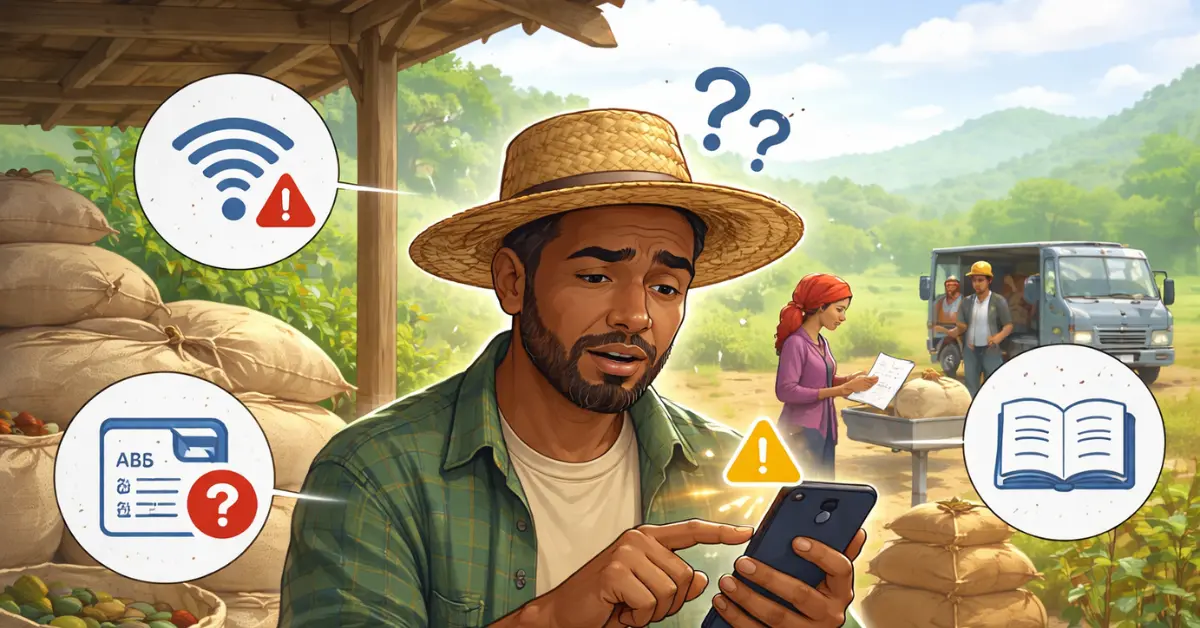
Supply chain traceability ultimately depends on someone at a farm, a collection point, or a cooperative entering accurate data into a mobile app or web form. If that interface is confusing, requires reliable internet, or assumes literacy in a language the user doesn’t speak fluently, the data doesn’t get entered. Or it gets entered wrong.
This is the last-mile problem. Most enterprise traceability platforms are designed for back-office procurement teams, not for field extension officers working with smallholder farmers in rural Tamil Nadu or rural Ethiopia. The UX mismatch is total, and it’s one of the most consistently underestimated drivers of traceability failure.
In a 2024 field study across coffee-sourcing geographies in South India, TraceX found that field agents using non-localized, connectivity-dependent data capture tools skipped an average of 34% of required data fields per farm visit compared to 6% field skip rates on offline-first, multilingual apps. That 28-percentage-point gap represents the difference between a traceable and untraceable supply chain.
The comparison table below shows how user clarity issues manifest across different supply chain roles:
| Role | Typical UI Barrier | Data Gap Created | Compliance Risk |
|---|---|---|---|
| Field Agent | English-only UI, complex forms | Missing farm plot GPS data | EUDR geolocation failure |
| Smallholder Farmer | No offline mode, low digital literacy | Missing harvest volumes, inputs | Food safety recall gap |
| Cooperative Manager | Desktop-only platform | Late or incomplete batch records | FSSC/BRC audit failure |
| Procurement Officer | Not integrated with ERP | Duplicate supplier records | Inventory reconciliation errors |
The fix: traceability platforms must be designed mobile-first, function offline, and support local languages. These aren’t nice-to-have features; they’re the difference between a system that gets used and one that doesn’t.
The majority of the world’s agricultural production happens in areas with poor or no mobile internet connectivity. Coffee is grown in the Western Ghats and the Ethiopian highlands. Palm oil is sourced from Indonesian and Malaysian smallholdings. Cocoa is harvested in West African regions where 4G coverage is intermittent at best.
When traceability platforms require an active internet connection to function, they simply don’t get used in the field. Field agents either skip data entry entirely or batch-enter records hours or days later from memory, introducing errors, approximations, and blank fields that break the chain of custody record.
In the Araku Valley of Andhra Pradesh, TechnoServe supports farmers across multiple mandals by providing agronomy training, post-harvest management, and market linkages to improve coffee productivity.
However, operations in remote regions were challenged by unreliable internet connectivity, making it difficult to capture farm-level data, track procurement, and maintain compliance.
By implementing an offline-enabled mapping and data sync solution, TechnoServe was able to ensure continuous farm data capture even in low-connectivity zones, maintain accurate, real-time visibility across farm and procurement activities, and strengthen compliance with evolving regulatory and traceability requirements.
The result: improved operational efficiency, better data reliability, and uninterrupted traceability from farm to market.
See how offline-first traceability can transform your field operations
Any traceability platform that doesn’t offer full offline functionality is structurally incapable of capturing farm-level data for nearly half the world’s smallholder-sourced commodities, creating systemic due diligence gaps under EUDR and FSSC compliance frameworks.
An offline-first architecture isn’t about working without the internet; it’s about designing so that the internet is optional. Data gets captured fully, locally, and syncs automatically when connectivity returns. TraceX’s mobile apps for field agents are built on this principle, with GPS capture, photo documentation, and form completion working entirely offline.
Traceability programs often stall before full deployment, and deeper supply-chain visibility remains limited, leaving many food-safety incidents linked to uncovered supplier tiers.
Partial adoption is the most insidious challenge because it’s invisible from the inside. A traceability platform deployed to processors and exporters looks fully functional, with dashboards showing data, reports generated, and auditors see records. But if the platform stops at tier-1 suppliers and doesn’t reach the farm level, the most critical data, GPS coordinates, chemical inputs, and harvest dates are simply absent.
This creates what practitioners call a ‘traceability facade’, a system that generates compliance documentation without actually verifying the underlying supply chain conditions. When a recall hits or a regulator conducts a field audit, the facade collapses.
The most common reason for partial adoption isn’t budget, it’s change management. Supply chain teams underestimate the training, language support, and process redesign required to bring tier-2 and tier-3 suppliers onto a digital platform. In TraceX deployments across India and Africa, onboarding time for smallholder farmer groups dropped by 60% when multilingual training materials and field agent-led onboarding workflows were introduced alongside the technology.
These five challenges don’t operate independently; they compound. Data inconsistency makes workflow misalignment worse. User clarity failures accelerate partial adoption. Offline connectivity gaps create the raw material for data inconsistency. Fixing them requires a systems approach, not point solutions.
The framework below maps each challenge to its operational fix and the platform capability required:
| Challenge | Real-World Frequency | TraceX Solution | Risk If Ignored |
|---|---|---|---|
| Data Inconsistency | High – siloed ERP, spreadsheets, paper | Blockchain-backed single source of truth | Manual reconciliation, audit failure |
| Workflow Misalignment | High – disconnected teams/systems | ERP/procurement API integrations | Data duplication, reporting errors |
| Lack of User Clarity | High – complex enterprise UIs | Mobile-first, multilingual UX | Low field adoption, missing data |
| Offline Connectivity | Critical in emerging markets | Offline-first mobile apps with sync | Data gaps, farm-level blind spots |
| Partial Adoption | Common – only 34% full deployment | Change management + training built-in | Traceability gaps, compliance failure |
The common thread across all five fixes is architecture. A traceability system that is blockchain-backed (for immutable data integrity), offline-first (for last-mile capture), API-integrated (for workflow alignment), and designed for non-expert users (for adoption) addresses all five failure modes simultaneously. This is precisely the design philosophy behind TraceX’s Sustainable Sourcing Platform, which is deployed across agri-food supply chains in India, Southeast Asia, and Africa.
The path to end-to-end visibility isn’t a single product decision, but it starts with one: choosing a platform architected for the reality of your supply chain, not just the ideal version of it.
End-to-end visibility doesn’t break overnight it erodes through small gaps in data accuracy, workflow alignment, and supplier traceability. As supply chains grow more complex and regulations tighten, these gaps become critical risks that impact compliance, operations, and trust. Companies that move beyond fragmented systems and invest in validated data, integrated workflows, and real-time traceability will be the ones that achieve true visibility. Because in today’s supply chains, visibility isn’t about having more data, it’s about having data you can trust, connect, and prove.
Still relying on spreadsheets? See how digital traceability systems change the game
Traceability starts at the farm. Learn how to manage it effectively
How do smallholder farmers fit into traceability? Find out
The five most common challenges are: data inconsistency across disconnected systems, workflow misalignment between procurement and field operations, lack of user clarity for last-mile field agents, offline connectivity gaps in remote sourcing regions, and partial platform adoption where only select tiers use the traceability system. Each one independently breaks end-to-end visibility.
Data inconsistency occurs when product information is captured in different formats across ERP systems, paper records, and spreadsheets. Without a unified data model, traceability platforms can’t reconcile records from farm to retail creating audit gaps, recall risks, and compliance failures.
Most smallholder farmers and field agents operate in areas with poor internet connectivity. Without offline-first mobile apps, data is either not captured or entered manually after the fact introducing errors, delays, and blind spots that break end-to-end traceability.
Partial adoption happens when only certain tiers of a supply chain, typically processors or exporters, use the traceability platform, while farm-level and logistics data remain offline or in separate systems. This creates visibility gaps that regulators and buyers can exploit during audits.
Full visibility requires four things working in concert: a single blockchain-backed data layer (not siloed databases), offline-first tools for field agents, ERP and procurement system integrations, and a phased change management program that brings every supply chain tier onto the platform.