Quick summary: Learn what the circular economy means for packaging businesses, including recyclability, reuse, and compliance, and how to prepare for sustainable packaging regulations.
The packaging industry is at an inflection point. What was once a voluntary sustainability initiative has become a strategic imperative driven by regulation, consumer demand, and a rapidly shifting investment landscape. The circular economy for packaging business, built on the principles of reduce, reuse, recycle, and regenerate, is reshaping every layer of how packaging businesses design, manufacture, distribute, and recover their products.
If your business hasn’t yet built a circular economy roadmap, you’re already behind. But the opportunity to gain competitive advantage is still wide open. This guide breaks down what circular economy goals actually mean in practice and how packaging businesses can turn compliance into growth.
According to market.us, the Global Circular Packaging Market is projected to reach USD 455.8 Billion by 2034, growing from USD 245.1 Billion in 2024, at a CAGR of 6.4% from 2025 to 2034. Paper & Cardboard dominated the By Material Analysis segment in 2024, holding a market share of 40.6%. The Food & Beverages sector led the By End Use Analysis segment in 2024, with a dominant share of 46.9%. Europe held the largest share of the global circular packaging market in 2024, with a market value of USD 81.8 Billion, representing 33.4% of the market.
Regulatory pressure has moved from aspirational to enforceable. Packaging businesses operating across any major global market are now subject to an accelerating wave of legislation that mandates specific circular economy outcomes. Here are the key regulations shaping the landscape:
| Regulation | Region | Key Requirement | Effective |
|---|---|---|---|
| EU Packaging & Packaging Waste Regulation (PPWR) | Europe | All packaging recyclable or reusable by 2030 | 2024–2030 |
| EU Circular Economy Action Plan (CEAP) | Europe | Reduce virgin plastic use; EPR schemes | Active |
| Extended Producer Responsibility (EPR) | US / Global | Brands pay for end-of-life packaging recovery | Multiple States |
| Single-Use Plastics Directive | Europe / Asia | Ban on select plastic products; labeling mandates | Active |
| Plastic Waste Management Rules | India | Ban on single-use plastics; recycled content mandates | 2022–2025 |
Europe continues to lead globally, holding 33% of the circular packaging market in 2024 and enforcing the world’s most rigorous standards. North America and Asia Pacific are catching up fast North America is set for strong CAGR growth, and countries like Thailand have implemented nationwide single-use plastic bans.
Explore the EU Circular Economy Action Plan
→ Understand the roadmap shaping sustainable packaging and compliance.
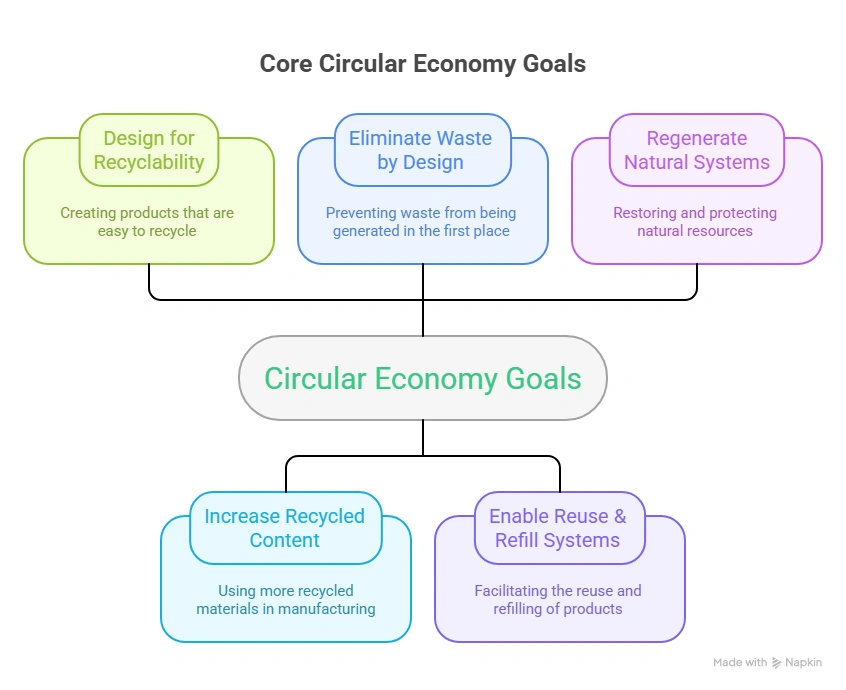
Understanding what circular economy goals mean in operational terms is the first step to building a credible strategy. Here’s what each principle demands from packaging businesses:
Packaging must be designed from the outset to enter a recycling stream. This means choosing mono-materials over multi-layer composites, eliminating inks and adhesives that contaminate recycling, and meeting standardized recyclability criteria set by bodies like the Ellen MacArthur Foundation and ISO.
Paper and cardboard currently dominate, holding 40% of circular packaging revenue in 2024 because the infrastructure and consumer behaviour already exist. Flexible plastics, by contrast, remain the sector’s biggest headache due to fragmented collection and sorting systems.
It’s not enough to make recyclable packaging. Brands must also buy back recycled materials and use post-consumer recycled (PCR) content in new packaging. Major brand owners have set targets Coca-Cola aims for 35–40% recycled content by 2035 (up from 28% in 2024), while Colgate-Palmolive reached 21% PCR content in 2024 and is targeting 25% in 2025.
| Colgate-Palmolive increased the recycled content in its plastic packaging from 18% in 2023 to 21% in 2024 a 3-point gain in a single year by investing in supplier partnerships and design changes. |
Right-sizing packaging, eliminating unnecessary layers, and removing non-functional elements (like window films on paperboard) are baseline expectations. The goal is to reduce the volume of packaging entering the waste stream in the first place before recyclability even becomes relevant.
The reusable packaging segment is the fastest-growing category in the circular market. While still a smaller portion of the total, refillable and loop-system packaging is gaining traction in beauty, food service, and e-commerce. Businesses that build reverse logistics infrastructure now will have a durable competitive moat as EPR costs rise.
Compostable packaging that returns nutrients to the soil rather than burdening landfills is the final frontier. Seaweed/algae-based packaging is one of the fastest-growing material innovations, driven by increasing awareness and alignment with circular principles. Industrial compostability certifications are increasingly required by retailers and municipalities.
Learn How Food Waste Recycling and Composting Work
→ Discover practical ways to reduce waste and improve sustainability.
Circular economy goals aren’t just policy targets they have direct operational and financial implications for every packaging business. Here’s how to map goals to your business functions:
| Business Function | Circular Economy Impact | Priority Action |
|---|---|---|
| Product Design & R&D | Must shift to mono-materials & recyclable inks | Audit all SKUs for recyclability by material |
| Procurement | Demand for PCR material will increase costs initially | Lock in recycled content supply agreements now |
| Manufacturing | Reduce process waste; optimize material efficiency | Implement waste tracking with circular KPIs |
| Sales & Marketing | ESG data is now a procurement requirement for B2B | Build a packaging sustainability data sheet per product |
| Logistics | EPR levies tied to packaging volume placed on market | Track packaging by weight and type per country |
| Finance | Carbon pricing and EPR fees are incoming cost lines | Model circular transition scenarios in 3-year plan |
As circular economy claims have proliferated, so has skepticism. According to 2024 data, 32% of Americans now doubt that curbside recycling works up from just 14% four years ago. The “recyclable” label on packaging has lost credibility with many consumers who know their local programs can’t actually process many materials.
A related phenomenon “greenhushing” has emerged where brands deliberately stop publicizing sustainability progress to avoid scrutiny. Neither approach builds the trust that converts buyers and retains corporate clients.
| The legal risk is real: In high-profile litigation, companies have attempted to defend vague sustainability claims as ‘classic puffery‘ a defense that regulators and consumers are increasingly unwilling to accept. |
The companies gaining market share in circular packaging aren’t waiting for regulation to force their hand. They’re treating circularity as a product differentiation strategy and locking in long-term contracts with sustainability-committed brand owners.
| Company | Circular Action | Result |
|---|---|---|
| Amcor plc | Doubled share of recycled content in plastic packaging | Recognized as market leader in circular packaging 2024 |
| Smurfit WestRock | Formed $32B fiber-based packaging giant via merger | Scaled circular paper systems globally across 40 countries |
| Asahi Breweries | Targeting 100% recycled/bio-based PET bottles by 2030 | Moved up 6 places in BNEF Circular Economy Ranking |
| Colgate-Palmolive | Increased PCR plastic content 18% → 21% in one year | On track to hit 25% target in 2025 |
| Mondi + Saga Nutrition | Mono-material recyclable pet food packaging | Replaced non-recyclable multi-material plastics |
The pattern is clear: companies making steady, measurable, year-over-year progress outperform those making big announcements followed by target revisions. PepsiCo, Unilever, and Coca-Cola all revised their circular targets to less ambitious levels and later deadlines in 2024–2025 taking a reputational hit in the process.
Understand PPWR Compliance Requirements
→ Learn what your business must do to meet EU packaging regulations.
Whether you’re just beginning your circular economy journey or accelerating an existing program, here’s a structured 90-day action framework to drive meaningful progress:
| ✓ | Conduct a full packaging audit categorize by material, recyclability, and recycled content percentage |
| ✓ | Map your current packaging against EPR regulations in all markets you sell into |
| ✓ | Benchmark your packaging portfolio against top competitors using publicly available sustainability reports |
| ✓ | Identify your top 3 highest-volume SKUs as the priority targets for circular redesign |
| ✓ | Set specific, time-bound circular targets (e.g., ‘80% recyclable packaging by 2027’) not vague commitments |
| ✓ | Open supplier conversations on PCR material availability, pricing, and minimum volumes |
| ✓ | Evaluate digital watermarking and material passport technologies for traceability |
| ✓ | Engage your legal team to model EPR cost exposure under current and proposed regulations |
| ✓ | Launch a pilot SKU redesign using mono-material or high-PCR content track cost delta carefully |
| ✓ | Submit your packaging data to at least one third-party certification body |
| ✓ | Build a one-page ‘Packaging Sustainability Fact Sheet’ for B2B sales conversations |
| ✓ | Set a quarterly circular economy review cadence with cross-functional leadership |
The Asia Pacific region is projected to grow at 9.8% CAGR the fastest globally driven by rapid urbanization, e-commerce expansion, and tightening EPR frameworks across India, Indonesia, Vietnam, and China. Bioplastics represent the fastest-growing material segment at 10.1% CAGR, while paper and cardboard remain the volume leader at 40% market share due to proven recyclability infrastructure.
E-commerce packaging a sector experiencing explosive growth is expected to be among the fastest-growing end-use segments through 2034, creating significant demand for right-sized, circular, and shelf-ready packaging solutions.
The message for packaging businesses is unambiguous: the window for proactive action is open now. Companies that invest in circular capabilities today will shape the standards that latecomers will be forced to meet. The circular economy isn’t coming it’s already here.
The circular economy is no longer a distant sustainability ideal it is a practical, regulatory, and competitive imperative for packaging businesses. Moving from linear “take-make-waste” models to circular systems requires rethinking design, materials, supply chains, and data management. Companies that embrace recyclability, reuse, and traceability will not only meet evolving regulations like PPWR but also unlock cost efficiencies, resource security, and stronger brand trust. The transition may be complex, but those who act early will be better positioned to lead in a future where sustainability and compliance go hand in hand.
It is a system where packaging is designed to be reused, recycled, or composted, minimizing waste and keeping materials in circulation.
It helps reduce environmental impact, ensures regulatory compliance, and improves resource efficiency and brand reputation.
PPWR enforces circular economy principles by requiring recyclability, recycled content, and waste reduction in packaging.
They must redesign packaging for recyclability, improve material tracking, reduce waste, and adopt data-driven compliance systems.
Begin by auditing packaging materials, engaging suppliers, improving traceability, and aligning with regulatory requirements.