
Quick summary: Explore how India’s rubber mat exporters can achieve EUDR compliance through digital traceability, geolocation mapping, and blockchain verification. Learn how digital platforms can simplify Due Diligence Statement (DDS) creation, ensure deforestation-free sourcing, and future-proof rubber exports to the EU market.

EUDR Compliance for Rubber Mat Exporters in India requires rigorous due diligence to ensure all rubber is sourced legally and deforestation-free. Exporters must map their supply chains, verify farm and plantation origins, and maintain traceable documentation for every batch. Compliance involves aligning procurement, processing, and export records with EU regulations, including environmental and social standards. Non-compliance risks shipment rejections, fines, and loss of market access. By adopting digital traceability systems, Indian rubber mat exporters can demonstrate full supply chain transparency, meet EU requirements, and strengthen credibility with global buyers while protecting long-term export opportunities.
India’s rubber mats export landscape (HS 4016.91 vulcanized rubber floor coverings/mats) thrives as a global leader with 36% market share, exporting $97 million in 2023 primarily to the United States ($34.4M), United Kingdom ($10.1M), and EU nations like Germany/Netherlands, driven by 83,000+ shipments from clusters in Kerala, Tamil Nadu, and Gujarat amid a domestic market growing at 5.4% CAGR to 2031. Key players like Esdee Enterprises and Great Eastern Impex leverage natural rubber dominance (78% from Kerala), targeting automotive, industrial, and home sectors with anti-slip/durable products, while EUDR compliance for HS 4001 inputs looms critical for EU flows post-Dec 2025, projecting $120-150M exports by 2025 amid $950M EU rubber mats demand.
India is a significant producer and exporter of rubber mats, primarily sourced from natural rubber plantations in Kerala, Tamil Nadu, and Karnataka. The country supplies both raw and processed rubber mats to markets in the EU, the US, and East Asia, driven by demand in construction, industrial, and commercial flooring sectors.
The rubber mat supply chain is highly fragmented, with 85–90% produced by smallholder farmers, creating traceability and compliance challenges. To meet EU Deforestation Regulation (EUDR) requirements, exporters must provide verifiable deforestation-free proof of origin, implement digital traceability systems, and maintain accurate farm-to-export records.
Key HS codes relevant to rubber mats under EUDR include:
• HS 4016 – Articles of vulcanized rubber (flooring mats, sheets, and tiles)
With the regulation effective from 29 June 2023 and due diligence required by 30 December 2025 (large/medium enterprises) and 30 June 2026 (small/micro enterprises), adopting blockchain-enabled traceability, automated origin verification, and AI-driven risk monitoring ensures compliance, strengthens buyer confidence, and positions Indian rubber mat exporters as leaders in sustainable, deforestation-free trade.
Master the step-by-step process of submitting Due Diligence Statements under the new EUDR rules.
Read the blog on filing DDS for EUDR compliance
Don’t wait until deadlines tighten learn how traceability, digital documentation, and risk intelligence can keep your exports compliant and competitive.
Read our latest blog on EUDR rubber regulations
India’s rubber mat industry, heavily reliant on smallholder rubber producers across Kerala, Tamil Nadu, Karnataka, and emerging Northeast plantations, faces several critical EUDR compliance challenges:
Map plantations accurately, generate EUDR-ready GeoJSON files, and validate deforestation-free sourcing in minutes. Start using our GeoJSON tool today to simplify EUDR compliance and protect your EU rubber mat exports.
TraceX EUDR Compliance Platform provides a digital-first, automated, and transparent platform tailored for India’s rubber mat exporters:
By integrating blockchain transparency, AI-assisted risk detection, and automated DDS workflows, TraceX transforms EUDR compliance for rubber mat exporters into a competitive advantage ensuring sustainable sourcing, protecting market access, and positioning India as a leader in deforestation-free rubber mat exports.
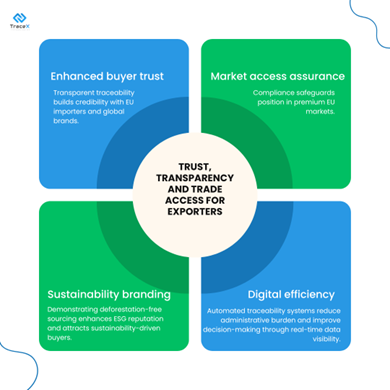
The EU Deforestation Regulation (EUDR) represents a pivotal shift for India’s rubber mat export ecosystem, transforming how producers, processors, and exporters demonstrate sustainability, legality, and transparency across supply chains. For India, a major supplier of rubber mats to Europe, EUDR compliance is not just a legal requirement but essential for continued access to high-value EU markets.
Proving Deforestation-Free and Legal Sourcing
Exporters must ensure all rubber mats are sourced from legally registered land and deforestation-free plantations. Each farm or supplier must be geo-referenced, with documentation proving compliance with Indian land-use, environmental, and agricultural regulations.
Farm-Level Traceability and Geo-Mapping
With supply chains dominated by smallholders, EUDR requires collecting farm-level geolocation and ownership data to link raw rubber to final mats. Digital traceability platforms help map plantations and monitor compliance efficiently.
Due Diligence Statement (DDS) Submission
Before export, companies must submit a DDS declaring proof of origin, legality, and deforestation-free sourcing. Inaccurate or missing DDS can lead to fines, shipment delays, or market exclusion.
Integrating Technology for Compliance Readiness
Tech solutions like TraceX provide blockchain verification, AI-driven deforestation risk assessments, and automated DDS generation, simplifying compliance and reducing audit risk.
Building Market Trust and Competitiveness
EUDR compliance positions Indian rubber mat exporters as responsible, traceable, and future-ready partners, enabling access to premium EU buyers and enhancing global brand credibility.
By adopting digital traceability, automated compliance workflows, and farm-level monitoring, India’s rubber mat sector can meet EUDR requirements while elevating its global reputation as ethical and deforestation-free.
Securing Market Access Through EUDR Compliance
For India’s rubber mat exporters, achieving EUDR compliance is no longer optional—it is critical for sustaining and expanding access to European markets. By implementing farm-level traceability, geo-mapping, and digital due diligence systems, exporters can prove deforestation-free sourcing, strengthen buyer trust, and reduce compliance risks. Leveraging technology-driven solutions transforms regulatory obligations into a strategic advantage, positioning Indian rubber mat producers as leaders in sustainable, transparent, and ethical trade while safeguarding long-term competitiveness in the global marketplace.
Understand the key components of EUDR compliance and how to streamline your DDS process efficiently.
Read the blog on EUDR Due Diligence
Learn how AI-driven automation and intelligent workflows simplify data collection, verification, and reporting.
Explore the blog on Agentic AI for EUDR
Discover how digital onboarding bridges the gap between smallholders and EUDR compliance.
Read our blog: Smallholder Onboarding for EUDR Compliance
EUDR compliance requires Indian rubber mat exporters to ensure that all mats are deforestation-free, legally sourced, and fully traceable to the plantation of origin before entering the EU market.
The EU is a key market for India’s rubber mats. Compliance guarantees continued access, strengthens buyer confidence, and positions exporters as leaders in sustainable and ethical trade.
Exporters must implement farm-level mapping, capture geolocation coordinates (GeoJSON), verify legality of plantations, and submit a Due Diligence Statement (DDS) via the EU portal for each shipment.
Challenges include fragmented smallholder networks, limited digital infrastructure, reliance on manual documentation, and the absence of standardized traceability frameworks across the supply chain.
Compliance enhances supply chain transparency, builds international buyer trust, strengthens ESG credentials, and opens access to premium European and global markets demanding sustainable, traceable rubber mats.