
Quick summary: Learn the difference between afforestation and reforestation, how each supports carbon projects, and which strategy aligns best with your climate, biodiversity, and carbon credit goals.

The confusion between afforestation and reforestation isn’t just semantic it has direct implications for your carbon credit eligibility, MRV methodology, and project ROI. Choosing the wrong strategy or tracking the right one incorrectly means delayed verification, rejected credits, and stalled ESG progress.
If you’re a sustainability manager, carbon project developer, or CSR lead you’re under pressure on multiple fronts:
This guide breaks down the core differences between afforestation and reforestation, what each means for your compliance requirements, and how TraceX DMRV gives you the real-time monitoring infrastructure to manage both at any scale.
Afforestation and reforestation are both nature-based climate strategies, but they serve different purposes in carbon projects.
The right strategy depends on:
For carbon project developers, understanding this distinction is critical for project design, monitoring, verification, and long-term climate impact.
Afforestation is the process of establishing forest cover on land that has been devoid of trees for at least 50 years or has never had forest cover at all. This includes barren land, degraded agricultural soil, arid wastelands, and areas suffering from desertification.
Afforestation is typically the right choice when:
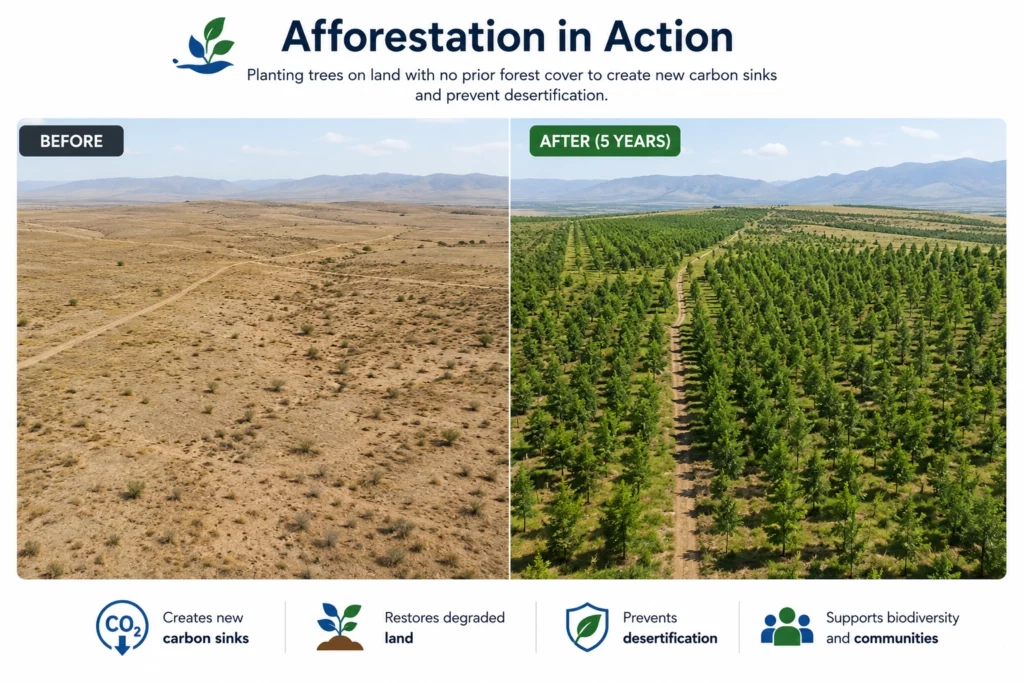
The challenge with afforestation? Every metric baseline carbon stock, tree survival rate, biomass accumulation has to be established from zero. That makes monitoring, reporting, and verification (MRV) complex and time-intensive without the right technology.
Nature-based solutions need more than sustainability claims they require measurable, verifiable impact data at scale. Explore how dMRV solutions are transforming monitoring, reporting, and verification for carbon, forestry, and regenerative supply chain programs.
Reforestation focuses on re-establishing trees in areas that previously had forest cover but lost it through deforestation, logging, wildfires, or agricultural expansion. The land retains an ecological memory existing soil composition, seed banks, and wildlife corridors which accelerates recovery timelines.
Reforestation is typically the right choice when:
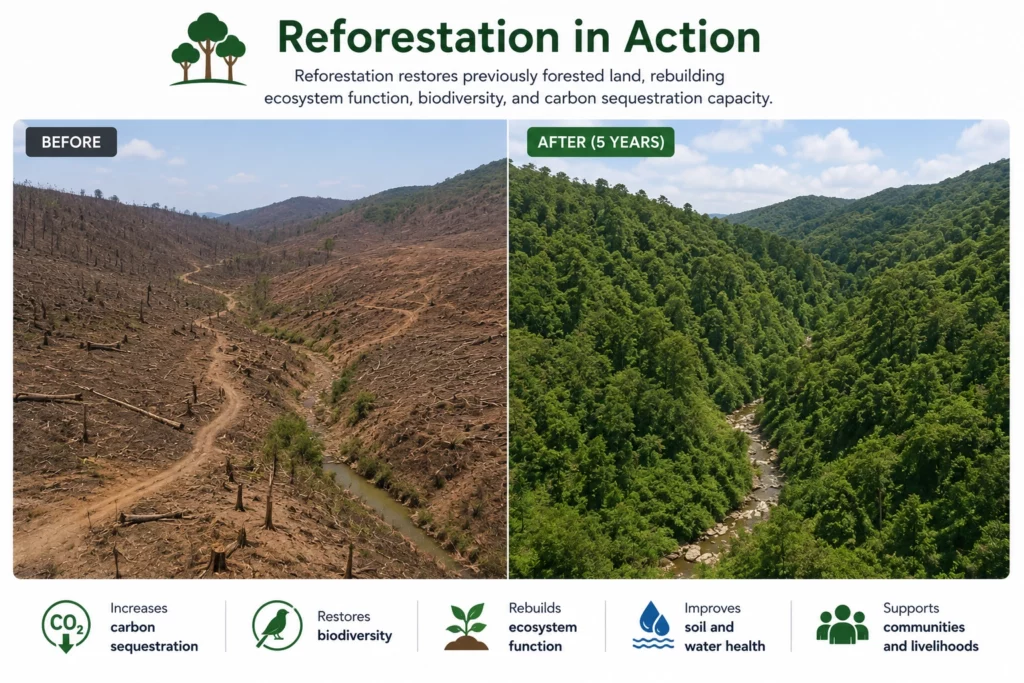
Reforestation is becoming a critical strategy for climate resilience, biodiversity restoration, and sustainable supply chains. Explore the key environmental, economic, and compliance benefits of reforestation and why businesses are investing in it now.
Use this table to determine which strategy aligns with your project goals, carbon standard requirements, and MRV obligations:
| Criteria | Afforestation | Reforestation |
|---|---|---|
| Definition | Planting trees where no forest existed (50+ years) | Restoring trees where forest was recently cleared |
| Land Type | Barren, degraded, arid, or non-forested land | Previously forested land (logged, burned, cleared) |
| Carbon Credit Type | Removal credits (new sinks created) | Removal credits (ecosystem restoration) |
| Biodiversity Impact | Builds new habitats for wildlife over time | Restores existing ecosystem biodiversity faster |
| Timeline to Impact | Longer building from scratch | Shorter leveraging existing soil/seed bank |
| MRV Complexity | High new baseline establishment required | Moderate historical data aids verification |
| Common Use Case | Corporate net-zero land restoration programs | Post-wildfire or deforestation recovery projects |
| TraceX DMRV Fit | Full lifecycle tracking from seed to carbon credit | Real-time monitoring, reporting, and verification |
Whether you’re running an afforestation program across 10,000 hectares or a post-wildfire reforestation effort with multiple field teams, the bottleneck is the same your MRV process is too manual, too slow, and too error-prone to generate the audit-ready data your carbon standard requires. Field teams are using spreadsheets. Satellite imagery isn’t being reconciled with ground data. Carbon credit verification gets delayed by 3-6 months. And when an auditor asks for your biomass accumulation data from Year 1, it’s scattered across five different documents.
TraceX’s Digital MRV (Monitoring, Reporting and Verification) platform integrates satellite imagery, IoT sensor data, and on-ground field inputs into a single, audit-ready dashboard purpose-built for afforestation, reforestation, and revegetation (ARR) projects.
Key capabilities:
Manual carbon project monitoring creates delays, data gaps, and verification challenges. Discover how TraceX dMRV solutions help carbon projects automate monitoring, improve data accuracy, and strengthen verification readiness at scale.
When a Sustainability Foundation integrated TraceX DMRV into their large-scale tree planting initiative, they reduced manual data reconciliation from weeks to days with precise environmental impact tracking and blockchain-backed transparency enabling faster partner reporting and improved donor trust. The result: operational efficiency gains across the board, and a data foundation that enables data-driven decision-making at project scale.
Depending on your organization type and project structure, TraceX DMRV serves distinct use cases:
If your company has committed to SBTi targets or a net-zero pledge that includes land-based carbon removals, you need a credible, auditable system to track every tree planted, every tonne of CO₂ sequestered, and every credit verified. TraceX connects your land restoration program to your ESG reporting dashboard in a single workflow. Explore how SBTi targets help organizations align emissions reduction strategies with global climate goals.
For foundations managing donor-funded reforestation projects, the stakes are high: every measurement must be defensible, every credit must be verifiable, and every partner report must be audit-ready. TraceX DMRV gives your team the infrastructure to operate at scale without scaling headcount.
If you’re developing afforestation or reforestation projects for carbon markets, you need your MRV methodology to align with Verra VCS, Gold Standard, or national compliance frameworks from day one. TraceX is purpose-built to generate the data structures these standards require reducing the documentation burden on your technical team. Simplify carbon project monitoring with automated, transparent, and audit-ready workflows. Explore the TraceX dMRV platform for real-time monitoring, reporting, and verification of nature-based and carbon projects.
For government agencies running afforestation initiatives across millions of hectares, accountability and transparency are non-negotiable. TraceX DMRV provides the centralized monitoring layer that enables cross-ministry oversight, real-time progress tracking, and compliance reporting for REDD+ and NDC commitments.
Afforestation, Reforestation, and Revegetation (ARR) projects are among the most established nature-based solutions in carbon markets. According to IPCC pathways targeting 2°C warming limits, approximately 40% of required carbon dioxide removal relies on ARR activities.
The opportunity for organizations:
The challenge: the quality of ARR credits varies significantly by project. Projects with robust digital MRV like those using TraceX consistently command premium prices and faster verification cycles compared to manually-managed alternatives. High-quality carbon credits depend on transparent, measurable, and verifiable project data. Explore how dMRV solutions are transforming carbon credit monitoring, reporting, and verification across nature-based and climate projects.
The distinction between afforestation and reforestation matters it affects your carbon credit methodology, your biodiversity claims, your regulatory obligations, and your timelines to impact. But what both strategies share is this: without a robust digital MRV system, your project cannot generate the verified, auditable data that funders, regulators, and carbon markets now require.
TraceX DMRV was purpose-built for organizations running afforestation, reforestation, and broader ARR programs at scale replacing manual processes with real-time satellite and ground-truth integration, blockchain-backed transparency, and credit pipeline management that auditors trust.
The question isn’t just which strategy is right for your land. It’s whether your MRV infrastructure can keep up with the ambition of your carbon commitments.
Yes. TraceX DMRV supports multi-project management across different land types, methodologies, and geographies from a single dashboard. Each project maintains its own baseline, methodology, and credit pipeline.
TraceX generates MRV data structured for Verra VCS (VM0047), Gold Standard, and national compliance frameworks. Our team works with your methodology consultant to ensure data outputs align with your chosen standard.
TraceX uses a combination of satellite imagery, historical land-use data, and field measurements to establish afforestation baselines from zero. All baseline data is stored immutably on the platform for audit access.
Most implementation teams are operational within 2-4 weeks. TraceX onboarding includes data migration from existing tracking systems, field app setup for ground teams, and satellite imagery calibration for your project site.
Traditional MRV relies on manual data collection, periodic field visits, and batch reporting typically generating 3-6 month reporting delays. Digital MRV (DMRV) integrates satellite imagery, IoT sensors, and mobile data collection into real-time reporting that is continuously auditable.
Yes. TraceX offers scalable deployment for projects of varying sizes. We work with foundations managing pilot programs of 500 hectares as well as national initiatives exceeding 20,000 hectares. Contact our team to discuss your project scale.