
Quick summary: Integrating agroforestry carbon credits into corporate offset strategies: learn benefits, MRV requirements, insetting vs offsetting, and how to build high-integrity carbon portfolios.

As climate change and biodiversity loss threaten both ecosystems and global economies, businesses are facing increasing pressure to take meaningful actions that go beyond mere pledges. However, many companies struggle to achieve their carbon neutrality goals due to the limitations of traditional carbon offset mechanisms. Agroforestry-based carbon credits can serve as a powerful tool to drive corporate carbon offset strategies, offering a credible, impactful way to meet emissions targets while supporting regenerative agriculture and sustainable livelihoods.
According to research reports, in 2023, the value of the carbon credit market related to agriculture, forestry, and land use was estimated at $6,283.0 million. It is projected to expand at a CAGR of 31.49%, reaching $97,100.4 million by 2033. This market is experiencing significant growth fueled by improvements in sustainable practices and innovative technologies.
The integration of trees into farming landscapes, Agroforestry, is a sustainable practice that offers both environmental and social benefits. By enhancing carbon sequestration, supporting biodiversity, and improving soil health, agroforestry provides a nature-based solution to climate change while fostering community resilience.
Key takeaways
Agroforestry carbon credits are verified units of carbon dioxide equivalent (tCO₂e) generated through agroforestry systems that integrate trees into agricultural landscapes, sequestering carbon in both tree biomass and soils. Each credit represents a measurable and independently verified amount of carbon removed from the atmosphere through long-term, land-based practices.
Agroforestry carbon credits differ fundamentally from industrial or technology-based offsets. While many industrial offsets focus on avoiding future emissions, such as improving energy efficiency or replacing fossil fuels, agroforestry credits are primarily based on carbon removal. Trees actively capture atmospheric carbon dioxide and store it over time, creating durable carbon sinks. In contrast to short-lived or indirect reductions, agroforestry delivers physical, biological sequestration that can be monitored and verified.
This distinction between carbon removal and carbon avoidance is increasingly important for corporate climate strategies. Carbon avoidance reduces emissions that would have occurred, while carbon removal actively draws down existing atmospheric carbon. Agroforestry credits are valued because they contribute to net atmospheric reductions, which are critical for achieving long-term net-zero goals.
Agroforestry carbon credits are classified as nature-based solutions (NbS) because they work with natural ecosystems to address climate change while delivering additional benefits. Beyond carbon sequestration, agroforestry improves soil health, supports biodiversity, enhances water regulation, and strengthens farmer livelihoods. These co-benefits, combined with verifiable carbon impact, make agroforestry carbon credits a high-integrity and increasingly preferred option in voluntary carbon markets.
Read our blog on Agroforestry Carbon Solutions to see how tree-based farming systems deliver verified carbon sequestration, climate finance readiness, and long-term sustainability outcomes.
Explore our guide on Agroforestry for Sustainable Agriculture and learn how integrating trees improves soil health, productivity, and farm resilience while meeting sustainability goals.
Corporate approaches to carbon offsetting are undergoing a major shift as scrutiny of carbon offsets intensifies. Regulators, investors, NGOs, and the media are increasingly questioning the credibility of low-cost, low-transparency credits. Claims that once passed with minimal evidence are now examined closely, especially as companies make public net-zero commitments and climate disclosures.
This scrutiny has heightened greenwashing risks. Buyers, consumers, and investors expect companies to substantiate climate claims with clear, verifiable data. Offsets that lack robust measurement, permanence, or transparency expose corporates to reputational damage and regulatory risk. As a result, sustainability teams are under pressure to ensure that every credit in their portfolio can withstand independent review and public accountability.
At the same time, there is a growing recognition that achieving net-zero requires more than short-term emission reductions. Corporates increasingly need high-integrity, long-term carbon removals that deliver durable climate impact. Removal-based credits such as those generated through agroforestry are gaining preference because they actively draw down atmospheric carbon and store it over extended periods, rather than simply avoiding future emissions.
This has driven a clear shift from cheap offsets to quality-driven portfolios. Instead of prioritizing volume or price, corporates are focusing on credit integrity, transparency, co-benefits, and alignment with long-term climate strategies. High-quality nature-based solutions are becoming a strategic component of corporate carbon portfolios, supporting credible climate action while reducing reputational and compliance risk.
| Feature | Agroforestry Credits | Reforestation (ARR) | REDD+ (Avoided Deforestation) | Industrial Offsets (Energy/Tech) |
| Mechanism | Carbon Removal: Active sequestration in biomass + soil. | Carbon Removal: Converting non-forest land to forest. | Avoidance: Protecting existing forest from being cut. | Avoidance/Reduction: Preventing future emissions. |
| Additionality | High: Directly incentivizes farmers to plant trees on food land. | Moderate/High: Dependent on land use history. | Controversial: Hard to prove a forest would have been cut. | Low: Many projects (wind/solar) are now “business as usual.” |
| Permanence | Moderate: Subject to farm management and fire risks. | High: Protected forest status (usually 40–100 years). | Variable: Dependent on local political stability. | High: Emissions were never released (irreversible). |
| Co-Benefits | Maximum: Food security, farmer income, soil health, biodiversity. | High: Ecosystem restoration and wildlife habitats. | Moderate: Biodiversity and indigenous rights. | Minimal: Usually limited to local job creation. |
| Audit Detail | Granular: Plot-level polygons and yield-balancing. | Macro: Satellite canopy cover monitoring. | Regional: Jurisdictional baseline monitoring. | Digital: Meter readings and energy output. |
| 2026 Price Tier | Premium ($35–$60/t): High demand for “High-Integrity” NbS. | Mid-High ($25–$45/t): Stable, trusted removal asset. | Discounted ($5–$15/t): Fatigue due to integrity controversies. | Commodity ($2–$8/t): Used for bulk, low-cost offsetting. |
Agroforestry offers corporates flexibility to pursue both carbon offsetting and carbon insetting, depending on their climate strategy, emissions profile, and supply chain exposure. While both approaches contribute to climate action, they serve different strategic objectives.
In a carbon offsetting approach, companies purchase agroforestry carbon credits generated by external projects to compensate for emissions they cannot yet eliminate. These credits become part of a broader carbon portfolio that may include multiple project types and geographies.
Agroforestry credits support portfolio diversification by adding high-integrity, removal-based credits alongside other offsets. This reduces reliance on a single project type and helps balance permanence, risk, and cost considerations. Because agroforestry projects are long-term and land-based, they also offer risk mitigation against volatility in carbon markets and growing scrutiny of low-quality credits.
For corporates without direct agricultural supply chains, offsetting through agroforestry provides a credible way to support climate action while delivering co-benefits such as livelihoods and biodiversity.
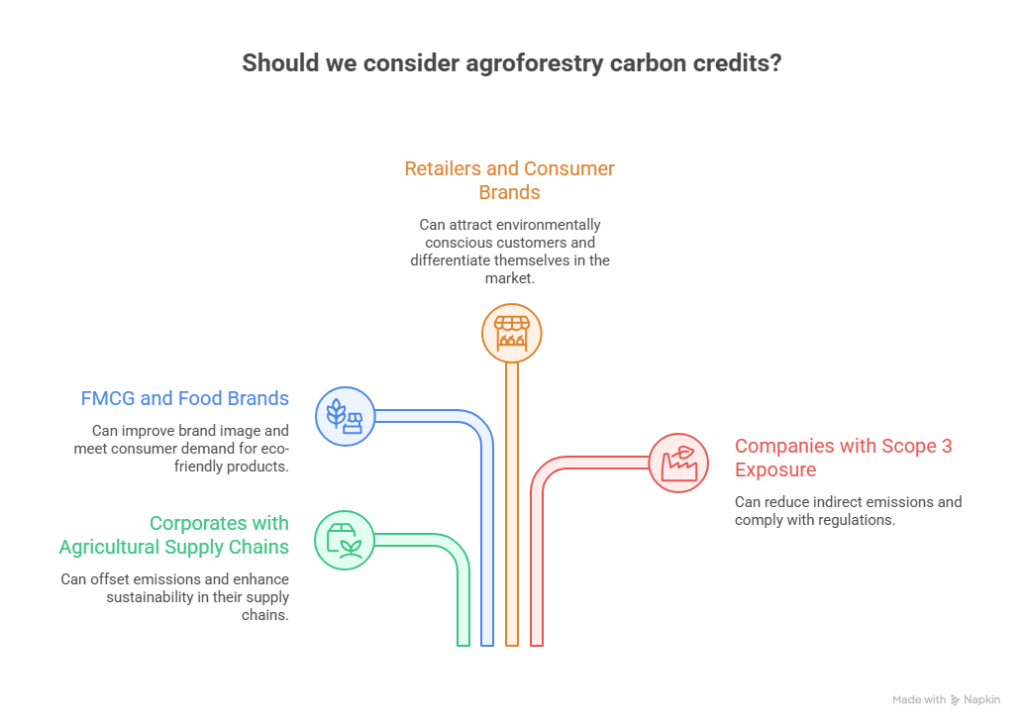
Carbon insetting embeds agroforestry directly within a company’s own supply chain, making it particularly relevant for food, agriculture, retail, and consumer goods companies. Instead of buying external credits, corporates invest in agroforestry practices among their suppliers or sourcing regions.
This approach helps reduce Scope 3 emissions, which often represent the largest share of a company’s carbon footprint. By improving land-use practices and increasing carbon sequestration at the source, insetting delivers climate impact where emissions occur.
Insetting also enables stronger sustainability narratives. Because actions are tied to a company’s own products and suppliers, agroforestry insetting demonstrates long-term commitment, supply chain resilience, and shared value creation, moving beyond compensation toward systemic change.
Agroforestry carbon credits are generated through a structured, multi-step process designed to ensure credibility, transparency, and environmental integrity. Each step is critical to building trust with buyers, auditors, and carbon registries.
Discover how structured monitoring and data-driven follow-up helped scale tree-planting initiatives with measurable climate outcomes.
For corporate buyers, Measurement, Reporting, and Verification (MRV) is the foundation of credible carbon claims.
At the core of both MRV and DMRV is traceability and transparency. Corporate buyers increasingly expect clear visibility into where carbon projects are located, how data is collected, and how carbon outcomes are calculated. High-traceability systems build confidence, support credible disclosures, and allow corporates to integrate carbon credits into long-term climate strategies with reduced risk.
TraceX DMRV Solutions enables corporates to invest in agroforestry carbon credits with the confidence, transparency, and scalability required for credible climate action. As expectations around carbon integrity rise, TraceX provides the digital infrastructure that connects on-ground agroforestry practices to verified, audit-ready carbon outcomes.
At the core is end-to-end digital MRV (DMRV), purpose-built for agroforestry projects. TraceX captures and integrates data across the full project lifecycle from farmer onboarding and plot mapping to tree growth monitoring and carbon accounting, ensuring that carbon removals are measured consistently and reported in line with approved methodologies.
Tree monitoring and geo-mapping capabilities provide spatially explicit evidence of project activity and performance. By validating plot boundaries, tracking tree survival and canopy growth, and linking field data with satellite observations, TraceX reduces uncertainty and strengthens permanence, and additionality claims key concerns for corporate buyers.
TraceX also delivers audit-ready carbon data. Structured datasets, standardized workflows, and transparent documentation make it easier for corporates to respond to audits, disclosures, and third-party reviews. This reduces verification friction and helps sustainability teams defend carbon claims with confidence.
Designed for scalable, multi-country implementation, TraceX supports corporate portfolios spanning multiple geographies and supply chains. Consistent data governance across regions allows companies to manage complexity while maintaining a single source of truth for agroforestry carbon credits, making TraceX a critical enabler of high-integrity, enterprise-grade carbon strategies.
Integrating agroforestry carbon credits into corporate carbon offset strategies enables companies to move beyond short-term compensation toward durable, high-integrity climate action. By prioritizing long-term carbon removals, verified MRV/DMRV, and strong social and environmental co-benefits, agroforestry credits help corporates reduce risk, strengthen ESG performance, and align offsets with net-zero roadmaps. When embedded through transparent monitoring and credible verification, agroforestry becomes a resilient pillar of quality-driven carbon portfolios.
Explore our blog on DMRV for Agroforestry to learn how satellite data, geo-mapping, and digital workflows enable scalable, audit-ready carbon verification.
Read our guide on Understanding the VCS Project Life Cycle to see how agroforestry and land-use projects move from design to verification and credit issuance.
Dive into our blog on Carbon Sequestration in Agroforestry to understand biomass, soil carbon pathways, and why agroforestry delivers long-term climate impact.
Yes. They provide long-term carbon removals with strong co-benefits and align well with quality-first net-zero strategies.
They integrate trees into productive farms, improving permanence through livelihood incentives while delivering verified carbon storage in biomass and soils.
Yes. Agroforestry is well-suited for insetting within agricultural supply chains, directly addressing Scope 3 emissions.
Robust MRV/DMRV with independent verification, transparent data, and registry issuance to ensure audit readiness and credibility.
They can be higher cost than low-quality offsets, but offer superior integrity, durability, and ESG value, reducing long-term risk.