
Quick summary: Agroforestry Solutions for Carbon: learn how tree-based farming systems deliver measurable carbon sequestration, digital MRV, and verified climate impact for carbon markets and net-zero goals.

Agroforestry is increasingly recognized as one of the most promising nature-based solutions for climate change, yet many agroforestry initiatives struggle to translate good farm practices into credible, verifiable carbon impact. Trees are planted, farmers participate, and landscapes improve but when it comes to proving how much carbon is actually sequestered, many projects fall short. Agroforestry Solutions for Carbon bridge this gap between practice and proof
Fragmented farm data, limited monitoring, and high verification costs often prevent agroforestry programs from accessing carbon markets or meeting corporate climate commitments. By combining tree-based farming systems with digital monitoring, geo-mapping, and robust measurement, reporting, and verification (MRV), these solutions enable agroforestry projects to move beyond intent and demonstrate real, auditable climate impact. As demand grows for high-integrity carbon outcomes, scalable agroforestry solutions are becoming essential not just for sustainability goals, but for credibility, funding, and long-term success.
Key Takeaways
Agroforestry Solutions for Carbon refer to tree-based agricultural systems that integrate trees, crops, and sometimes livestock in a single landscape to sequester carbon while sustaining farm productivity, supported by measurable and verifiable data. In agroforestry systems, trees are intentionally planted or retained alongside crops or grazing land, such as in alley cropping, silvopasture, or multistrata systems, allowing carbon to be captured in both above-ground biomass and soil organic matter without displacing food production.
Agroforestry integrates trees into agricultural landscapes to sequester carbon effectively, storing it in biomass, soil, and detritus while boosting farm resilience and yields. It offers 25-40% higher sequestration than monocrops, with US practices alone capturing 219 Tg C/yr across 37+ Mha.
Agroforestry is considered a high-impact nature-based solution (NbS) because it delivers multiple climate and development benefits at once: long-term carbon sequestration, improved soil health, biodiversity restoration, and increased farmer resilience. When combined with digital monitoring and verification, agroforestry solutions for carbon move beyond tree planting to provide credible, scalable, and auditable climate impact, making them well suited for carbon markets, corporate net-zero strategies, and landscape-level climate programs.
Explore our blog on Agroforestry for Sustainable Agriculture to see how tree-based systems improve productivity, soil health, and farmer livelihoods while supporting climate goals.
Read our deep dive on Agroforestry Carbon Credits to learn how carbon is measured, verified, and converted into high-integrity credits for voluntary carbon markets and net-zero strategies.
Agriculture is both a victim of climate change and a significant contributor to it. Globally, agriculture, forestry, and land use account for a substantial share of greenhouse gas emissions, driven by deforestation, soil degradation, monocropping, and land-use change. Conventional agricultural systems often prioritize short-term yields at the expense of soil carbon, biodiversity, and long-term resilience, leaving farms increasingly vulnerable to climate shocks such as droughts, floods, and temperature extremes.
Traditional climate responses in land use have focused heavily on monoculture farming or reforestation-only models, both of which have limitations. Monocultures tend to degrade soil organic carbon, reduce biodiversity, and increase dependency on external inputs, ultimately weakening climate resilience. Reforestation-only approaches, while valuable, often remove land from productive use, face land tenure challenges, and can struggle with long-term survival if not integrated into local livelihoods. These models can create trade-offs between climate action and food security.
Agroforestry addresses these gaps by integrating trees directly into agricultural landscapes, allowing climate mitigation and food production to coexist. From a carbon perspective, agroforestry systems sequester carbon in multiple pools tree biomass, roots, litter, and soil organic matter resulting in higher and more stable carbon storage than annual cropping systems alone. Unlike short-lived interventions, well-managed agroforestry systems provide long-term, durable carbon sequestration.
Beyond carbon, agroforestry strengthens climate resilience at the farm and landscape level. Trees improve soil structure and water retention, reduce erosion, moderate microclimates, and buffer crops against extreme weather. This resilience is increasingly critical as climate variability intensifies.
Equally important, agroforestry supports farmer livelihoods. By diversifying income through timber, fruit, fodder, or non-timber forest products, agroforestry reduces economic risk and improves adoption rates. This alignment of climate benefits with livelihood outcomes is why agroforestry is increasingly recognized as one of the most effective and scalable nature-based solutions for climate change mitigation.
Agroforestry is widely recognized as a climate-smart farming system because it integrates trees into agricultural landscapes in ways that enhance productivity, sustainability, and climate resilience simultaneously. At its core, agroforestry is the deliberate combination of trees with crops and/or livestock on the same land, designed to optimize ecological and economic interactions rather than compete for resources.
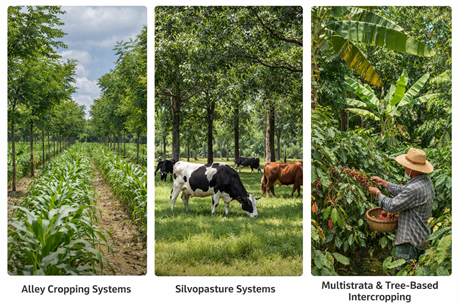
Several agroforestry systems are commonly practiced across regions. Alley cropping involves planting rows of trees alongside annual or perennial crops, improving soil fertility and capturing carbon while maintaining crop yields. Silvopasture systems integrate trees with grazing livestock, providing shade, improving pasture quality, and increasing carbon storage in both biomass and soils. Multistrata or tree-based intercropping systems, often found in tropical regions, layer trees, shrubs, and crops to mimic natural forests, resulting in high biodiversity and strong carbon sequestration potential.
| System | Rate (Mg C/ha/yr) | Notes |
| Alley Cropping | Varies | Part of US 219 Tg/yr |
| Silvopasture | 12-228 total | 34 Mha US |
| Riparian Buffers | High soil C | 640k ha US |
Beyond system design, agroforestry delivers climate and livelihood co-benefits that traditional farming systems struggle to achieve. Trees enhance soil organic matter, reduce erosion, improve water infiltration, and create microclimates that protect crops from heat and wind stress. At the same time, farmers benefit from diversified income streams such as timber, fruit, fodder, or fuelwood which reduce dependence on a single crop and increase economic resilience. This alignment of environmental and economic incentives is a key reason agroforestry achieves higher adoption rates than purely conservation-focused interventions.
Agroforestry also plays a growing role in global climate goals. Many countries now include agroforestry in their Nationally Determined Contributions (NDCs) under the Paris Agreement as a strategy for reducing emissions and enhancing carbon sinks. For corporations pursuing net-zero and Scope 3 emissions reductions, agroforestry offers a credible pathway to address agricultural emissions while supporting smallholder farmers. By combining sustainable agriculture with measurable climate impact, agroforestry stands out as a practical, scalable solution at the intersection of food security, livelihoods, and climate action.
Carbon sequestration in agroforestry systems occurs through multiple, reinforcing pathways, making these systems more effective and resilient than conventional monoculture farming. By combining trees with crops and sometimes livestock, agroforestry captures and stores carbon both above and below ground, while maintaining productive agricultural landscapes.
Aboveground biomass carbon is the most visible form of sequestration in agroforestry. Trees accumulate carbon as they grow, storing it in trunks, branches, leaves, and woody biomass over many years. Unlike annual crops, which are harvested and replanted each season, trees provide long-term carbon storage, with biomass increasing steadily as trees mature. In multistrata and tree-dense systems, this aboveground carbon stock can approach levels found in natural forests.
Equally important is belowground and soil organic carbon. Tree root systems extend deeper and wider than annual crops, transferring carbon into the soil through root growth, turnover, and organic matter inputs such as leaf litter. These processes enhance soil structure, microbial activity, and organic carbon content, often resulting in more stable and durable carbon storage than surface biomass alone. Agroforestry systems are particularly effective at rebuilding degraded soils that have lost carbon under monocropping.
A key advantage of agroforestry is long-term carbon permanence. Because trees remain in place for decades and are integrated into farming livelihoods, the risk of sudden carbon loss is lower than in short-term interventions. Diversified income from agroforestry products such as fruit, timber, fodder, or shade-grown crops encourages farmers to maintain tree cover, strengthening permanence and reducing reversal risk.
When compared to monoculture farming, agroforestry consistently delivers superior carbon outcomes. Monocultures rely on annual crops with limited biomass and shallow root systems, resulting in minimal carbon storage and frequent soil disturbance that releases stored carbon back into the atmosphere. Agroforestry systems, by contrast, reduce tillage, protect soil, and create layered vegetation that continuously captures and retains carbon. This combination of biological efficiency and socio-economic viability is why agroforestry is increasingly recognized as one of the most robust land-based solutions for long-term climate mitigation.
Agroforestry carbon credits are verified units of greenhouse gas removals generated from agroforestry systems that sequester carbon through the integration of trees into agricultural landscapes. Each credit typically represents one metric ton of carbon dioxide equivalent (tCO₂e) that has been removed from the atmosphere and stored in tree biomass or soil. Unlike credits from industrial or energy projects, agroforestry carbon credits are rooted in nature-based, land-use practices that deliver both climate and development benefits.
Carbon credits are generated from agroforestry systems through a structured process. First, a baseline is established to estimate what carbon stocks would have been without the agroforestry intervention. As trees are planted or retained and managed over time, increases in aboveground biomass and soil organic carbon are measured or modelled. These net removals after accounting for risks such as leakage and non-permanence are quantified, monitored, and verified according to approved methodologies. Once verified, the carbon reductions or removals are issued as tradable credits.
Agroforestry carbon credits primarily operate within voluntary carbon markets (VCMs), where companies and institutions purchase credits to meet climate commitments beyond regulatory requirements. These markets increasingly favour high-integrity, nature-based solutions that demonstrate clear additionality, long-term permanence, and strong social co-benefits. Agroforestry projects are particularly attractive in this context because they combine measurable carbon sequestration with improved farmer livelihoods, biodiversity gains, and climate resilience.
Agroforestry also plays a distinct role in insetting versus offsetting strategies. Offsetting involves purchasing carbon credits from external projects to compensate for emissions elsewhere, while insetting embeds carbon sequestration directly within a company’s own supply chain. Agroforestry is well suited for insetting, especially in agricultural and food supply chains, as it allows companies to reduce Scope 3 emissions by supporting tree-based practices among their suppliers. This dual applicability both as offsets and insets makes agroforestry carbon credits a flexible and increasingly strategic tool in corporate climate action.
Measurement, Reporting, and Verification (MRV) is widely recognized as the biggest bottleneck in scaling agroforestry solutions for carbon. While agroforestry systems can deliver significant climate benefits in theory, proving those benefits in a way that meets carbon market and buyer expectations is far more complex in practice.
A primary challenge lies in the complexity of smallholder and dispersed plots. Agroforestry projects often involve thousands of small farms, each with different tree species, planting densities, management practices, and growth rates. Carbon sequestration varies significantly across plots, making standardized measurement difficult. Without precise farm- or plot-level data, aggregating carbon outcomes across a landscape becomes unreliable and prone to error.
Traditional MRV approaches also face serious cost and scalability constraints. Field-based measurements, manual surveys, and periodic audits are expensive, time-consuming, and logistically challenging especially in remote rural areas. As project size grows, MRV costs can quickly exceed the value of the carbon credits generated, undermining project viability. These limitations make it difficult for agroforestry initiatives to move beyond pilot phases into large-scale, long-term programs.
Another critical risk is the rise of unverifiable or weakly substantiated carbon claims. Without robust MRV, projects may rely on assumptions, generic models, or outdated data that fail to reflect real on-ground conditions. This exposes buyers and project developers to reputational risk and accusations of greenwashing, particularly as scrutiny of nature-based carbon credits intensifies.
As a result, many agroforestry projects fail at the verification stage. Incomplete data, inconsistent monitoring, unclear baselines, or insufficient documentation can lead to rejected credit issuances or reduced credit volumes. These failures not only delay revenue but also erode trust among farmers, investors, and carbon buyers. Overcoming the MRV challenge is therefore essential for transforming agroforestry from a promising concept into a credible, scalable solution for climate impact.
Digital Measurement, Reporting, and Verification (dMRV) refers to the use of digital technologies to accurately quantify, monitor, and verify carbon sequestration outcomes in agroforestry systems at scale. In the context of Agroforestry Solutions for Carbon, dMRV replaces or augments traditional, manual MRV approaches with data-driven, automated workflows that are better suited to complex, smallholder-based landscapes.
At its core, dMRV enables agroforestry projects to move from estimates and assumptions to continuous, evidence-based carbon accounting a critical requirement as carbon markets and buyers demand higher integrity and transparency.
Traditional MRV methods struggle to capture the variability inherent in agroforestry systems, where tree species, planting densities, and management practices differ from plot to plot. DMRV improves accuracy by combining multiple data sources and validating them against one another, reducing reliance on generalized models.
From a scalability perspective, DMRV allows projects to monitor thousands or even millions of trees across dispersed farms without proportionally increasing costs. Automated data collection and processing make it possible to update carbon estimates more frequently, respond quickly to verification requests, and support long-term project monitoring without repeated, costly field campaigns.
Satellite imagery is a foundational component of DMRV for agroforestry. High-resolution and time-series satellite data enable:
By observing changes over time, satellite data provides independent evidence of tree survival and growth, strengthening confidence in reported carbon outcomes.
Geographic Information Systems (GIS) and geo-mapping translate agroforestry activities into spatially explicit data. Plot-level maps define where trees are planted, link carbon estimates to specific locations, and ensure consistency between farm records and satellite observations. Geo-mapping is especially important for verifying additionality and preventing double counting across projects or landscapes.
Read the case study to learn how precise plot boundary checks reduce double counting, improve audit readiness, and increase verifier confidence.
While remote sensing is powerful, field data and farmer records remain essential. Tree counts, species information, planting dates, and management practices collected at the farm level provide the ground truth needed to interpret satellite signals correctly. When digitized, farmer records create a continuous data trail that connects on-the-ground practices to carbon accounting outputs.
For agroforestry projects to issue carbon credits, DMRV systems must align with the requirements of carbon standards and registries such as Verra, Gold Standard, or Plan Vivo. This includes supporting approved methodologies, transparent data documentation, and audit-ready reporting formats. Well-designed DMRV frameworks ensure that data collected in the field can flow seamlessly into verification and credit issuance processes.
In summary, DMRV is the enabling infrastructure that allows agroforestry solutions for carbon to scale with credibility. By integrating satellite data, spatial mapping, and farm-level records into a single digital workflow, DMRV transforms agroforestry from a promising climate practice into a verifiable, investable, and market-ready climate solution.
Tree monitoring and geo-mapping form the evidence layer of credible agroforestry carbon projects. Because carbon sequestration depends on tree survival and growth over time, projects must demonstrate not just planting activity, but ongoing performance at the plot level.
Tree survival, growth, and canopy monitoring are essential to confirm that trees remain alive and continue to sequester carbon. Monitoring tracks indicators such as survival rates, canopy expansion, and biomass accumulation, helping projects identify underperforming areas early and take corrective action. This continuous visibility reduces permanence risk and strengthens confidence for auditors and buyers.
Plot-level geo-mapping and boundary validation ensure that every tree and farm is spatially verified. Accurate mapping prevents overlap between projects, supports additionality claims, and aligns field data with satellite imagery. Geo-mapping also enables precise attribution of carbon outcomes to specific locations, which is increasingly required by registries and verification bodies.
Over time, projects must track biomass growth, converting tree and canopy data into carbon estimates using approved models. When this temporal data is consistently captured, it creates a transparent growth trajectory rather than a one-time snapshot. By linking tree data directly to carbon accounting, agroforestry projects can demonstrate how physical tree growth translates into measurable, verifiable climate impact.
Many agroforestry projects fail not because of weak carbon potential, but due to data gaps at the first mile. Digital nursery and farm-level data play a critical role in maintaining carbon integrity from the outset.
Nursery traceability ensures visibility into where planting material originates, which species are distributed, and when saplings are planted. This information is foundational for survival modelling and long-term carbon estimates. Without nursery-level data, projects often rely on assumptions that weaken verification outcomes.
See how digital nursery traceability strengthens agroforestry projects
Read the case study to learn how digitizing nursery operations improved planting quality, survival rates, and downstream carbon verification.
Species selection and survival rates directly influence carbon sequestration potential. Different species grow at different rates, store carbon differently, and respond uniquely to climate stress. Digitally tracking species-level data allows projects to refine carbon models and improve long-term performance.
At the farm level, farmer profiling and plot digitization create accountability and continuity. Digitized records link farmers to specific plots, trees, and management practices, ensuring traceability across project years even as participants or field staff change. This structure prevents data loss and supports consistent monitoring.
By addressing these first-mile data needs, projects can prevent downstream inconsistencies, reduce audit friction, and build a defensible data foundation for carbon claims.
Turning agroforestry practices into verified climate impact requires transforming raw field data into standardized, auditable outputs. This process begins with carbon baselines, which define what carbon stocks would look like without the project intervention. Accurate baselines rely on geo-mapped plots, historical land-use data, and validated assumptions.
As trees grow and soils improve, monitored data feeds into calculations of verified emission removals. These removals are adjusted for risk factors such as non-permanence, leakage, and uncertainty, ensuring conservative and credible results.
The final step is converting verified outcomes into registry-ready reports. Carbon standards and registries require structured documentation, traceable data sources, and clear methodologies. Manual processes struggle to meet these requirements at scale.
Here, automation and standardized workflows are critical. Digital systems integrate satellite data, field records, and carbon models into a single pipeline, reducing errors and accelerating verification cycles. This automation enables projects to move from data collection to credit issuance efficiently and consistently.
TraceX DMRV Solution enables agroforestry projects to operationalize Agroforestry Solutions for Carbon through an end-to-end digital infrastructure designed for scale and verification.
TraceX supports end-to-end DMRV for agroforestry, integrating satellite monitoring, GIS-based geo-mapping, and farm-level data capture into a unified system. Tree monitoring tools track survival, growth, and canopy change, while spatial validation ensures plots remain consistent over time.
The platform also provides carbon accounting and reporting support, translating biological data into registry-aligned carbon metrics. Standardized outputs simplify audits and verification, reducing time and cost to issuance.
Designed for multi-country and large-scale agroforestry programs, TraceX enables consistent data governance across regions, making it easier for project developers and buyers to manage complexity while maintaining credibility.
The future of agroforestry in carbon markets is closely tied to a growing demand for high-integrity, nature-based carbon credits. As scrutiny of carbon markets increases, buyers are moving away from low-quality or opaque offsets toward solutions that deliver measurable climate impact alongside social and environmental co-benefits. Agroforestry is well positioned in this shift because it combines long-term carbon sequestration with biodiversity enhancement, soil restoration, and farmer livelihoods attributes increasingly valued by corporates, investors, and regulators.
At the same time, carbon markets are undergoing a transition toward digitally verifiable carbon. Buyers and standards bodies now expect continuous monitoring, transparent data, and audit-ready evidence rather than periodic, assumption-based reporting. Digital MRV (dMRV), satellite monitoring, and geo-mapped farm data are becoming baseline requirements for market credibility. Agroforestry projects that adopt digital verification early will be better equipped to meet evolving standards, reduce verification costs, and maintain buyer confidence over long crediting periods.
Read our blog on Tree Monitoring in Agroforestry to learn how survival tracking, canopy monitoring, and geo-mapping strengthen verification and long-term climate impact.
Explore our guide on Digital Nursery Management for Agroforestry and see how traceable planting material, species tracking, and data-driven planning improve survival rates and carbon outcomes.
Discover the Key Benefits of Agroforestry—from carbon sequestration and climate resilience to farmer livelihoods and biodiversity restoration.
Agroforestry solutions for carbon integrate trees into agricultural systems to sequester carbon in biomass and soils, supported by measurable and verifiable monitoring frameworks that enable climate impact reporting and carbon credit generation.
Carbon sequestration varies by system, species, and climate, but agroforestry can typically sequester significantly more carbon than monoculture farming by storing carbon both above ground in trees and below ground in soils over long periods.
Yes, when supported by robust measurement, reporting, and verification (MRV). High-integrity agroforestry credits are verified using approved methodologies, transparent data, and independent audits to ensure additionality and permanence.
Carbon is measured using a combination of tree biomass models, soil carbon assessments, satellite imagery, geo-mapping, and field data to quantify net carbon removals over time.
Agroforestry MRV uses digital tools such as satellite monitoring, GIS-based plot mapping, mobile data collection, and automated carbon accounting platforms to enable scalable, audit-ready verification.