
Quick summary: A complete guide to Illegal Logging Prohibition Act (ILPA) compliance for timber importers. Understand due diligence requirements, risk assessment, and legal sourcing obligations.

Australia’s Illegal Logging Prohibition Act (ILPA) Compliance requires every timber importer to complete documented due diligence covering information collection, risk assessment, and risk mitigation before any regulated shipment enters the country. As of March 3, 2025, the rules changed significantly. A new two-pathway risk assessment system replaced three previous methods, a repeat due diligence exception was introduced, and timber testing technology powers were granted to enforcement authorities.
Non-compliance is not a paperwork issue. It is a criminal offense carrying financial penalties and potential import bans. If your business imports timber, wood products, pulp, or paper into Australia, this guide walks you through every step you must take and how digital traceability solutions from TraceX can transform this from a compliance burden into a competitive advantage.
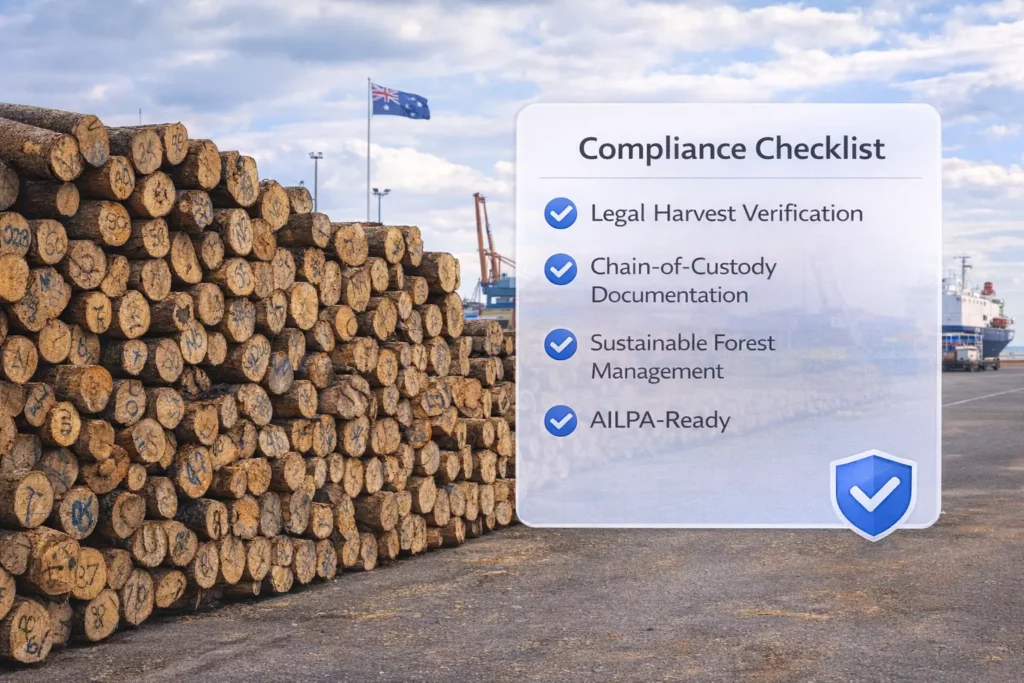
Australia’s illegal logging laws have been in place since the Illegal Logging Prohibition Act 2012, making it a criminal offense to knowingly import wood, pulp, or paper products that have been illegally logged. Before the reforms, three overlapping risk assessment methods created significant confusion for importers. The system needed a structural overhaul and in 2024, it got one.
~10% of timber imported to Australia before 2012 was estimated to be illegally logged — directly undercutting legal suppliers.
Source: Australian Government DAFF / Forest Policy Group, 2023
7–16% Price disadvantage suffered by legally harvested timber when competing with illegally sourced imports.
Source: Australian Government Minister’s Office, Illegal Logging Bill Media Release
The government’s response was decisive. The Illegal Logging Prohibition Amendment (Strengthening Measures to Prevent Illegal Timber Trade) Act 2024 passed in September 2024 and came into full effect on March 3, 2025. The new Illegal Logging Prohibition Rules 2024 replaced the previous Illegal Logging Prohibition Regulation 2012.
Three previous risk assessment methods (Country Specific Guidelines, Timber Legality Frameworks, and Regulated Risk Factors) were replaced with two distinct pathways: one for certified timber and one for non-certified timber.
Three additional reforms matter immediately:
The March 2025 reforms represent the most significant overhaul of Australia’s illegal logging framework in over a decade. Importers who treated the transition as a minor form update missed substantive changes to how risk must be legally assessed.
Want to understand how Australia is tackling illegal timber imports?
Read our guide to ILPA and learn how the regulation helps prevent illegal logging from entering Australian markets.
Illegal logging continues to threaten forests and supply chains worldwide.
Explore our blog on illegal logging regulations to see how global policies are tightening enforcement.
The legislation applies equally to importers and domestic processors. If you bring regulated timber products into Australia, you are an importer under this Act regardless of whether you consider yourself a trader, distributor, retailer, or manufacturer.
Regulated products include: raw timber, sawn wood, veneers, plywood, joinery, mouldings, pulp, paper, and wood-based furniture components. The scope is intentionally broad.
12+ regulated product categories covered under ILPA – from raw logs and sawn timber to paper and wood-based furniture.
Source: Illegal Logging Prohibition Rules 2024, Schedule 1 (DAFF, Australia)
Due diligence is not required for: consignments where the combined value of regulated timber content is AUD $1,000 or less; products made entirely from post-consumer recycled materials; and the recycled component of mixed-source products.
A certified supplier does NOT automatically exempt you from ILPA due diligence. An FSC-certified business can still deal in non-certified raw logs. Certification applies to the business, not automatically to every product it handles.
| Obligation | Importer | Domestic Processor |
|---|---|---|
| Written due diligence system | Required before first import | Required before first processing |
| Information gathering | Every regulated shipment | Every raw log batch |
| Risk assessment (two-pathway) | Required | Required |
| Customs declaration | Required per shipment | Not required |
| Advance notice to DAFF (pending) | Coming – IT system pending | Coming – IT system pending |
| Repeat due diligence exception | Available (12-month window) | Available (12-month window) |
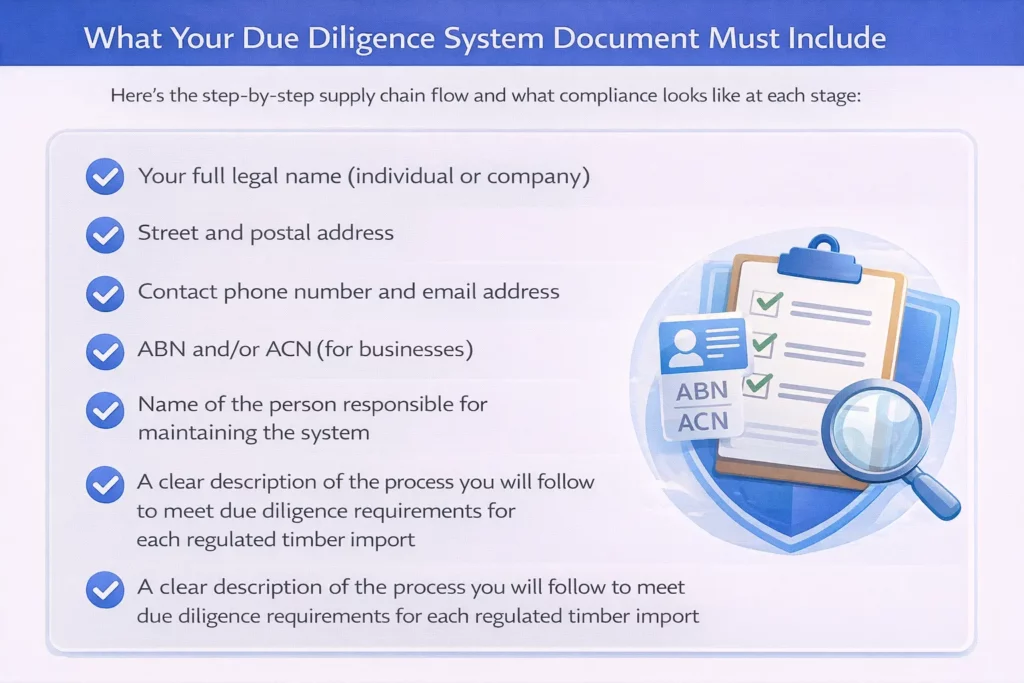
The single most common compliance failure isn’t a bad risk assessment, it’s not having a documented system at all. You must have a written due diligence system in place before importing any regulated timber product. This must exist before the first shipment. It cannot be backdated after a DAFF audit notice arrives.
Think of this document as your compliance constitution. Every decision in the five-step process below flows from it. DAFF compliance officers review your system first, then examine how you applied it to specific shipments. A gap between the documented process and actual practice is the fastest route to a formal compliance failure.
Write your due diligence system in plain language that any staff member can follow. Update it whenever your supplier base, product range, or country risk environment changes. Version-control the document with dates – DAFF may ask to see its history.
Information gathering is the foundation of your risk assessment. You cannot assess what you haven’t documented. At minimum, you must record: a description of the product (species, product form), the country and sub-national area of harvest, the quantity of the shipment, and full supplier details. But the depth of required documentation differs significantly between certified and non-certified timber.
~60% of timber importers in high-risk-origin markets lack full harvest-to-border documentation chains, exposing them to DAFF audit risk
Source: Environmental Investigation Agency / CIEL – Calculated Risk: Australia’s Exposure to Illegal Logging, 2023
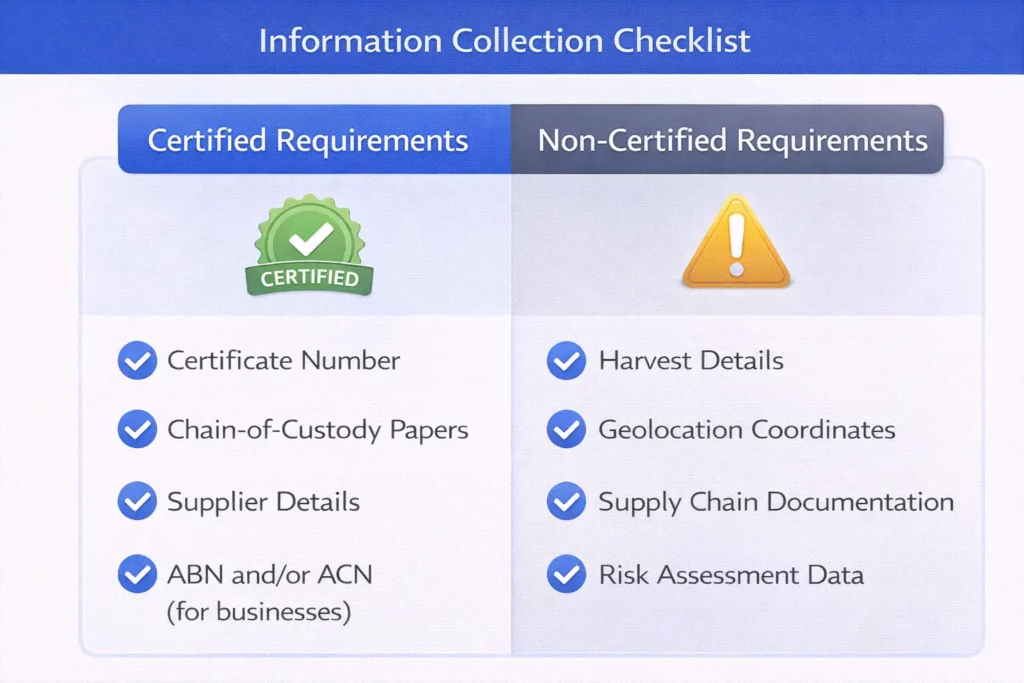
A product qualifies as certified if you have obtained and verified documents from a recognised certification scheme. You must gather:
Non-certified timber requires a substantially richer evidence base. You must gather:
The legislation requires information to be gathered to a ‘reasonable standard.’ For high-risk source countries, this means supplier self-declarations alone are insufficient. You must apply genuine scrutiny and document that scrutiny.
Risk assessment is where most importers make costly errors either by over-relying on certification, or by conducting a geographic check so superficial it doesn’t meet DAFF’s reasonable standard. The March 2025 reforms introduced a structured two-pathway system that determines which level of scrutiny applies to your shipment.
If your timber meets the certified product definition and you have verified the required transaction certificates, you access a simplified assessment pathway. This does not mean no assessment it means the baseline risk is lower because an independent certification body has already verified legal harvesting practices.
Critical point: certification does not provide a guarantee of legality. It does not provide a blanket exemption from due diligence. You still complete the assessment; it is simply less onerous for compliant, low-risk origins.
Non-certified timber requires analysis across specific risk dimensions. DAFF’s compliance teams actively look for weakness in each of these areas:
| Risk Factor | What DAFF Assesses | High-Risk Indicators |
|---|---|---|
| Country Governance | Corruption levels, rule of law, enforcement effectiveness | Low TI Corruption Index score; weak forest governance rating |
| Conflict-Affected Areas | Active conflict in harvest region | Source region flagged in UN or DAFF conflict alerts |
| Threatened Species | Species listing and protection status | CITES Annex I/II species; nationally protected species |
| Supply Chain Complexity | Number of intermediaries, country hops | 3+ transhipment countries; unclear chain of custody |
| Tax Haven Transhipment | Routing through known laundering routes | Transit through jurisdictions flagged by DAFF / FATF |
| NGO / Monitoring Reports | Field intelligence from environmental organisations | Active deforestation alerts; published investigation reports |
Over 40% of high-risk timber supply chains involve at least one transhipment country flagged for inadequate enforcement – making chain-of-custody documentation critical
Source: Environmental Investigation Agency – Stained Timber: Illegal Logging and Transhipment Routes, 2024
This is the most operationally significant new provision in the 2025 reforms. The repeat import exception allows an importer to rely on a previous risk assessment when importing the same product from the same supplier within a 12-month window provided no circumstances have materially changed.
The exception applies only to risk assessment and risk mitigation. It does not exempt you from information gathering. You still collect information for every shipment. What you can rely on is a previous risk conclusion, not a previous information collection exercise.
Document your reliance on the repeat exception as carefully as you documented the original assessment. If DAFF audits you, they will verify that conditions for the exception were genuinely met new NGO alerts, supplier certification lapses, or country risk changes could all invalidate it.
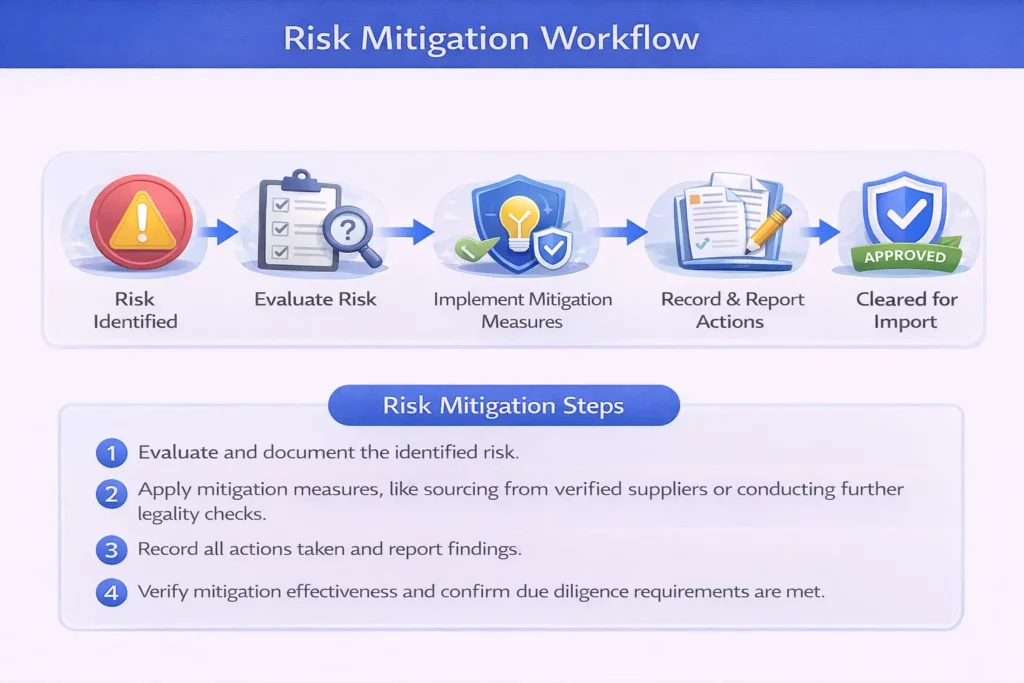
Once your risk assessment concludes that risk is above negligible, you cannot simply proceed with the import. You must take active mitigation steps and document them in writing before the shipment is cleared.
MYTH BUST – FSC IS NOT A SUBSTITUTE FOR DUE DILIGENCE
One of the most persistent compliance myths in the Australian timber import market: an FSC chain of custody manual is not sufficient to meet ILPA due diligence obligations. Certification may assist and establish some elements of due diligence, but the legal obligations of the Rules are distinct from the function of a chain of custody manual. FSC is an input to your assessment never a replacement for it.
A compliant due diligence system is only as strong as the records that prove it was applied. DAFF’s compliance process follows a specific sequence: when selected for assessment, you will receive a Requirement to Give Information and Produce Documents notice. You must respond with your written due diligence system and evidence of how you applied it to the specific shipments under review.
5 Years is the recommended minimum retention period for ILPA due diligence records, aligned with Australian tax and customs record-keeping standards.
Source: DAFF Compliance Guidance / Australian Taxation Office Alignment, 2025
The legislation requires your risk identification and assessment to be to a ‘reasonable standard’ and supported by the information gathered. This means you must actively demonstrate through written records that you applied genuine analytical scrutiny to each shipment. Rubber-stamping supplier declarations does not satisfy this standard for high-risk origins.
If you cannot locate a shipment’s complete due diligence record within 24 hours of receiving a DAFF notice, your record-keeping system is not audit-ready. Digital traceability platforms centralise all records and produce compliant exports in minutes.
Manual ILPA compliance spreadsheets, email threads, scanned PDFs, handwritten risk notes isn’t just inefficient. It’s structurally unreliable. Every step in the five-stage process requires documented evidence, and evidence dispersed across inboxes and filing cabinets fails under audit.
| Compliance Step | Manual Approach | Digital Platform (TraceX) |
|---|---|---|
| Written due diligence system | Word document, updated ad hoc | Centralised, version-controlled system template |
| Information gathering | Email / supplier self-declaration | Structured supplier portal with required data fields |
| Species and origin verification | Manual document review | AI-powered document parsing, auto-extraction |
| Geolocation verification | Manual GPS entry / map check | GPS polygon mapping validated against satellite datasets |
| Risk assessment | Spreadsheet scoring | Automated risk scoring with real-time deforestation alerts |
| Record keeping | Shared folder / filing cabinet | Audit-ready records – one-click PDF, XML, CSV export |
| Audit response time | Days to weeks | Hours – centralised audit trail |
| Repeat exception tracking | Calendar reminders / manual | Automated 12-month tracking by product and supplier |
Australia isn’t acting alone. Timber and forest-risk commodity importers now face a converging set of demand-side laws across three major markets and the compliance architectures are structurally similar.
| Framework | Jurisdiction | Scope | Core Requirement | TraceX Coverage |
|---|---|---|---|---|
| ILPA | Australia | Timber and wood products | Written DDS + two-pathway risk assessment | Full |
| EUDR | European Union | 7 forest-risk commodities incl. timber | Due Diligence Statement + geolocation data | Full |
| Lacey Act | United States | Plants, plant products, timber | Import declarations + harvest legality | Partial |
Businesses exporting timber or wood products to both the EU and Australia face dual compliance obligations: EUDR’s Due Diligence Statement requirements and ILPA’s due diligence system, which are structurally similar but differ in specific documentary requirements. A unified digital platform that maps supply chain data once and generates compliant outputs for multiple regulatory frameworks eliminates the duplication that currently forces exporters to run parallel manual processes.
ILPA compliance isn’t a one-time exercise. It’s a supply chain operating discipline that must be applied before every regulated timber import. The five-step framework, written system, information gathering, risk assessment, risk mitigation, and record keeping is clear, structured, and manageable. The March 2025 reforms didn’t add new obligations so much as clarify and streamline them. But the two-pathway risk system, the repeat exception, and the incoming timber testing and notification requirements signal that the regulatory floor is rising.
The importers who navigate this most effectively aren’t those with the thickest compliance binders. They’re the ones with digital systems that make data collection, risk scoring, and audit-trail generation a standard part of every procurement workflow eliminating the scramble when a DAFF notice lands.
ILPA requires timber importers to: (1) maintain a written due diligence system; (2) gather specified information about the timber and supply chain before every import; (3) conduct a two-pathway risk assessment (certified or non-certified); (4) mitigate risk where it exceeds negligible; and (5) retain written records of every step. The Illegal Logging Prohibition Rules 2024 (in effect from March 3, 2025) govern this process. Failure to comply is a criminal offense.
The most significant change was the replacement of three previous risk assessment methods with two distinct pathways one for certified timber and one for non-certified timber. A repeat due diligence exception was also introduced, allowing importers to rely on previous risk assessments for the same product and supplier within a 12-month window. DAFF also received authority to use timber testing technologies to verify species and origin claims.
At minimum: product description (species, form), country and sub-national area of harvest, quantity, and supplier details. For non-certified timber, you additionally need legal harvest documentation (permits, licences, royalty payments), transport documentation, and relevant third-party audit or NGO monitoring reports. All information must be gathered to a ‘reasonable standard’ – superficial supplier self-declarations are insufficient for high-risk origins.
No. FSC or PEFC certification enables the simplified certified timber risk assessment pathway, but it does not exempt you from ILPA due diligence obligations. You must still gather information, conduct a pathway assessment, and retain records. An FSC chain of custody manual is not a substitute for a written ILPA due diligence system this is one of the most commonly cited misconceptions flagged in DAFF’s compliance guidance.
Failing to complete due diligence before importing regulated timber products is a criminal offense under the Illegal Logging Prohibition Act 2012, carrying significant financial penalties. Criminal penalties including fines and imprisonment can apply where a person or company is convicted of knowingly importing illegally logged timber. DAFF applies a proportionate, risk-based enforcement approach but businesses that cannot produce due diligence records during an audit face formal compliance action.