
Quick summary: Biochar raises soil fertility, crop yield, and water retention and can earn carbon credits. See the field evidence and what it means for agribusiness.
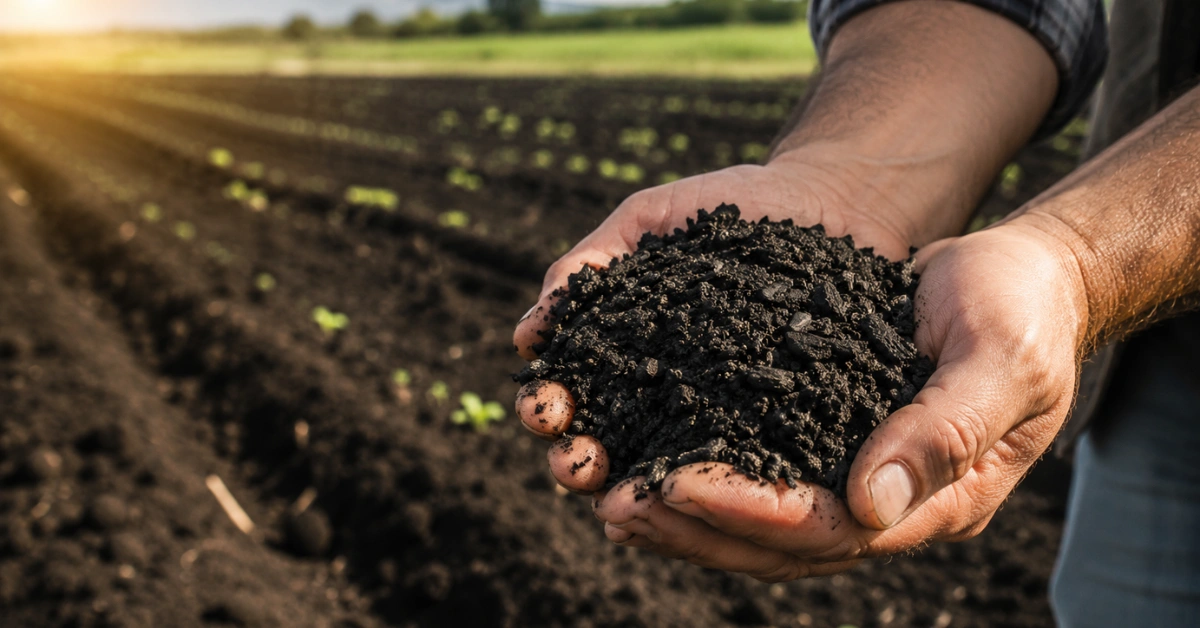
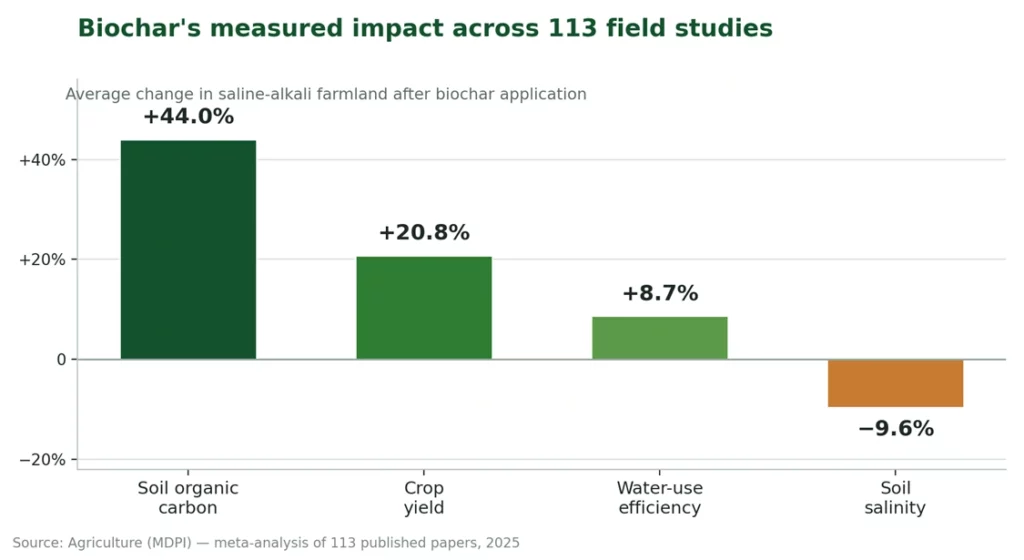
Biochar improves soil health by raising organic carbon, holding nutrients and water in the root zone, and giving soil microbes a stable place to live. The field evidence is now substantial. Across 113 published studies, biochar lifted crop yields by an average of 20.8% and soil organic carbon by 44% in degraded farmland. For agribusiness, those agronomic gains also convert into carbon-removal credits and verifiable sustainability claims.
A coffee processor in Karnataka burns its husk waste every harvest season. A few hundred kilometres away, a second processor pyrolyses the same husk into biochar, digs it into supplier farms, and books a carbon-removal credit for every tonne. Same residue two very different outcomes. That gap, between waste and verified climate asset, is why biochar has moved from a niche soil amendment to a board-level conversation in agri-food.
| Key Takeaways Biochar is charred biomass that, dug into soil, raises fertility, water retention, and microbial activity for decades. Meta-analyses report crop-yield gains of 5–51% and soil organic carbon increases of 12–102% (Scientific Data, 2024). For agribusiness, biochar also generates durable carbon credits but only if its soil and carbon impact is measured and verified. |
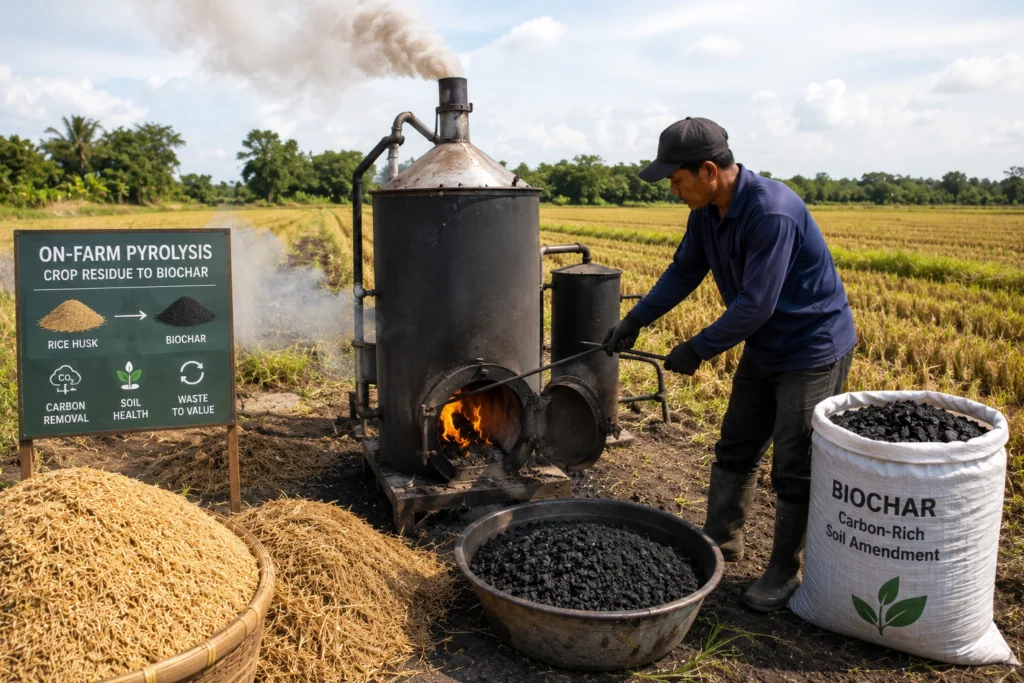
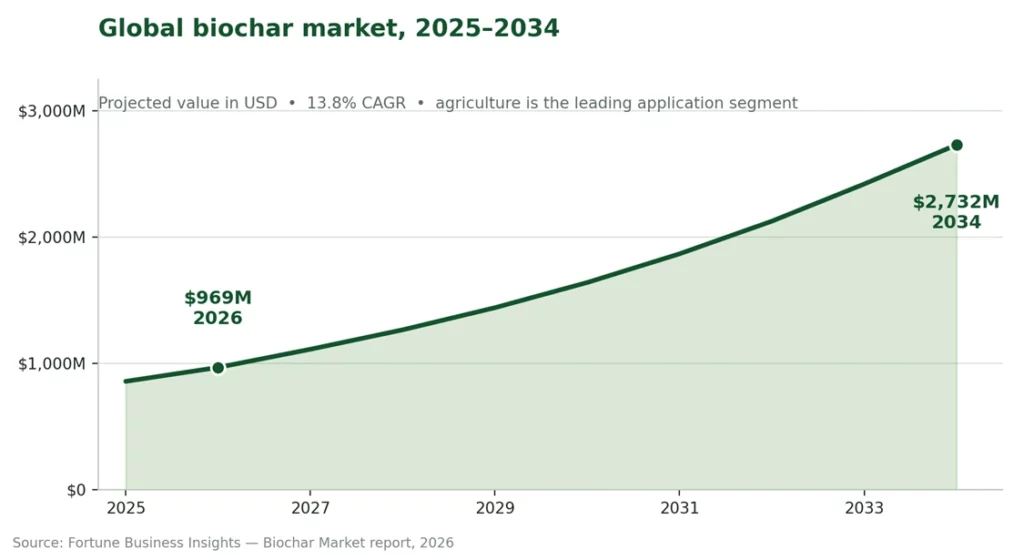
Biochar is a carbon-rich material made by heating crop residue, wood, or manure with very little oxygen a process called pyrolysis. The agriculture segment held roughly 41% of the biochar market in 2026, the largest of any application (Fortune Business Insights, 2026). Farmers are paying attention because biochar answers two problems with one product: tired soil and unpriced waste.
The idea isn’t new. In the Amazon basin, patches of dark, fertile soil called terra preta were created by people centuries ago who worked charred biomass into the ground. Those soils are still productive today. That longevity is the point. Burning crop residue releases its carbon as CO₂ within minutes. Pyrolysis locks most of that carbon into a stable, porous solid that resists decay for decades or longer.
Feedstock matters. Rice husk, coffee husk, sawdust, sugarcane trash, and manure all work, and the choice shapes the final product’s pH, surface area, and nutrient content. For an agri-food business, that’s a useful detail: the residue you already pay to dispose of can become the input that restores your supplier farms.
So why the surge in interest right now? Three forces line up: soil degradation is cutting into yields, residue-burning bans are tightening across India and Southeast Asia, and carbon markets have started paying for permanent carbon removal. Biochar sits at the centre of all three
Explore how biochar is emerging as a scalable carbon removal solution.
Learn how biochar supports long-term carbon sequestration, soil health improvement, and high-integrity carbon credit generation.
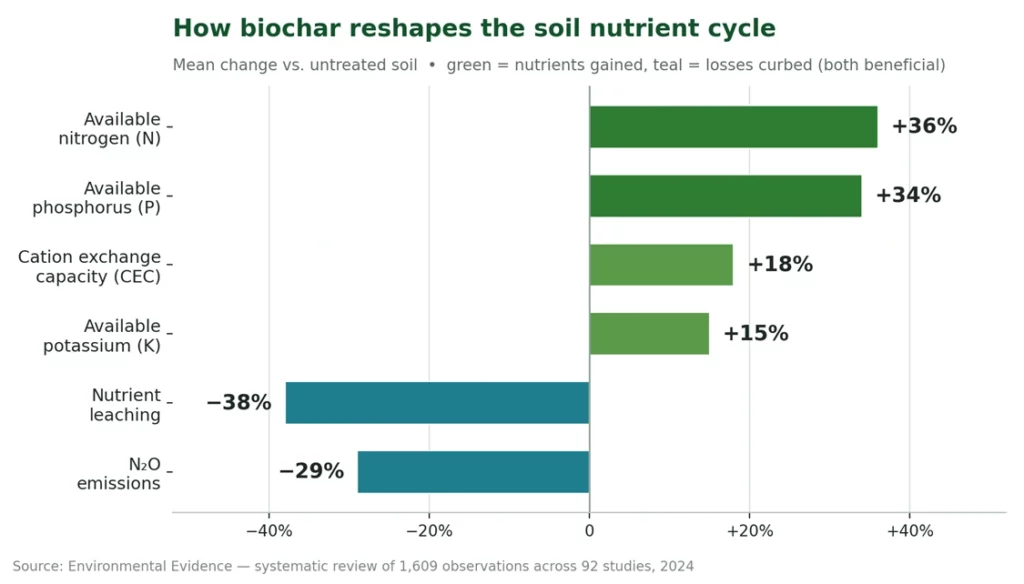
Biochar improves soil fertility mainly by holding nutrients where roots can reach them. A systematic review of 1,609 observations found biochar raised available nitrogen by 36%, phosphorus by 34%, and cation exchange capacity by 18%, while cutting nutrient leaching by 38% (Environmental Evidence, 2024). In plain terms: fewer of your inputs wash away, and more of them feed the crop.
The mechanism is physical. Biochar is riddled with microscopic pores, giving it an enormous internal surface area and a negatively charged structure. That surface grabs onto positively charged nutrients ammonium, calcium, magnesium, potassium and releases them slowly. Cation exchange capacity, the soil’s ability to store and trade nutrients, climbs as a result.
Biochar also buffers pH. Most biochars are mildly alkaline, so on acidic soils common across tropical farming regions they nudge pH toward the range where nutrients stay available to plants. Less leaching has a second payoff: nitrogen that stays in the field is nitrogen that doesn’t pollute waterways or escape as emissions.
| Biochar improves soil fertility by raising cation exchange capacity by an average of 18% and reducing nutrient leaching by 38%, according to a 2024 systematic review of 1,609 observations across 92 studies (Environmental Evidence). Its porous, negatively charged surface holds ammonium, potassium, and other cations in the root zone, so fertiliser feeds the crop instead of washing away. |
Discover how sustainable sourcing is transforming modern agribusiness.
Explore strategies for improving traceability, supplier transparency, responsible sourcing, and sustainability compliance across agricultural supply chains.
Biochar boosts crop yield by improving the soil’s physical structure and its ability to store water. A global meta-analysis of 65 studies found that in tropical, acidic soils, biochar raised yields by 38% and plant-available water by 47.3% (Soil Use and Management, 2025). The water effect is the engine behind much of the yield gain.
Think of biochar as a sponge built into the soil. Its pore network holds water against gravity and releases it gradually as the crop needs it. The same structure lowers soil bulk density, so roots travel further and air moves more freely. On sandy or degraded land that drains too fast, this is the difference between a crop that survives a dry spell and one that doesn’t.
Now the honest part. Biochar doesn’t always raise yield. A global meta-analysis put the grand mean increase at about 10%, with individual results ranging from a 28% loss to a 39% gain (global meta-analysis, via Frontiers, 2023). The result depends on feedstock, application rate, soil type, and climate. Biochar performs best on degraded, acidic, and sandy soils, and adds little to already-fertile loam.
| +20.8%average crop yield gain in degraded farmland | +47.3%more plant-available water (continental zones) | 5–51%reported yield-gain range across studies |
Sources: Agriculture (MDPI), 2025; Soil Use and Management, 2025; Scientific Data, 2024.
That variability is not a weakness in the case for biochar it’s the case for measurement. If results swing this widely with conditions, an agribusiness can’t manage a biochar programme on assumptions. It needs field-level data on where biochar went, at what rate, and what changed.
Learn how farm management practices can drive sustainability at scale.
Explore how digital tools, traceability, regenerative agriculture, and data-driven decision-making are helping farms improve productivity, compliance, and environmental performance.
Biochar changes microbial soil activity by creating physical shelter and a steady supply of moisture and nutrients. Researchers call the zone of intense microbial life around biochar particles the charosphere, where microbial biomass and enzyme activity run measurably higher than in surrounding soil
Biochar’s pores are sized like apartments for bacteria and fungi. They offer protection from predators, hold onto water through dry periods, and buffer temperature swings. Microbes that drive nutrient cycling fixing nitrogen, freeing up phosphorus, breaking down organic matter find these microhabitats ideal. The pH buffering helps too, since most soil microbes prefer near-neutral conditions.
Enzyme activity is the visible signal. Studies consistently find higher enzymatic activity in biochar-amended soil, a sign that the microbial community is working harder at recycling nutrients. One detail with practical weight: composted biochar tends to outperform raw biochar applied straight, because composting pre-loads the pores with microbial life and nutrients
| Biochar increases microbial soil activity by forming protected microhabitats in its pore structure. In this “charosphere”, microbial biomass and enzyme activity are elevated relative to surrounding soil (Frontiers in Soil Science, 2026). Because soil microbes drive nitrogen, phosphorus, and carbon cycling, a healthier microbial community is the underlying mechanism behind biochar’s measured fertility and yield gains. |
Why does this matter beyond the agronomy? Because microbial activity, organic-matter accumulation, and water retention move together. When one improves, the others tend to follow
Explore why soil organic carbon is becoming central to climate-smart agriculture.
Learn how improving soil carbon supports regenerative farming, carbon sequestration, soil health, and sustainable supply chain outcomes.
Biochar fits regenerative agriculture because it builds stable soil carbon that doesn’t break down for decades. In a three-year German trial, adding biochar to a regenerative system cut native soil-carbon loss by 18% a process known as negative priming (Scientific Reports, 2026). Most regenerative practices build carbon slowly; biochar makes that carbon stick.
Regenerative agriculture combines minimum tillage, cover crops, and livestock integration to rebuild soil. The weak point is permanence. Compost and crop residue feed the soil, but most of that organic matter decomposes within a few years, returning its carbon to the air. Biochar is different. Its carbon is already stabilised, so it acts as the durable carbon layer beneath the living, fast-cycling layer.
Negative priming is the surprising part. In the German trial, biochar didn’t just add its own carbon it slowed the breakdown of the soil’s existing carbon. The regenerative-plus-biochar plots also showed better root penetration and higher microbial efficiency. Biochar can also reduce nitrous oxide emissions from soil by up to 50%, which matters because N₂O is a far stronger greenhouse gas than CO₂
| Biochar supports regenerative agriculture by adding permanent, stabilised carbon to soil and by slowing the decomposition of existing soil carbon. A three-year German organic-farm trial recorded an 18% reduction in native soil-carbon loss when biochar was combined with reduced tillage and cover crops (Scientific Reports, 2026), alongside improved root growth and microbial efficiency. |
There’s a circular-economy logic here too. Crop residue that would have been burned becomes biochar, which goes back into the soil it came from. For an agribusiness running a regenerative-sourcing programme, biochar turns a waste-disposal cost into a soil-building input and into a measurable carbon outcome.
Discover how regenerative agriculture is reshaping sustainable food systems.
Explore how regenerative practices improve soil health, biodiversity, carbon sequestration, and long-term resilience across agricultural supply chains.
For agribusiness, biochar’s business case rests on three returns: lower input cost, durable carbon credits, and defensible sustainability claims.
According to Mordor Intelligence, organic farmers are replacing synthetic inputs with biochar as they chase higher soil organic carbon scores required for premium certification.
Biochar is one of the cheapest and most permanent carbon-removal pathways available. Biochar prices have averaged around $131 per metric tonne, against roughly $488 for carbon removal across all approaches (Inkwood Research, 2026). The European Union’s Carbon Removal Certification Framework became operational in 2026, and corporate buyers including Microsoft and Google are purchasing biochar credits at scale. A tonne of biochar in the soil can become a second revenue line.
Explore how carbon credits are shaping the future of climate action and sustainability finance.
Learn how carbon markets work, how credits are generated and verified, and why transparency and integrity are becoming critical in global climate strategies.
Regenerative practices on supplier farms sit inside a brand’s Scope 3 footprint the emissions category that dominates most agri-food companies’ totals. Biochar applied across a sourcing base genuinely lowers that number. But CSRD and similar frameworks require primary data, not industry averages. Practices you can’t measure don’t count in the report.
Buyers increasingly pay more for verified climate-positive sourcing. Organic and regenerative certifications already reward higher soil-organic-carbon scores. The risk runs the other way too: an unverified “carbon-negative” claim is a greenwashing exposure, not an asset. The table below shows where biochar sits against other common soil amendments.
| Attribute | Biochar | Compost | Synthetic NPK | Cover cropping |
|---|---|---|---|---|
| Carbon permanence | Decades to centuries | A few years | None | A few years |
| Water retention | High | Moderate | None | Moderate |
| Microbial habitat | High — porous shelter | High — food source | Low | Moderate |
| Carbon-credit eligibility | Yes — durable removal | Limited | No | Limited — practice-based |
| Application cadence | Once; effect lasts decades | Recurring | Recurring | Recurring, seasonal |
| Best fit | Degraded, acidic, sandy soils | Most soils | Quick deficiency fix | Whole-system soil building |
This is where measurement becomes the bottleneck. A coffee or cocoa exporter can dig biochar into 2,000 supplier farms but without geotagged application records and a verified carbon model, none of it counts toward a credit or a CSRD disclosure. Platforms such as the TraceX Digital MRV system are built for this exact step: capturing primary farm data and turning regenerative practices into audit-ready carbon reporting.
You prove biochar’s impact by measuring it at the source: geotagged application records, soil sampling, and a carbon model aligned to a recognised registry standard. Without primary data, biochar’s benefits stay invisible to auditors, carbon registries, and the buyers paying a premium for them. Applying biochar and proving biochar are two different jobs.
A credible biochar claim needs four things on record: the feedstock and how the biochar was produced; the application rate and the GPS boundary of each plot; a soil baseline and follow-up measurements; and a lifecycle model that estimates how much carbon is durably stored. Standards such as the European Biochar Certificate and registry carbon protocols define how this is done. Spreadsheets spread across regions and languages don’t survive an audit.
This is the work TraceX is built for. The Digital MRV platform calculates Scope 3 emissions from primary supply-chain data rather than industry averages, supports regenerative-agriculture and nature-based carbon projects, and produces audit-ready carbon reports aligned to registry standards and frameworks like SBTi and TNFD. Offline-first mobile apps let field agents log biochar application on remote farms, and multilingual portals bring smallholders into the same dataset.
Make every tonne of biochar count
Biochar becomes a carbon asset only when its impact is measured, verified, and reported to registry standards. TraceX helps agri-food exporters, F&B brands, and development programmes turn regenerative practice into Scope 3 data and verified carbon credits — from the farm plot to the audit file.
Picture a spice exporter, or a development NGO running a smallholder programme across thousands of plots. Each farm applies biochar made from local residue. With farm-level capture, every application becomes a data point feeding a carbon report, a CSRD disclosure, and a verified provenance claim on the finished product. Without it, the same effort produces healthier soil and nothing a buyer or auditor can see.
| Biochar’s soil and carbon impact is proven through measurement, reporting, and verification (MRV): geotagged application records, soil baselines, and a lifecycle carbon model aligned to a registry standard such as the European Biochar Certificate. Digital MRV platforms capture this primary farm data so biochar applications can qualify for carbon credits and satisfy CSRD Scope 3 reporting. |
Learn how dMRV strengthens transparency and credibility in biochar projects.
Explore how digital monitoring, reporting, and verification supports accurate carbon accounting, traceability, and high-integrity biochar carbon credits.
Biochar is proven enough to act on. The evidence base hundreds of studies and global meta-analyses shows real gains in fertility, water retention, microbial activity, and stable soil carbon. For farmers, that means more resilient land. For agribusiness, it means three returns at once.
The deciding factor isn’t the science it’s whether the impact is measured. Biochar in the ground builds soil. Biochar measured, reported, and verified builds a balance-sheet asset.
Biochar’s carbon is highly stable and can persist in soil for decades to centuries the Amazon’s terra preta soils remain fertile after hundreds of years. Meta-analyses report soil organic carbon increases of 12–102% under biochar (Scientific Data, 2024). That permanence is exactly what makes biochar eligible for carbon-removal credits.
No. A global meta-analysis found a grand mean yield increase of about 10%, with results ranging from a 28% loss to a 39% gain depending on conditions. Biochar performs best on degraded, acidic, and sandy soils and adds little to already-fertile loam. Outcomes depend on feedstock, rate, soil type, and climate.
There is no single rate. Field studies commonly test between 10 and 40 tonnes per hectare, and meta-analyses show higher application rates and higher-carbon biochar tend to perform better (Soil Use and Management, 2025). The right rate depends on soil type, crop, and biochar quality, so it should be set with local agronomic advice.
Yes. Biochar is recognised as a durable carbon-removal method, and credits have traded above $100 per tonne of CO₂e (Mordor Intelligence, 2026). Earning them requires verified measurement, reporting, and verification documented feedstock, geotagged application, and a carbon model aligned to a registry protocol or the European Biochar Certificate.
Yes. Biochar can be produced from local crop residue using simple pyrolysis equipment, which suits smallholder and emerging-market supply chains. The agriculture segment leads the global biochar market at roughly 41% in 2026 (Fortune Business Insights, 2026). The main barrier is capturing farm-level data for verification – solved with offline-first, multilingual field tools.