
Quick summary: Carbon accounting in food & agri value chains explained. Learn how to measure agricultural emissions, manage Scope 3 data, align with standards, and achieve net-zero goals.

Food and agriculture account for nearly one-third of global greenhouse gas emissions, yet most companies can’t accurately see where those emissions come from. Carbon accounting in food & agri value chains is the process of measuring, tracking, and managing greenhouse gas (GHG) emissions generated across agricultural production, processing, transportation, and distribution.
For food and agriculture businesses, the challenge isn’t whether emissions exist, it’s that they are highly fragmented, largely Scope 3, and buried deep within farm-level and supplier data. Without credible carbon accounting, companies face growing risks: regulatory non-compliance, supply-chain blind spots, missed net-zero targets, and loss of buyer trust.
This guide explains why carbon accounting is critical for food and agriculture businesses, how agri-value-chain emissions differ from other sectors, and how companies can build credible, standards-aligned carbon strategies that turn complex data into actionable climate outcomes.
Key Takeaways
Carbon accounting in food & agri value chains refers to the systematic process of measuring, quantifying, tracking, and managing greenhouse gas (GHG) emissions generated across the entire lifecycle of food from agricultural inputs and on-farm activities to processing, transportation, retail, and consumption.
In an agricultural context, carbon accounting goes beyond energy use and fuel combustion. It must capture biological, land-based, and supply-chain-driven emissions, including methane from livestock, nitrous oxide from soils, emissions from fertilizer production, and carbon losses or gains from land-use practices.
| Aspect | Generic Carbon Accounting | Agri-Specific Carbon Accounting |
| Primary Focus | Energy, fuel, and stationary industrial processes (mechanical). | Biological & Land-Based: Soil carbon, methane (livestock), and N2O (fertilizer). |
| Emission Nature | Relatively stable and predictable based on utility bills. | High Variability: Fluctuates by soil type, micro-climate, yield, and specific field practices. |
| Scope Hierarchy | Primarily focused on Scope 1 & 2 (Direct operations and energy). | Dominated by Scope 3 (Upstream), often representing 80–90% of total food system impact. |
| Data Foundation | Uses standardized operational data (meters, receipts, and spend). | Relies on Farm-Level Activity Data: Planting dates, fertilizer types, and geolocated polygons. |
| Supply Chain Depth | Limited or superficial interaction with upstream suppliers. | Requires Deep Engagement with thousands of fragmented smallholders and aggregators. |
| Calculation Engine | Static Emission Factors (e.g., X per kWh). | Dynamic Models: Often uses IPCC Tier 2 or 3 methodologies to account for local environmental factors. |
| Unit of Value | Usually calculated at the Company Level. | Calculated at the Batch or Product Level to ensure “Farm-to-Fork” traceability. |
Explore our in-depth guide on GHG emissions in agriculture to learn how methane, nitrous oxide, land use, and farming practices shape the carbon footprint of food value chains and how they’re measured in practice.
Read the blog: GHG Emissions in Agriculture
Our detailed guide breaks down the GHG Protocol, ISO 14064, and SBTi, explaining how these frameworks apply to agriculture and how to align your reporting with buyer and regulatory expectations.
Read the blog: Carbon Accounting Standards for Food & Agri
Carbon accounting in food and agriculture must cover end-to-end value chain emissions, often referred to as farm-to-fork or seed-to-shelf emissions.
This is typically the largest and most complex emissions source in food and agri value chains.
Key emission drivers include:
Emissions at this stage are highly variable and depend on:
Upstream agricultural inputs contribute significantly to embedded or upstream Scope 3 emissions.
Key sources include:
Although these emissions occur outside a company’s direct operations, they are often among the largest contributors to a food product’s carbon footprint.
Once raw agricultural commodities are harvested, emissions arise during processing and transformation.
Typical sources:
Processing emissions are usually more measurable than farm-level emissions but can vary significantly by technology, energy mix, and efficiency.
Transportation and storage emissions increase substantially in food value chains due to temperature control requirements.
Key contributors:
Cold chains are especially emissions-intensive for perishable goods such as dairy, meat, seafood, fruits, and vegetables.
Downstream emissions are often overlooked but remain material.
They include:
For many food categories, food loss and waste alone can represent a significant share of total lifecycle emissions.
Because emissions are distributed across multiple actors and stages, carbon accounting in food & agri value chains is inherently Scope 3-heavy, data-intensive, and collaborative. Accurate accounting requires integrating farm data, supplier information, operational metrics, and lifecycle thinking into a single, credible framework.
Greenhouse gas emissions from food and agriculture are fundamentally different from those of energy, manufacturing, or heavy industry. Unlike most sectors where emissions primarily come from fuel combustion or electricity use agricultural emissions are largely biological, land-based, and dispersed across complex supply chains. This makes them harder to measure, manage, and reduce, but also critical to address.
Biogenic emissions are emissions that arise from natural biological processes, and they dominate food and agri value chains.
Unlike fossil fuel emissions, methane in agriculture is part of a biological carbon cycle, but its near-term climate impact makes it a critical focus area for mitigation.
This variability makes soil emissions difficult to estimate using generic averages and highlights the need for practice- and location-specific carbon accounting.
Agriculture is unique in that it can be both a source and a sink of carbon.
Accurate carbon accounting must therefore balance emissions and removals, ensuring sequestration claims are credible, measurable, and permanent.
Land use decisions play a defining role in the carbon footprint of food and agri systems.
Deforestation
Soil Carbon Loss
Regenerative Agriculture Potential
However, these benefits must be measured carefully to avoid over-crediting or double counting.
For food and agri companies, the majority of emissions occur outside their owned or controlled operations.
As a result, Scope 3 emissions often account for 70–90% of total emissions in food value chains, making traditional operational-only carbon accounting insufficient.
Capturing Scope 3 emissions in agriculture is uniquely complex due to:
Many smallholders operate with minimal documentation, yet their activities are central to a company’s carbon footprint. Effective carbon accounting therefore depends on farmer engagement, simplified data collection, and scalable digital tools that balance accuracy with practicality.
Measuring greenhouse gas (GHG) emissions in agriculture requires approaches that can handle biological processes, variable farming practices, and highly fragmented supply chains. Unlike sectors with centralized operations, agri emissions measurement combines activity data, emission factors, and yield-based metrics across multiple stages of the value chain.
Carbon accounting in agriculture follows the same scope structure used across industries, but the sources and proportions of emissions differ significantly.
Scope 1 emissions include direct emissions from sources owned or controlled by the farm or agribusiness.
Key sources:
These emissions are often highly variable, influenced by farm size, mechanization level, animal productivity, and management practices.
Scope 2 emissions arise from purchased electricity, heat, or steam used in agricultural and food operations.
Typical examples:
While Scope 2 emissions are generally easier to quantify than farm-level emissions, they still vary depending on energy mix, efficiency, and location.
Scope 3 emissions account for the largest share of total emissions in food and agri value chains.
Major Scope 3 sources include:
Because these emissions occur outside direct control, accurate Scope 3 measurement depends on supplier data, proxies, and robust estimation methods.
The quality of carbon accounting depends heavily on the type of data used.
Primary data is directly collected from farms and operations.
Examples include:
Primary data offers higher accuracy and better decision-making insights, but it can be difficult to collect at scale especially from smallholders with limited digital access.
When primary data is unavailable, companies rely on secondary data, primarily emission factors.
Emission factors:
Secondary data is essential for early-stage accounting but should be gradually replaced with primary data where material.
Yield-based metrics help normalize emissions against production output.
Common examples:
Yield-based calculations allow:
However, yield variability due to weather, soil, and management practices must be carefully accounted for to avoid misleading conclusions.
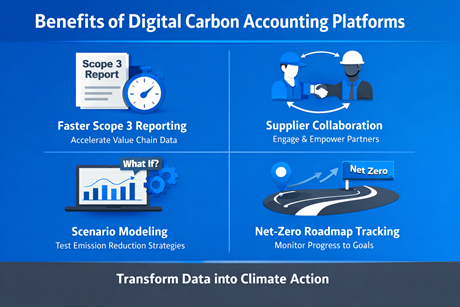
To ensure credibility, comparability, and regulatory acceptance, carbon accounting in food and agriculture must be aligned with globally recognized standards. These frameworks provide consistent methodologies for measuring emissions, setting reduction targets, and reporting progress while allowing flexibility to address the unique complexities of agri value chains.
The GHG Protocol is the most widely used carbon accounting framework globally and serves as the foundation for corporate and value-chain emissions reporting.
In food and agriculture, the GHG Protocol:
For agri businesses, the GHG Protocol enables consistent reporting across diverse geographies, crops, and supplier types, making it especially relevant for global supply chains.
ISO 14064 is an internationally recognized standard that focuses on the quantification, reporting, and verification of GHG emissions.
Its relevance to food and agri companies includes:
ISO 14064 is often used by companies seeking third-party assurance or operating in regions where ISO-aligned reporting is preferred or required.
The Science Based Targets initiative (SBTi) provides guidance on setting emissions reduction targets aligned with climate science.
For food and agri businesses, SBTi:
SBTi does not define how to calculate emissions in detail but builds on GHG Protocol data, making accurate carbon accounting a prerequisite for target validation.
Food and agri businesses often need to account for emissions at multiple levels:
Agriculture frequently requires both approaches, as buyers increasingly demand product-specific carbon data while regulators focus on corporate inventories.
Carbon accounting standards must also align with external expectations, including:
Using recognized standards ensures that carbon data is:
Carbon accounting in agriculture succeeds only when it balances scientific rigor with on-the-ground practicality. Given the dominance of Scope 3 emissions, fragmented supplier networks, and limited farm-level data, agri businesses need approaches that are scalable, credible, and farmer-centric.
Farmers and suppliers are the primary source of emissions data, yet they are often the least equipped to provide it. When farmers understand how data is used and see value in providing it data quality and participation improve significantly.
Participation increases when carbon accounting delivers direct benefits to farmers and suppliers. Incentives help shift carbon accounting from a compliance exercise to a collaborative value-creation process.
Not all emissions are equally significant. Successful agri businesses focus first on what matters most. This targeted approach avoids spreading resources too thin and enables faster, measurable impact.
Clear documentation is essential for credibility and verification. Strong documentation ensures continuity, even as teams, suppliers, or systems change.
Transparency builds trust with auditors, buyers, regulators, and suppliers. Transparent carbon accounting strengthens confidence in reported data and supports credible emissions reduction and net-zero strategies.
Reaching net-zero in food and agri value chains is not possible with spreadsheets, surveys, and annual estimates alone. The scale, variability, and Scope 3 dominance of agricultural emissions demand digital carbon accounting systems that can collect data at source, standardize calculations, and continuously track progress.
Technology enables agri businesses to move from one-time reporting to ongoing carbon management, turning emissions data into a strategic asset.
Digital MRV (Monitoring, Reporting, and Verification) is the backbone of scalable carbon accounting in agriculture. It integrates farm-level data, supplier inputs, and standardized methodologies into a single system that supports both accuracy and efficiency.
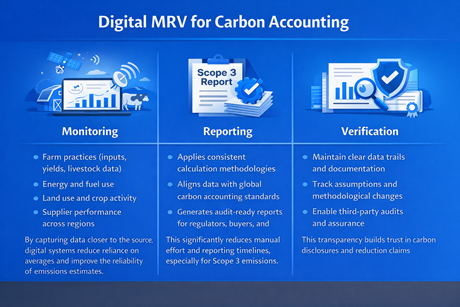
TraceX’s digital MRV (dMRV) solutions are designed specifically for the complexity of food and agri value chains.
TraceX dMRV:
By combining traceability with digital MRV, TraceX enables companies to measure emissions accurately, engage suppliers at scale, and track progress toward net-zero targets with confidence.
Carbon accounting in food & agri value chains is no longer just a reporting requirement it is a strategic foundation for resilience, compliance, and competitive advantage. As emissions increasingly sit upstream at the farm and supplier level, businesses need accurate, transparent, and scalable carbon accounting to understand their true footprint. By combining agri-specific methodologies with digital MRV systems and globally recognized standards, food and agriculture companies can move beyond fragmented data toward credible emissions reductions, stronger supplier engagement, and measurable progress toward net-zero goals.
Learn what Scope 3 emissions mean for agri-food and global supply chains, why they matter, and how leading companies are tackling them.
Read the blog: Understanding Scope 3 Emissions
Understand how SBTi FLAG impacts food, agriculture, and land-use-intensive businesses and what’s required to align emissions reductions with climate science.
Read the blog: SBTi FLAG Explained
Discover how digital MRV (dMRV) enables real-time monitoring, audit-ready reporting, and verified emissions data across complex supply chains.
Explore digital MRV for carbon accounting
Carbon accounting in food and agriculture is the process of measuring, tracking, and managing greenhouse gas emissions across farming, processing, transport, retail, and consumption stages of the food value chain.
Scope 3 emissions often represent 70–90% of total emissions in food and agri value chains, as most emissions occur at the farm and supplier level rather than within direct operations.
Farm-level emissions are measured using a combination of primary farm data (inputs, yields, livestock) and secondary data such as emission factors, often normalized using yield-based calculations.
Commonly used standards include the GHG Protocol, ISO 14064, and the Science Based Targets initiative (SBTi), all of which support credible, comparable, and audit-ready reporting.
Digital carbon accounting platforms enable real-time monitoring, automated reporting, and transparent verification, helping businesses identify emissions hotspots, engage suppliers, and track progress against net-zero roadmaps.