
Quick summary: Discover the 4 best carbon accounting practices for food & agri companies to manage Scope 3 emissions, improve data accuracy, meet compliance needs, and accelerate net-zero goals.

Food and agriculture sit at the center of the climate challenge, yet most companies still lack a clear, reliable view of their true emissions footprint. Adopting the best carbon accounting practices is therefore essential not just for reporting, but for building trust, meeting regulatory requirements, and driving measurable climate impact across agri value chains.
Carbon accounting in food and agriculture is uniquely complex due to biological emissions, land-use impacts, and supply chains where 70–90% of emissions fall under Scope 3, far beyond direct operational control.
For food & agri companies, this complexity creates real pain points: fragmented farm data, limited supplier visibility, inconsistent methodologies, and growing pressure from buyers and regulators to deliver credible, audit-ready emissions data. Relying on averages, spreadsheets, or one-time assessments not only increases compliance risk but also makes it nearly impossible to identify real reduction opportunities or stay on track toward net-zero goals.
This guide outlines four proven carbon accounting practices that work in real-world agri value chains.
Key Takeaways
Effective carbon accounting in food and agriculture requires approaches that reflect the real-world complexity of farming systems and global supply chains. The best practices below help companies move beyond high-level estimates toward credible, scalable, and action-oriented carbon management.
Farm-level activities are the largest source of emissions in food and agri value chains, yet they are often the least visible. Best-in-class carbon accounting starts by collecting primary data directly from farms, including inputs, yields, livestock numbers, and energy use. While perfect data is rarely available, even simplified, practice-based data significantly improves accuracy compared to generic averages. The key is to balance data quality with ease of collection, especially in smallholder and fragmented farming systems.
Because most agri emissions fall under Scope 3, supplier engagement is critical. Leading companies embed carbon accounting into their supplier relationships by educating farmers and aggregators, explaining how data is used, and aligning incentives. When suppliers see value such as access to preferred markets, premiums, or operational insights, participation increases and data quality improves. Carbon accounting becomes a collaborative effort rather than a compliance burden.
Manual surveys and spreadsheets cannot keep pace with the scale and variability of agri value chains. Digital MRV (Monitoring, Reporting, and Verification) tools enable companies to standardize calculations, automate reporting, and maintain clear data trails. By integrating farm, supplier, and operational data into a single system, digital platforms improve consistency, reduce errors, and support faster Scope 3 reporting aligned with global standards.
Carbon accounting is not a one-time exercise. Best practices focus on continuous improvement, regularly updating emission factors, methodologies, and datasets as better information becomes available. At the same time, companies must ensure audit readiness through strong documentation, version control, and transparency around assumptions. This approach builds confidence with auditors, regulators, buyers, and investors while enabling more accurate tracking of emissions reductions over time.
When implemented together, these best practices transform carbon accounting from a reporting obligation into a strategic capability. Food and agri companies gain clearer emissions visibility, stronger supplier engagement, and a reliable foundation for meeting regulatory requirements and achieving net-zero goals.
Explore our complete guide to carbon accounting in food & agri value chains and learn how emissions are measured from farm to market and why Scope 3 data is critical.
Read the blog: Carbon Accounting in Food & Agri Value Chains
Learn why farm-level data is the foundation of credible carbon accounting and how it improves accuracy, transparency, and emissions reduction outcomes.
Read the blog: Why Farm-Level Data Matters
Farm-level data sits at the heart of carbon accounting in food and agriculture because most emissions originate on the farm from inputs, livestock, soils, and land management practices. Without reliable farm data, carbon accounting relies heavily on averages and assumptions, which can significantly misrepresent actual emissions and undermine credibility.
Industry averages and generic emission factors are often used when farm data is unavailable, but they fail to capture the wide variability in agricultural practices. Two farms growing the same crop can have vastly different emissions depending on fertilizer use, irrigation methods, soil health, and yield.
Primary farm-level data enables:
While secondary data has a role, especially in early stages, primary data is essential for meaningful carbon management.
Effective agri carbon accounting typically draws on a small but critical set of data points:
These data points allow emissions to be calculated with sufficient accuracy while remaining practical for farmers to provide.
Collecting farm-level data is especially challenging in regions dominated by smallholder and fragmented farms. Common barriers include:
These realities mean that carbon accounting systems must be designed around farmers, not the other way around.
The most effective systems minimize farmer burden by:
Simplification improves participation and data consistency.
Rather than creating new reporting requirements, best practices build on records farmers already maintain, such as:
This reduces friction and improves data reliability.
In food and agriculture, the majority of greenhouse gas emissions occur outside a company’s direct operations. Farm production, input use, primary processing, and logistics are typically managed by independent farmers, aggregators, cooperatives, and processors, placing these emissions firmly within Scope 3.
Because of this structure:
Treating suppliers as passive data sources limits both data quality and impact. Leading agri companies instead engage suppliers as active partners in carbon accounting and emissions reduction.
Different actors contribute different types of critical data:
Together, these actors form the backbone of Scope 3 carbon data in agri value chains.
Supplier engagement improves when stakeholders clearly understand:
Providing simple explanations, sharing results, and offering feedback helps build trust and encourages long-term participation.
Incentives turn carbon accounting from a compliance exercise into a value proposition.
Common approaches include:
When suppliers see tangible benefits, data quality and consistency improve significantly.
Clear, structured data-sharing frameworks are essential for scale and trust.
Best practices include:
Strong frameworks create consistency while respecting supplier constraints. Engaging suppliers as carbon accounting partners transforms Scope 3 reporting from a challenge into an opportunity.
Food and agri value chains generate vast amounts of emissions data across farms, suppliers, processors, and regions. Managing this complexity with spreadsheets, emails, and manual surveys quickly becomes unmanageable and error-prone.
Key limitations of manual approaches include:
As reporting expectations increase from buyers, regulators, and investors, food & agri companies need scalable, standardized systems that can handle large, diverse datasets while maintaining accuracy and transparency.
Digital MRV (Monitoring, Reporting, and Verification) platforms enable continuous or near real-time tracking of:
This shifts carbon accounting from retrospective reporting to proactive emissions management, allowing companies to identify hotspots early and respond faster.
Digital MRV tools apply consistent methodologies across the value chain by:
This ensures that emissions data is comparable, repeatable, and compliant, even as supply chains scale or change.
Credibility depends on traceability and verification. Digital MRV systems:
These audit-ready data trails build confidence in disclosures and protect companies from compliance and reputational risks.
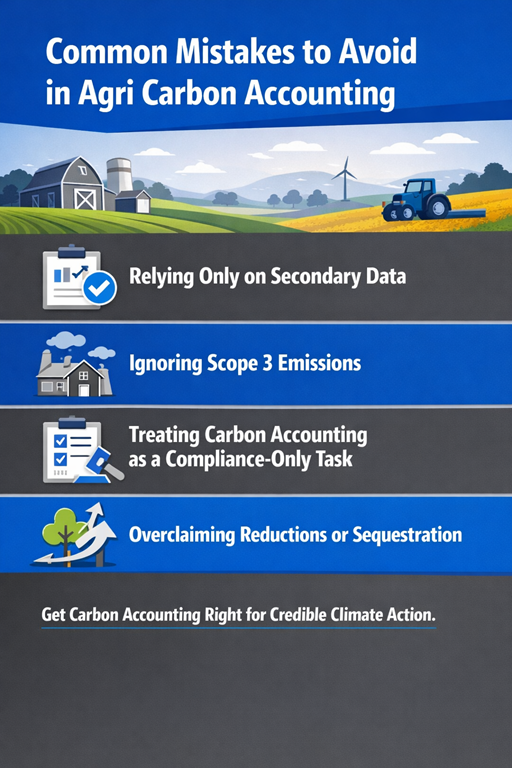
In food and agriculture, carbon accounting cannot be treated as a one-off compliance exercise. Emissions profiles evolve continuously as farming practices change, suppliers shift, yields fluctuate, and new scientific guidance emerges. Leading agri companies approach carbon accounting as an iterative, long-term process that improves in accuracy and impact over time.
Iterative improvement is important because:
By regularly refining calculations and data inputs, companies build more accurate emissions baselines and stronger foundations for reduction strategies.
Emission factors and calculation methodologies are not static. Best practices include:
This ensures carbon data remains scientifically credible and comparable over time.
Strong documentation is essential for verification and compliance. Best-in-class systems:
This level of traceability enables smooth audits and reduces compliance risk.
As data and methods evolve, version control becomes critical.
Effective version control:
This is especially important in agriculture, where methodological updates are frequent.
Transparency builds trust with regulators, buyers, investors, and partners.
Best practices include:
Transparent disclosure strengthens credibility and ensures carbon claims withstand scrutiny.
TraceX’s digital MRV (dMRV) solution transforms carbon accounting from a static reporting exercise into a scalable, real-time monitoring and verification platform. By integrating farm-level data, satellite insights, and supplier inputs, TraceX dMRV delivers standards-aligned emissions measurement, automated reporting, and audit-ready data trails. Built for complex agri and food supply chains, the platform enables companies to accelerate Scope 3 reporting, improve transparency, and make informed decisions that drive measurable climate impact. With robust documentation, verification workflows, and traceability at every step, TraceX dMRV empowers enterprises to meet compliance requirements and advance net-zero goals with confidence.
Implementing the best carbon accounting practices for food & agri companies is no longer optional; it is essential for credibility, compliance, and long-term resilience. By grounding carbon accounting in farm-level data, engaging suppliers as partners, leveraging digital MRV tools, and building systems that improve continuously and stand up to audits, companies can move beyond fragmented reporting. These practices enable food and agri businesses to gain clear visibility into Scope 3 emissions, meet evolving regulatory and buyer expectations, and translate carbon data into measurable emissions reductions and net-zero progress across their value chains.
Learn how digital MRV (dMRV) enables real-time monitoring, standards-aligned reporting, and audit-ready verification across complex supply chains.
Read the blog: What Is dMRV and Why It Matters
Explore our deep dive into GHG emissions in agriculture, covering methane, nitrous oxide, land use, and why farm practices matter.
Read the blog: GHG Emissions in Agriculture Explained
Learn how supplier mapping in traceability helps companies uncover upstream risks, improve data accuracy, and strengthen sustainability reporting.
Read the blog: Supplier Mapping for Traceability
The best practices include collecting farm-level data, engaging suppliers for Scope 3 emissions, using digital MRV platforms, and maintaining audit-ready systems with continuous improvement.
Farm-level data captures real emissions drivers such as inputs, yields, livestock, and energy use, enabling more accurate calculations than industry averages.
By collaborating with farmers, aggregators, and processors, setting clear data-sharing frameworks, and using scalable digital tools to capture supplier emissions data.
Digital MRV enables real-time monitoring, automated reporting aligned with global standards, and transparent, audit-ready data trails across complex agri value chains.
They provide accurate baselines, identify emissions hotspots, support credible reduction tracking, and ensure progress toward net-zero targets is measurable and verifiable.









