
Quick summary: Carbon insetting cuts Scope 3 emissions inside your supply chain via regenerative ag, agroforestry & DMRV-verified projects. Complete guide for sustainability leaders.
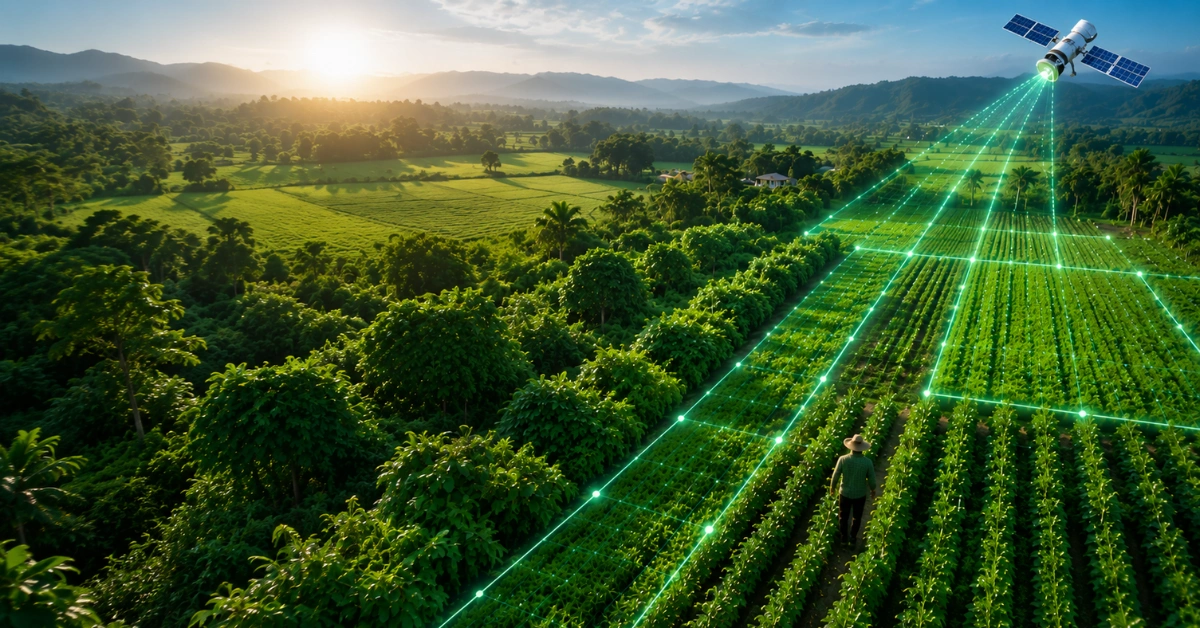
Carbon insetting is the practice of investing in greenhouse-gas reduction and carbon-sequestration projects within a company’s own supply chain typically through regenerative agriculture, agroforestry, and reforestation with direct suppliers. Unlike carbon offsetting (which buys credits from outside the value chain), insetting addresses Scope 3 emissions at their source, strengthens supplier relationships, and produces verifiable, traceable climate impact tied to the products a company actually sells.
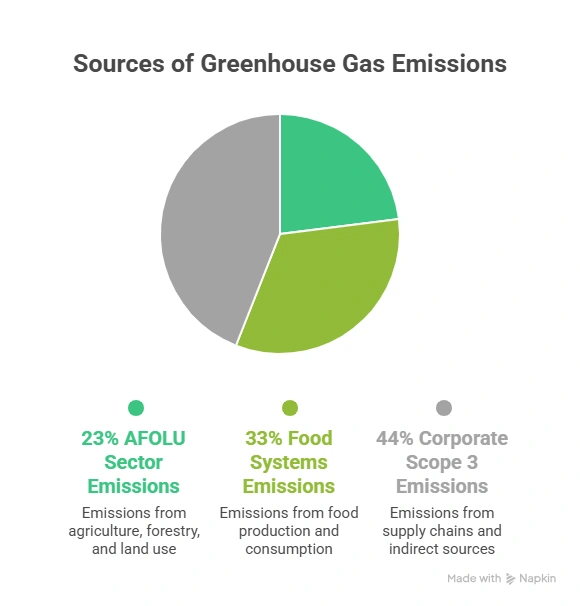
| Key takeaways Carbon insetting funds emission-reduction projects inside your own value chain not external offsets. It directly tackles Scope 3 emissions, which make up 70–90% of the footprint for most F&B and agribusiness companies. Typical projects: regenerative agriculture, agroforestry, reforestation, soil-carbon sequestration, and renewable energy at supplier level. Insetting is SBTi FLAG-aligned and EUDR / CSRD compatible when paired with farm-level DMRV. TraceX DMRV turns insetting into audit-ready, verifiable, traceable climate action. |
If you’re a Chief Sustainability Officer, ESG lead, Head of Climate Action, or Supply Chain Sustainability Manager at a food, beverage, FMCG, fashion, or agri-commodity company, you’re probably stuck in one of these traps right now:
Carbon insetting solves all five at once but only if it’s built on a foundation of farm-level, traceable, verifiable data. This guide shows you exactly what carbon insetting is, how it works in agricultural supply chains, the projects you can fund, the regulatory frameworks it aligns with, and how to verify the impact so it actually counts.
Carbon insetting is a corporate decarbonization strategy where a company funds emission-reduction or carbon-sequestration projects within the boundaries of its own supply chain — most commonly with the farmers, cooperatives, and landowners who already grow its raw materials.
In an agricultural context, this almost always means one or more of the following on supplier farms:
The defining feature: the emission reduction happens inside the same value chain that produces the company’s revenue. The carbon impact is tied to the actual products on the shelf not to a far-away project the company has no operational connection to.
| Dimension | Carbon Offsetting | Carbon Insetting |
|---|---|---|
| Where the project sits | Outside your value chain (anywhere in the world) | Inside your own supply chain (with your suppliers) |
| Emission scope addressed | Compensates for residual Scope 1–3 | Directly reduces Scope 3 at source |
| Mechanism | Buy credits from a project developer | Co-invest in projects with your own suppliers |
| Traceability | Often limited credits aggregated from many sources | Farm-level, parcel-level when DMRV is in place |
| Supply-chain effect | No direct supply impact | Strengthens supplier relationships, improves resilience and supply security |
| Co-benefits | Vary by project; often hard to verify | Biodiversity, soil health, farmer income, water quality measurable |
| Regulatory alignment | Limited under SBTi FLAG; under scrutiny | Recognized by SBTi FLAG, GHG Protocol Land Sector guidance |
| Reputational risk | Greenwashing accusations common in 2024–2026 | Defensible tied to actual products and suppliers |
Three converging pressures are forcing the shift from offsetting to insetting in 2026:
SBTi FLAG guidance now requires food, agriculture, and forestry companies to set Scope 3 land-use reduction targets and to report on land-use-change and land-management emissions inside their value chains. The EU’s CSRD and EUDR add deforestation due-diligence and disclosure requirements that offsets cannot satisfy. The bar for ‘verified’ is rising fast.
Offsets have been hit by multiple major investigations questioning their additionality, permanence, and double-counting. Boards and CFOs are now demanding climate claims tied to a company’s own products and operations. Insetting answers that demand because the impact is structurally inside the business.
Climate volatility drought in coffee-growing regions, flooding in rice belts, soil degradation in cotton zones is now a P&L risk. Insetting investments that build soil health, restore landscapes, and stabilize smallholder incomes don’t just cut emissions; they protect future supply.
Understand how SBTi FLAG guidance is reshaping climate targets for land-intensive industries. Explore our guide to learn how companies in agriculture, forestry, food, and land-use sectors can address emissions, removals, and deforestation commitments under the SBTi FLAG framework.
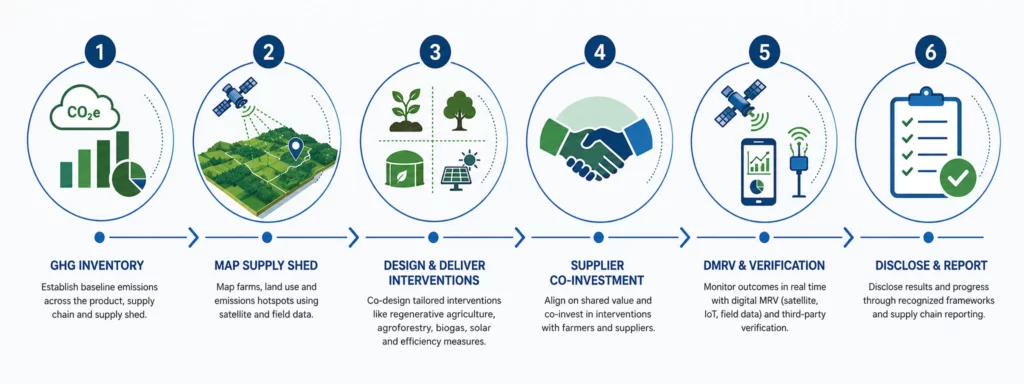
Here’s the end-to-end process most insetting programs follow. Treat this as a buyer’s checklist every credible program covers these steps.
Cover cropping, reduced or no-till, crop rotation, organic amendments, and integrated livestock all build soil organic carbon while improving water retention and yield resilience. This is the most-scalable insetting category for cropping-based supply chains like grains, oilseeds, and cotton.
See how a global agribusiness used TraceX to scale regenerative agriculture and sustainable land restoration initiatives. Explore how digital traceability, geospatial intelligence, field-level monitoring, and sustainability data workflows helped enable measurable environmental impact and resilient agricultural supply chains.
Combining trees with crops (alley cropping, silvopasture, shade systems) sequesters carbon in both biomass and soil. Especially relevant for coffee, cocoa, palm oil, and spice supply chains. Co-benefits include biodiversity, shade, and supplementary farmer income.
Restoring degraded land within sourcing landscapes riparian buffers, hedgerows, mangrove restoration adds carbon sinks and supports EUDR-aligned ‘no deforestation’ claims.
Improved feed, rotational grazing, anaerobic digesters, and methane-capture systems reduce one of the hardest-to-abate emission categories in animal-protein supply chains.
Solar dryers, biogas units, and efficient processing equipment reduce the energy intensity of post-harvest activities, especially in commodity supply chains with long aggregation and processing tails.
Most insetting programs stall at one of these five points. Recognize them early and you can plan around them.
Aggregated commodities (cocoa, coffee, palm, dairy) often pass through multiple traders before reaching the brand. Without farmer-level traceability, you can’t prove who reduced what and the reductions can’t be claimed under GHG Protocol Scope 3 guidance.
How to solve it: Deploy a farmer-onboarding and farm-mapping system before you commit to project funding. TraceX captures geo-mapped polygons, farmer IDs, and practice records that survive audit.
Discover how farm management systems can drive measurable sustainability outcomes. Explore our blog to learn how digital farm management enables traceability, regenerative agriculture tracking, resource optimization, compliance readiness, and data-driven sustainability across agricultural value chains.
Insets must be claimed once, by one party. SBTi FLAG, the GHG Protocol Land Sector guidance, and Value Change Initiative (VCI) protocols all have specific rules about who can claim what. Get it wrong and you face a restatement.
How to solve it: Use a DMRV system that records evidence at parcel level and applies internationally recognized standards (VCS, Gold Standard) or the Value Change Initiative methodology.
Explore how dMRV is transforming transparency and credibility in carbon projects. Learn how digital Monitoring, Reporting, and Verification (dMRV) enables real-time carbon tracking, geospatial validation, project integrity, and scalable reporting for carbon developers and climate programs.
Smallholders produce roughly a third of the world’s food but often lack digital literacy, smartphones, or reliable connectivity. Generic ESG software fails here.
How to solve it: Mobile-first, low-bandwidth, multi-language data capture with field officer workflows combined with satellite remote sensing for parcel-level verification without farmer burden.
Explore how TraceX enabled seamless field data capture, geolocation visibility, and connected farm management even in low-connectivity agricultural environments.
Manual MRV at scale is unworkable. Field audits across thousands of farms cost more than the projects produce.
How to solve it: Digital MRV (DMRV) blends remote sensing, IoT, and farm records to cut verification cost by an order of magnitude while improving evidence quality.
Even with great data, sustainability teams often struggle to tell the insetting story to investors, regulators, and customers without it sounding like marketing.
How to solve it: Tie every claim to a verifiable data point in your DMRV system. Show the parcel, the practice, the measured outcome, and the standard it was verified against. Boring evidence beats glossy claims.
Insetting only works if you can prove it. TraceX DMRV is purpose-built for the operational reality of agricultural supply chains fragmented, smallholder-heavy, multi-language, and audit-scrutinized.
Offsetting compensates for your emissions by funding a project anywhere in the world. Insetting reduces your emissions by funding projects with your own suppliers, inside your own value chain. Insetting changes the carbon footprint of the products you actually sell; offsetting only neutralizes them on paper.
Yes — when it’s done inside your value chain and verified to a recognized standard. SBTi FLAG guidance explicitly recognizes land-use removals and reductions inside the value chain. The key requirements are additionality, primary data, third-party verification, and proper attribution under GHG Protocol Land Sector guidance.
You need a mobile-first, offline-capable DMRV system combined with satellite remote sensing. Field officers onboard farmers and capture practice data on phones; remote sensing verifies land use and biomass at parcel level. This is the model TraceX solutions is built around designed for fragmented, smallholder supply chains.
The most widely recognized are Verra VCS, Gold Standard, Plan Vivo, the Value Change Initiative (VCI) methodology by SustainCert and Gold Standard, and the GHG Protocol Land Sector and Removals Guidance. Insetting programs should also align with SBTi FLAG and, where applicable, EUDR and CSRD disclosure requirements.
Per tonne, insetting projects often cost more than commodity offsets in the short term — but they deliver supply-chain resilience, supplier loyalty, regulatory-aligned Scope 3 reductions, and a defensible climate narrative that low-cost offsets cannot. Most companies who move to insetting report it pays back through reduced supply risk and brand value, not just carbon cost.
Regenerative agriculture (cover cropping, no-till, crop rotation), agroforestry, reforestation, soil-carbon sequestration, improved livestock and manure management, and renewable energy on supplier operations. The project must be inside your value chain, additional (would not have happened anyway), and verifiable.
A pilot covering one supply shed typically takes 6–9 months: 1–2 months for baseline and supply-shed mapping, 2–3 months for farmer onboarding and intervention design, 3–4 months for first measurement cycle. A full multi-geography program builds out over 18–36 months.
Yes, indirectly. EUDR requires geo-located, deforestation-free sourcing for seven commodities (cocoa, coffee, palm oil, rubber, soy, cattle, wood). The same farm-level mapping infrastructure that powers an insetting program also produces the EUDR due-diligence evidence so most companies deploy them together.









