
Quick summary: Timber chain of custody breaks at processing. Learn how to maintain origin integrity across sawmills, traders & exporters and automate EUDR compliance. | TraceX

Chain of custody in timber supply chains is the documented, verifiable trail tracking every custody transfer of wood products from forest concession through sawmills, trading companies, and processors to the final buyer. For EUDR compliance and sustainability certification, this trail must remain unbroken; a single undocumented handoff is enough to invalidate an entire shipment’s legal origin claims.
Here’s the problem nobody in the timber trade talks about openly: most companies can’t actually trace where their wood came from.
Not because they don’t want to. But because their chain of custody systems paper manifests, spreadsheet logs, PDF certificates were never designed for the demands of the EU Deforestation Regulation. And with EUDR enforcement active for large operators and SME deadlines arriving in June 2026, the gap between what regulators require and what companies can prove is creating a market-access crisis.
Forest Trends has highlighted that timber supply chains often pass through multiple processing intermediaries, which can weaken origin-data integrity and make traceability harder. This guide breaks down exactly how timber chain of custody works, where it fractures, what EUDR demands, and how digital traceability closes the gap permanently.
Chain of custody (CoC) in timber is the sequential, documented record of who held custody of a wood product at each stage of its journey from harvest authorisation in a forest concession to the final invoice issued to an EU buyer. Certification schemes like FSC (Forest Stewardship Council) and PEFC (Programme for the Endorsement of Forest Certification) have formalised this into audit-ready standards used by buyers and certifiers worldwide.
But CoC in practice is far more operationally complex than a certificate suggests. It requires:
The FSC Chain of Custody Standard (FSC-STD-40-004) and PEFC Chain of Custody Standard (PEFC ST 2002:2020) provide the auditable framework. But standards compliance alone doesn’t create data and in an era where EUDR demands machine-readable GPS polygon coordinates for every sourcing parcel, paper-based CoC systems are structurally incapable of meeting the bar.
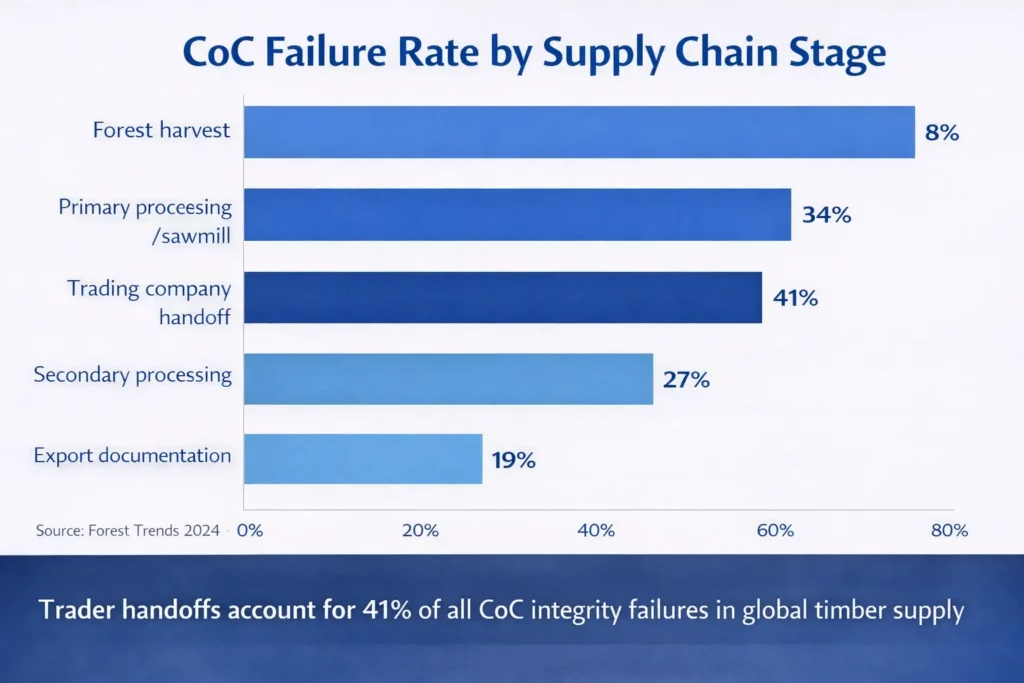
Chain of custody doesn’t fail uniformly it breaks at specific, predictable chokepoints. Understanding these failure modes is the first step to building a system that survives audit pressure.
Sawmills and veneer plants are the first major custody risk point. When logs from multiple sources, different forest concessions, different legal authorisation dates, different risk geographies enter a single processing facility without rigorous lot segregation and input-output yield tracking, origin integrity is lost. WWF’s Forest Practice materials highlight processing facilities as a significant source of chain-of-custody integrity risk, but the exact share of failures needs the original report to verify.
Trading companies are the single biggest CoC failure point. When a timber trader buys from multiple processor-suppliers and sells mixed lots to downstream buyers, the documentation trail typically collapses into generic certificates that state species and volume but not forest-of-origin coordinates. This is where substitution fraud mixing legal timber with unknown-origin material most commonly occurs.
Smallholder and community forest concessions supply an estimated 30-40% of tropical timber in Southeast Asia and they lack the digital infrastructure to generate the GPS polygon, plot boundary, and harvest authorisation records that EUDR now requires. This isn’t a certification gap; it’s a data infrastructure gap that no paper form can fix.
Non-compliance penalties: Up to 4% of EU annual turnover per violation | Shipment seizure at port of entry | Permanent ban from EU market for repeat offenders | 10-15% of current timber trade flows classified at high deforestation risk under EUDR criteria
The EU Deforestation Regulation (EU 2023/1115) came into force on June 29, 2023. Large operators faced a December 30, 2025 deadline. SMEs have a revised deadline of June 30, 2026. Timber is one of seven regulated commodity categories.
EUDR requires operators placing timber on the EU market to:
The critical insight: EUDR doesn’t just require a certificate. It requires geospatial data GPS polygon coordinates at plot level that paper-based CoC systems cannot produce or store. A timber exporter with FSC certification but without GPS-linked harvest records will still fail a EUDR audit.
Digital CoC platforms replace chains of paper documents with a continuous, machine-readable data trail that follows the physical product through every custody transfer. Here’s how origin integrity is maintained at each stage:
Field agents capture GPS polygon boundaries for every forest plot, log authorisation numbers, harvest dates, and species data. In remote areas without connectivity, offline-first mobile apps capture and sync data when a connection is available. This foundational record is what everything downstream references.
When logs arrive at a sawmill, digital systems assign unique lot identifiers linked to the forest-of-origin GPS records. Input and output volumes are reconciled within permitted yield ranges. Any unexplained volume discrepancy triggers an alert. Lot-splitting and lot-merging are recorded with full parent-lot linkage.
When title passes from processor to trader, a digital custody transfer record captures lot ID, GPS origin references, volume, species, and certification status. Blockchain-backed systems make this record tamper-proof no party can retroactively alter what was declared at the time of transfer.
At export, the platform aggregates all upstream custody records and automatically generates the EUDR Due Diligence Statement GPS coordinates, satellite deforestation verification, supplier KYC, and risk assessment already populated. What previously took compliance teams days of manual assembly happens in minutes.
| Tracking Method | Paper / Manual | Basic ERP / Spreadsheet | Digital CoC Platform (TraceX) |
|---|---|---|---|
| Origin verification | No verification | Partial batch-level | GPS polygon + satellite validation |
| Processing traceability | Manual logs only | Batch-level only | Lot-split/merge tracking |
| EUDR DDS automation | Manual creation | Semi-manual | Auto-generated and submitted |
| Fraud/substitution risk | Very high | Medium | Low – blockchain-backed |
| Audit readiness | Days to compile | Hours | One-click export |
| Smallholder support | None | None | Offline mobile, multilingual |
| Deforestation alerts | None | None | JRC/Hansen satellite |
Blockchain’s role in timber CoC is specific and functional not about cryptocurrency. It’s about creating an immutable, time-stamped record of every custody transfer that no single party can retroactively alter.
In practice: when a sawmill records receiving 200 cubic metres of teak from GPS lot #TH-2024-1127 on a specific date, that record is cryptographically locked. If a trader three steps downstream claims 250 cubic metres from the same lot, the discrepancy is mathematically visible.
Traditional CoC audit systems are backward-looking they investigate fraud after detection. Blockchain-backed CoC systems are prospectively fraud-resistant making volume inflation and origin substitution detectable in real-time, before shipments reach EU ports. This is the fundamental shift in compliance architecture that EUDR rewards.
TraceX’s blockchain-backed traceability layer means every GPS plot record, custody transfer, and volume reconciliation creates a tamper-proof single source of truth that EU customs authorities, FSC auditors, and corporate buyers can independently verify.
This is the question certification standards don’t answer and where most CoC programs fail in practice. Over 70% of tropical timber sourcing in Southeast Asia involves forest plots in areas with unreliable mobile connectivity and low digital literacy among plot holders. Any CoC system requiring constant internet or complex interfaces is effectively excluding the origin data it most needs to capture.
The solution requires three design principles absent from most enterprise traceability tools built for Western markets:
Field agents must be able to open a mobile app in a forest concession with zero signal, capture GPS plot boundaries, photograph harvest authorisation documents, and record volume data with all records syncing automatically when connectivity is restored. This isn’t optional; it’s the only way to build credible CoC data from tropical timber sources.
Timber concession holders in Indonesia, Malaysia, Vietnam, or Central Africa cannot navigate an English-language portal. Supplier onboarding portals and field apps must operate in local languages this is an accessibility requirement, not a preference.
Harvest permits, land tenure documents, and KYC records exist as scanned PDFs or photos. Agentic AI that automatically extracts relevant data fields concession numbers, boundary coordinates, authorisation dates, species permits from unstructured documents dramatically reduces manual data-entry burden at origin. TraceX’s agentic AI layer does exactly this: parsing supplier documents automatically to populate compliance records without requiring a data-entry operator at each supply chain node.
Implementing digital chain of custody doesn’t require rebuilding your supply chain. It requires connecting the data points that already exist harvest permits, sawmill intake logs, export invoices into a single continuous trail. Here’s a practical implementation sequence:
Timber chain of custody has always been a quality and sustainability signal. Under EUDR, it’s become a hard market access requirement with GPS verification, satellite deforestation screening, and automated DDS submission as the technical floor.
The companies that will maintain EU market access through 2026 and beyond aren’t those with the most paper certificates. They’re the ones who’ve replaced fragmented, paper-based CoC systems with continuous digital data trails GPS-linked from the forest plot, blockchain-backed through every custody transfer, and audit-ready at every stage.
TraceX is built for exactly this challenge. Purpose-designed for commodity supply chains across timber, rubber, palm oil, and agri-commodities in emerging markets, TraceX EUDR Solutions combines GPS polygon mapping, blockchain-backed lot tracking, AI-powered document parsing, and automated EUDR DDS generation including offline mobile data capture for remote forest concessions that most enterprise tools ignore.
Struggling to manage forest compliance data? Discover the tools that simplify traceability, risk assessment, and EUDR readiness – read our blog.
FSC-certified wood supports sustainable sourcing but does it meet EUDR requirements? Find out in our detailed blog.
EUDR compliance for timber goes beyond documentation. Discover what it takes to meet requirements and avoid market risks – read our guide.
Chain of custody certification for timber is a third-party verified system typically under FSC or PEFC standards documenting custody transfer of wood products at every step from forest harvest to final sale. Certification confirms that the volume and species claimed can be traced to a legal, certified forest source with records at each processing and trading stage. Under EUDR, certification is a supporting document, not a substitute for GPS data submission.
FSC (Forest Stewardship Council) is more commonly required by EU and North American buyers, covering both forest management and CoC. PEFC (Programme for the Endorsement of Forest Certification) recognises multiple national schemes and has broader adoption in Europe and Australasia. For EUDR compliance, neither certification replaces the GPS plot data and DDS submission the regulation independently requires they are complementary, not equivalent.
EUDR creates a legal GPS data requirement independent of FSC/PEFC certification: operators must provide GPS polygon coordinates for every forest parcel, verify no deforestation after December 31, 2020, and submit a Due Diligence Statement via EU TRACES before market placement. Companies with FSC certification but without digital GPS data systems will still be non-compliant under EUDR. The regulation applies to timber and all timber-derived products including furniture, paper, and packaging.
EUDR non-compliance consequences include: fines up to 4% of total EU annual turnover per violation, shipment seizure and prohibition from EU market entry, confiscation of products and revenues, and temporary exclusion from EU public procurement. Repeat violations can result in permanent market exclusion. Beyond regulatory penalties, CoC failures trigger buyer contract cancellations and reputational damage difficult to reverse in sustainability-sensitive procurement markets.
SMEs have a revised EUDR deadline of June 2026, but data requirements are identical to large operators. Practical options include: joining industry-level GPS data collection programs coordinated by exporters or certification bodies, using low-cost offline mobile apps for GPS plot capture without full enterprise deployment, partnering with buyers who provide CoC infrastructure as part of supplier onboarding, and using cloud-based platforms with volume-based pricing rather than large upfront investment.