
Quick summary: CLMRS, Child Labour Monitoring and Remediation Systems, are structured, field-led systems that identify children in or at risk of child labour in cocoa-growing communities and deliver targeted support until those children are permanently removed from risk. When paired with digital traceability platforms, CLMRS also generates the farm-level data cocoa businesses now need to meet EUDR […]

CLMRS, Child Labour Monitoring and Remediation Systems, are structured, field-led systems that identify children in or at risk of child labour in cocoa-growing communities and deliver targeted support until those children are permanently removed from risk. When paired with digital traceability platforms, CLMRS also generates the farm-level data cocoa businesses now need to meet EUDR compliance requirements, ESG mandates, and buyer due diligence obligations. For cocoa exporters sourcing from West Africa, digitising CLMRS is no longer optional; it is the foundation of a compliant, auditable, and commercially viable supply chain.
Cocoa is the world’s most scrutinised soft commodity. Around 5-6 million smallholder farms, most under five hectares, produce roughly 90% of the global cocoa supply. Two countries, Côte d’Ivoire and Ghana, account for approximately 60% of that production. And in those same communities, child labour is pervasive, deforestation is accelerating, and regulatory pressure from the EU is intensifying fast.
Morningstar Sustainalytics recorded 612 human rights incidents linked to food supply chains between 2014 and 2024, and 27% of them were incidents of child labour on cocoa farms. At the same time, the EU Deforestation Regulation (EUDR) is forcing every cocoa exporter targeting the EU market to prove deforestation-free sourcing at the plot level, or risk losing market access entirely.
The industry’s response? CLMRS, Child Labour Monitoring and Remediation Systems. But CLMRS alone is no longer enough. The companies winning on both compliance and commercial positioning are the ones integrating CLMRS data into end-to-end digital traceability platforms, turning social protection systems into compliance infrastructure.
Explore the tools exporters need for EUDR cocoa compliance. Learn how to simplify traceability, risk assessment, and DDS submission.
A Child Labour Monitoring and Remediation System (CLMRS) is a child-centred support mechanism built to identify children in, or at risk of, child labour in agricultural supply chains and then systematically reduce that risk over time. Unlike audit-based approaches that produce point-in-time snapshots, CLMRS is an ongoing, community-embedded system.
These four activities must operate as a continuous cycle, not an annual audit, to meet the CLMRS Core Criteria established by the International Cocoa Initiative (ICI).
Community-embedded monitoring can improve case detection and follow-up compared with external audits alone, especially where child-labour risks are hard to observe.
Despite more than a decade of investment from industry bodies, NGOs, and major chocolate companies, the International Cocoa Initiative estimates that CLMRS currently covers only around 25% of the cocoa supply chain in Cote d’Ivoire and Ghana. The goal was 100% by 2025. The gap is stark and it comes down to three structural problems.
Most cocoa is grown by subsistence farmers in remote, poorly connected regions. Collecting GPS plot coordinates, household data, and child labour indicators from thousands of dispersed smallholders without digital infrastructure is expensive, slow, and error-prone. When paper forms are used, data enters the system weeks late if at all.
Running a CLMRS at enterprise scale requires hundreds of trained Community Facilitators. In Nestle’s system, 1,640 monitors track the families of over 86,000 children in Cote d’Ivoire alone. Scaling this model to 100% of supply chains without digital tools to reduce cost per household is economically unsustainable for most mid-market exporters.
Many companies run CLMRS as a standalone social programme disconnected from their commercial supply chain data. This means the remediation data never feeds into EUDR compliance documentation, ESG reporting, or buyer due diligence workflows. The systems exist, but don’t compound.
Tony’s Chocolonely data shows that at longer-term partner cooperatives where CLMRS has operated for multiple seasons, child labour rates drop to 4.4%, compared to a 10.5% rate across newer relationships. This proves that sustained, integrated CLMRS delivers compounding impact.
Is your cocoa supply chain CLMRS-ready and EUDR-compliant?
TraceX’s Sustainable Sourcing Platform digitises farmer onboarding, GPS plot mapping, CLMRS data collection, and EUDR Due Diligence Statements in one connected system built for emerging-market supply chains. Explore our Solutions
The EU Deforestation Regulation (EUDR), effective December 30, 2026, for large operators, mandates that all cocoa entering the EU market must be fully traceable to deforestation-free farm plots verified through GPS polygon mapping and satellite cross-referencing. For cocoa, this is among the most demanding compliance regimes ever enacted for an agricultural commodity.
Every batch of cocoa beans or derivative product entering the EU now requires a Due Diligence Statement (DDS) submitted through the EU TRACES system. That DDS must include: verified geolocation data for every farm plot; risk assessment against JRC and Hansen satellite deforestation datasets; and legal compliance evidence for the producing country.
A study in the Cavally region of Cote d’Ivoire found that approximately 30% of farm plot data collected on the ground failed to meet EUDR reliability standards. This isn’t a data entry problem; it’s a systems problem. The only scalable solution is digital-first field data capture at the point of farmer interaction.
Explore how to achieve EUDR compliance in cocoa supply chains. Learn the key requirements, data needs, and steps to stay export-ready.
Here is the strategic insight most cocoa businesses are missing: CLMRS field operations and EUDR compliance data collection are conducted in the same households, at the same time, by the same community agents. Integrating these workflows rather than running them as separate programmes is the single highest-leverage efficiency gain available to cocoa supply chain operators right now.
Explore how digital traceability enables EUDR compliance. Learn how to track sourcing, validate data, and meet regulatory requirements with confidence.
| Data Point | CLMRS Purpose | EUDR Compliance Value |
|---|---|---|
| Farm household GPS location | Map family to supply chain node | Farm plot geolocation for DDS |
| Land parcel boundaries | Identify farm context for child exposure | Polygon mapping for deforestation check |
| Farmer identity and KYC | Family profile for remediation planning | Supplier identity verification |
| Crop season records | Seasonal child labour risk assessment | Harvest traceability for batch tracking |
| Community context data | Root cause analysis for remediation | Legal compliance documentation |
When CLMRS and traceability workflows are unified on a single digital platform, the cost of EUDR compliance drops dramatically because the data already exists. The investment is in the integration layer, not in building parallel field operations.
Mondelez’s Cocoa Life programme scaled CLMRS to cover 89% of West African Cocoa Life communities by the end of 2024, conducting 240,000 interviews in the process, demonstrating that enterprise-scale digital CLMRS is achievable before the EUDR deadline.
Building a system that satisfies both child labour monitoring obligations and EUDR compliance requirements demands five non-negotiable capabilities:
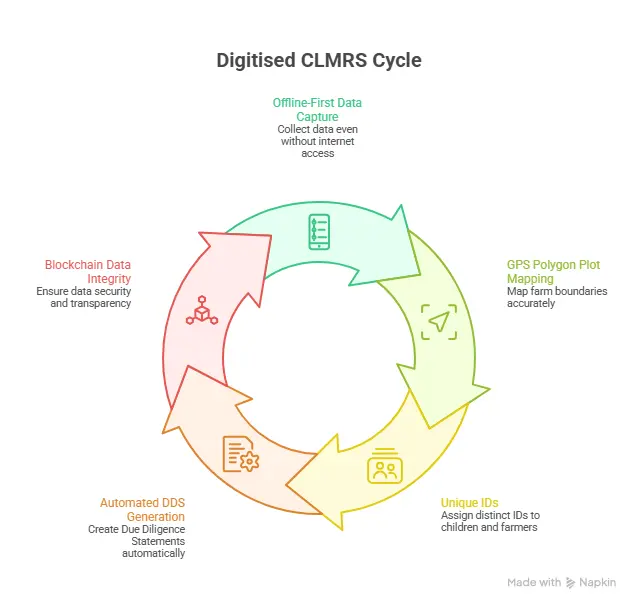
Community Facilitators work in areas with limited or no internet connectivity. Any digital CLMRS must function offline, syncing data to the cloud when a connection is available. Without this, field agents revert to paper, and the data integration breaks.
Each farm household must be geotagged with polygon-level precision, validated against satellite deforestation datasets. Point coordinates are no longer sufficient for EUDR; the regulation prefers polygon boundaries, particularly for plots over 4 hectares.
Nestle’s CLMRS assigns each monitored child a unique code to track progress across multiple seasons. The same unique ID logic must apply to farmers for supply chain traceability: each farmer node must be persistent and verifiable across harvests.
When CLMRS data is connected to compliance workflows, generating EUDR Due Diligence Statements should require minimal manual effort. An AI-powered platform can auto-parse farmer KYC documents, match plot coordinates to satellite data, and populate DDS templates ready for TRACES submission.
EUDR auditors and EU buyers need to know the data hasn’t been tampered with. Immutable blockchain records provide a tamper-proof audit trail from farmgate to export, a capability that standard databases cannot replicate.
This is exactly the capability stack that TraceX delivers: offline mobile apps for field agents, GPS polygon capture, automated DDS generation via agentic AI, and blockchain-backed immutability designed specifically for emerging-market supply chains where connectivity, language, and digital literacy are real barriers.
| Dimension | CLMRS (Integrated Digital) | Third-Party Audit |
|---|---|---|
| Frequency | Continuous (quarterly visits) | Annual snapshot |
| Community access | Trusted local facilitators | External auditors (lower trust) |
| Data depth | Child-level, household-level records | Farm-level compliance check |
| Remediation | Built-in support delivered in-system | Referral to external bodies |
| EUDR data utility | GPS, KYC, crop data captured simultaneously | Minimal compliance data generated |
| Scalability | Digitally scalable to thousands of farms | Cost-prohibitive at scale |
| Impact durability | Compounding rate drops with tenure (4.4% vs 10.5%) | Resets each cycle |
The commercial argument for CLMRS over audits is now decisive: audits generate liability documentation. CLMRS generates impact evidence, compliance data, and buyer trust simultaneously.
TraceX’s Sustainable Sourcing Platform and Regulatory Compliance Platform are built to work as a unified stack for cocoa supply chains. Here is how the integration works end-to-end:
Field agents use TraceX’s offline-first mobile app to onboard farmers with GPS-tagged plots, land records, and household demographics even in zero-connectivity environments. The same onboarding captures the data required for both CLMRS household monitoring and EUDR plot verification.
TraceX’s agentic AI layer auto-extracts KYC documents, land tenure records, and certification evidence from supplier communications, populating EUDR Due Diligence Statements without manual data entry. This reduces DDS creation from days of effort to minutes.
Every GPS polygon captured in the field is automatically cross-referenced against JRC and Hansen satellite datasets for deforestation risk. Real-time alerts flag at-risk plots before they appear in an audit, not after.

All CLMRS data, farmgate transactions, and compliance documentation are written to an immutable blockchain record, providing the tamper-proof audit trail that EUDR enforcement authorities and EU buyers require.
TraceX is purpose-built for the realities of cocoa supply chains in West Africa and Southeast Asia. Multilingual supplier portals, low-bandwidth mobile apps, and smallholder-first onboarding flows make adoption possible at the last mile.
EUDR compliance requires trusted data. Discover how blockchain ensures transparency, immutability, and audit-ready records.
For procurement leaders, sustainability heads, and compliance managers at cocoa exporters and F&B brands, the operational blockers are well-known:
TraceX’s field app digitises the collection process: agents capture polygon GPS, household data, and CLMRS indicators in one visit, with offline sync. No paper, no duplication, no data gaps.
Agentic AI automation reduces DDS creation to a near-automated workflow, parsing supplier documents, populating templates, and flagging risk exceptions before submission to EU TRACES.
Blockchain-backed records on TraceX provide an immutable, real-time single source of truth from farmgate to export documentation, accessible to internal teams, auditors, and EU buyers.
TraceX’s Digital MRV platform calculates Scope 3 emissions from primary supply chain data (not industry averages), supports CSRD reporting, and generates audit-ready carbon and sustainability reports aligned to SBTi and TNFD standards.
The cocoa industry’s child labour challenge and its EUDR compliance challenge are, at their root, the same challenge: a structural absence of reliable, verifiable, farm-level data from the last mile of the supply chain. CLMRS was built to address the social dimension of this gap. EUDR was built to address the environmental dimension. And digital traceability platforms are the connective tissue that makes both work simultaneously.
The companies that will lead the next decade of cocoa trade on price premiums, buyer relationships, and regulatory standing are the ones investing now in integrated digital systems that turn field agent visits into multi-purpose data events: collecting CLMRS indicators, GPS coordinates, and compliance documentation in a single interaction.
TraceX exists to make that integration possible for cocoa exporters, F&B brands, development organisations, and sustainability teams who can’t afford to run two parallel infrastructure programmes to solve one structural problem.
CLMRS stands for Child Labour Monitoring and Remediation System. In cocoa supply chains, it is a continuous community-based programme that identifies children in or at risk of child labour through regular household visits, provides tailored remediation support, and monitors each child’s situation until they are permanently removed from risk. When implemented properly, CLMRS can reduce child labour by over 50% over three years.
CLMRS is not explicitly mandated by the EUDR, but the farm-level household data that CLMRS generates, GPS coordinates, farmer KYC, and land records, is directly required for EUDR Due Diligence Statements. Companies that have already invested in digital CLMRS are therefore in a far stronger position to achieve EUDR compliance efficiently, because the foundational data infrastructure already exists.
As of 2023, the International Cocoa Initiative estimates that CLMRS covers approximately 25% of the cocoa supply chain in Côte d’Ivoire and Ghana. The ICI’s original target was 100% coverage by 2025. Major buyers, including Nestle, Mondelez, Hershey, and Tony’s Chocolonely, have made significant progress, but closing the coverage gap requires scalable digital tools to overcome last-mile data collection barriers.
An effective digital CLMRS for EUDR compliance requires: offline-first mobile data capture for field agents; GPS polygon mapping validated against satellite deforestation datasets; unique persistent IDs for farmers and children; automated DDS generation with AI document parsing; and blockchain-backed data integrity for audit-proof records. Platforms like TraceX bundle all these capabilities into a single system designed for emerging-market supply chains.
Large operators and traders placing cocoa on the EU market must comply with EUDR from December 30, 2026. Micro and small enterprises have until June 30, 2027. Non-compliance risks shipment rejection, fines of up to 4% of annual EU turnover, and loss of EU market access. Given the complexity of collecting farm-level geolocation data from thousands of smallholders, early digitalisation of the supply chain is essential.