
Quick summary: Circular Economy Action Plan (CEAP): Discover how the EU’s systemic circular economy framework reshapes product design, supply chains, reporting, and compliance under the Green Deal and what it means for businesses operating in or exporting to the EU.
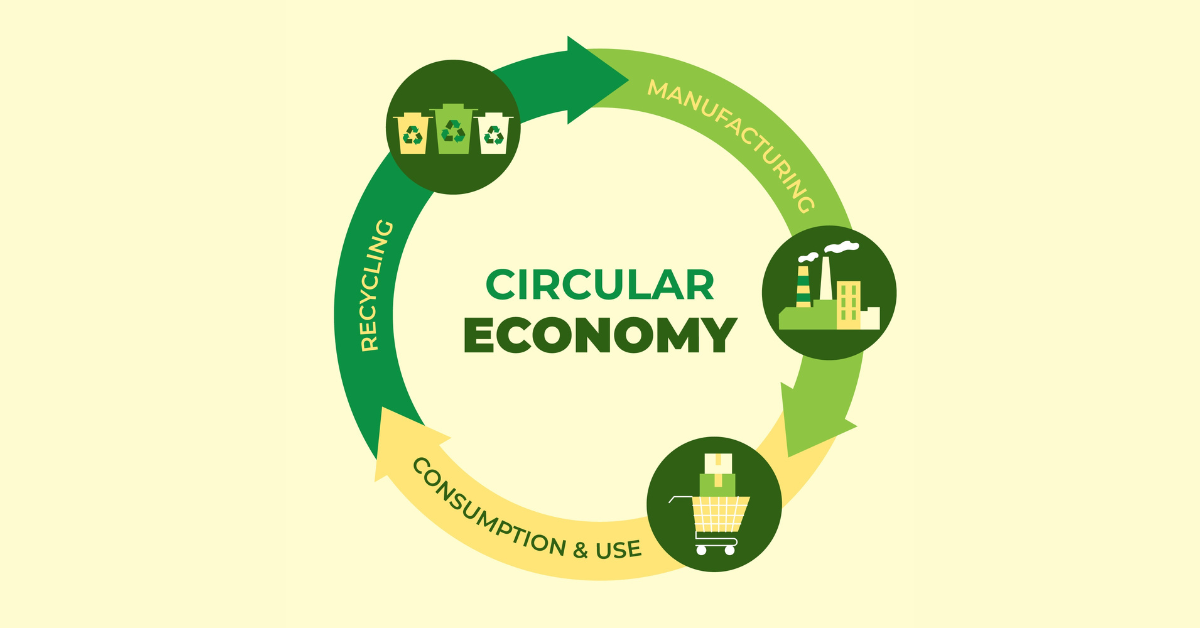
For years, sustainability was treated as a corporate commitment a goal to work toward, a report to publish, a strategy to refine over time. That era is over. The European Union is no longer encouraging circularity, it is mandating it. Through the Circular Economy Action Plan (CEAP), sustainability has shifted from voluntary ambition to enforceable policy, reshaping how products are designed, manufactured, distributed, and recovered across the EU market.
For businesses operating in or exporting to Europe, the pressure is mounting. Product design requirements are tightening. Supply chain transparency expectations are expanding. Reporting obligations are becoming more structured. Waste and material recovery standards are increasing. And digital traceability is fast becoming non-negotiable.
The real pain point isn’t awareness it’s readiness.
Many companies understand the concept of circularity, but lack the systems, data architecture, and cross-functional alignment required to comply at scale. The risk? Product redesign delays, regulatory exposure, disrupted market access, and competitive disadvantage.
The question is no longer whether circular practices matter.
The question is whether your business is operationally prepared for systemic change.
Key Takeaways
The Circular Economy Action Plan (CEAP) is the European Union’s policy framework under the EU Green Deal aimed at transitioning from a linear “take-make-dispose” economy to a circular model that prioritizes product durability, reuse, recycling, and resource efficiency across sectors.
Introduced under the EU Green Deal, CEAP sets the foundation for new regulations that impact product design standards, material transparency, waste reduction, digital product tracking, and supply chain accountability. For businesses operating in the EU, it signals a structural shift from voluntary sustainability efforts to enforceable circular economy requirements.
CEAP is just one pillar of a much broader transformation. The EU Green Deal is reshaping climate policy, industrial reform, and sustainability regulation across Europe.
Read Our Complete Guide to the EU Green Deal
Circularity isn’t just policy it’s a new economic model built around durability, reuse, and lifecycle transparency.
Explore Our In-Depth Circular Economy Guide
The Circular Economy Action Plan (CEAP) was introduced as a structural response to mounting environmental, economic, and geopolitical pressures facing the European Union.
At its core, CEAP’s strategic objective is to decouple economic growth from resource consumption ensuring that Europe can continue to grow economically without proportionally increasing material use, waste, and environmental impact.
The shift from a linear to a circular model represents more than a change in waste management it is a systemic redesign of how economies function.
In the traditional linear model, value creation depends on continuous extraction of raw materials. Products are manufactured, consumed, and ultimately discarded. Growth is directly tied to increasing resource use, short product lifecycles, and waste generation. Traceability is limited, and once a product leaves the factory, visibility largely disappears.
The circular model reverses this logic. Products are designed intentionally for longevity, repairability, modularity, and recyclability from the outset. Materials are viewed as assets rather than disposable inputs. Waste becomes a recoverable resource that re-enters the production cycle. Instead of “end-of-life,” products move through extended lifecycles reuse, refurbishment, remanufacturing, and recycling.
This transformation also requires full lifecycle transparency. Data must follow the product from raw material sourcing to manufacturing, distribution, use, repair, and end-of-life recovery. Digital traceability systems become foundational, enabling regulators, manufacturers, and consumers to verify sustainability claims and material flows.
Ultimately, the systemic transformation under CEAP shifts the economy from one based on extraction and disposal to one based on regeneration and value preservation decoupling growth from resource depletion while increasing resilience, competitiveness, and accountability.
| Feature | Linear Model (“The Old Way”) | Circular Model (“The 2026 Way”) |
| Core Workflow | Take → Make → Dispose: Raw materials are extracted, used once, and discarded. | Design → Use → Reuse → Recycle: Closed-loop systems prioritize regeneration. |
| Product Lifespan | Planned Obsolescence: Short cycles designed to drive frequent replacements. | Extended Durability: Products are designed for easy repair, modularity, and upgrades. |
| Waste Perception | End-Point: Waste is a liability to be managed (landfills/incineration). | Resource: Waste is “secondary raw material” to be fed back into production. |
| Traceability | Limited Transparency: Origins are often opaque; supply chain “blind spots” are common. | Lifecycle Transparency: Digital Product Passports track every material from birth to rebirth. |
| Business Value | Profit per Unit: Success is measured by the number of new items sold. | Profit per Service: Revenue comes from leasing, repairs, and “Product-as-a-Service” (PaaS). |
| Compliance Risk | High: Faces bans on destroying unsold goods and heavy EPR (Extended Producer Responsibility) fees. | Low: Aligned with ESPR 2026 mandates; eligible for “Green Public Procurement” incentives. |
At the core of CEAP is the transformation of product design. The EU recognizes that up to 80% of a product’s environmental impact is determined at the design stage. Therefore, CEAP expands eco-design requirements beyond energy-related products to cover a broader range of goods placed on the EU market.
What This Means:
Eco-Design Expansion
Products must now meet environmental performance standards that consider durability, reparability, energy efficiency, and material use not just functionality and cost.
Digital Product Passports (DPP)
Products will require structured digital records containing lifecycle data such as material composition, carbon footprint, repair instructions, and recycling guidance. This enables traceability and regulatory oversight.
Durability & Repairability Requirements
Manufacturers must design products that last longer, can be repaired, and are not prematurely obsolete. This directly challenges planned obsolescence models.
Mandatory Recycled Content Targets
Certain sectors will be required to incorporate minimum levels of recycled materials, reducing reliance on virgin resource extraction.
Strategic Impact: Product development, sourcing strategies, supplier qualification, and data systems must evolve to support lifecycle-based compliance.
CEAP prioritizes high-impact sectors that consume large volumes of resources or generate significant waste.
Electronics & ICT
Batteries & Vehicles
Packaging
Plastics
Textiles
Construction & Buildings
Food Systems
Strategic Impact: Companies operating in these sectors face phased regulatory tightening, requiring proactive redesign and traceability alignment.
CEAP shifts focus from managing waste to preventing it at the source.
Waste Reduction Targets
The EU is setting measurable reduction goals across multiple industries to reduce material consumption and disposal rates.
Landfill Reduction
Landfilling is increasingly discouraged, pushing companies toward recycling, recovery, and reuse models.
Extended Producer Responsibility (EPR)
Producers are made financially and operationally responsible for post-consumer waste management. This incentivizes better design and lifecycle planning.
Circular Public Procurement
Governments are encouraged to prioritize sustainable and circular products in public contracts, creating demand-side pressure for compliance.
Strategic Impact: Companies must account for end-of-life management costs and integrate reverse logistics into business models.
Digital infrastructure is the backbone of CEAP implementation. Circularity at scale requires structured, interoperable, and verifiable data.
Digital Product Passports
Enable regulators, consumers, and recyclers to access reliable product data across the lifecycle.
Lifecycle Traceability
Material origin, transformation processes, and recovery stages must be digitally trackable.
Material Transparency
Companies must disclose what materials are used, where they come from, and how they can be reused or recycled.
Data Interoperability
Systems across manufacturers, suppliers, regulators, and recyclers must communicate seamlessly. This requires standardized, machine-readable data architectures.
Strategic Impact: Digital traceability and compliance technology are no longer optional enhancements they are foundational infrastructure for market access under CEAP.
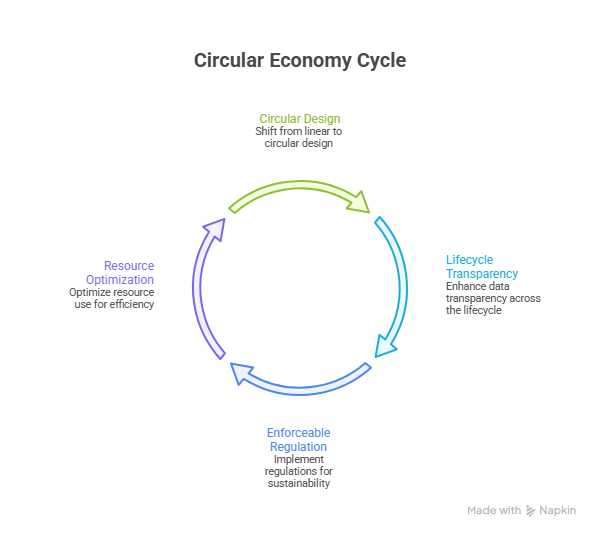
The Circular Economy Action Plan (CEAP) is not a high-level sustainability vision it directly affects how companies design products, manage supply chains, allocate capital, and structure operations. Its impact spans compliance, operational processes, and financial strategy.
Product Redesign Obligations
Companies must reassess how products are engineered. Durability, repairability, recyclability, and recycled content are becoming regulatory expectations rather than optional sustainability features. Product development cycles may need restructuring to meet eco-design standards.
Reporting & Disclosure Requirements
CEAP-linked regulations require structured, verifiable data reporting. This includes product lifecycle information, material composition, environmental performance, and digital product passport data. Compliance becomes data-driven and audit-sensitive.
Supply Chain Transparency
Businesses must gain deeper visibility into upstream suppliers. Material origin, processing methods, and sustainability credentials must be documented and traceable across tiers.
Material Sourcing Accountability
Companies are increasingly responsible for the environmental footprint of raw materials. This may require switching suppliers, verifying recycled content claims, or redesigning procurement policies.
Compliance shifts from policy statements to enforceable operational controls.
Procurement Restructuring
Procurement teams must incorporate circular criteria into supplier selection. Cost and quality are no longer the only decision drivers environmental performance and traceability become key evaluation metrics.
New Supplier Qualification Criteria
Suppliers may be required to provide structured lifecycle data, digital documentation, and evidence of sustainable sourcing. This raises the entry bar for supplier onboarding.
Data Capture & Lifecycle Tracking
Organizations must implement systems capable of collecting, storing, and exchanging lifecycle data often across multiple internal platforms (ERP, PLM, traceability tools). Digital infrastructure becomes foundational.
Reverse Logistics Integration
Circularity requires planning for product return, refurbishment, recycling, and material recovery. Reverse logistics must be integrated into core operations, not treated as an afterthought.
Operational complexity increases but so does resilience and visibility.
Capital Investments
Companies may need to invest in product redesign, new materials, digital systems, supplier audits, and process reengineering. Short-term costs may increase during transition.
Innovation & Funding Opportunities
The EU offers funding mechanisms and green finance incentives for circular innovation. Businesses that align early may access grants, subsidies, or sustainability-linked financing.
Competitive Advantage for Early Adopters
Early movers can differentiate on sustainability performance, strengthen brand trust, secure long-term contracts, and reduce regulatory disruption risks. Late adopters may face rushed compliance costs and market access barriers.
CEAP transforms sustainability from a cost center into a strategic investment area.
The Circular Economy Action Plan (CEAP) is not a standalone initiative it is a core pillar of the EU Green Deal, serving as the operational framework that translates climate ambitions into industrial and product-level transformation.
CEAP acts as a foundational policy driver, aligning multiple regulatory instruments that collectively reshape how products are designed, reported, traded, and regulated within the EU market.
Here’s how CEAP integrates with key EU regulations:
The EU Taxonomy defines which economic activities are considered environmentally sustainable for investment purposes.
CEAP supports the Taxonomy by:
In essence, CEAP provides the operational criteria that help companies qualify as “sustainable” under the Taxonomy framework. Without circular practices, meeting Taxonomy thresholds becomes difficult.
CEAP drives the real-economy transformation; the Taxonomy channels capital toward it.
The CSRD requires companies to disclose detailed sustainability information, including environmental impacts, supply chain risks, and resource usage.
CEAP strengthens CSRD reporting requirements by:
In practice, companies implementing CEAP-aligned systems will be better prepared for CSRD reporting obligations.
CEAP shapes what companies must operationalize; CSRD requires them to disclose it.
The EUDR focuses on preventing deforestation-linked commodities from entering the EU market.
CEAP complements EUDR by:
Both policies rely heavily on structured data and lifecycle tracking — reinforcing the need for interoperable compliance systems.
CEAP promotes circular material use; EUDR ensures responsible sourcing of those materials.
The Ecodesign for Sustainable Products Regulation (ESPR) is the regulatory engine of CEAP.
It introduces:
ESPR operationalizes CEAP’s product-focused ambitions and makes circular design enforceable.
CEAP sets the vision; ESPR implements it.
The CBAM imposes carbon costs on certain imported goods to prevent carbon leakage and ensure fair competition.
CEAP supports CBAM by:
Companies aligning with CEAP principles are better positioned to manage carbon intensity and reduce CBAM exposure.
CEAP reduces material and carbon intensity; CBAM enforces fair carbon pricing at borders.
“It’s just about recycling.”
CEAP goes far beyond waste management. Recycling is only one component of a broader systemic transformation. The policy reshapes product design, material sourcing, durability standards, digital transparency, and lifecycle accountability.
Regulatory instruments under CEAP (such as the Ecodesign for Sustainable Products Regulation) directly impact how products are engineered before they even enter the market not just how they are disposed of.
CEAP is about preventing waste at the design stage, not managing it at the end.
“It only applies to EU manufacturers.”
CEAP applies to any company placing products on the EU market, including non-EU manufacturers and exporters.
If your products are sold in the EU, you must meet eco-design requirements, digital product passport standards, and sustainability criteria regardless of where production occurs.
Market access to the EU increasingly depends on CEAP-aligned compliance.
“It’s a long-term strategy not urgent.”
While CEAP is a long-term transformation framework, implementation is already underway through binding regulations such as ESPR, CSRD, and sector-specific delegated acts.
Phased rollouts mean requirements will expand progressively and companies that delay preparation risk rushed redesign, supply chain disruption, and compliance penalties.
The transition timeline is gradual, but regulatory enforcement is real and advancing.
“It’s voluntary sustainability guidance.”
CEAP is embedded within the EU Green Deal and implemented through legally binding regulations.
It introduces enforceable standards, data reporting requirements, product design obligations, and compliance checks tied directly to market access.
This is not a corporate social responsibility initiative it is regulatory architecture.
CEAP transforms sustainability from voluntary ambition into a structured, enforceable policy.
The Reality
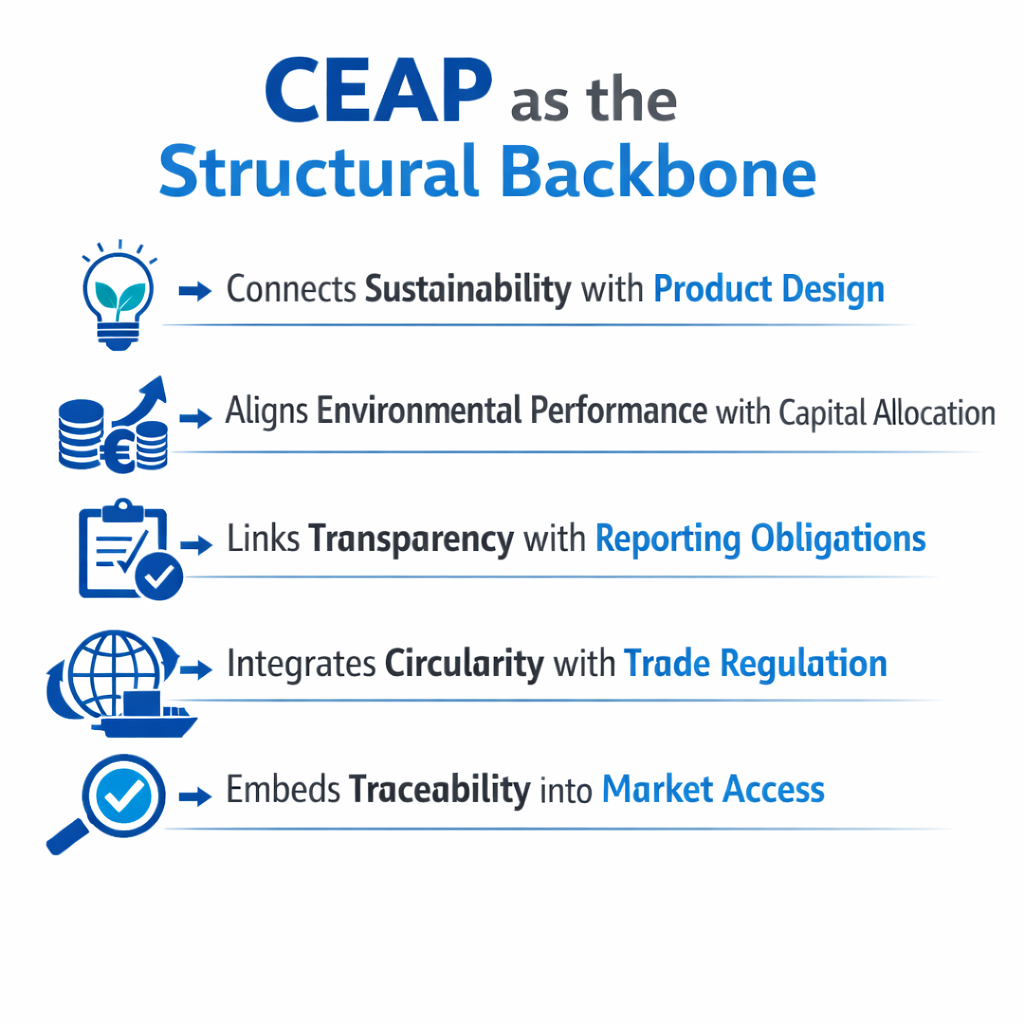
CEAP represents a structural shift in how economic activity is regulated in Europe. It influences product design, procurement, supply chain transparency, reporting, trade, and digital traceability simultaneously.
Companies that treat CEAP as a symbolic risk are underestimating its compliance impact.
Companies that treat it as foundational can future-proof operations and gain a competitive advantage.
Evaluate the full environmental footprint of your products from raw material extraction to end-of-life disposal. Identify high-impact stages, material inefficiencies, and redesign opportunities aligned with circular requirements.
Map suppliers, material origins, and processing stages to understand exposure to sustainability and compliance risks. Strengthen visibility into upstream sourcing and validate data integrity.
Implement structured digital systems to capture lifecycle data, material composition, and compliance metrics. Interoperable platforms enable audit readiness and support Digital Product Passport requirements.
Embed durability, repairability, recyclability, and recycled content into product development processes. Align R&D and procurement teams with circular design principles early in the design cycle.
Track evolving EU regulations linked to CEAP (ESPR, CSRD, EPR, CBAM, etc.). Establish internal governance processes to continuously adapt to new delegated acts and sector-specific requirements.
Preparation for CEAP is not a one-time compliance task it requires cross-functional alignment, digital infrastructure, and proactive monitoring to stay ahead of regulatory expansion.
Digital traceability is foundational to the success of the Circular Economy Action Plan (CEAP) because circularity depends on structured, verifiable lifecycle data.
CEAP shifts focus from isolated product stages to full lifecycle accountability from raw material extraction to reuse and recycling. Without continuous data capture across stages, companies cannot demonstrate durability, carbon performance, or circular compliance.
Regulations increasingly require disclosure of material origin, recycled content, and environmental impact. Transparent, structured material data reduces greenwashing risk and supports Digital Product Passport requirements.
Circular compliance involves multiple stakeholders manufacturers, suppliers, recyclers, regulators, and investors. Systems must communicate seamlessly to exchange machine-readable data across platforms and borders.
Circularity requires that information travels with the product throughout its lifecycle. This enables repairability, recovery, resale, and regulatory verification. Static documentation is no longer sufficient.
In this environment, compliance technology becomes an enabler not just for reporting, but for embedding traceability, transparency, and accountability directly into product and supply chain operations.
TraceX DPP Solutions enable companies to structure lifecycle data, integrate supplier inputs, and generate interoperable Digital Product Passports that align with evolving EU circular compliance requirements transforming regulatory readiness into operational advantage.
CEAP is often viewed through a compliance lens — but for forward-looking companies, it represents a strategic opportunity. Early adopters that redesign products, digitize lifecycle data, and embed circular principles into procurement and operations can unlock measurable cost efficiencies, particularly through reduced material dependency and improved resource optimization. Stronger ESG performance enhances brand credibility and positions organizations favourably with regulators, customers, and sustainability-focused investors.
Proactive alignment with CEAP also reduces future regulatory disruption, preventing rushed redesigns or supply chain restructuring as new requirements phase in. Additionally, companies leading on circular innovation are better positioned to access EU green funding programs and sustainability-linked finance instruments.
In short, CEAP is not merely a regulatory obligation it is a pathway to resilience, capital access, operational efficiency, and long-term competitive strength in the European market.
The Ecodesign for Sustainable Products Regulation (ESPR) is transforming how products must be designed, documented, and placed on the EU market.
Read Our Complete Guide to ESPR
Digital Product Passports are becoming central to EU circular compliance — requiring structured, machine-readable lifecycle data.
Explore Our Deep Dive on Digital Product Passports (DPP)
ESPR sets the product sustainability rules — DPP is the digital mechanism that enables enforcement and transparency.
Discover How ESPR & DPP Regulations Interconnect
CEAP is the EU’s policy framework under the Green Deal aimed at transitioning from a linear economy to a circular model focused on durability, reuse, recycling, and resource efficiency.
CEAP itself is a strategy, but it is implemented through legally binding regulations such as ESPR, CSRD, and sector-specific laws.
If they place products on the EU market, they must comply with CEAP-aligned regulations, including eco-design and data transparency requirements.
High-impact sectors include electronics, batteries, packaging, plastics, textiles, construction, and food systems.
CEAP is a core pillar of the EU Green Deal, operationalizing its sustainability and climate neutrality objectives through product and industrial reform.









