
Quick summary: Learn about the critical role of crop residue management in sustainable agriculture with our informative blog. Discover the benefits of this practice in reducing soil erosion, improving soil health, and enhancing crop yields. Our expert insights and strategies will help you implement effective crop residue management techniques for a more sustainable and profitable farming future. Read on to learn more about the importance of crop residue management in sustainable agriculture.
Crop residue management (CRM) is the practice of handling plant material left after harvest stalks, leaves, husks and stems to improve soil instead of being burned. Core techniques are mulching, incorporation, retention under no-till, composting, baling for off-field use, and pyrolysis into biochar.
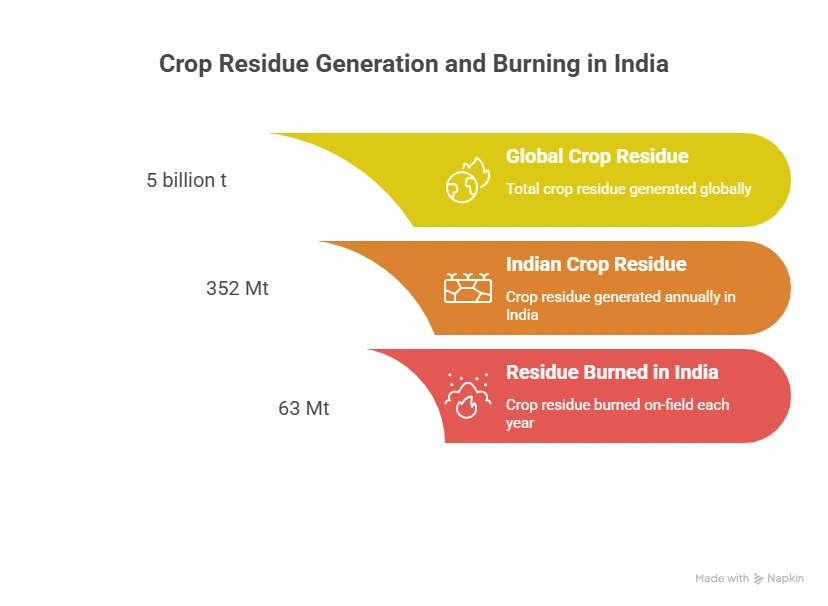
India generates roughly 352 million tonnes of crop residue a year and burns about 23% of it, releasing an estimated 91 Mt of CO₂ and 1.2 Mt of particulate matter.
Managed well, that same residue rebuilds soil organic carbon, cuts fertilizer cost, and can generate verified carbon credits.
| Residue practices now have to be measured, reported, and verified. Buyers and regulators want farm-level proof not averages. Digital MRV platforms such as TraceX turn residue activity into audit-ready, credit-ready data. |
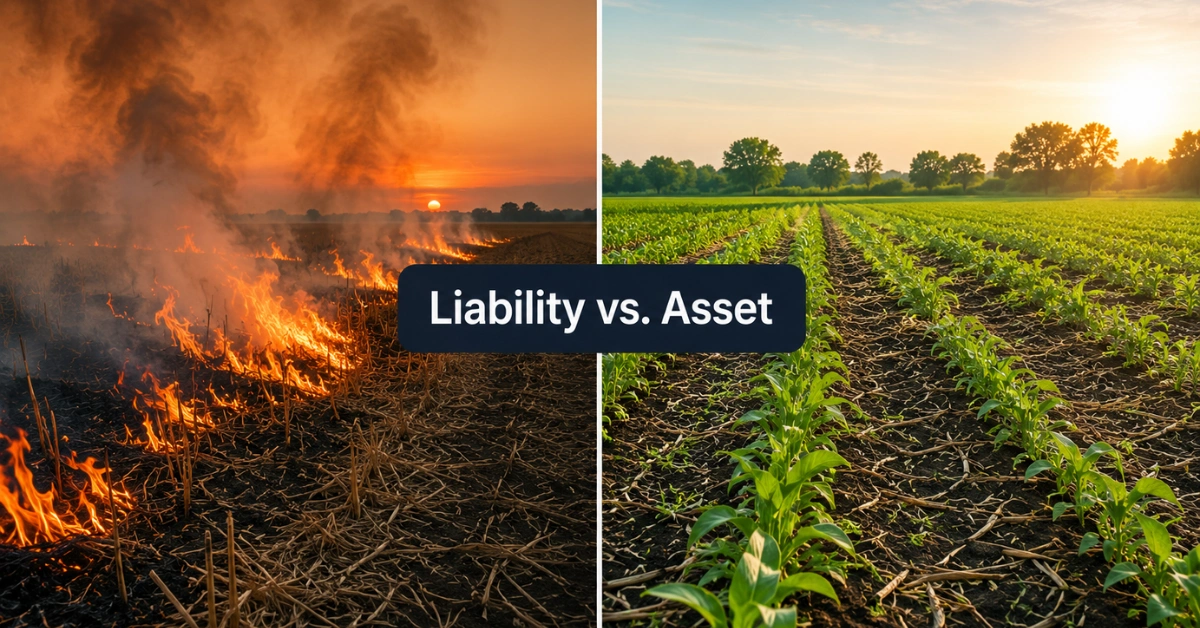
Every harvest leaves a decision on the field. The combine moves on, and what remains stubble, straw, stalks becomes either next season’s soil or this season’s liability.
For most agribusinesses and sourcing teams, that decision still defaults to burning. It is fast, it is cheap, and it clears the field inside the three-week window between paddy harvest and wheat sowing. But the costs are no longer hidden:
Crop residue is a 5-billion-tonne global resource managed well it rebuilds soil; burned, it becomes pollution and compliance risk.
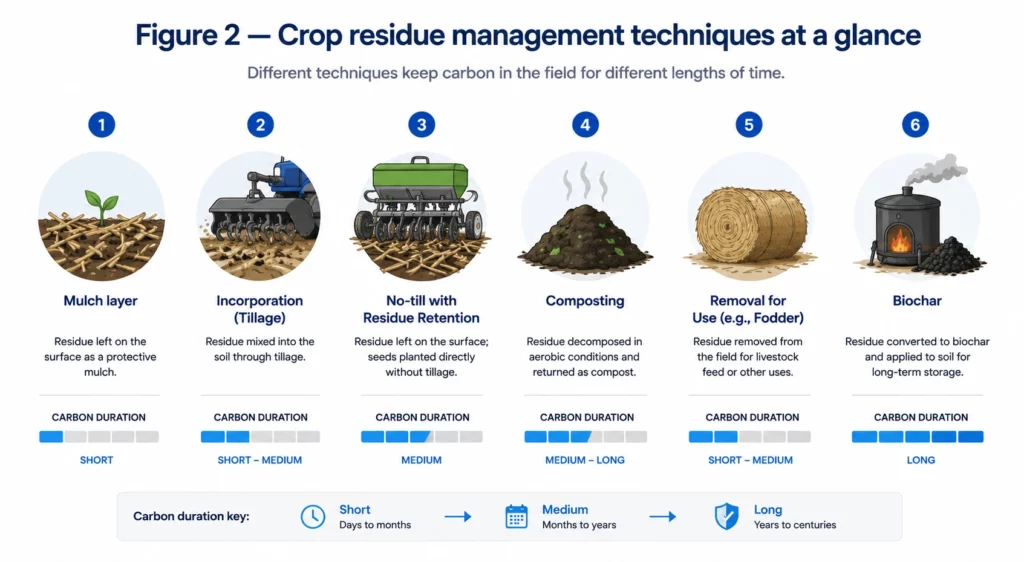
Six core techniques mulching, incorporation, no-till retention, composting, baling, and biochar each carry climate value, but only if the activity can be measured.
Biochar is the highest-integrity option: it locks crop-residue carbon away for decades to centuries and produces a sellable output.
The real bottleneck in 2026 is not the field practice it is proof. Averages and assumptions no longer satisfy buyers, registries, or regulators.
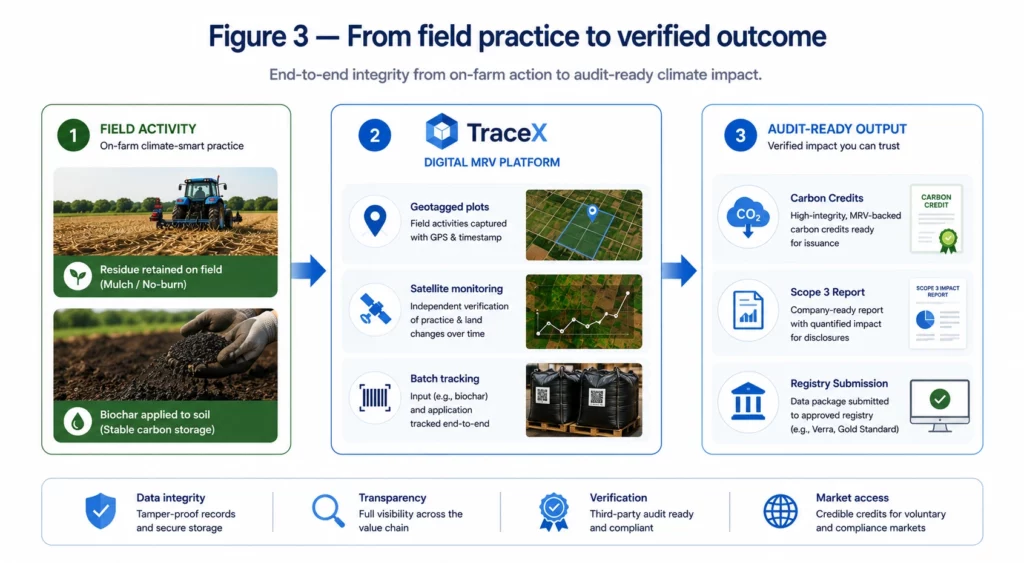
Digital MRV platforms such as TraceX close that gap, turning residue and biochar activity into geotagged, audit-ready, credit-ready evidence
Crop residue management (CRM) is a conservation practice: handling the plant material left after harvest to control wind and water erosion, enhance soil quality, and improve nutrient cycling instead of removing or burning it.
The scale is the reason it matters. According to the FAO, roughly 5 billion tonnes of crop residue are generated globally each year. More than half of all the dry matter in the global harvest is residue. In India alone, intensive rice-wheat rotation generates an estimated 352 million tonnes annually and roughly 84 million tonnes of that is burned on-field.
When residue is retained or returned to the field rather than burned, it works as a system:
More residue is not automatically better. Too much can immobilize nitrogen, keep soils cool and wet, and slow germination. Research suggests removal should generally stay within 20–30% of residue on most soils. Crop residue management is about calibration and calibration requires data, which is exactly where the technology layer comes in.
There is no single correct method. The right technique depends on crop, soil, climate, machinery access, and increasingly on whether you need to generate a verifiable outcome from it. Here is how the main options compare.
| Technique | What it does | Best when | Carbon / verification angle |
|---|---|---|---|
| Mulching | Residue is chopped and spread as a surface layer. | Erosion control and moisture retention are the priority. | Builds the bio-available soil carbon fraction; needs activity logging to count. |
| Incorporation | Residue is tilled back into the soil. | Rapid nutrient recycling is needed before the next crop. | Returns nutrients fast but carbon turns over quickly; modest sequestration. |
| No-till retention | Residue is left undisturbed on the surface; the next crop is direct-seeded. | Long-term soil health and SOC build-up are the goal. | Strong, durable SOC gains a credible basis for soil-carbon programs. |
| Composting | Residue is broken down off-field into a stable soil amendment. | Residue can be aggregated and processed near the farm. | Stabilizes carbon and nutrients; chain-of-custody data strengthens claims. |
| Baling (ex-situ use) | Residue is collected and sold for energy, biogas, or industry. | A nearby buyer (e.g. biomass power) exists; in-field retention isn’t viable. | Avoids burning emissions; allocation rules decide who can claim the benefit. |
| Biochar (pyrolysis) | Residue is converted via low-oxygen heating into a stable carbon material. | Long-term carbon removal and a sellable output are the objective. | Highest-integrity, longest-duration carbon see the next section. |
Notice the pattern in the fourth column. Every technique has a climate value but in 2026, value is only realized if it can be measured and verified. A practice you cannot prove is a practice you cannot monetize or report.
Of every technique above, biochar is the one most directly tied to the carbon market so it deserves its own section.
Biochar is the carbon-rich solid produced when biomass is heated in a low-oxygen environment, a process called pyrolysis. When the biomass feedstock is crop residue, biochar becomes a way to capture carbon the plant already pulled from the air and lock it into a form that does not quickly return to the atmosphere.
Explore how biochar is emerging as a scalable solution for carbon removal and climate resilience.
Learn how biochar supports long-term carbon sequestration, soil regeneration, regenerative agriculture, and high-integrity carbon credit generation.
Both raw residue and biochar add carbon to soil but they behave very differently:
That durability is precisely what makes biochar attractive as a carbon dioxide removal (CDR) method: the carbon stays put long enough to count as a real removal, not a temporary store.
85%
Share of one global biochar carbon estimate attributable to crop-residue feedstock
Biochar is rarely a single-purpose decision. Applied to soil, it can also:
Biochar’s value depends entirely on traceability. A carbon buyer or registry will ask: which residue, from which farm, processed how, applied where, and how do you know it is still there? Without feedstock chain-of-custody, pyrolysis records, and field application data, biochar is just charcoal. With that data, it is a verified carbon removal credit. The difference is a measurement system.
Running a biochar or residue-to-carbon project?
Carbon buyers fund proof, not promises. TraceX’s Digital MRV platform geotags plots, tracks feedstock from field to pyrolysis, and links every step to audit-ready records so residue and biochar activity becomes a defensible, credit-ready carbon outcome.
→ Explore TraceX Digital MRV for carbon projects
Here is the shift that defines 2026. The agronomy of crop residue management is well understood. The constraint has moved downstream: most agricultural emissions and outcomes are still reported using averages, surveys, and assumptions data that cannot be tied to the physical flow of crops through a supply chain.
That gap breaks the moment a claim is tested. Two farms using the same residue technique can have very different real outcomes depending on soil, climate, and execution. Buyers, registries, and regulators increasingly refuse to accept the average. They want farm-level, batch-level, audit-ready evidence.
This is the real reason crop residue projects stall. The field practice is solvable. The proof is what’s missing and proof is a technology problem.
TraceX DMRV solutions turns sustainability practices into traceable, verifiable, audit-ready data. For crop residue and biochar programs, the relevant capability is its Digital MRV (Measurement, Reporting, and Verification) platform.
Digital MRV replaces manual, sample-based monitoring with satellite data, geospatial intelligence, automation, and secure digital records. Mapped against the residue management challenges above, here is how it fits:
The pain it solves — residue practices reported as averages collapse under due diligence. TraceX digitizes farm data and maps plots so each residue activity mulching, retention, baling, biochar feedstock collection is tied to a specific, geotagged field rather than an estimate.
The pain it solves — biochar and ex-situ residue lose their carbon value without chain of custody. TraceX links field actions, environmental outcomes, and reported credits into a single traceable system, so feedstock can be followed from harvest through pyrolysis to soil application.
The pain it solves — a one-time survey can’t prove permanence. TraceX combines continuous satellite monitoring with field data to support credible baselines, early risk detection, and long-term permanence assurance for soil-carbon and removal claims.
The pain it solves — registry submissions and Scope 3 disclosures demand standardized evidence. TraceX automates MRV workflows and generates audit-ready outputs aligned to standards such as Verra reducing manual effort while improving consistency and verification speed.
With a Digital MRV layer in place, crop residue management stops being a practice you hope counts and becomes a practice you can prove. Residue retention, composting, and biochar activity convert into verifiable, revenue-ready carbon and sustainability outcomes the difference between a sustainability story and a defensible claim.
To make the trade-offs concrete, here is a side-by-side comparison of the three paths a tonne of crop residue can take.
| Factor | Burning | In-field management | Biochar |
|---|---|---|---|
| Soil carbon | Destroyed | Added (short-term) | Added (long-term, stable) |
| Air quality | Severe pollution | Neutral | Low emissions if pyrolysis is controlled |
| Carbon permanence | None | Seasons | Decades to centuries |
| Compliance risk | High — fined & monitored | Low | Low |
| Revenue potential | None | Fertilizer savings | Carbon credits + by-products |
| Verification need | N/A | Activity logging | Full chain of custody |
The conclusion is hard to argue with: burning is the only option that destroys value on every axis. The remaining question is not whether to manage residue, but how to prove you did.
It is the practice of handling the plant material left after harvest stalks, straw, leaves so it improves the soil instead of being burned or wasted. Common methods include mulching, tilling residue back in, leaving it under no-till systems, composting, baling for off-field use, and converting it to biochar.
Burning destroys the carbon and nitrogen in the biomass, degrades soil structure, and releases large volumes of CO₂ and particulate matter. In India it is a major driver of seasonal air pollution and is now regulated, fined, and satellite-monitored making it both an environmental and a compliance liability.
Biochar is a stable, carbon-rich solid made by heating crop residue in a low-oxygen process called pyrolysis. Unlike raw residue, which decomposes within a season or two, biochar breaks down 10 to 100 times more slowly locking carbon in the soil for decades to centuries, which makes it suitable for carbon dioxide removal.
It depends on the soil and crop, but research generally suggests removing no more than 20–30% of residue, and aiming for at least 30% surface cover after planting to control erosion. Too much residue can immobilize nitrogen and keep soils cool and wet, so calibration matters.
Yes, practices such as no-till residue retention and biochar production can create soil-carbon and carbon-removal credits. However, credits require farm-level, audit-ready evidence: geotagged plots, continuous monitoring, and chain-of-custody data. This is why projects pair field practices with a Digital MRV platform.
TraceX’s Digital MRV platform digitizes farm data, maps plots, tracks residue and biochar batches, monitors fields via satellite, and generates audit-ready reports aligned to standards such as Verra and EUDR. It converts residue practices from unverifiable averages into defensible carbon and Scope 3 evidence.