Data Ownership in Digital Product Passports: Who Owns, Who Controls, and Why It Matters
Published
, 19 minute read
Share this article
Quick summary: Explore data ownership in Digital Product Passports (DPPs), including access rights, liability, and governance. Learn how brands, suppliers, and regulators manage product data in the era of ESPR compliance.
As companies scramble to collect and share product data across complex supply chains, a pressing question arises: “Who actually owns and controls this data?” Without clear ownership, brands risk errors, liability, and lost trust, while suppliers struggle with inconsistent reporting. Understanding data ownership in Digital Product Passports is essential not just for meeting ESPR requirements, but for turning compliance into a competitive advantage.
In a Digital Product Passport (DPP), data ownership defines who is responsible for creating, controlling, and verifying product information across the supply chain. Brands typically own the overall DPP, ensuring accuracy, compliance, and reporting, while suppliers provide verified upstream data. Regulators and authorized partners have controlled access for audit or transparency purposes. Clear ownership establishes accountability, reduces liability for incorrect or missing data, and enables trust, traceability, and compliance with ESPR and related regulations, making data governance in DPPs a critical operational and strategic function.
Key Takeaways
In a Digital Product Passport (DPP), data ownership defines who is accountable for creating, verifying, and maintaining product information, while clear governance ensures accuracy, traceability, and regulatory compliance.
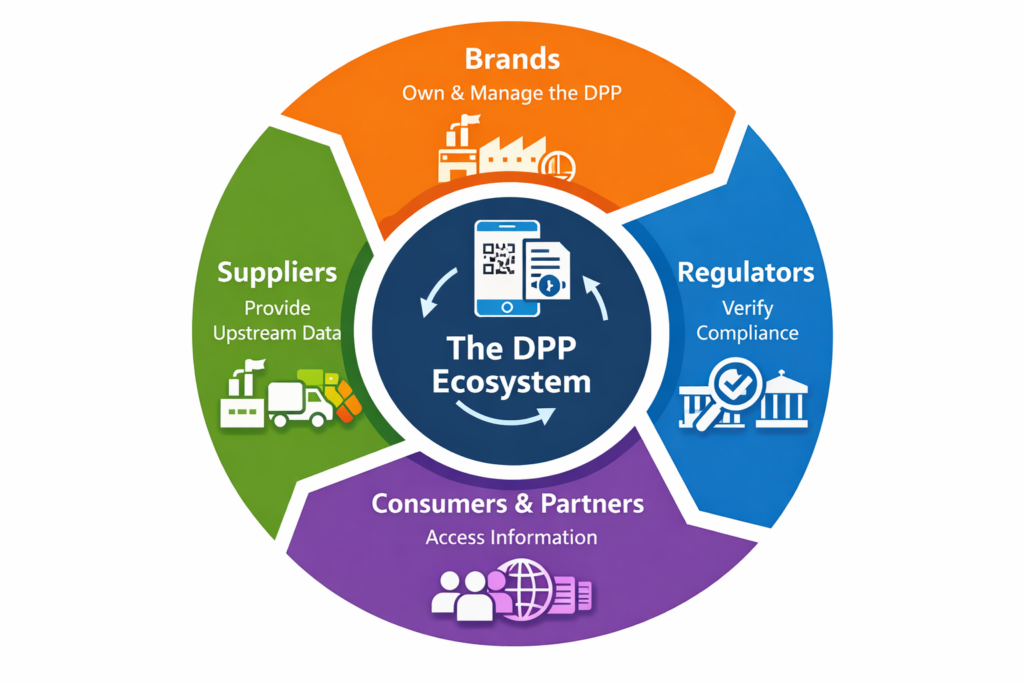
Key stakeholders include brands (owners), suppliers (data contributors), regulators (verifiers), and consumers/partners (viewers), each with role-based access to protect sensitive information.
Secure data sharing is enabled via centralized platforms, digital identifiers, and blockchain-backed audit trails, reducing errors and disputes.
Best practices include standardized identifiers, immutable records, privacy/IP policies, and clear responsibilities, while common pitfalls fragmented systems, ambiguous roles, and unclear access rights can undermine compliance and trust.
Technology underpins all of this, enabling scalable, auditable, and secure DPP ecosystems.
Download our free DPP ebook now and turn regulatory requirements into a competitive advantage.
Discover how DPPs transform compliance, traceability, and supply chain transparency. Learn about data ownership, stakeholder roles, secure data sharing, and best practices in one comprehensive resource.
In the context of a Digital Product Passport, data ownership refers to the accountability and responsibility for generating, maintaining, and verifying product information throughout the supply chain. The owner ensures that the data is accurate, complete, and compliant with regulatory frameworks like ESPR. Ownership is not just about having the data it’s about being legally and operationally responsible for its integrity. For instance, a brand may own the DPP as a whole, while suppliers contribute verified upstream data, making both parties accountable for different layers of information.
Difference Between Ownership, Access Rights, and Stewardship
These three concepts are often confused but are distinct in DPP governance:
Ownership: The party legally or operationally responsible for the data. They are accountable for correctness, regulatory compliance, and liability. For example, the brand that sells a product usually owns the DPP.
Access Rights: Determines who can view, modify, or share the data. Regulators may have read-only access, suppliers may update specific fields, and consumers may view product provenance or sustainability information.
Stewardship: Refers to who actively manages and maintains the data on a day-to-day basis, ensuring quality, updates, and verification. Stewardship can be delegated to digital platforms, data managers, or internal teams, without transferring ownership.
Clear separation ensures accountability, security, and regulatory compliance across multi-tier supply chains.
Examples of Product Data Types in a DPP
Digital Product Passports aggregate a wide variety of product-related data, each with its own ownership and verification requirements:
Materials Data: Composition of raw materials, recycled content, hazardous substances, fiber types in textiles, or battery chemistries. Critical for compliance with ESPR, EUDR, or sustainability claims.
Lifecycle Events: Manufacturing dates, assembly or processing events, transport milestones, and usage history. These trace the product’s journey from raw material to consumer, enabling recalls, ESG reporting, and circularity tracking.
Supplier Data: Multi-tier supplier details, certifications, and declarations regarding inputs, origin, and compliance. This ensures accountability across Tier-1, Tier-2, and Tier-3 suppliers.
Sustainability & Compliance Data: Carbon footprint, water usage, circularity indicators, and waste or recycling metrics. Needed for reporting under ESPR, CSRD, and other regulatory frameworks.
Digital Identifiers & Metadata: Unique IDs, barcodes, QR codes, or blockchain references that link physical products to their digital passport and enable secure access.
Together, these data types create a holistic, verifiable record that enables transparency, compliance, and trust while empowering brands and suppliers to manage liability and regulatory obligations effectively.
Explore how DPPs are structured to ensure traceability, compliance, and multi-tier collaboration. Learn how architecture choices impact data flow, stakeholder roles, and regulatory readiness.
Read our in-depth blog on DPP Architecture now to see how the system works end-to-end.
Discover what data is essential for DPP compliance, how to capture it across the supply chain, and how to maintain accuracy, completeness, and traceability.
Check out our detailed blog on DPP Data Requirements and ensure your supply chain is audit-ready.
Key Stakeholders and Their Roles in Digital Product Passports (DPPs):
Brands / Manufacturers
Brands and manufacturers are the primary owners of the Digital Product Passport. They hold ultimate accountability for ensuring that the data is accurate, complete, and compliant with regulations such as ESPR (European Sustainable Product Regulation) or related directives. Their responsibilities include:
Data Accuracy: Ensuring that all product information materials, components, lifecycle events, and sustainability metrics is verified and correct.
Compliance Reporting: Generating reports and documentation required by regulators, auditors, or sustainability frameworks.
Liability Management: Being legally accountable for errors, omissions, or misrepresentations in the DPP data.
Digital Oversight: Overseeing the integration of supplier data into their DPP systems, ensuring traceability across the entire product lifecycle.
Essentially, the brand acts as the central hub for DPP governance, linking upstream suppliers, regulators, and downstream partners in a transparent ecosystem.
Suppliers
Suppliers are critical contributors to the DPP because they provide the upstream data that forms the foundation of traceability and compliance. Their roles include:
Data Submission: Providing verified information on raw materials, components, and intermediate products.
Traceability Assurance: Ensuring that materials can be tracked through each stage of the supply chain.
Compliance Alignment: Meeting standards for quality, sustainability, and regulatory requirements, often through certifications or declarations.
Collaboration: Actively coordinating with brands and other suppliers to ensure multi-tier transparency, especially for complex supply chains spanning Tier-1 to Tier-3 suppliers.
Without supplier engagement and accurate input, the DPP cannot provide reliable, verifiable information, which undermines trust and regulatory compliance.
Regulators
Regulators are authoritative stakeholders with limited but essential access to DPP data. Their primary role is verification and enforcement rather than direct data management. Key responsibilities include:
Audit and Oversight: Reviewing DPP data for compliance with ESPR, EUDR, or other relevant frameworks.
Verification Rights: Accessing select data points, often read-only, to confirm legality, traceability, and sustainability claims.
Market Enforcement: Ensuring that non-compliant products are flagged, penalized, or excluded from regulated markets.
Standardization Guidance: Providing rules and frameworks that define what must be included in DPPs and how data should be structured.
Regulators rely on accurate, traceable DPP data submitted by brands and suppliers to perform audits efficiently.
Consumers / Partners
While consumers and downstream partners are optional stakeholders, they play an increasingly important role in transparency, trust, and engagement. Their involvement includes:
Access to Verified Data: Viewing relevant product information such as material composition, sustainability metrics, and lifecycle data, often through QR codes or digital platforms.
Informed Purchasing Decisions: Using DPP information to assess environmental impact, social compliance, or circularity potential of products.
Supply Chain Collaboration: Partners such as retailers or recyclers may use DPP data to support secondary markets, take-back schemes, or end-of-life processing.
By providing selective visibility, DPPs empower consumers and partners without compromising sensitive supplier or brand data.
How is DPP Data shared securely?
1. Role-Based Access Models
In a Digital Product Passport, not all stakeholders should have the same level of access to data. Role-based access control (RBAC) ensures that each participant, whether brand, supplier, regulator, or consumer, can view or modify only the information relevant to their responsibilities.
Suppliers (Read/Write Access): Suppliers typically provide upstream data, such as material composition, processing steps, or certifications. They can update or verify specific fields, ensuring the accuracy of their contribution without altering unrelated data.
Brands / Manufacturers (Full Access): Brands, as DPP owners, maintain complete control. They can review, consolidate, and validate supplier inputs, generate compliance reports, and enforce quality and traceability standards across the entire product lifecycle.
Regulators (View-Only Access): Regulators usually have restricted, read-only access to verify compliance with ESPR, EUDR, or other legal frameworks. This prevents unauthorized changes while allowing efficient auditing.
Consumers / Partners (Selective View): Retailers, recyclers, or end consumers may be granted limited visibility into non-sensitive information like sustainability metrics, material composition, or product origin, fostering transparency and trust.
Role-based access reduces the risk of errors, data breaches, and liability while keeping sensitive commercial or proprietary information secure.
2. Data Sharing Across Multi-Tier Supply Chains
Modern supply chains are complex, multi-tiered networks spanning suppliers, subcontractors, manufacturers, and logistics partners. Effective access control enables:
Granular Sharing: Each tier shares only the data required for compliance or operational purposes, maintaining confidentiality of competitive information.
Traceability: Upstream inputs from Tier-2 and Tier-3 suppliers can be traced to the finished product, supporting audits, ESG reporting, and circular economy requirements.
Collaboration: Brands and suppliers can work collaboratively on quality control, risk management, and sustainability initiatives without compromising data integrity.
Version Control: DPP systems track every update, ensuring that downstream actors receive accurate, consistent data.
This approach minimizes duplication, prevents unauthorized edits, and ensures a single source of truth across the entire product lifecycle.
3. Use of Digital Identifiers, Blockchain, and Secure Platforms
To enforce access rights and maintain data integrity, DPPs leverage advanced digital infrastructure:
Digital Identifiers: Unique IDs (e.g., GS1 identifiers, batch IDs, QR codes) link each product or material to its digital record, ensuring that only authorized stakeholders can access or update relevant data.
Blockchain Technology: Immutable, time-stamped blockchain records prevent tampering, provide audit-ready evidence, and enforce traceability from raw materials to finished goods.
Secured Platforms: Centralized or cloud-based DPP platforms provide secure login, encryption, and user authentication, controlling who can view, edit, or share data. Role-based permissions are embedded in the system, automatically enforcing compliance rules.
By combining identifiers, blockchain, and secure platforms, DPPs create trustworthy, tamper-proof data ecosystems, supporting regulatory compliance, risk mitigation, and supply chain transparency.
Liability and Risk in Digital Product Passports (DPPs)
Legal Implications of Incorrect or Missing Data
DPP are legal and regulatory tools under frameworks like ESPR, which require accurate, verifiable product information for compliance. Errors or omissions such as misreported materials, missing supplier declarations, or incomplete lifecycle data can lead to:
Regulatory penalties: Fines or sanctions from authorities for non-compliance.
Market restrictions: Products may be blocked from sale in regulated regions like the EU.
Contractual liability: Brands may face claims from customers or partners if inaccurate data causes harm or breaches agreements.
In essence, digital product passport liability is directly tied to the accuracy and completeness of data across the supply chain.
Risk Exposure for Brands vs Suppliers
The risk landscape differs depending on stakeholder role:
Brands / Manufacturers: As owners of the DPP, brands bear primary responsibility for overall compliance. They are accountable for consolidating supplier inputs, verifying data, and reporting to regulators. Any inaccuracies at the brand level can trigger legal action, reputational damage, or lost market access.
Suppliers: Suppliers face upstream risk, as their submitted data must be correct and traceable. Errors in raw materials, certification, or processing information can cascade downstream, exposing brands and triggering audits. Suppliers may also face penalties under contractual obligations.
Clearly defined roles and responsibilities reduce ambiguity and ensure accountability across multi-tier supply chains.
How Traceable, Verified DPP Data Reduces Risk
Implementing a robust DPP system that captures traceable, verified data minimizes liability and mitigates operational and legal risk:
Fines and penalties are reduced because regulators can audit and verify the chain of custody easily.
Product recalls are faster and more precise, targeting affected batches only rather than entire product lines.
Reputational risk is managed by providing transparent, verifiable data to consumers and partners, demonstrating commitment to compliance and sustainability.
Insurance and contracts benefit because verified data reduces uncertainty and liability exposure.
Technologies like blockchain, unique digital identifiers, and centralized DPP platforms strengthen traceability, making DPP compliance risks manageable rather than overwhelming.
What are the best practices for DPP data ownership?
1. Centralized vs Distributed Data Ownership
Data governance begins with clarity on ownership and control. Organizations can structure DPP data in two main ways:
Centralized Ownership: The brand or manufacturer acts as the single source of truth, consolidating data from all suppliers and stakeholders. This ensures consistency, simplifies audits, and makes compliance reporting more efficient.
Distributed Ownership: Each stakeholder suppliers, processors, or logistics partners maintains responsibility for their segment of the data. This can increase transparency and accountability across the supply chain but requires robust coordination and integration mechanisms.
Many organizations use a hybrid model, centralizing critical compliance data while allowing suppliers to manage operational inputs.
Standards Adoption: GS1 Identifiers and EPCIS Events
Standards are essential for interoperability, traceability, and accuracy in DPPs:
GS1 Identifiers: Unique codes such as GTINs (Global Trade Item Numbers) and GLNs (Global Location Numbers) link products and locations to their digital records, enabling multi-tier traceability.
EPCIS Events: Electronic Product Code Information Services (EPCIS) capture lifecycle events manufacturing, processing, shipping, and transformation creating a real-time digital record of product movement.
Adopting these standards ensures data consistency, machine readability, and seamless integration across platforms and stakeholders, which is critical for regulatory compliance and operational efficiency.
Audit Trails and Blockchain for Immutability
Immutable audit trails are central to trust and compliance:
Blockchain Technology: Provides tamper-proof, time-stamped records that verify every step in the product lifecycle.
Audit Trails: Track all updates, approvals, and data submissions in the DPP, allowing regulators, auditors, or brands to reconstruct the product history accurately.
Immutable records reduce disputes, accelerate audits, and mitigate liability by proving that data has not been altered or falsified.
Policies for Data Privacy, IP Protection, and ESG Reporting
Good data governance goes beyond traceability it also protects sensitive information and supports sustainability:
Data Privacy: Ensure compliance with GDPR or other local privacy laws, especially when capturing supplier or customer data.
Intellectual Property Protection: Restrict access to proprietary formulas, production methods, or design details while still sharing necessary compliance data.
ESG Reporting: Structure DPP data to support environmental, social, and governance metrics, including carbon footprint, chemical safety, and circularity reporting.
Strong governance policies balance transparency with security, enabling collaboration across stakeholders without compromising competitive advantage.
Challenges and Common Pitfalls in Digital Product Passports (DPPs)
1. Ambiguity Between Suppliers and Brands
One of the most common challenges in DPP implementation is unclear roles and responsibilities between brands and their suppliers.
Suppliers may be unsure which data they are responsible for, how it should be verified, and the level of detail required.
Brands may assume suppliers have already provided verified data, leading to gaps or inaccuracies in the DPP.
Ambiguity creates risk for regulatory non-compliance, liability, and audits, and can slow down onboarding of multi-tier suppliers.
Solution: Clearly define ownership, stewardship, and submission responsibilities upfront, supported by digital onboarding workflows and supplier training.
2. Multiple Systems Creating Fragmented Data
Fragmentation occurs when stakeholders use different platforms, spreadsheets, or disconnected tools to manage product data:
Data may be duplicated, inconsistent, or outdated across systems.
Fragmentation increases errors, audit failures, and compliance risk.
Reconciling multi-tier supplier data manually is time-consuming and prone to mistakes.
Solution: Use centralized or integrated DPP platforms with standardized identifiers (GS1, EPCIS) to maintain a single source of truth across the supply chain.
3. Lack of Clarity on Access Rights for Downstream Partners
Without clearly defined access rights, downstream partners such as retailers, recyclers, or consumers may:
Gain too much access, risking IP exposure or data misuse.
Have insufficient access, limiting transparency and circularity reporting.
Cause confusion in multi-tier supply chains, making it difficult to verify compliance or traceability.
Solution: Implement role-based access models, defining read/write privileges per stakeholder type (suppliers, regulators, consumers, partners). Use secure platforms and digital identifiers to enforce access automatically.
4. Recommendations for Avoiding These Pitfalls
Define Roles and Responsibilities: Clearly assign data ownership, stewardship, and submission requirements.
Adopt Standardized Systems: Use centralized DPP platforms, GS1 identifiers, and EPCIS event tracking.
Implement Role-Based Access Control: Ensure each stakeholder only has access to relevant data.
Conduct Regular Training: Educate suppliers and internal teams on data standards, compliance requirements, and platform usage.
Audit and Monitor: Continuously review data quality and completeness to identify gaps early.
Technology in Governance and Data Security for DPPs
In Digital Product Passports (DPPs), technology is the backbone that enforces data governance, ensures integrity, and maintains secure access across the supply chain. Clear ownership and stewardship policies only work when supported by digital systems that:
Enforce Role-Based Access: Platforms restrict who can view, edit, or share specific product data, protecting sensitive supplier or IP information while ensuring transparency for regulators and consumers.
Enable Immutable Records: Blockchain and audit trails capture every change or event in the product lifecycle, making data verifiable, tamper-proof, and audit-ready.
Centralize Multi-Tier Data: Technology consolidates inputs from suppliers, manufacturers, and partners, creating a single source of truth that reduces errors and simplifies compliance reporting.
Support Standardization and Interoperability: Digital systems integrate GS1 identifiers, EPCIS events, and other industry standards, enabling seamless communication and data verification across platforms and stakeholders.
By combining these capabilities, technology not only secures and governs DPP data but also enables scalable supplier collaboration, faster audits, and reliable ESG reporting.
The TraceX platform serves as a comprehensive Digital Product Passport solution, enabling brands to meet evolving EU DPP compliance standards with ease. By providing GPS-linked supplier mapping, blockchain-backed audit trails, and batch-level digital IDs, the platform creates a secure ‘digital twin’ for every product. This ensures that verified product lifecycle data is accessible to regulators and consumers alike, reducing manual intervention while future-proofing your supply chain against global transparency mandates.
Data Ownership as a Strategic Enabler
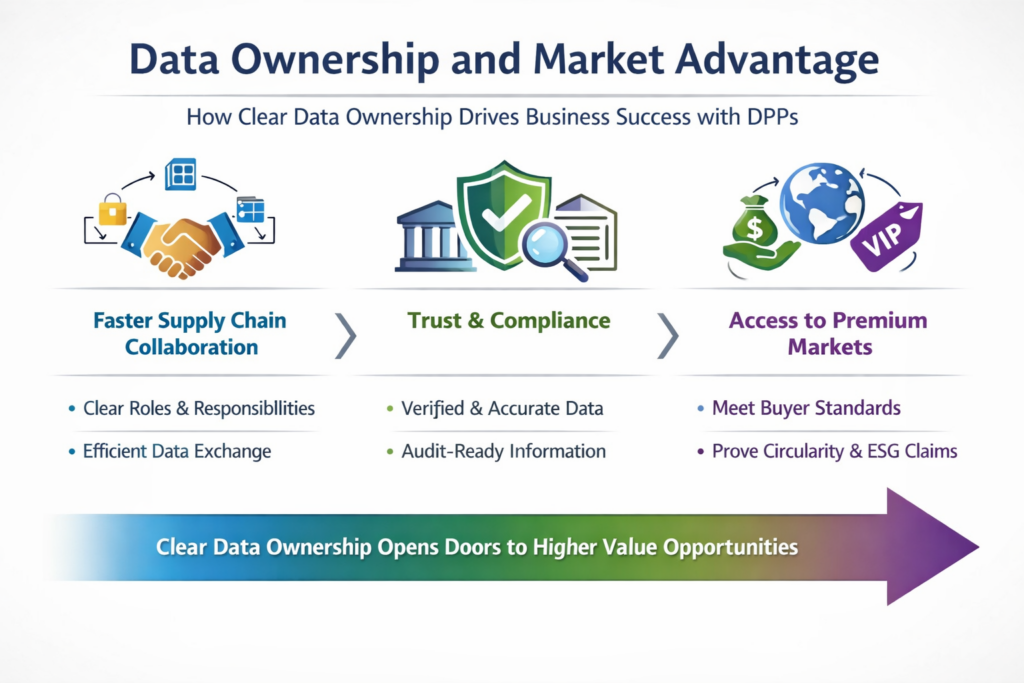
Clear data ownership in Digital Product Passports is more than a compliance requirement it is a strategic enabler for trust, efficiency, and market advantage. By defining who owns, who controls, and who stewards product data, brands can ensure accuracy, reduce liability, and foster collaboration across suppliers, regulators, and downstream partners. Verified and traceable DPP data not only satisfies regulatory obligations under ESPR but also builds confidence with buyers, supports ESG reporting, and opens access to premium markets. In essence, data ownership transforms digital product passports from a regulatory necessity into a competitive asset.
Learn how Digital Product Passports (DPPs) seamlessly integrate with multiple systems, standards, and stakeholders to enable real-time data sharing and traceability.
Read our blog on DPP Interoperability to see how connected supply chains become compliant and efficient.
Explore the technologies that power DPPs blockchain, digital identifiers, cloud platforms, and secure access control and how they enable compliance, traceability, and data governance.
Check out our blog on the DPP Technology Stack and learn how to future-proof your supply chain.
Understand how suppliers contribute critical upstream data to DPPs, why accurate supplier information is essential for traceability, ESG reporting, and regulatory compliance, and how digital systems streamline collaboration.
Read our blog on DPP Supplier Data to optimize your multi-tier data management.
Frequently Asked Questions (FAQ’s)
Who owns the data in a Digital Product Passport?
Typically, the brand or manufacturer owns the overall DPP, as they are responsible for product compliance, reporting, and traceability. Suppliers contribute verified upstream data, but ultimate accountability for accuracy, completeness, and regulatory adherence lies with the brand. Ownership defines who can make final decisions and bear liability for errors.
Can suppliers control or edit their DPP data?
Yes, suppliers generally have controlled, role-based access to input, update, or verify their own data such as material composition, certifications, or processing steps. However, they usually cannot edit other parts of the DPP outside their scope. This ensures data integrity while allowing multi-tier collaboration.
How do brands ensure compliance with ESPR using DPPs?
Brands ensure compliance by:
Collecting verified data from suppliers across all tiers
Using standardized identifiers (GS1, EPCIS) for traceability
Maintaining immutable audit trails for regulatory verification
Generating automated reports aligned with ESPR requirements A robust DPP system reduces errors, demonstrates compliance, and supports regulatory audits efficiently.
Is blockchain required for data ownership in DPPs?
Blockchain is not mandatory, but it enhances trust, transparency, and immutability. It ensures that every update or transaction in the DPP is time-stamped and tamper-proof, which simplifies audits, strengthens liability management, and builds confidence with regulators, suppliers, and consumers.
How does DPP data ownership affect market trust and competitiveness?
Clear ownership and verified data increase trust with regulators, buyers, and consumers, enabling premium market access, smoother audits, and credible ESG reporting. Brands that manage ownership effectively can turn compliance into a competitive advantage, rather than a regulatory burden.
Start using TraceX
Transparency, Trust, & Success for your Climate Journey.
We use cookies on our website to give you the most relevant experience by remembering your preferences and repeat visits. By clicking “Accept All”, you consent to the use of ALL the cookies. However, you may visit "Cookie Settings" to provide a controlled consent.
This website uses cookies to improve your experience while you navigate through the website. Out of these, the cookies that are categorized as necessary are stored on your browser as they are essential for the working of basic functionalities of the website. We also use third-party cookies that help us analyze and understand how you use this website. These cookies will be stored in your browser only with your consent. You also have the option to opt-out of these cookies. But opting out of some of these cookies may affect your browsing experience.
Necessary cookies are absolutely essential for the website to function properly. These cookies ensure basic functionalities and security features of the website, anonymously.
Cookie
Duration
Description
cookielawinfo-checkbox-analytics
11 months
This cookie is set by GDPR Cookie Consent plugin. The cookie is used to store the user consent for the cookies in the category "Analytics".
cookielawinfo-checkbox-functional
11 months
The cookie is set by GDPR cookie consent to record the user consent for the cookies in the category "Functional".
cookielawinfo-checkbox-necessary
11 months
This cookie is set by GDPR Cookie Consent plugin. The cookies is used to store the user consent for the cookies in the category "Necessary".
cookielawinfo-checkbox-others
11 months
This cookie is set by GDPR Cookie Consent plugin. The cookie is used to store the user consent for the cookies in the category "Other.
cookielawinfo-checkbox-performance
11 months
This cookie is set by GDPR Cookie Consent plugin. The cookie is used to store the user consent for the cookies in the category "Performance".
viewed_cookie_policy
11 months
The cookie is set by the GDPR Cookie Consent plugin and is used to store whether or not user has consented to the use of cookies. It does not store any personal data.
Functional cookies help to perform certain functionalities like sharing the content of the website on social media platforms, collect feedbacks, and other third-party features.
Performance cookies are used to understand and analyze the key performance indexes of the website which helps in delivering a better user experience for the visitors.
Analytical cookies are used to understand how visitors interact with the website. These cookies help provide information on metrics the number of visitors, bounce rate, traffic source, etc.
Advertisement cookies are used to provide visitors with relevant ads and marketing campaigns. These cookies track visitors across websites and collect information to provide customized ads.