
Quick summary: Deforestation-free sourcing is no longer a sustainability label or one-time audit. Learn why EUDR compliance now depends on procurement capabilities, systems, and repeatable operating models.

Deforestation-Free Sourcing Under EUDR looks straightforward on paper: don’t source from deforested land, collect supplier data, submit a Due Diligence Statement, and move goods to market. In reality, this is where many supply chains start to break. The regulation demands plot-level proof, verified geolocation, and continuous risk assessment yet most sourcing and procurement processes still run on documents, declarations, and trust. The result is a growing gap between policy intent and operational reality, where one missing polygon, one inconsistent supplier record, or one manual handoff can delay shipments, block market access, or trigger enforcement action.
This guide explains why deforestation-free compliance fails in execution, not regulation and how companies can bridge the gap between policy and procurement before risk becomes disruption.
Key Takeaways
The EUDR sets a strict, evidence-based standard for placing certain commodities on the EU market. “Deforestation-free” is not a marketing phrase here it’s a legal condition backed by geospatial proof and traceability.
Below is a clear breakdown of what that really means.
Under the EUDR, a product is considered deforestation-free if both conditions are met:
Key nuance:
This applies to high-risk commodities like cattle, cocoa, coffee, palm oil, soy, rubber, and wood, as well as many derived products.
The EUDR requires precise geolocation data for every production plot:
What this means in practice:
This eliminates:
Every operator must submit a due diligence statement before placing goods on the EU market.
The EUDR uses a fixed historical cut-off date:
If the forest was cleared after 31 December 2020, products from that land are non-compliant permanently.
Important implications:
Why the EU chose this approach:
Under the EUDR, assertions are meaningless without evidence.
What doesn’t count:
What does count:
Enforcement reality:
Explore how deforestation-free supply chains actually work under the EUDR →
Explore the procurement challenges blocking EUDR readiness →
On paper, deforestation-free sourcing sounds straightforward: know where a product comes from and ensure no forest was cleared. In reality, it breaks down at several structural pressure points especially once commodities move beyond the farm gate.
Most forest-risk commodities move through long, multi-tier supply chains before reaching exporters or EU operators.
Typical challenges include:
As commodities move downstream, traceability weakens:
The result: companies are several steps removed from the land-use decision that actually determines compliance.
Aggregation is one of the biggest structural blockers to deforestation-free sourcing.
At aggregation points such as:
Products from many farms are mixed together, often without physical or digital segregation.
Why does this break deforestation-free claims?
Even when suppliers claim “deforestation-free sourcing,” aggregation often means:
Under regulations like the EUDR, averages and probability are not enough each unit placed on the market must be traceable back to compliant land.
Many sourcing systems still rely on documents rather than data.
Common examples:
Why this approach fails in practice:
Most critically, document-based models:
This is why many “zero-deforestation” commitments looked credible pre-EUDR—but collapse when regulators ask for geospatial evidence.
Procurement sits at the point of decision, choosing suppliers, approving shipments, and releasing goods to market. Under the EUDR, that makes procurement the function most exposed to compliance failure. Not because teams lack intent, but because they inherit risk without having the systems designed to see it.
Procurement is no longer just about price, quality, and delivery. Under the EUDR, it becomes a compliance gatekeeper.
Procurement teams are responsible for ensuring that every shipment has the data required to submit a Due Diligence Statement (DDS). If plot-level geolocation, legality information, or supplier risk assessments are incomplete or inconsistent, the DDS cannot be lawfully filed, blocking market access.
Risk under the EUDR is assessed per shipment, not per supplier relationship. Procurement must determine whether the specific volume being purchased is linked to compliant plots. A trusted supplier can still ship a non-compliant product if sourcing changes upstream.
Once a company places goods on the EU market, liability does not sit with the farmer or intermediary it sits with the operator or trader. Procurement decisions therefore, directly translate into regulatory, financial, and reputational exposure downstream.
These are the pressure points where deforestation-free sourcing most often collapses.
Geolocation, legality documents, volumes, and supplier information live in different systems (or inboxes). Procurement cannot form a single, auditable view of risk at shipment level.
Even when suppliers provide coordinates or polygons, files are often technically invalid self-intersecting shapes, wrong coordinate systems, missing boundaries making them unusable for satellite verification or regulatory submission.
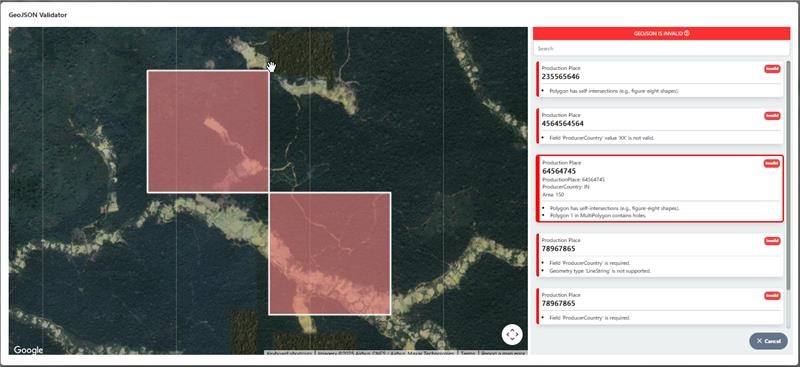
Procurement still receives critical compliance inputs as PDFs, scans, or self-declarations. These confirm claims, not land-use reality, and cannot be programmatically validated against deforestation data.
Risk checks, document reviews, and DDS preparation are handled manually, often under time pressure. This increases error rates, limits scalability, and makes it impossible to respond quickly to regulatory requests.
Because DDS submission happens late in the process, procurement teams often discover gaps only when a shipment is ready to ship. At that point, options are limited: delay, reroute, or accept non-compliance risk.
This is the practical layer where deforestation-free commitments turn into day-to-day procurement actions. The goal is simple: make the right behaviour the easy behaviour for buyers, suppliers, and compliance teams without turning procurement into a GIS department.

Start by classifying suppliers before onboarding or contract renewal.
What procurement needs to assess:
Outcome:
Procurement must request structured, machine-readable data, not documents.
Minimum EUDR-ready inputs per supplier:
Outcome:
Geospatial data is where most suppliers struggle and where procurement can quietly prevent failure.
Best practices:
Outcome:
Once risks are identified, procurement must formalize responsibility.
What contracts should cover:
Risk mitigation actions:
Outcome:
Below are three common procurement scenarios that show where deforestation-free sourcing breaks or holds once EUDR rules meet real supply chains. These are framed from a procurement perspective: what teams actually face, what goes wrong, and what “good” looks like.
The reality
Cocoa is typically sourced from thousands of smallholders, often selling through cooperatives or local buyers. Farms are small, informal, and frequently lack clear boundaries or digitized records.
Where compliance breaks
What deforestation-free procurement requires
Procurement takeaway
The bottleneck isn’t farmer intent it’s aggregation without traceability. Procurement must force plot-level data upstream or accept that volumes cannot move to the EU.
Read how a Nigerian trading firm achieved EUDR compliance with TraceX →
The reality
Palm oil supply chains converge at mills, which receive fruit from:
Once fruit enters the mill, it is physically mixed.
Where compliance breaks
What deforestation-free procurement requires
Procurement takeaway
Palm oil is lost or won at the mill intake gate. If procurement cannot control what enters, it cannot credibly claim deforestation-free output.
The reality
Coffee is often blended across:
This blending happens before export, during processing, or even in importing countries.
Where compliance breaks
What deforestation-free procurement requires
Procurement takeaway
Coffee compliance fails when commercial blending decisions are made before compliance decisions. Procurement must influence blending logic, not just supplier selection.
Deforestation-free procurement fails when compliance is reactive, checked at shipment time, based on documents, under deadline pressure. Digital tools from TraceX EUDR solutions flip that model by embedding compliance upstream, continuously, and visibly into procurement workflows.
The problem procurement faces
Traditionally, procurement discovers missing geolocation data, invalid plots, or non-compliant origins after contracts are signed or shipments are assembled when fixing the issue is expensive or impossible.
How TraceX changes this
TraceX enables pre-shipment validation by embedding EUDR checks directly into supplier onboarding and purchase workflows:
The problem procurement faces
Deforestation risk is not static. Suppliers change sourcing, add farms, or expand plots often without downstream buyers knowing.
How TraceX changes this
TraceX applies continuous monitoring across mapped supply bases:
The problem procurement faces
DDS preparation often happens too late, with teams scrambling to assemble data across systems, emails, and PDFs only to discover gaps that delay or block shipments.
How TraceX changes this
TraceX provides DDS readiness visibility at shipment level:
Deforestation-free sourcing has crossed a threshold. Under regulations like the EUDR, it is no longer a sustainability label, a one-off audit outcome, or a CSR promise it is a repeatable procurement capability. That capability lives in day-to-day buying decisions: how suppliers are onboarded, what data is required before contracting, how risk is assessed at the shipment level, and whether non-compliant supply can be stopped before it moves. Organizations that succeed treat deforestation-free compliance the same way they treat quality, pricing, or trade compliance: as an operating model, supported by systems, controls, and accountability inside procurement. Those that don’t will continue to face last-minute DDS failures, shipment delays, and regulatory exposure no matter how strong their sustainability commitments look on paper.
Learn how deforestation risk is assessed under EUDR—and what regulators actually check →
Understand EUDR geolocation requirements and why polygons—not points—matter →
See how to assess suppliers for EUDR risk before contracts are finalized →
Because the EUDR requires plot-level, shipment-specific proof, not program-level assurances. Certifications and labels may support risk assessments, but they cannot replace geospatial evidence and traceability tied to actual volumes placed on the EU market.
Deforestation risk changes over time. Farms expand, suppliers shift sourcing, and aggregation patterns evolve. A point-in-time audit cannot detect post-2020 forest loss or new risk that emerges after the audit is completed.
Procurement controls supplier selection, contracting, data requirements, and shipment approval. Under the EUDR, liability sits with the operator placing goods on the EU market making procurement the function where compliance either holds or fails.
It means standardized supplier onboarding, structured data collection, automated risk checks, continuous monitoring, and clear go/no-go rules before shipments move applied consistently across all sourcing decisions.
Companies typically encounter DDS gaps, delayed shipments, rejected goods, and enforcement risk. More importantly, teams stay in reactive mode, fixing compliance issues late instead of preventing them upstream.