
Ultimate Guide to Digital Product Passport (DPP): Navigating the Future of Circular Economy and Compliance 

Published
, 17 minute read

Quick summary: A complete guide to the Digital Product Passport (DPP), covering EU regulations, ESPR requirements, implementation steps, and how DPP enables circular economy and compliance.

In the coming years, every product sold in the European Union from the battery in your electric vehicle to the shirt on your back will carry a “digital soul.” This is the Digital Product Passport (DPP), a cornerstone of the EU’s transition toward a circular economy. 

For manufacturers, importers, and distributors, the DPP is not just a label; it is a fundamental shift in how product data is managed, shared, and utilized across the entire value chain. This guide provides a comprehensive deep dive into the fundamentals, regulations, technology, and implementation of the DPP. 

Key Takeaways 

  • A Digital Product Passport (DPP) is a legally mandated digital record that captures a product’s origin, material composition, sustainability impact, and end-of-life information to support transparency and circularity.  
  • Backed by the EU under the Ecodesign for Sustainable Products Regulation (ESPR)DPPs define strict compliance requirements enforced through delegated acts.  
  • They rely on interoperable data standards, digital identifiers like QR codes, and secure technologies such as blockchain to ensure accuracy and auditability.  
  • Across sectors from batteries and textiles to electronics and chemicals, DPPs enable real-world outcomes like reuse, repair, and safer disposal. 
  • TraceX solutions help companies meet DPP requirements by digitizing supply chain data end-to-end, ensuring compliance-ready reporting and scalable, future-proof DPP implementation. 

What is a Digital Product Passport (DPP)? 

A Digital Product Passport (DPP) is a structured collection of product-related data that is digitally accessible via a data carrier (such as a QR code or NFC chip). It contains information about a product’s origin, material composition, sustainability performance, repairability, and end-of-life handling. 

Think of it as a digital twin that travels with the physical product, ensuring that every stakeholder from the raw material miner to the final recycler has the information they need to act sustainably. 

At its core, the DPP is about transparency. It replaces opaque supply chains with a verifiable data trail. The “passport” aspect implies that the product has a recognized identity that grants it “entry” into the EU market based on its compliance with environmental and social standards. 

Why the EU Introduced the DPP 

The European Commission introduced the DPP as part of the Circular Economy Action Plan. The goal is twofold: 

  1. To empower consumers: Allowing them to make informed, eco-friendly choices. 
  1. To enable circularity: Providing recyclers and repairers with the exact chemical and structural information needed to keep materials in the loop. 

Product Passport vs. Digital Product Passport 

While a traditional “product passport” or technical file might exist as a static PDF or paper document in a manufacturer’s filing cabinet, a Digital Product Passport is: 

  • Dynamic: It can be updated throughout the product’s life. 
  • Interoperable: It uses standardized languages so different software systems can read it. 
  • Accessible: It is available to the public or specific stakeholders instantly via the cloud. 

Key Benefits of the DPP 

  • For Manufacturers: Enhanced brand loyalty through transparency and better supply chain visibility. 
  • For Consumers: Access to “repairability scores” and authentic sustainability claims (curbing greenwashing). 
  • For the Planet: Reduced waste through optimized recycling and extended product lifespans. 

Learn how digital traceability, reuse, and recycling models are reshaping sustainable production and consumption. 

Explore our blog on the circular economy and product lifecycle transparency 

Understand how ESPR requirements, Digital Product Passports, and compliance frameworks will impact your products and EU market access.

Read our blogs on ESPR and EU sustainability regulations »

DPP Regulation & Policy – The Legal Framework 

The Digital Product Passport (DPP) is not a voluntary sustainability initiative or an industry best practice it is a binding legal requirement driven by the European Union’s regulatory agenda. Backed by the European Commission, the DPP is designed to fundamentally change how products are designed, documented, traded, and regulated within the EU market. 

The Ecodesign for Sustainable Products Regulation (ESPR) 

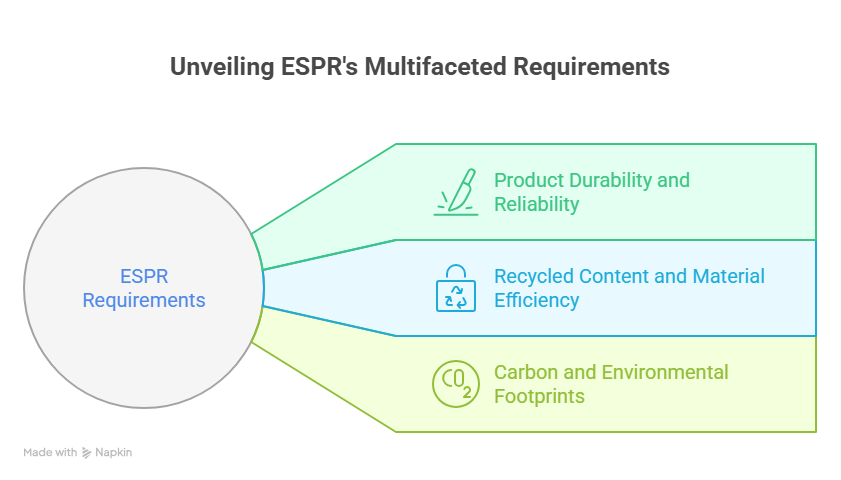
The primary legal foundation for the Digital Product Passport is the Ecodesign for Sustainable Products Regulation (ESPR). ESPR replaces the earlier Ecodesign Directive, which focused mainly on energy-related products and efficiency metrics.
The Role of the European Commission 

The European Commission plays a central role in shaping how DPP requirements are applied in practice. 

Delegated Acts: Defining the Details

Rather than issuing one-size-fits-all rules, the Commission is developing product-specific “Delegated Acts.” These acts will: 

  • Define which product categories require a DPP 
  • Specify the exact data fields that must be disclosed 
  • Set rules for data access, format, and interoperability 
  • Clarify who is responsible for data accuracy (manufacturer, importer, distributor) 

This approach ensures that DPP requirements are tailored to the risk profile, environmental impact, and complexity of each product group. 

Products Requiring a DPP: The Priority List 

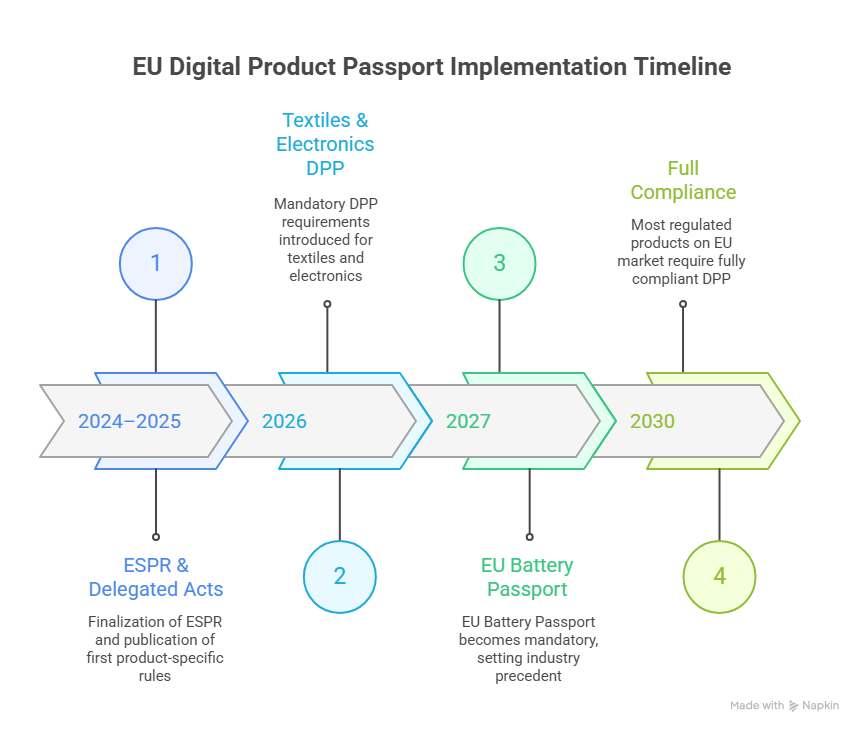
The EU is implementing DPPs through a phased, risk-based rollout, starting with sectors that have high environmental impact, complex supply chains, or significant circularity potential. 

Priority Sectors Include: 

  1. Batteries 
  • Governed under the separate EU Battery Regulation 
  • Mandatory battery passports from 2027 
  • Focus on raw materials, carbon footprint, performance, and recycling 
  1. Textiles & Apparel 
  • Emphasis on fiber composition, chemical usage, durability, and recyclability 
  • Aimed at reducing fast fashion waste and greenwashing 
  1. Electronics & ICT 
  • Focus on “right to repair,” component traceability, and rare earth recovery 
  • Addresses e-waste and resource dependency risks 
  1. Construction Products 
  • Tracks materials to enable reuse after demolition 
  • Supports circular construction and low-carbon building practices 
  1. Chemicals and Plastics 
  • Highlights toxicity, hazardous substances, and recycled content 
  • Improves transparency and chemical safety across supply chains 

Additional sectors will be added as the framework matures. 
Why This Legal Framework Matters 

The DPP legal framework signals a fundamental shift in EU market access rules. Products without compliant, digital, and verifiable data will increasingly face market restrictions, penalties, or exclusion. For manufacturers, exporters, and importers, early alignment with ESPR and DPP requirements is not just about compliance it is about future-proofing access to the EU market and maintaining competitiveness in a transparency-driven economy. 

DPP Data & Technology – Under the Hood 

For the Digital Product Passport (DPP) to function at scale across industries and borders, it requires a robust, interoperable, and secure technological foundation. The DPP is not a single document but a dynamic digital system that connects product data, supply chains, and regulatory oversight throughout a product’s lifecycle. 

Required DPP Data Fields 

While the exact data requirements vary by product category and delegated acts under ESPR, most Digital Product Passports will include four core data layers: 

1. Basic Product Identity 

This establishes the unique digital identity of the product: 

  • GTIN (Global Trade Item Number) or equivalent identifier 
  • Batch or serial number for traceability and recalls 
  • Manufacturing location and date 

This information ensures one-to-one linkage between the physical product and its digital record. 

2. Material Composition 

To enable sustainability, safety, and circularity, DPPs must disclose: 

  • Detailed breakdown of raw materials and components 
  • Identification of Substances of Very High Concern (SVHCs) 
  • Material sourcing and recyclability attributes 

This data supports chemical safety regulations, recycling operations, and transparency for downstream actors. 

3. Sustainability Metrics 

Environmental performance is a core pillar of the DPP: 

  • Carbon footprint (CO₂ equivalent) across the lifecycle 
  • Water usage and resource intensity metrics 
  • Other product-specific environmental indicators 

These metrics enable consistent ESG reporting and comparability across products and suppliers. 

4. End-of-Life Instructions 

To support the circular economy, DPPs must include: 

  • Disassembly manuals for repair and recycling 
  • Reuse and recycling instructions 
  • Standardized recycling and material symbols 

This information empowers repair technicians, recyclers, and consumers to extend product life and reduce waste. 

QR Codes & Identifiers

The physical connection between a product and its DPP is typically enabled through: 

  • QR codes, often using the GS1 Digital Link standard 
  • NFC or RFID tags for higher-value or long-life products 

These identifiers must be: 

  • Durable enough to last the product’s full lifecycle 
  • Scannable across geographies and environments 
  • Securely linked to the correct DPP data source 

Blockchain & the DPP 

Blockchain or Distributed Ledger Technology (DLT) is frequently used to enhance trust and auditability in DPP systems. 

Why Blockchain Matters 

  • Ensures data immutability once recorded, data cannot be altered 
  • Prevents downstream manipulation of origin or sustainability claims 
  • Creates an audit-ready, tamper-proof trail for regulators and buyers 

For example, once a manufacturer logs raw material origin data in a blockchain-backed DPP, it remains verifiable throughout the product lifecycle. 

Data Interoperability Standards 

A DPP is only effective if data can move seamlessly across borders and systems. 

EU Interoperability Mandates 

The EU requires the use of open, globally recognized standards, including: 

  • ISO standards for data formats and reporting 
  • GS1 standards for identification and digital links 

This ensures that a recycler in Poland, a regulator in Germany, and a manufacturer in India can all access and interpret the same product data without system conflicts. 

DPP System Architecture 

Contrary to common assumptions, the DPP is not a centralized EU database. 

How the Architecture Works 

  • Manufacturers host and manage their own product data 
  • Data is stored in secure, compliant systems or platforms 
  • A central EU registry acts as an index, pointing to the data location via secure links 

This decentralized model improves scalability, data ownership, and security while enabling regulatory access when needed.

Implementation – A Roadmap for Businesses

Implementing a Digital Product Passport is a cross-functional transformation project involving procurement, sustainability, compliance, IT, and operations. 

How to Create a Digital Product Passport 

DPP creation typically involves three interconnected layers: 

  1. Data Collection 
  • Gather primary data from Tier 1, Tier 2, and Tier 3 suppliers 
  • Standardize material, sustainability, and compliance disclosures 
  1. Data Storage 
  • Upload data to a secure, cloud-based DPP or traceability platform 
  • Ensure version control, audit logs, and access permissions 
  1. Data Access 
  • Generate and print a QR code or digital identifier 
  • Link the identifier directly to the live DPP record 

DPP Implementation Steps 

A structured approach reduces cost and risk: 

  1. Gap Analysis 
    Assess current data availability against ESPR and delegated act requirements. 
  1. Supplier Engagement 
    Digitally onboard suppliers to collect standardized material and sustainability data. 
  1. Technology Selection 
    Partner with a DPP-ready traceability platform (such as TraceX) that supports blockchain, interoperability standards, and EU-compliant reporting. 
  1. Pilot Program 
    Test DPP generation on a single product line to validate workflows and data quality. 
  1. Full Scale-Up 
    Integrate DPP creation into ERP, PLM, and quality systems for automated, batch-level passports. 

Roles in the Value Chain 

Manufacturers 

  • Create the initial DPP 
  • Ensure data accuracy and completeness 
  • Maintain lifecycle updates 

Importers & Distributors 

  • Verify that products entering the EU have valid DPPs 
  • Share legal responsibility for non-compliant products 
  • Enable data access for authorities and buyers 

DPP Implementation Costs 

DPP implementation costs vary based on supply chain complexity and digital maturity. 

Typical Cost Components 

  • Software licensing for traceability and DPP platforms 
  • Internal labor for data mapping and supplier onboarding 
  • Hardware upgrades for labeling, scanning, or RFID 

Long-Term ROI 

While upfront costs exist, companies often realize savings through: 

  • Reduced audit and compliance costs 
  • Faster regulatory approvals 
  • Higher brand trust and market valuation 

The Digital Product Passport is a data-first regulatory system that demands robust technology, interoperable standards, and disciplined implementation. Organizations that invest early in scalable DPP infrastructure will not only meet EU compliance requirements but also gain long-term advantages in transparency, efficiency, and circular economy readiness. 

Compliance – Staying on the Right Side of the Law 

DPP Compliance Requirements 

To be compliant, a DPP must be: 

  • Complete: Including all mandatory fields from the delegated acts. 
  • Accurate: Reflecting the actual batch-level data of the product. 
  • Accessible: The link must work for the entire expected lifespan of the product. 

DPP Compliance Checklist 

  • Is the data carrier (QR/NFC) easily visible on the product? 
  • Does the DPP link directly to the specific batch/model? 
  • Are disassembly and recycling instructions included? 
  • Is the data stored for the required duration (usually 10 years)? 

Non-Compliance Penalties 

The EU is taking a “carrot and stick” approach. Potential penalties include: 

  • Market Ban: Products without a valid DPP will be barred from entry into the EU. 
  • Heavy Fines: Often calculated as a percentage of annual turnover. 
  • Reputational Damage: Inclusion on public lists of non-compliant companies. 

Audits & Market Surveillance 

National authorities in each EU member state will conduct spot checks. They will scan QR codes in warehouses and retail stores to verify that the digital data matches the physical product. 

DPP Use Cases – Real-World Impact 

The Digital Product Passport (DPP) is designed to deliver practical, real-world value across industries by making product data accessible, verifiable, and actionable throughout the lifecycle. Below are detailed, real-world scenarios showing how DPPs transform operations, compliance, and sustainability outcomes in key sectors.

Sector Cost Savings Emission Reductions Key Data  
Batteries (Pioneer) 40-60% audit costs via automation; 9.7% premium pricing 20-30% Scope 3 via recycled sourcing tracking (cobalt/lithium) Battery Reg mandates DPP 2027; circularity boosts 2nd-life recovery 
Textiles & Fashion 30-50% waste reduction; supply chain visibility cuts risks 25% 15-25% lifecycle CO₂e via material traceability First-wave priority; 80% consumer willingness-to-pay more 
Electronics 20-40% efficiency gains; faster NPI via data flows 10-20% from repairability/disassembly data ICT hardware pilots; e-waste circularity potential high 
Construction Products 25-35% admin streamlining; embodied carbon tracking 15-30% CO₂ reductions supporting BREEAM/LEED First-wave; resource recovery prioritized 
Chemicals 20-40% compliance costs; hazardous substance monitoring 10-25% via optimized disposal/recycling Plastics/chemicals in scope; EU free movement ensured 

1. Batteries – The Pioneer Use Case 

Real-world scenario: 

An electric vehicle (EV) battery reaches the end of its automotive life after 8–10 years but still retains usable capacity. 

How DPP helps: 

  • The Battery Passport records State of Health (SoH) and State of Charge (SoC) over time 
  • Second-life companies can instantly assess whether the battery is suitable for reuse in home energy storage or grid balancing systems 
  • Recycling operators know exactly which materials (lithium, cobalt, nickel) are present and how to recover them 

Impact: 

  • Extends battery life cycles 
  • Reduces raw material demand 
  • Improves the safety and economic viability of second-life applications 

2. Textiles & Fashion – From Claims to Proof 

Real-world scenario: 

A clothing brand markets a product as “organic cotton” and “low-impact dyed.” 

How DPP helps: 

  • The DPP traces cotton back to a specific farm polygon, proving organic certification and land-use compliance 
  • Chemical data from dyeing and finishing processes shows restricted substance compliance 
  • Consumers scan a QR code to view fiber composition, water usage, and environmental footprint 

Impact: 

  • Eliminates greenwashing risks 
  • Builds consumer trust through transparency 
  • Supports textile recycling by revealing fiber blends 

3. Electronics – Enabling the Right to Repair 

Real-world scenario: 

A consumer wants to repair a smartphone instead of replacing it. 

How DPP helps: 

  • The DPP includes a Repairability Score, spare-part availability, and disassembly instructions 
  • Repair shops access component specifications and replacement guidance 
  • Regulators can verify compliance with EU “right to repair” laws 

Impact: 

  • Extends product lifespans 
  • Reduces e-waste 
  • Empowers consumers to make informed purchasing decisions 

4. Construction Products – Circular Buildings in Practice 

Real-world scenario: 

A commercial building is demolished after 40 years, and materials are evaluated for reuse. 

How DPP helps: 

  • Steel beams and concrete panels carry data on structural integrity, load capacity, and material composition 
  • Engineers can certify reused materials for new construction projects 
  • Architects design buildings knowing materials can be reclaimed at end-of-life 

Impact: 

  • Enables circular construction models 
  • Reduces embodied carbon 
  • Cuts demolition waste significantly 

5. Chemicals – Transparency for Safety & Compliance 

Real-world scenario: 

A waste management company must safely dispose of chemical byproducts from manufacturing. 

How DPP helps: 

  • The DPP tracks the Identity of Substances, including SVHCs 
  • Waste handlers instantly know handling, storage, and disposal requirements 
  • Regulators can verify compliance with REACH and chemical safety regulations 

Impact: 

  • Improves hazardous waste management 
  • Reduces environmental and health risks 
  • Strengthens regulatory compliance and audit readiness 

Why These Use Cases Matter 

Across industries, DPPs turn static compliance into dynamic, lifecycle-driven transparency. They enable reuse, repair, recycling, and responsible disposal while reducing risk, cost, and environmental impact. 

In practice, DPPs are not just digital records they are enablers of the circular economy, trusted compliance, and smarter consumer and business decisions. 

Powering Compliance with TraceX

The digital product passport solution by TraceX enables businesses to meet regulatory requirements by digitizing product and supply chain data end-to-end. The platform:

  • Captures Verified Data: Records origin, material composition, sustainability, and compliance data at the source.
  • Maintains Granular Traceability: Tracks batch- and lot-level data through every stage of processing.
  • Secures Digital Identifiers: Links verified data to secure digital carriers, such as QR codes or RFID, for easy accessibility.
  • Ensures Interoperability: Uses standardized data formats that align with ESPR and European Commission requirements.

By utilizing blockchain-backed integrity and audit-ready records, TraceX helps companies manage their digital product passport ecosystem, reducing compliance risk while building a foundation for long-term circularity.

Are you ready to start your DPP journey?

Get in touch with our experts »

Preparing for the Transparency Era 

The Digital Product Passport is more than a regulatory hurdle; it is a bridge to a more efficient, transparent, and profitable way of doing business. By digitizing the “life story” of your products today, you are not just ensuring compliance you are building the foundation for a brand that consumers can trust in the 21st century. The Digital Product Passport (DPP) marks a fundamental shift in how products are designed, documented, and regulated in the European Union. More than a compliance obligation, DPPs are a powerful enabler of transparency, circular economy practices, and data-driven decision-making across product lifecycles. Companies that act early by digitizing supply chain data, aligning with ESPR requirements, and adopting interoperable DPP-ready systems will not only reduce regulatory risk but also gain a competitive advantage in sustainability-led markets. As DPP adoption accelerates, readiness will define who can innovate, comply, and scale in the future EU economy. 

Discover how the EU Green Deal is revolutionizing product design, traceability, and sustainability expectations worldwide. 

Explore our blog on the EU Green Deal and sustainable supply chains 

Discover how GS1 identifiers, QR codes, and Digital Link standards enable interoperable, end-to-end traceability. 

Read our blog on GS1 traceability standards and digital product identification 

Understand how evolving EU sustainability laws impact manufacturers, exporters, and global supply chains and how to prepare early. 

Explore our blog on EU Green Deal regulations and compliance requirements

Frequently Asked Questions (FAQ’s)


What is a Digital Product Passport (DPP)?

A Digital Product Passport is a digital record containing key information about a product’s origin, materials, sustainability impact, and end-of-life handling, mandated under the EU’s ESPR framework. 

Which products will require a Digital Product Passport? 

Priority sectors include batteries, textiles, electronics, construction products, chemicals, and plastics, with phased rollouts starting from 2026 onward. 

How can companies prepare for DPP compliance?

Companies should begin by mapping supply chain data, engaging suppliers digitally, adopting interoperable traceability platforms, and piloting DPPs on selected product lines before full-scale rollout. 

Start using TraceX
Transparency, Trust, & Success for your Climate Journey.
Get the demo

Get your free trial

Request for a Demo Session

Download your Ultimate Guide to Digital Product Passport (DPP): Navigating the Future of Circular Economy and Compliance  here

Download your Ultimate Guide to Digital Product Passport (DPP): Navigating the Future of Circular Economy and Compliance  here

Download your Ultimate Guide to Digital Product Passport (DPP): Navigating the Future of Circular Economy and Compliance  here

[hubspot type=form portal=8343454 id=304874ea-d4e0-4653-9825-707360746edb]
[hubspot type=form portal=8343454 id=b8321ac0-687a-4075-8035-ce57dd47662a]
food traceability, food supply chain, blockchain traceability, agriculture traceability software

Is Your Supply Chain Audit-Ready for 2026?

Get the free TraceX Playbook — 10 traceability failures to fix before your next audit, a 10-point maturity scorecard.

Grab your Free Trial now

Ensure your supply chain is EUDR-ready with TraceX.

Don’t miss out on your chance to grab access to our early bird offer!

food traceability, food supply chain

Are you EUDR Due-Diligence Ready?

Your essential compliance guide

food traceability, food supply chain

Please leave your details with us and we will connect with you for relevant positions.

[hubspot type=form portal=8343454 id=e6eb5c02-8b9e-4194-85cc-7fe3f41fe0f4]
food traceability, food supply chain

Please fill the form for all Media Enquiries, we will contact you shortly.

[hubspot type=form portal=8343454 id=a77c8d9d-0f99-4aba-9ea6-3b5c5d2f53dd]
food traceability, food supply chain

Kindly fill the form and our Partnership team will get in touch with you!

[hubspot type=form portal=8343454 id=b8cad09c-2e22-404d-acd4-659b965205ec]