
Quick summary: Learn how eIDAS 2.0 and the European Digital Identity framework enable secure Digital Product Passport verification across EU supply chains. Prepare for DPP compliance today.

By 2026, thousands of manufacturers, importers, and distributors operating in the EU will be required to share verified, structured product data across borders, not just internally, but with regulators, partners, recyclers, and even consumers. The challenge isn’t just data transparency. It’s trusted verification across complex, multi-actor value chains. This is where Digital Product Passport and EUDI become strategically connected.
For many organizations, this is where compliance risk escalates.
How do you ensure that sustainability claims are legally valid across all 27 EU member states?
How can each supply chain actor authenticate, sign, and verify product data without creating manual bottlenecks?
And how do you prevent identity gaps that expose your business to regulatory penalties under evolving EU frameworks?
Under the updated eIDAS 2.0 framework, the European Union is introducing the European Digital Identity Wallet (EUDI Wallet) a standardized digital identity system designed to enable legally recognized, cross-border authentication and verifiable credentials. When combined with the Digital Product Passport (DPP), it creates a trusted infrastructure for secure, multi-actor verification across EU value chains.
For compliance leaders, digital transformation heads, and ESG executives, the question is no longer if these frameworks will impact operations but how quickly your organization can align its identity, verification, and value chain systems before enforcement deadlines begin to bite.
In this guide, we break down how Digital Product Passport and EUDI work together, what eIDAS 2.0 changes in practice, and how companies can build a future-proof verification architecture across EU value chains with Digital Product Passport Solutions from TraceX
A Digital Product Passport is a structured digital record that stores verified data about a product’s origin, materials, sustainability footprint, and lifecycle. Under EU regulations, DPPs rely on secure digital identity frameworks like EUDI and eIDAS 2.0 to enable trusted cross-border verification across supply chains.
The European Union is not introducing the Digital Product Passport (DPP) as a tech innovation trend it is mandating it as a regulatory instrument to transform how products are designed, verified, traded, and recycled across the single market.
At the core of this shift are four major policy drivers:
Under the Circular Economy Action Plan, the EU committed to decouple economic growth from resource consumption. The plan recognizes that up to 80% of a product’s environmental impact is determined at the design stage.
However, circularity fails without data transparency.
Today, recyclers often lack verified information about:
The Digital Product Passport ensures that structured lifecycle data follows a product from manufacturing to reuse and recycling enabling a functioning circular economy rather than a theoretical one.
The Ecodesign for Sustainable Products Regulation (ESPR) makes Digital Product Passports legally enforceable across most physical goods placed on the EU market.
ESPR expands ecodesign rules beyond energy-related products to include:
Under ESPR, certain product categories must provide machine-readable, interoperable product data, and this is where the Digital Product Passport becomes mandatory.
Key shift: Compliance is no longer document-based. It becomes digitally verifiable and cross-border enforceable.
The EU is tightening rules against vague environmental claims.
With frameworks like the Green Claims Directive and stricter ESG disclosure requirements, companies must prove:
Without standardized digital verification, these claims risk being classified as misleading.
Digital Product Passports create:
In other words, DPP shifts sustainability from marketing narrative to verifiable compliance infrastructure.
The EU is phasing DPP implementation by high-impact sectors:
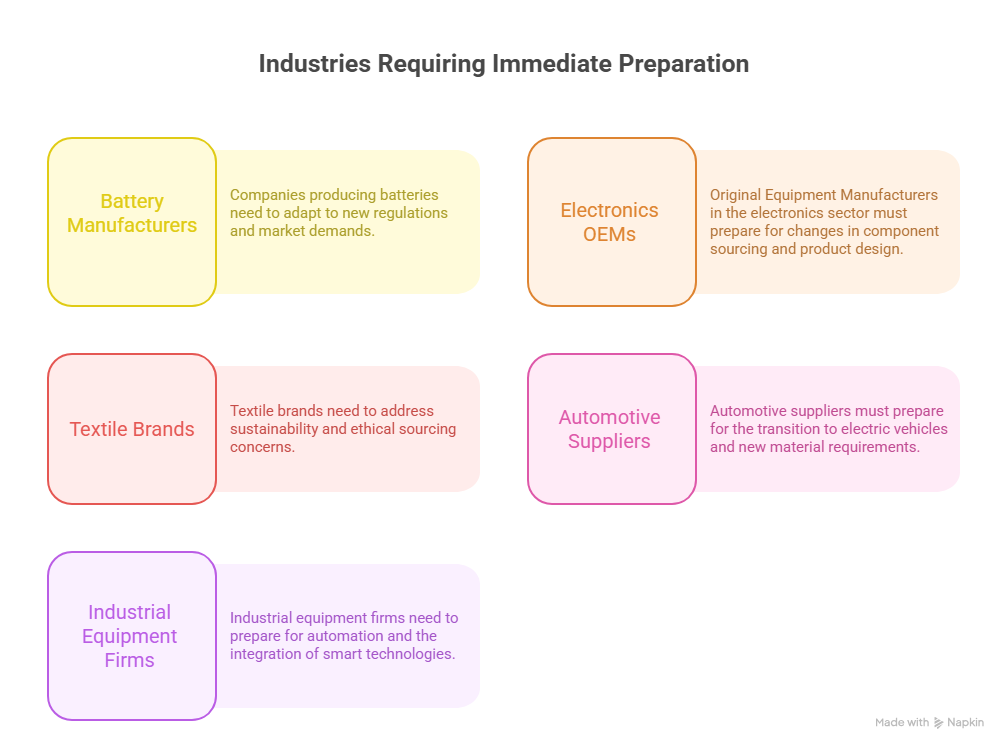
Batteries
Under the EU Battery Regulation, battery passports are among the first mandatory implementations, including carbon footprint and due diligence data.
Textiles
Textiles are prioritized due to their waste volume and the impacts of fast fashion. DPP will support sorting, reuse, and recycling.
Electronics & ICT
High resource intensity and e-waste concerns make electronics a key early adopter sector.
Future categories are expected to include:
Strategic implication: Organizations in these sectors cannot treat DPP as a future IT upgrade; it is a near-term compliance requirement with operational consequences.
The EU is mandating Digital Product Passports because traditional compliance models are fragmented, paper-heavy, and difficult to enforce across borders.
DPP introduces:
When combined with identity frameworks like eIDAS 2.0 and EUDI, the EU creates something unprecedented:
A legally trusted, interoperable data ecosystem across all 27 member states.
For companies, this is not just regulatory pressure; it is a redesign of how product data, sustainability claims, and supply chain accountability operate in the European market.
Understand the identity layer, trust framework, data architecture, and verification mechanisms that power compliant Digital Product Passports.
Read: “Digital Product Passport Architecture Explained”
DPP compliance isn’t just about traceability it requires structured, regulation-ready product data across lifecycle, sustainability, and material disclosures.
Read: “Digital Product Passport Data Requirements: What Manufacturers Must Capture”
The European Digital Identity (EUDI) Framework is the European Union’s standardized system for secure, legally recognized digital identity across all 27 member states. It enables individuals and businesses to authenticate themselves, share verified data, and sign transactions digitally with cross-border legal validity.
The framework builds on the original eIDAS Regulation and, under eIDAS 2.0, is significantly expanded to introduce a unified digital identity ecosystem for both citizens and organizations.
In simple terms:
At the centre of the framework is the EU Digital Identity Wallet (EUDI Wallet).
This is a secure digital wallet (mobile or enterprise-integrated) that allows users to:
Unlike traditional logins or platform-based identity systems, the EUDI Wallet is:
For businesses, this means identity verification no longer depends on fragmented national systems or private authentication providers.
One of the most critical expansions under eIDAS 2.0 is support for both natural persons and legal entities.
Natural Persons
They can use the wallet to:
Legal Entities
Organizations can now hold digital identity credentials and issue legally valid electronic seals a crucial capability for regulated supply chains and Digital Product Passport ecosystems.
This distinction is essential in multi-actor value chains, where not only individuals but entire organizations must be authenticated and legally accountable.
A core innovation of the EUDI framework is the use of verifiable credentials.
These are digitally signed, cryptographically secure credentials that:
Examples in supply chains:
Verifiable credentials reduce fraud, eliminate manual verification processes, and enable machine-readable compliance checks especially important for Digital Product Passport systems.
One of the biggest barriers in EU digital trade has been inconsistent national identity systems.
The EUDI framework ensures:
Under eIDAS 2.0, a credential issued in Germany must be verifiable in France, Italy, or Spain without additional national-level revalidation.
For regulated sectors, this enables:
In frameworks like Digital Product Passport, identity is not optional it is foundational.
Every product data entry must be:
The European Digital Identity Framework provides the trust layer that enables this.
Without EUDI and eIDAS 2.0:
With it, the EU is creating a unified digital trust infrastructure — one that supports compliance, reduces fraud, and enables scalable digital ecosystems across industries.
The European Digital Identity (EUDI) framework differs from traditional digital identity systems by providing government-recognized, cross-border, and legally enforceable digital identity across all EU member states. Unlike platform-based or national ID systems, EUDI enables both individuals and legal entities to use interoperable digital wallets, share verifiable credentials, and apply legally valid electronic signatures under eIDAS 2.0.
This creates a standardized trust framework for secure, multi-actor authentication across the European Union.
Modern EU value chains involve dozens of independent actors operating across jurisdictions. Without a unified trust framework, verifying who submitted, approved, or modified compliance data becomes fragmented and legally risky.
The updated eIDAS 2.0 establishes a harmonized legal and technical infrastructure that enables secure, cross-border, and machine-verifiable multi-actor authentication critical for Digital Product Passport and other regulated ecosystems.
At the core of eIDAS 2.0 is the ability to issue and verify verifiable credentials tied to authenticated identities (via EUDI wallets or organizational identity systems).
Each supply chain participant can hold digitally signed credentials proving specific attributes:
These credentials are:
This eliminates paper-based validation and reduces fraud risks, while ensuring that every data contribution to a Digital Product Passport is attributable to a verified legal entity.
One of the strongest legal mechanisms under the original eIDAS Regulation now reinforced in eIDAS 2.0 is the concept of qualified electronic signatures (QES) and qualified electronic seals (QSeal).
Why this matters:
Under eIDAS 2.0:
For multi-actor supply chains, this means:
This creates a legally harmonized trust environment across the EU single market.
Traditional compliance relies on PDFs, scanned certificates, and manual review processes. That model does not scale for digital ecosystems like Digital Product Passports.
eIDAS 2.0 supports:
When compliance data is:
It becomes machine-readable and automatically verifiable.
This enables:
In a Digital Product Passport context, this ensures that every lifecycle data entry from raw material sourcing to recycling can be digitally authenticated, legally recognized, and programmatically verified.
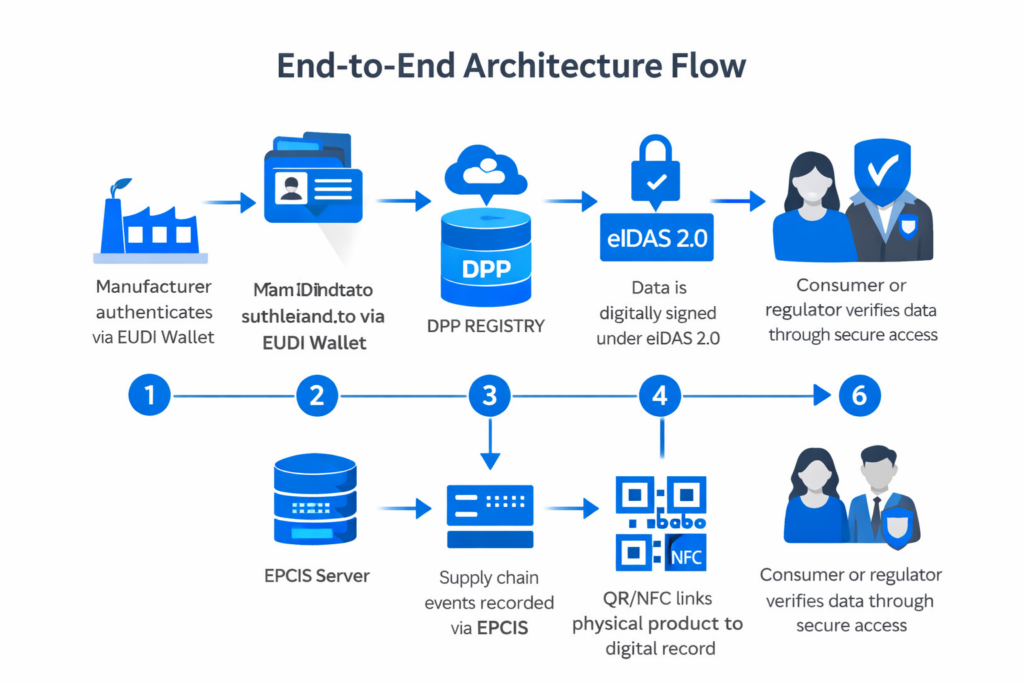
When Digital Product Passport (DPP) integrates with the European Digital Identity framework, it forms a multi-layered trust architecture that connects products, companies, regulators, and consumers.
Below is a clear breakdown of the technical stack ideal for architects, compliance officers, and digital transformation leaders evaluating implementation models.
At the top of the architecture sits the Identity Layer, powered by the European Digital Identity (EUDI) Wallet under the revised eIDAS 2.0 framework.
What It Does
Why It Matters for DPP
DPP data is only valuable if the accessing party is trusted.
The EUDI Wallet ensures:
Operational Benefit:
Prevents identity spoofing and fraudulent sustainability claims across borders.
The Trust Layer formalizes legal recognition of digital transactions across the EU.
Core Elements Under eIDAS 2.0
Role in DPP Architecture
When a manufacturer uploads product lifecycle data:
This ensures:
Strategic Insight:
Without a formal trust layer, DPP becomes just a database.
With eIDAS 2.0, it becomes a legally binding compliance infrastructure.
This is the operational backbone.
A. Centralized or Federated DPP Registry
B. EPCIS (Event-Based Traceability)
Based on GS1 standards, EPCIS enables:
C. Blockchain (Optional Layer)
Used when:
Important:
Blockchain is not mandatory for DPP compliance it is an architectural choice depending on scale, risk exposure, and ecosystem complexity.
Data Governance Considerations
This is the interaction layer where DPP becomes accessible.
QR Code
NFC Tag
API Access
How It Works in Practice
This layered verification prevents:
This creates a trusted digital twin of the product that persists across borders.
As Digital Product Passport (DPP), EUDI, eIDAS 2.0, and EUDR frameworks mature, companies often focus on data collection but overlook structural compliance risks embedded in their architecture.
Below are the four most common operational and legal blind spots.
The Risk
Many organizations assume that supplier declarations are sufficient proof of compliance. In reality:
TraceX DPP Solutions integrate:
This ensures every data submission is linked to a verified legal actor closing identity gaps across the value chain.
The Risk
Compliance teams often rely on:
TraceX digitizes verification workflows through:
The Risk
Many systems operate in silos:
TraceX supports:
This ensures that product data is not just stored but trusted and legally defensible.
The Risk
Exporters often underestimate that:
TraceX provides:
Digital Product Passport (DPP) and EUDI are not parallel regulatory initiatives they are structurally connected components of Europe’s emerging digital trust infrastructure. Under eIDAS 2.0, identity, authentication, digital signatures, and cross-border recognition become legally enforceable layers that strengthen DPP data integrity.
For manufacturers, exporters, and platform providers, compliance is no longer just about uploading sustainability data. It requires a secure identity layer, interoperable digital credentials, structured traceability systems, and legally recognized trust services.
Organizations that architect DPP solutions with EUDI and eIDAS 2.0 alignment from the outset will benefit from reduced legal exposure, faster regulatory approvals, improved audit readiness, and stronger cross-border market access. Those that treat compliance as a documentation exercise risk operational bottlenecks and regulatory friction.
The future of EU market access is built on verifiable digital trust and DPP + EUDI is the foundation.
DPP compliance depends on the right data carrier strategy from QR codes to NFC and GS1 Digital Link.
Read: “DPP Data Carriers Explained: QR, NFC & Digital Link Strategies”
GS1 standards are emerging as a foundational layer for product identification, EPCIS traceability, and structured DPP data exchange.
Read: “How GS1 Standards Power Digital Product Passports”
JTC 24 is shaping the technical standardization framework for Digital Product Passports across industries.
Read: “JTC 24 Explained: The Technical Framework Behind DPP”
Digital Product Passport manages structured product lifecycle and sustainability data, while EUDI (European Digital Identity) provides verified digital identities for entities interacting with that data. Together, they ensure product information is both transparent and legally trustworthy.
eIDAS 2.0 establishes a legal framework for electronic identification, digital signatures, seals, and trust services across EU Member States. When DPP data is digitally signed under eIDAS 2.0, it gains cross-border legal recognition and audit defensibility.
The EUDI Wallet is not mandatory for all DPP use cases today, but it is expected to become central for secure authentication, credential exchange, and cross-border compliance interactions under the evolving EU digital identity framework.
Yes. Any company placing regulated products on the EU market must comply with DPP requirements. While eIDAS 2.0 directly governs EU digital trust services, non-EU entities must ensure their digital processes align with EU-recognized trust standards to avoid market access risks.
No. Blockchain is optional. DPP requires secure, traceable, and verifiable product data, but organizations may use centralized, federated, or distributed architectures depending on their risk profile and operational scale.