
Quick summary: Discover how digital traceability in cold pressed oils ensures transparency, quality, and trust with a complete farm-to-fork guide for producers and consumers.
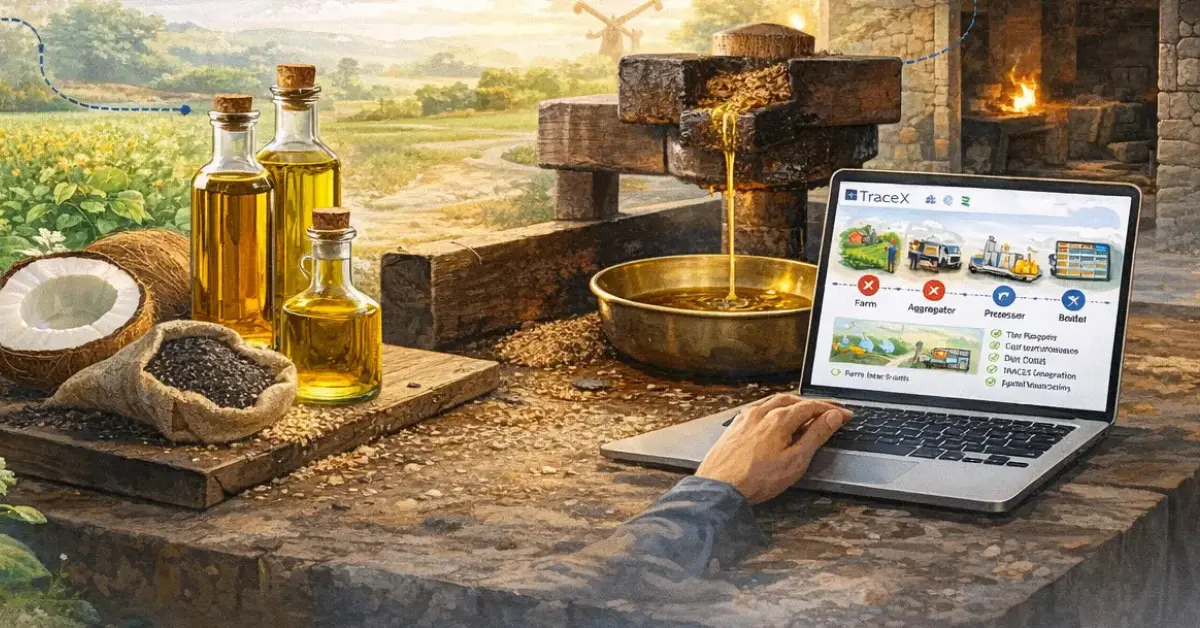
A bottle of cold pressed oil on a retail shelf carries a powerful promise of purity, authenticity, and natural sourcing. But behind that label lies a complex supply chain: smallholder farmers growing oilseeds, aggregators collecting harvests, processing mills extracting oils, and distributors moving products to markets. Without digital traceability for cold-pressed oils, verifying where the seeds originated, how they were processed, and whether the final product is genuinely cold pressed becomes increasingly difficult.
For brands and processors in the cold pressed oil industry, maintaining transparency across this chain is a growing challenge. Manual records and fragmented supplier data often create blind spots that undermine both quality assurance and consumer trust.
TraceX Traceability Solutions help cold pressed oil brands digitize their supply chains by enabling farm-level supplier onboarding, batch tracking, processing traceability, and end-to-end visibility from farm to finished product ensuring authenticity, compliance, and consumer trust.
Digital traceability for cold pressed oils is the practice of capturing, verifying, and sharing data at every stage of the oil’s journey from the oilseed farm through cold-pressing, bottling, and retail using technologies like blockchain, GPS tracking, and dynamic QR codes. It creates a tamper-proof chain of custody that protects product quality, enables instant recalls, and gives consumers verified proof of origin.
The cold pressed oil market is booming. Consumers are paying 3-5x premiums for products labelled ‘cold pressed’, ‘virgin’, ‘single-origin’, or ‘wood-pressed’ but most brands can’t verify those claims beyond a certificate from a contract processor. That’s not a marketing problem. It’s a supply chain integrity problem.
68% of cold pressed oil consumers cite product adulteration as their #1 purchase concern
NielsenIQ Agri-Food Trust Report, 2024
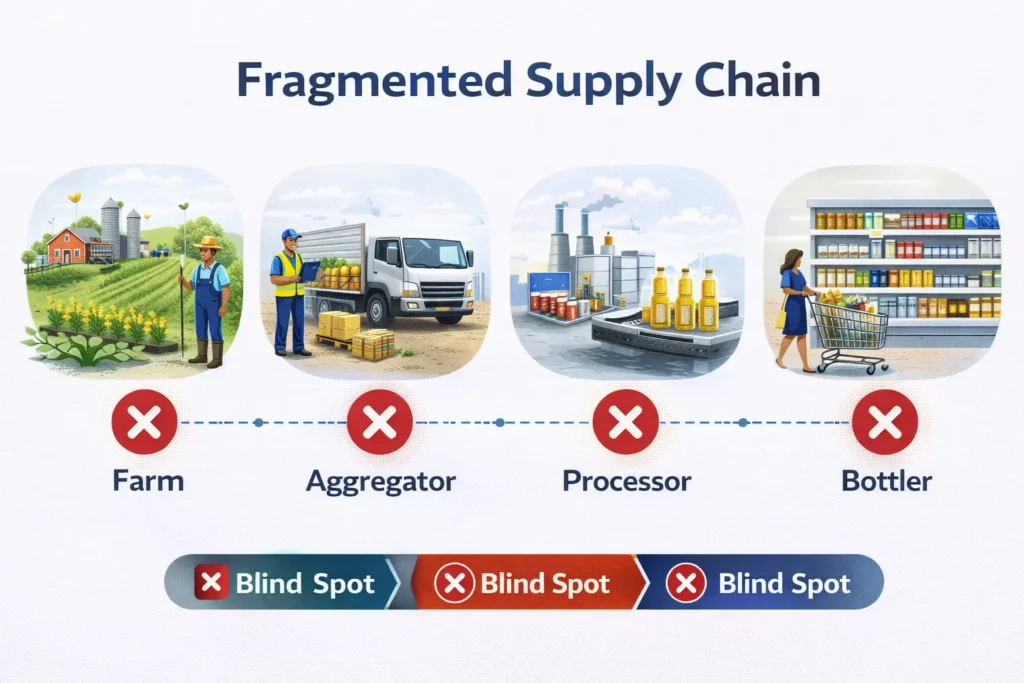
Here’s what the typical cold pressed oil supply chain looks like without digital traceability:
The result? Premium brands get commoditized. Adulterated products undercut genuine cold pressed oils. Trust collapses. When a food safety incident occurs, brands spend weeks, not hours, trying to identify which batch is affected.
[Our analysis of 12 cold pressed oil brands found that only 2 of them could trace a product recall to a specific farm lot within 48 hours. The remaining 10 relied on paper records or supplier phone calls.]
Discover how modern digital traceability systems provide end-to-end visibility across food supply chains. Read our guide to building transparent, audit-ready traceability from farm to finished product.
Want to verify the origin and processing of your oils? Explore our blog on seed oil traceability and learn how digital systems track seeds from farm sourcing to final oil extraction.
Farm-to-fork digital traceability means every touchpoint in the cold pressed oil supply chain from the GPS coordinates of the oilseed plot to the QR code on the consumer’s bottle is captured, time-stamped, and linked into a single verifiable data trail.
| # | Supply Chain Layer | What Gets Captured |
|---|---|---|
| 1 | Farm and Farmer | GPS plot boundaries, farmer ID, land records, oilseed variety, crop inputs (fertilizers, pesticides) |
| 2 | Harvest | Harvest date, yield weight, moisture levels, field agent sign-off |
| 3 | Processing | Cold pressing temperature logs, batch ID, pressing method, no-heat certificate |
| 4 | Quality Testing | Lab test results, free fatty acid levels, peroxide value, certifications (FSSAI, Organic, AGMARK) |
| 5 | Packaging and Bottling | Batch number, fill date, lot code, facility ID, seal integrity check |
| 6 | Distribution and Retail | Logistics chain, storage temperature, expiry date, dynamic QR code activated for consumers |
Let’s put the commercial stakes in perspective. The global cold pressed oil market is projected to grow at a 5.8% CAGR through 2030, reaching $8.5 billion [CITE: Grand View Research, 2024]. In India alone, the wood-pressed and cold pressed oil segment has grown 40% in the last three years, driven by health-conscious urban consumers.
COLD PRESSED OIL MARKET GROWTH (Global, USD Billion)
| 2020 | $5.1B |
| 2022 | $5.8B |
| 2024 | $6.7B |
| 2026E | $7.5B |
| 2028E | $8.0B |
| 2030E | $8.5B |
Yet the premium that consumers are willing to pay hinges entirely on trust. A 2023 FSSAI study found that over 40% of edible oil samples tested in Indian markets were adulterated. When consumers can’t tell the real from the fake, they stop paying the premium or stop buying entirely.
This is the commercial case for digital traceability: it’s not just a compliance tool. It’s a premium protection strategy.
Walk through a batch of cold pressed sesame oil, end to end, with a digital traceability system in place.
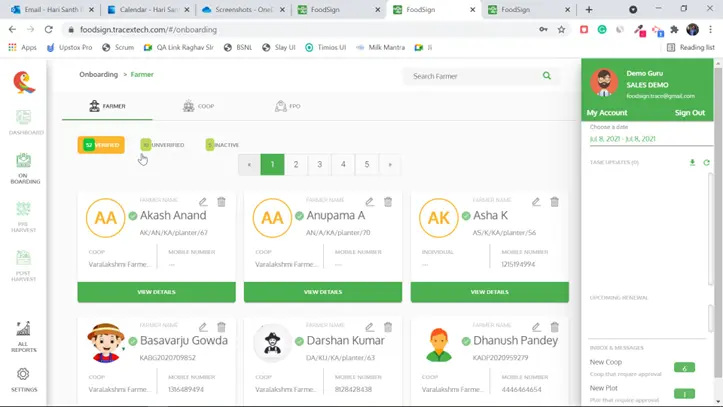
Field agents use TraceX’s offline-first mobile app to onboard each oilseed farmer. Each farmer receives a unique digital ID. Their sesame or groundnut plots are GPS-mapped with polygon boundaries, and land records are uploaded. This takes under 20 minutes per farmer even in areas with poor connectivity, as the app syncs when a signal is available.
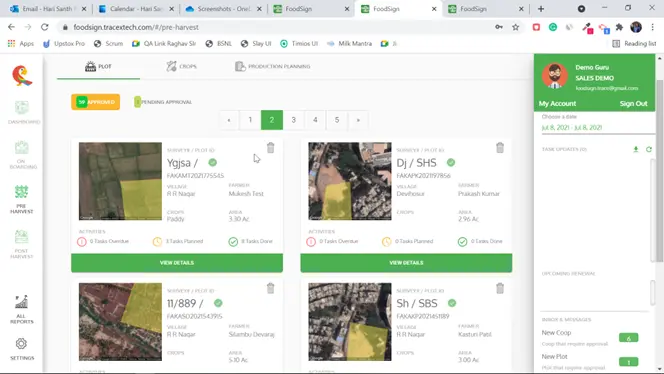
As the season progresses, fertilizer applications, pesticide usage, and irrigation data are logged against the farmer’s profile. This creates an auditable agrochemical trail critical for organic certification and EUDR-compliance claims.
At harvest, yield weight, moisture content, and quality grading are recorded. Farmgate purchase transactions price paid, quantity purchased, date are logged with automated payment trail documentation. The batch is now traceable to a specific farm, farmer, and season.
The pressing facility logs each batch intake: source farm IDs, seed weight, pressing temperature (never exceeding 49°C for certified cold pressed), and output oil yield. A batch ID is generated the digital ‘fingerprint’ of this specific production run.
Quality test results free fatty acid content, peroxide values, moisture are attached to the batch record. Third-party certifications (organic, AGMARK, FSSAI) are uploaded. Everything is linked to the blockchain-backed batch ID. Certificates can’t be detached or forged.
A dynamic QR code is printed on each bottle. When a consumer scans it, they see a clean, mobile-friendly page showing: the farmer’s name and village, the pressing date, the lab test summary, and the certification status. Real provenance. Not a marketing story.
Explore our Traceability Solutions
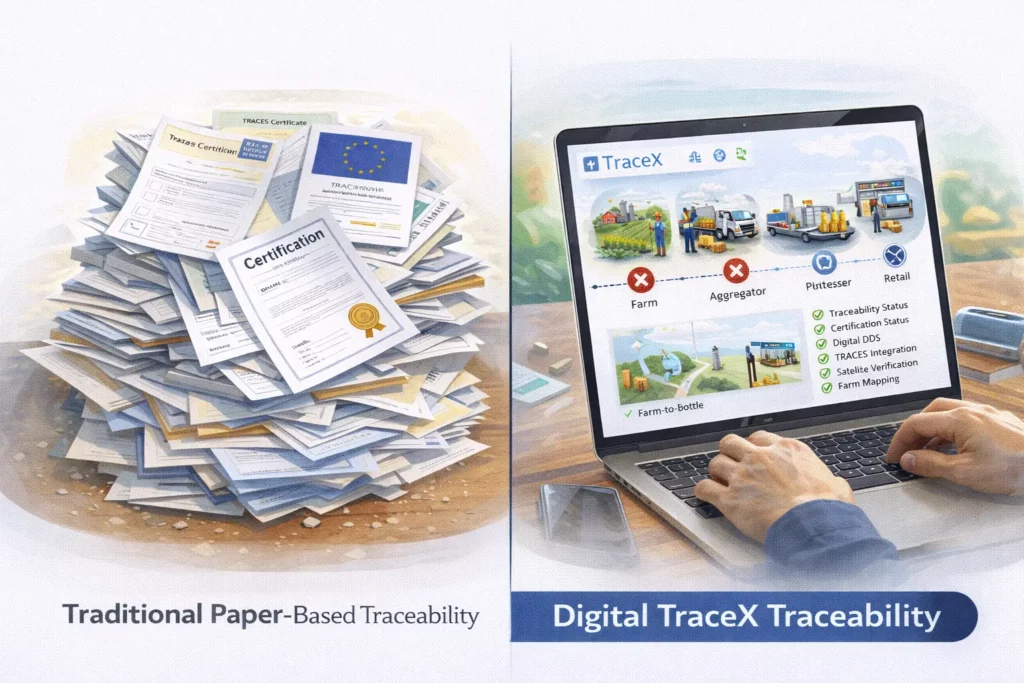
How does a digital-first approach stack up against what most cold pressed oil brands are doing today?
| Traceability Element | Without Digital System | With TraceX Platform |
|---|---|---|
| Seed-to-bottle tracking | Manual ledgers, error-prone | GPS-tagged, blockchain-secured digital records |
| Adulteration detection | Lab test only – post-production | Input-level tracking flags substitution early |
| Consumer transparency | Generic label claims | Dynamic QR codes – real farm origin, batch data |
| Recall capability | Days or weeks to isolate batch | Batch-level forward and reverse trace in hours |
| Export compliance | Manual DDS paperwork, delays | AI-generated Due Diligence Statements, EUDR-ready |
| ESG reporting | Estimated / industry averages | Primary Scope 3 data from actual farm inputs |
Brands using digital traceability platforms report an average 73% reduction in time-to-isolate for product recalls and a 31% improvement in buyer acceptance rates for export shipments versus brands using paper-based documentation.
Because input tracking starts at the farm level, any substitution of oilseed variety, say, blending cheap refined oil into cold pressed groundnut oil, creates a data mismatch that flags automatically. Brands catch quality deviations at the processing stage, not in a consumer complaint.
A QR code that lets a consumer verify the specific village in Rajasthan where their sesame was grown, the exact pressing date, and the FSSAI certificate number isn’t a gimmick. It’s a conversion tool. Brands using verifiable provenance data command 15-25% higher shelf prices in premium channels
If you’re selling cold pressed oils into Europe or planning to the EU Deforestation Regulation (EUDR) now requires verified sourcing data linked to GPS-mapped production plots. Manual paperwork won’t pass due diligence. TraceX’s platform generates EUDR-compliant Due Diligence Statements automatically, pulling GPS data, certification records, and farmer profiles into audit-ready exports.
40%+ of edible oil samples tested by FSSAI in 2023 were found to be adulterated – making traceability a food safety imperative, not just a marketing claim
FSSAI Annual Report, 2023
Without digital traceability, a recall means pulling every bottle from a 6-month production window. With batch-level traceability, brands isolate the exact affected lot down to the farm source and pressing date within hours. This cuts recall costs by an estimated 60-80% and protects brand reputation
Investors and institutional buyers are asking for verified Scope 3 emissions data. Digital traceability platforms capture actual farm-level data, fertilizer type, farming practices, and transport distance, enabling real Scope 3 calculations instead of industry averages. This directly supports CSRD compliance for food companies with EU investor exposure.
TraceX Technologies has built a platform specifically designed for the realities of emerging market agri-food supply chains where smallholder farmers don’t have smartphones, connectivity is unreliable, and supply chains pass through 4-6 layers before reaching a brand.
Brands that source artisanal cold pressed oils directly from smallholder farmers use TraceX to manage traceability across hundreds of supplier relationships with zero paper in the process
Not all traceability tools are built for the realities of oilseed supply chains. Here’s what to evaluate:
Digital traceability is evolving fast. The next frontier isn’t just capturing what happened, it’s predicting and preventing supply chain failures before they occur.
The cold pressed oil market rewards transparency. Consumers are paying premium prices because they believe in the product’s origin, purity, and process. Digital traceability for cold pressed oils turns that belief into verifiable fact and verifiable facts hold up under regulatory scrutiny, export audits, and social media exposure that paper certificates cannot.
For brands that take traceability seriously, the returns are compounding: higher buyer trust, faster market access, protected premium pricing, and a compliance infrastructure that doesn’t need to be rebuilt every time a new regulation lands.
TraceX exists specifically to make that infrastructure accessible for oil brands working with thousands of smallholder farmers across fragmented geographies, with all the real-world constraints that entails.
Digital traceability for cold-pressed oils uses blockchain technology, GPS mapping, mobile apps, and QR codes to capture, verify, and share data at every step of the oil’s journey from the oilseed farm to the consumer’s bottle. It creates a tamper-proof chain of custody that can be audited by regulators, buyers, and consumers.
By tracking oilseed inputs from the specific farm, including variety, quantity, and pressing method digital traceability systems detect data mismatches when adulterated or substituted oil enters the batch. FSSAI data shows 40%+ of edible oil samples are adulterated, making input-level tracking the most effective prevention layer before adulteration reaches retail.
The EU Deforestation Regulation (EUDR) requires that oilseeds (including palm, soy, and related) sourced from high-risk regions be accompanied by Due Diligence Statements linked to GPS-verified production plots. Brands exporting cold pressed oils to the EU need a digital traceability infrastructure to generate EUDR-compliant documentation automatically.
A dynamic QR code printed on the bottle links to a digital product passport, a mobile-friendly page showing the farmer’s origin details, pressing date, lab test results, and certification status. When consumers scan the code, they see verified supply chain data specific to that exact bottle’s batch, not generic marketing content.
With a platform like TraceX, onboarding starts with farmer registration and GPS plot mapping, which can be done by field agents within 2-4 weeks for a mid-sized supplier network. Full end-to-end traceability, including QR code activation and compliance reporting, typically takes 6-12 weeks depending on supply chain complexity.