
Quick summary: Explore the future of sustainability with Digital MRV Systems. Dive into the world of advanced monitoring, efficiency, and tech-driven solutions for emission reduction projects. Discover how digital innovation is reshaping the landscape of carbon offset initiatives.

Carbon markets are growing fast but so is scepticism. Buyers, regulators, and investors are increasingly questioning whether carbon credits truly represent real, additional, and permanent climate impact. At the heart of this trust gap is a persistent pain point: manual, fragmented, and slow MRV processes that struggle to scale and withstand scrutiny. This is where DMRV for Carbon Credits becomes critical. By replacing estimation-heavy methods with continuous, digital verification, DMRV addresses integrity risks head-on enabling carbon markets to scale with confidence, transparency, and credibility.
It is estimated that trading in carbon credits can reduce the cost of implementing NDCs by $250 billion by 2030.
DMRV for Carbon Credits refers to the use of digital technologies such as satellite monitoring, geospatial mapping, automation, and secure data systems to measure, report, and verify carbon emissions reductions and removals at scale. By replacing manual, sample-based MRV with continuous, data-driven monitoring, DMRV for Carbon Credits ensures credible baselines, validates additionality, and enables ongoing leakage and permanence checks. This strengthens carbon credit integrity, reduces fraud and double counting, accelerates verification cycles, and builds trust among regulators, buyers, and investors in increasingly scrutinized carbon markets.
Key Takeaways
DMRV for carbon credits refers to the use of digital technologies such as satellite monitoring, geospatial mapping, automation, and secure data systems to measure, report, and verify carbon emissions reductions or removals accurately and at scale. Unlike traditional MRV, DMRV replaces manual, sample-based processes with continuous, data-driven verification, improving transparency, auditability, and market confidence.
| Phase | How it Works in the Digital Era |
| Digital Monitoring | Instead of manual tape measures, we use LiDAR (Light Detection and Ranging), high-resolution Satellite Imagery, and AI to calculate the exact biomass of a forest or the carbon content in soil. |
| Digital Reporting | Field data is uploaded via mobile apps directly from the farm. This data is geotagged and timestamped, creating a “Digital Twin” of the project that updates in near real-time. |
| Digital Verification | Instead of an auditor flying across the world once a year, Smart Contracts and Machine Learning algorithms cross-reference satellite data with ground sensors to instantly verify that the carbon is still there. |
One MRV system. Carbon and nature, verified.
Dive deeper into how DMRV supports both carbon credits and NbS with audit-ready proof.
Explore our DMRV systems blog
Measuring nature impact goes beyond carbon
Discover how DMRV verifies agroforestry, reforestation, soil carbon, and biodiversity outcomes.
Read our guide to DMRV for Nature-Based Solutions
Digital Monitoring, Reporting, and Verification (DMRV) is critical for carbon credit markets as it addresses core issues of trust, scalability, and integrity in the voluntary carbon market (VCM), projected to grow from $4.04B in 2024 to $23.99B by 2030 at 35.1% CAGR. Traditional MRV relies on costly, manual audits prone to errors (1/3 credits flagged for quality issues), while DMRV leverages satellite imagery, AI, IoT sensors, and blockchain for real-time, tamper-proof data boosting accuracy 79%, cutting costs 50-70%, and enabling frequent credit issuance.
DMRV scales VCM by supporting $50B+ demand by 2030, reducing greenwashing via transparent audits and enabling institutional investment (e.g., tokenized credits on blockchain). In agriculture/forestry, it verifies FLAG/SBTi targets (260+ companies) and EUDR compliance, with pilots showing 95% traceability for exporters. World Bank notes DMRV creates standardized data flows, slashing verification timelines from years to days.
Carbon credit markets are under unprecedented scrutiny as stakeholders question whether issued credits truly reflect real, additional, and permanent climate impact. High-profile cases of over-crediting, weak or outdated baselines, double counting across projects, and unverifiable claims have eroded trust. As a result, buyers, regulators, and registries are no longer willing to rely on estimates or infrequent field checks they increasingly demand verifiable, data-backed proof.
DMRV directly addresses these integrity gaps by generating objective, time-stamped data from satellites, geospatial systems, and digital field inputs, reducing reliance on subjective assessments. Instead of periodic audits that capture only snapshots in time, DMRV enables continuous monitoring, allowing risks such as land-use change, leakage, or reversals to be detected early. Automated workflows significantly reduce verification time and cost, making high-integrity MRV scalable across large and complex projects. Most importantly, DMRV strengthens trust by providing transparent, auditable evidence that supports both voluntary and compliance carbon markets making it foundational infrastructure for the future of credible carbon credit systems.
Carbon credits are like the currency of the fight against climate change, but their value lies in their credibility. To understand how Digital MRV systems fit into this, let’s take a closer look at the carbon credit lifecycle and why accuracy and transparency are so crucial.
The journey of a carbon credit starts with a project think reforesting an area, switching to renewable energy, or adopting sustainable farming practices. The lifecycle typically goes like this:
Traditional MRV methods often involve manual data collection, field visits, and piles of paperwork. This approach can be slow, expensive, and prone to errors. Enter Digital MRV systems, which revolutionize this process by:
For example, imagine a reforestation project using a Digital MRV system. Satellite images track tree growth over time, sensors measure carbon absorption, and the system automatically updates the project’s progress. This data can then be instantly shared with stakeholders, ensuring trust and credibility.
Do you know that excel worksheets, pdfs still rule the Carbon offset market? Verification and accuracy are very critical in validating Carbon offsets to generate carbon credits in carbon markets.
Carbon credits only work if people trust them. If a company buys credits to offset its emissions, it wants to know those credits represent real, measurable reductions. Inaccurate or unverifiable data can erode trust, jeopardize funding, and even harm global climate efforts. Digital MRV systems solve this by providing clear, irrefutable evidence of a project’s impact.
In short, Digital MRV systems are the backbone of modern carbon credit projects. They make the process faster, cheaper, and more reliable, ensuring that every credit issued truly makes a difference for the planet.
Summary Table: Traditional vs. Digital MRV
| Feature | Traditional MRV (2020) | DMRV (2026) |
| Data Frequency | Annual or Biennial | Continuous / Real-time |
| Verification | Manual site visits / Paper logs | Remote / Digital Audit Trails |
| Trust Level | Moderate (subject to human error) | High (Immutable, AI-verified) |
| Cycle Time | 12–24 Months | 1–3 Months |
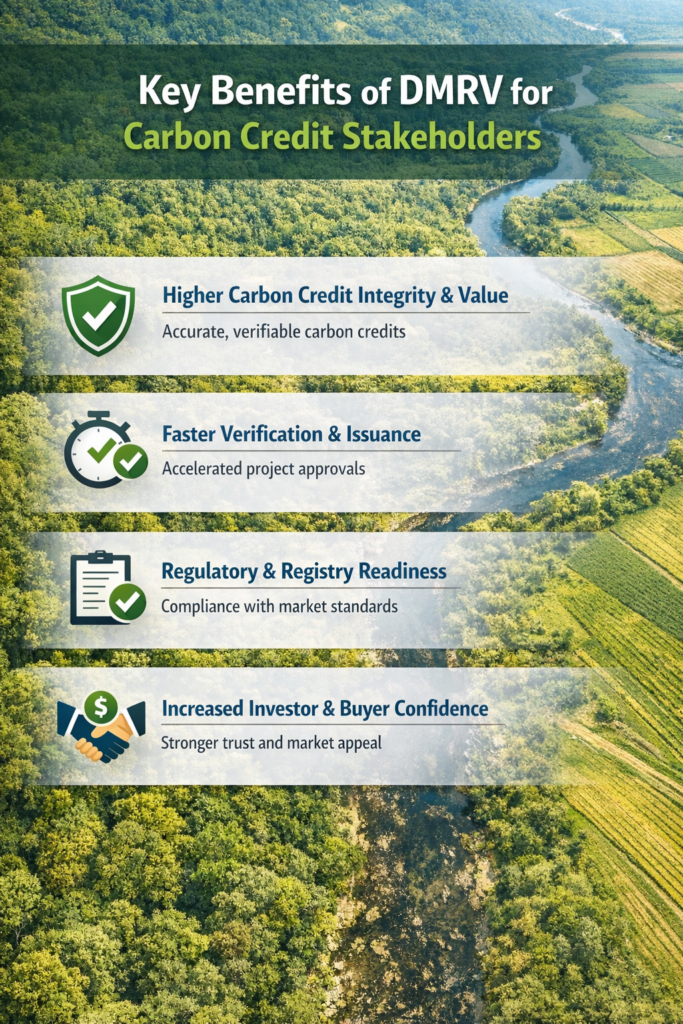
DMRV plays a central role in ensuring that carbon credits are accurate, defensible, and aligned with high-integrity standards. By digitizing the most critical stages of credit generation, DMRV replaces assumptions and infrequent checks with continuous, evidence-based verification.
DMRV enables the creation of robust, data-driven baselines using historical satellite imagery, land-use records, and geospatial analysis to define pre-project emissions or carbon stocks. This allows project developers to clearly demonstrate additionality, proving that emissions reductions or removals would not have occurred without the project intervention. Transparent assumptions, standardized methodologies, and traceable data inputs reduce subjectivity and increase confidence among registries, verifiers, and buyers that each issued credit represents genuine climate impact.
Through continuous monitoring, DMRV detects risks that can undermine long-term credit validity. It helps identify leakage, where emissions activities shift outside project boundaries, by tracking surrounding land-use changes and activity patterns. DMRV also monitors permanence risks, such as deforestation, fire events, or land-use reversals, using real-time satellite data and alerts. This ongoing oversight significantly strengthens long-term credit credibility by ensuring that stored or avoided carbon remains intact over time meeting the durability expectations of modern carbon markets.
Carbon credit integrity depends on the ability to prove that each credit represents a real, unique, and verifiable climate benefit. DMRV directly addresses the most persistent integrity risks in carbon markets by embedding transparency and accountability into every stage of the MRV process.
Fraud prevention is strengthened through immutable, time-stamped datasets generated from satellites, geospatial systems, and secure digital records. These data trails reduce the risk of manipulation, selective reporting, or retroactive adjustments by ensuring that all measurements and calculations are traceable and auditable. Double-counting avoidance is enabled by clearly defined digital project boundaries, geolocation-linked assets, and end-to-end traceability that prevents the same emissions reduction from being claimed multiple times across projects or registries. In addition, automation significantly shortens verification cycles, reducing manual reviews and bottlenecks while maintaining rigor. The result is higher-quality carbon credits that inspire stronger buyer confidence, withstand regulatory scrutiny, and command more stable pricing in increasingly integrity-driven markets.
Importantly, DMRV aligns with the integrity principles promoted by the Integrity Council for the Voluntary Carbon Market (ICVCM), which emphasizes robust baselines, additionality, permanence, and transparent monitoring. By providing continuous, auditable evidence, DMRV helps projects meet ICVCM-aligned expectations resulting in higher-quality credits that earn stronger buyer trust and more durable market value.
DMRV is especially critical for nature-based solutions (NbS), where outcomes vary across landscapes and time.
Key NbS applications include:
Beyond carbon, DMRV can also track biodiversity indicators, ecosystem health, and livelihood impacts, supporting next-generation, multi-benefit credits.
DMRV is defined by a “multi-modal” tech stack where different technologies cross-verify one another to create a “Truth Layer.”
The following breakdown explains how these four core technologies work together to create a defensible and scalable carbon market.
1. Satellite & Remote Sensing
Remote sensing provides the macroscopic evidence needed to monitor massive landscapes without manual labour.
2. GIS & Geospatial Intelligence
Geographic Information Systems (GIS) translate satellite pixels into actionable, plot-level boundaries.
3. AI & Automation
Artificial Intelligence turns terabytes of raw satellite and IoT data into quantifiable carbon metrics.
4. Blockchain & Secure Ledgers
Blockchain provides the permanent, unchangeable home for all the data collected by the other three technologies.
A coffee roaster buys a carbon credit. They scan the Blockchain record, which points to a GIS polygon in Ethiopia. That polygon is linked to a Satellite time-series showing 5 years of tree growth, verified by an AI model that confirms exactly 12.4 tonnes of CO2 were sequestered.
Digital MRV means less time spent on tedious data collection and reporting, letting project developers focus more on their core activities. It also reduces costs associated with manual tracking, making projects more profitable
Having accurate, real-time data means sustainability heads can report their achievements with confidence. This ensures that their claims about reducing emissions are backed up by solid data, which is crucial for maintaining trust with stakeholders and customers
Digital MRV simplifies the verification process. Automated data collection and analysis make it easier for verification bodies to assess projects quickly and accurately. Plus, the transparency offered by digital tools like blockchain ensures that all data is reliable, reducing the chance of errors or fraud
Digital Monitoring, Reporting, and Verification (DMRV) solutions greatly benefit environmental NGOs by enhancing data accuracy and transparency in their projects. With real-time monitoring and blockchain integration, these solutions enable NGOs to ensure accountability and build trust with stakeholders.
By making the process smoother for each of these groups, digital MRV helps create a more efficient and trustworthy carbon market.
Addressing these challenges requires purpose-built, end-to-end digital platforms rather than fragmented tools.
TraceX DMRV Platform is designed specifically to operationalize DMRV for real-world carbon and nature-based projects, addressing implementation challenges through a unified, scalable platform.
TraceX enables farm and plot-level geolocation, establishing accurate project boundaries and defensible baselines critical for additionality and compliance. Its batch and activity-level tracking links field actions, environmental outcomes, and reported credits into a single traceable system. Automated MRV workflows and reporting standardize data collection, processing, and documentation, significantly reducing manual effort while improving consistency, accuracy, and audit readiness.
For agroforestry and broader NbS projects, TraceX provides integrated tracking of carbon sequestration, biodiversity indicators, and livelihood metrics, delivering a holistic view of impact. Continuous satellite monitoring combined with field data enables early risk detection and long-term permanence assurance. With secure, scalable data infrastructure and audit-ready outputs, TraceX supports verification, registry submissions, and buyer due diligence enabling project developers, corporates, and buyers to move confidently from sustainability claims to verifiable proof.
See how DMRV turns sustainability goals into verified impact
Discover how a sustainability foundation used TraceX’s DMRV platform to measure, monitor, and prove real-world environmental outcomes.
Read the Case Study
As carbon markets mature, credibility is no longer optional it is foundational. DMRV for Carbon Credits provides the digital infrastructure needed to move from assumptions to evidence, enabling defensible baselines, continuous monitoring, and audit-ready verification at scale. By addressing risks such as over-crediting, double-counting, and unverifiable claims, Digital MRV strengthens market trust while reducing cost and complexity. For project developers, buyers, and investors, DMRV is not just a technology upgrade it is the backbone of scalable, transparent, and high-integrity carbon markets.
Integrity is the future of carbon markets
Learn what it takes to build trust, transparency, and credibility in the voluntary carbon market.
Read our blog on Building Integrity in the VCM
Not all carbon offsets are created equal
Understand how high-quality carbon offset projects are designed, monitored, and verified.
Read our guide to Carbon Offset Projects
Agroforestry delivers climate and nature benefits—can you prove it?
See how DMRV measures carbon, biodiversity, and livelihoods in agroforestry projects.
Read our blog on DMRV for Agroforestry
DMRV for Carbon Credits uses digital technologies like satellite monitoring, geospatial analytics, and automation to measure, report, and verify carbon emissions reductions or removals accurately and at scale.
DMRV improves integrity by enabling defensible baselines, continuous monitoring, fraud prevention, double-counting avoidance, and faster, more transparent verification cycles.
While not always mandatory, DMRV is increasingly expected by registries, regulators, and buyers as carbon markets shift toward higher integrity standards and proof-based verification.
Yes. DMRV is especially well suited for nature-based solutions, enabling plot-level monitoring of agroforestry, reforestation, soil carbon, and avoided deforestation projects while tracking permanence, leakage, and co-benefits.
By automating data collection, analysis, and reporting, DMRV reduces manual field surveys and documentation effort, allowing verifiers to access audit-ready evidence faster and lowering overall verification timelines and costs.









